Great is the LORD and greatly to be praised in the city of our God!
His holy mountain - Mount Zion, in the far north, the city of the great King!
-Psalm 48
The incident has been reviewed, and we have no concerns over the officer's actions and we are satisfied that they were reasonable and proportionate in the circumstances.
We would ask that footage is not further shared to allow the legal process to take its course.
@TheresaArueyin1 For it is by grace you have been saved, through faith—and this is not from yourselves, it is the gift of God lest any man should boast. Ephesians 2:8
A man can sit in church for years and still never know the Lord.
He can hear sermons, sing hymns, attend meetings, learn Christian language, quote verses, defend doctrine, serve in ministries, and still remain a stranger to the new birth. Church attendance can surround a man with truth, but it cannot raise a dead soul to life. Only God can do that.
“Unless one is born again he cannot see the kingdom of God” (John 3:3).
This is one of the most terrifying realities in the visible church. Many have become comfortable around holy things without being made holy by God. They are familiar with sermons but unfamiliar with repentance. They know the sound of prayer but not the poverty of spirit. They speak of Christ but do not bow to Him. They have religion in their habits but no resurrection in their hearts.
“Having a form of godliness, although they have denied its power” (2 Timothy 3:5).
The danger is not merely outside the church. The danger is inside the pew, inside the choir, inside the ministry team, inside the pulpit, inside the home that calls itself Christian while the heart remains unchanged. A man may be known by the church and still be unknown by Christ.
“Not everyone who says to Me, Lord, Lord, will enter the kingdom of heaven” (Matthew 7:21).
That should make us tremble. Jesus did not warn atheists only. He warned religious people who used His name, claimed spiritual activity, and yet never belonged to Him. Their mouths were full of ministry, but their lives were full of lawlessness. Their confidence was in what they did for Christ, not in whether they had truly been brought to Christ.
“And then I will declare to them, I never knew you; depart from Me, you who practice lawlessness” (Matthew 7:23).
The new birth is not a mood. It is not a decision card. It is not church culture. It is not being raised in a Christian family. It is not agreeing with Christian morals. It is the supernatural work of God by which a sinner is made alive, given a new heart, brought to repentance, granted faith in Christ, and turned from darkness to light.
“Moreover, I will give you a new heart and put a new spirit within you” (Ezekiel 36:26).
Do not comfort yourself merely because you are near the things of God. Judas was near Christ and perished. The Pharisees searched the Scriptures and rejected the One to whom the Scriptures testified. The Israelites saw mighty works and still hardened their hearts.
“Test yourselves to see if you are in the faith; examine yourselves” (2 Corinthians 13:5).
The question is not, “Have I been in church?” The question is, “Have I been born again?” Do I hate the sin I once protected? Do I love the Christ I once resisted? Do I bow to the Word I once ignored? Do I grieve over my corruption? Do I run to the cross? Do I bear fruit that only grace can produce?
“By this we know that we have come to know Him, if we keep His commandments” (1 John 2:3).
A church seat cannot save you. A Christian family cannot save you. Baptism cannot save you. Ministry cannot save you. Knowledge cannot save you. Morality cannot save you. Only Christ can save sinners, and the man who belongs to Christ will not remain dead in the very sins from which Christ came to deliver him.
“They profess to know God, but by their deeds they deny Him” (Titus 1:16).
So let every churchgoer tremble kindly before God. Let every professing Christian examine himself in the light of Scripture. Let no one hide behind years of attendance while the soul remains untouched by grace.
It is better to be disturbed now than damned later.
It is better to question false peace than to hear Christ say, “I never knew you.”
Religion can place you among the people of God.
Only the new birth can place you in Christ.
“The Trouble with Anesthetizing the Dead” was written by anesthesiologist William Perez MD — pointing out the Orwellian doublethink that allows the organ harvesting of neurologically injured people labeled as “brain dead:”
“It was early in my career as a private practice anesthesiologist. On call one night, I was informed that there was a case—and that case would be an organ harvest. Confused, I made a query and had it confirmed—they needed me to conduct an anesthetic on the organ donor.”
“A number of questions entered my mind…But the paramount question flashing across my brain was ‘Why does the donor need an anesthesiologist if he is dead?’”
“During that case, and a few others over the ensuing years, I learned what I had to do. First, I had to provide anesthesia to the brain-dead organ donor in a virtually identical fashion to that which I provide for other critically ill patients. It turns out that brain-dead patients react to scalpels and electrocautery similarly to my other patients. Without adequate anesthesia, they become tachycardic and hypertensive. Perhaps even more bothersome was the fact that I had to administer paralytics to prevent our organ donors from moving during the case…In short, it was similar to so many anesthetics we conduct for critically ill patients.”
“But there were also stark differences…The first thing I noticed was the normal respect for the patient seemed to be missing from the room. Part of this may be that harvest teams are almost invariably from outside institutions and organ procurement companies. They travel about harvesting organs routinely and seemed, at least to me, unconcerned with the organ donor as a person. Perhaps everyone simply considered the patient on the table to be gone, so they acted consistently with that. But the joking, the music, the conversation—it all seemed so out of place. I thought, ‘Even though this patient is dead, he or she deserves some respect.’ This was, even if noble, a somber business. From cutting out and removing the heart, lungs, and liver to the later harvest of corneas and replacing long bones with the equivalent of broomsticks, the entire sequence was somewhere between disturbing and horrific.”
“To make matters worse, I was personally involved in at least two cases where proper protocol and criteria for declaring ‘brain death’ were not applied. In one case, we discovered the patient had paralytics on board in the intensive care unit during an apnea test. We reversed the paralytic, and it became clear that the patient, while critically ill, was not dead. In another instance, I could find no documentation that proper testing had been done at all; I insisted on conducting my own makeshift apnea test in the operating room before I let them proceed. This ruffled a few feathers, but I stood my ground. This was the last harvest I participated in; I refused from that point on.”
Resist the doublethink.
Refuse to participate.
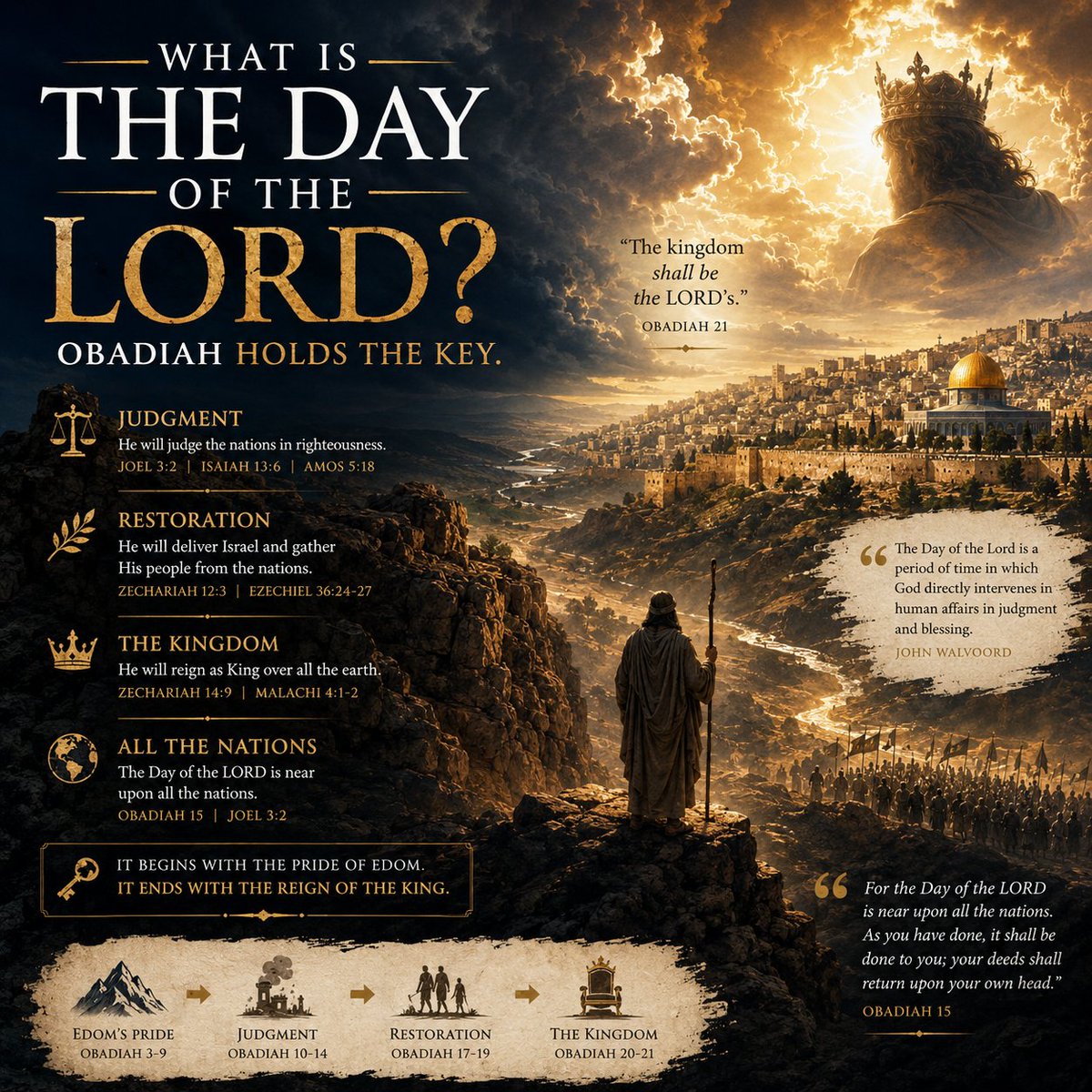
What Is the Day of the LORD? Obadiah Holds the Key.
📖 Few themes in Scripture are as majestic, repeated, and misunderstood as the Day of the LORD.
It echoes throughout Scripture. Isaiah, Jeremiah, Ezekiel, Joel, Amos, Obadiah, Zephaniah, Zechariah, and Malachi all proclaim it. Paul and Peter continue the theme in the New Testament. Across centuries, different prophets point to the same climactic intervention of God in history.
The Day of the LORD is not just another prophecy. It is one of Scripture's great organizing themes, tying the writing prophets together into one unified story of judgment, restoration, and the coming Kingdom.
Surprisingly, one of the clearest doorways into this theme is not found in Isaiah or Joel, but in the shortest book of the Minor Prophets: Obadiah.
At first glance, Obadiah concerns one nation: Edom, the descendants of Esau. God exposes their pride, violence, and betrayal of Judah. Secure in their mountain strongholds, they believed no one could bring them down. Yet the Lord declared, "The pride of your heart has deceived you" (Obadiah 3).
🔍 Then, almost without warning, the prophet lifts his eyes beyond Edom.
Suddenly, the horizon expands.
"For the Day of the LORD is near upon all the nations. As you have done, it shall be done to you; your deeds shall return upon your own head." (Obadiah 15)
That single verse changes everything.
Obadiah is no longer speaking only about Edom. One nation's judgment becomes a preview of God's future intervention against every nation that exalts itself against Him and opposes His covenant purposes.
This is a recurring pattern in biblical prophecy: historical judgments foreshadow the ultimate one. Babylon points beyond Babylon. Joel's locust plague points beyond the locusts. Edom points beyond Edom. The near event anticipates the final.
At this point, an important question arises: Hasn't the Day of the LORD already happened?
Scripture records historical "days of the LORD," localized acts of divine judgment. Yet Obadiah expands the scope to "all the nations" (Obadiah 15). Joel foresees all nations gathered for judgment because of Israel (Joel 3:2). Zechariah looks ahead to all nations coming against Jerusalem before the Lord reigns as King over all the earth (Zechariah 14:2, 9). Peter carries the Day of the LORD to the renewal of creation (2 Peter 3:10–13). No historical event fulfills that complete picture.
Throughout Scripture, the Day of the LORD describes God's climactic intervention in history when He openly judges evil, vindicates His holiness, fulfills His covenant promises, delivers Israel, defeats His enemies, and establishes the righteous reign of the Messiah.
As theologian John Walvoord observed:
"The Day of the Lord is a period of time in which God directly intervenes in human affairs in judgment and blessing."
🌍 Like watchmen standing on different mountains watching the same sunrise, the prophets describe this coming Day from different vantage points.
❖ Isaiah speaks of a day against the proud (Isaiah 2:12) and announces, "Wail, for the day of the LORD is near" (Isaiah 13:6).
❖ Joel sees God gathering all nations because of Israel (Joel 3:2) and asks, "The day of the LORD is great and very terrible; who can endure it?" (Joel 2:11).
❖ Amos warns, "Woe to you who desire the day of the LORD!" (Amos 5:18).
❖ Zephaniah proclaims, "The great day of the LORD is near, near and coming quickly" (Zephaniah 1:14).
❖ Zechariah foresees all nations gathered against Jerusalem (Zechariah 12:3; 14:2), the Lord descending to the Mount of Olives (14:4), and the glorious climax: "The LORD shall be King over all the earth" (Zechariah 14:9).
❖ Malachi captures both sides of that Day: "Surely the day is coming; it will burn like a furnace" for the wicked, yet "the Sun of Righteousness will rise with healing in its rays" (Malachi 4:1–2).
❖ Paul reminds believers that "the day of the Lord will come like a thief in the night" (1 Thessalonians 5:2).
❖ Peter carries the theme to its ultimate conclusion in the renewal of creation (2 Peter 3:10–13).
Once you recognize this pattern, the prophets no longer read like isolated books. Together they form one unified testimony to God's coming intervention in history.
Why does this matter today?
Because the very conditions the prophets described are increasingly visible before our eyes. The nations are increasingly fixing their attention on Jerusalem, just as the prophets foresaw. Hostility toward Israel continues to grow. Much of the world celebrates moral autonomy while rejecting God's authority. These are not isolated events. They are converging toward the Day of the LORD.
History is not unraveling.
It is unfolding exactly as God declared.
👑 The Day of the LORD is the culmination of God's covenant promises, the answer to every prayer that longs for justice, and the fulfillment of every prophecy anticipating the return of the King.
That is why Obadiah is so remarkable.
It begins with the pride of Edom.
It ends with the reign of the King.
Its final declaration is one of the most triumphant in all of Scripture:
"The kingdom shall be the LORD's." (Obadiah 21)
In twenty-one verses, Obadiah carries us from the mountains of Edom to the consummation of history, from one rebellious nation to all nations, from judgment to restoration, and from the arrogance of man to the glorious reign of Israel's Messiah.
History is not spiraling toward chaos.
It is moving toward a King.
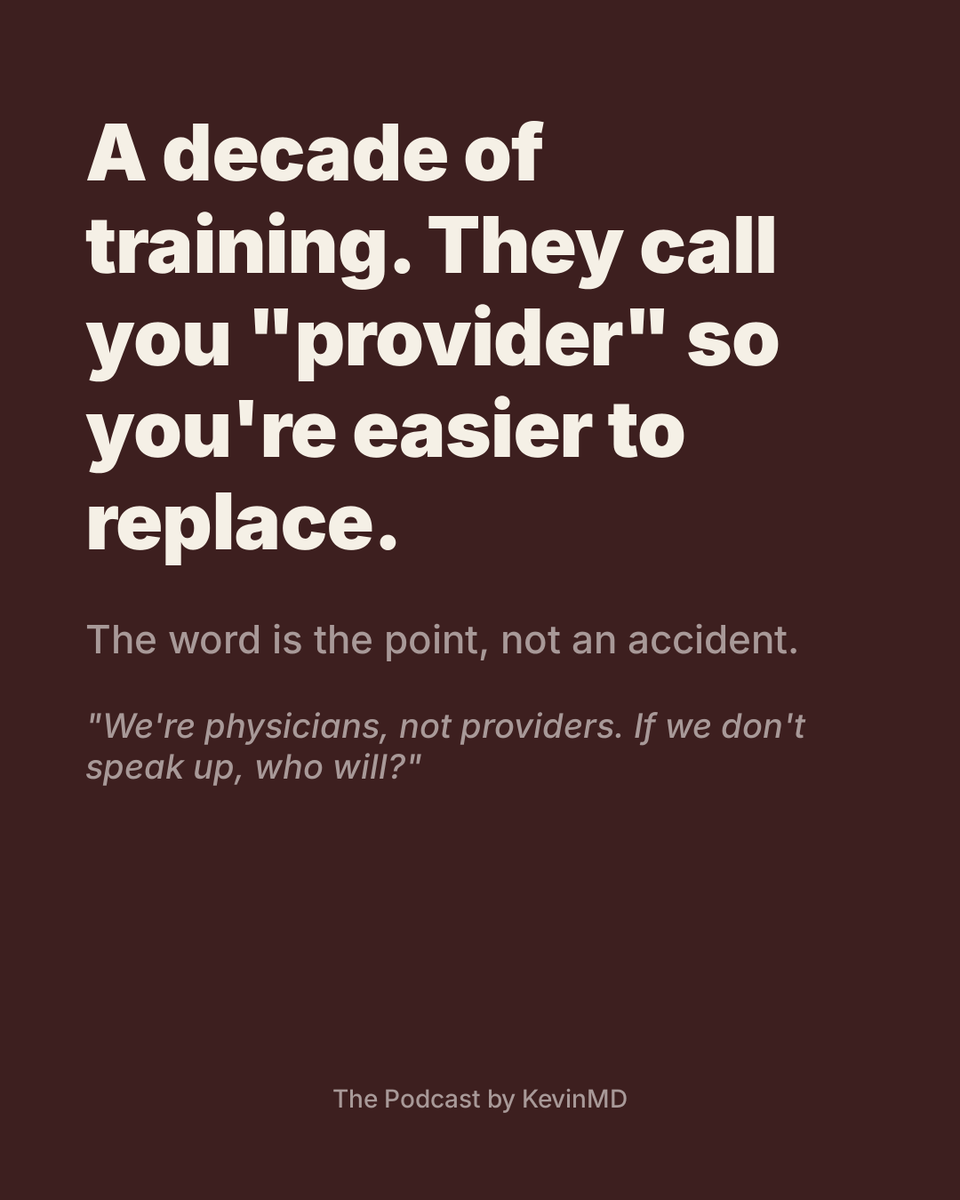
Calling every clinician a "provider" is how you make them replaceable.
This is the part that gets waved off as a style quibble. It is not. The word is doing structural work, and once you see the mechanism you cannot unsee it.
Start with what the label does. Lump the physician, the nurse practitioner, and the physician assistant under one term and they start to look interchangeable. Interchangeable people are easy to swap out. You do not deprofessionalize a workforce with a memo. You do it with a noun. The word is not describing the work. It is softening the ground for replacing it.
Now the history, because the word did not come from nowhere. "Provider" entered the system in 1965, when Medicare began paying any "provider of services." That single phrase put the person at the bedside in the same category as the hospital and the insurance company. The clinician and the billing entity got filed under one heading. One word, and the distinction between caring for a patient and billing for one quietly collapsed.
That collapsed distinction is the whole point, because the two things on either side of it answer to completely different masters. A physician's first obligation is to the patient. A corporate entity answers to its board and its shareholders. Those are not the same job. One word should not be allowed to pretend they are. This is why the American College of Physicians framed it not as a matter of taste but as a matter of ethics: the word you choose decides which of those two obligations you are actually naming.
And it is worth knowing what the word "physician" carries that "provider" throws away. Janet Jokela, MD, former treasurer of the American College of Physicians, points to the root. The Latin origin of "compassion" means "to suffer with." A patient is, at root, one who suffers. That relationship, to suffer alongside the person in front of you, is what the word was built to name. "Provider" carries none of it. It describes a transaction. It cannot describe a vocation.
None of this means the nurse practitioner or the physician assistant should be flattened either. They are clinicians. They are harmed by the same erasure. The label that dissolves the physician dissolves them too. The villain here is the system that finds it convenient to call everyone the same thing, not the colleagues standing next to each other under it.
So the correction is small and deliberate and entirely within reach. Doctors are crossing "provider" off forms and writing "physician," then signing underneath. Some have trained their staff to do the same. One document at a time. It is the only kind of correction that scales, because it happens everywhere the word appears.
Listen to the full conversation on The Podcast by KevinMD. Link in the replies.
What is the first thing you would change about how clinical teams get labeled? #PhysicianNotProvider #ThePodcastbyKevinMD
You know what shook me when I was Muslim?
The story of Hosea. God tells a prophet to marry a woman He knows will betray him.
She does. She runs to other men. She ends up enslaved, sold, used up, worthless to the world.
And God tells Hosea to go BUY HER BACK.
To pay money for his own wife who cheated on him, and love her again. Hosea 3.
I thought it was the most humiliating command in the Bible. Why would any man do that?
Then I realized I was the wife.
I gave my heart to everything but God. I chased other masters. I sold myself cheap. I made myself worthless.
And God looked at me, the betrayer, and didn’t say “you’re not worth it.”
He said, “Name the price. I’m buying her back.”
That’s the Gospel. God doesn’t wait for the unfaithful to come crawling back clean.
He pays to redeem them while they’re still dirty.
Islam told me to make myself worthy of God.
Hosea showed me a God who pays to redeem the unworthy.
The cross was Him naming the price.
Praise the Lord.
The Ottoman Devshirme system lasted for 250 years. Muslims forcibly collected Christian boys aged 8-20 from conquered families, converted them to Islam, had their family ties severed, and trained them as Janissaries to terrorize their native communities.
🚨 AMERICANS ARE DECLARING WAR ON FLOCK CAMERAS — AND PEOPLE ARE TEARING THEM DOWN
Something is happening all over America.
People aren't just complaining about surveillance cameras anymore.
They're taking action.
Reports are emerging of Flock cameras being cut down, damaged, disabled, and targeted in multiple cities.
Why?
Because what started as a tool to track stolen vehicles has turned into something many people believe is far bigger.
The breaking point came when public records reportedly revealed that federal agencies had conducted thousands of searches through local camera networks.
For many people, that confirmed their worst fears.
But now the story is getting even darker.
People are learning the next generation of surveillance won't stop at license plates.
New systems are already being discussed that could potentially pull Bluetooth identifiers from phones, smart watches, earbuds, and other devices traveling inside vehicles.
In other words, your car may not be the thing they're interested in tracking.
You are.
Meanwhile, cities across the country are beginning to reconsider their contracts as public backlash continues to grow.
And as more cameras go up, more cameras seem to be coming down.
How much surveillance are people supposed to tolerate before they start fighting back?
Before the Crusades, two-thirds of the Christian world had already fallen under Islamic rule.
Your school probably skipped that part.
They taught you the Crusades began in 1095, as if Christians just woke up one morning and decided to march east for no reason.
But history did not begin in 1095.
By then, Islamic armies had already conquered massive portions of the Christian world:
Syria.
Egypt.
North Africa.
The Holy Land.
Spain.
In 711 AD, Islamic forces crossed into Spain.
By 732 AD, they had pushed all the way into France.
That is where Charles Martel met them at the Battle of Tours and stopped the advance into Western Europe.
Some historians consider it one of the most decisive battles in world history.
So when people talk about the Crusades without mentioning the 400 years before them, they are not giving you history.
They are giving you a narrative.
Were the Crusades complicated?
Of course.
Were Christians perfect?
No.
But the idea that the Crusades were some random act of Christian aggression is historically dishonest.
The real story begins long before 1095.
And once you know what happened before the Crusades, the entire conversation changes.
They buried this.
Now you know.
@Write4Republic Women have somehow fallen for the lie that career is peak success and achievement - that personal freedom trumps everything in life. So they kill their offspring so they remain free.
6 AM Call to Action
If you have a colleague here on a visa who clearly cannot do their job, report them anonymously - and tell your other colleagues this option exists. Remember the ability to communicate effectively is also a requirement for a visa.
This is how we make it uncomfortable for employers who abuse the system. This is also how we empower the good employers who feel powerless as their teams get flooded with H-1B workers who cannot perform at the expected level.
Every report is required to generate an investigation, eventually. HR may never tell you, but these reports impact financials, policy, and hiring practices over time. It also leads to investigations into whether their academic credentials are valid.
Use the official channels:
- USCIS Tip Form: https://t.co/RvF91BTY75
- Department of Labor Foreign Labor Certification: https://t.co/YxwGF1Q5Nw
- DOL Wage and Hour: 1-866-4-USWAGE (1-866-487-9243)
I prefer online as that leaves an FOIA path that is easily traced.
Quietly share this path with others. When enough people document real performance and communication failures, companies will finally feel pressure to hire Americans who can actually do the work.
Birthright citizenship tale... Our social circle in Maskachusetts included a guy married to a Honduran. Every time one of his wife's relatives is pregnant she comes to stay with them. When it is time to deliver the baby, the relative Ubers to one of the most expensive hospitals in the world, e.g., Beth Israel. She gives birth, says the magic words to avoid ever receiving a bill ("I'm undocumented"), and, after a few weeks, heads back to Honduras with baby, birth certificate, and U.S. passport. This one family has likely cost taxpayers at least $300,000 in payments to the hospital for "uncompensated care" and more than 10 U.S. citizens have been minted. When the kids are adults they have an automatic right to sponsor their parents for green cards, so eventually this one family will be responsible for perhaps 40 or 50 legal immigrants from Honduras to the U.S.
@JewishWarrior13 Our Greek great-grandfather was drawn and quartered in front of his family. The baby was thrown in the river to drown and the mother killed, leaving two orphans. That was the justice and compassion of Turkey and the Turkish soldiers.
Research from Arizona Christian University finds only 37% of U.S. Christian pastors hold a biblical worldview.
Only a 1/3 of pastors read Scripture (devotionally) weekly.
If you want to understand the lack of discipleship in American Christians, look no further.