The moon, unlike Earth, is not shielded from radiation by a magnetosphere. The lunar surface is subject to roughly 1-4 radioactive particles per square centimeter per second. Photos from the landings, taken on film, are totally devoid of the expected signs of radiation damage.
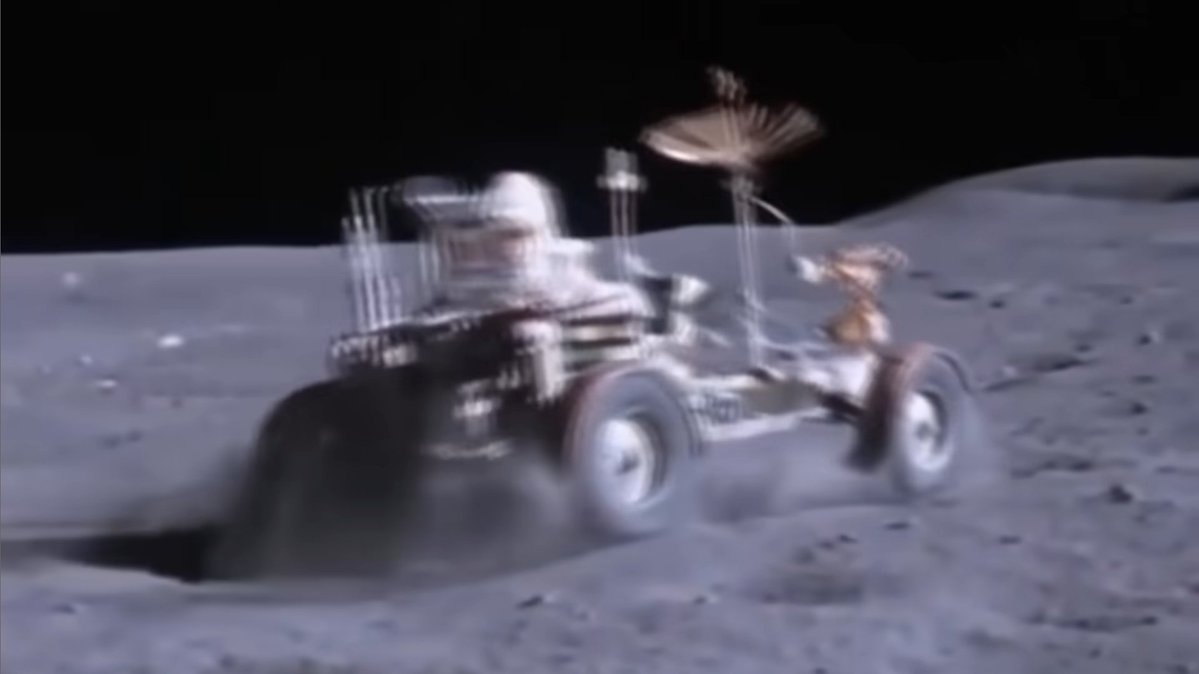
Obviously, the moon has no atmosphere. It's a vacuum. In a vacuum, dust shouldn't form clouds. Note the clouds of dust behind the lunar rover's wheels. In a vacuum, this dust would be thrown in a parabolic arc behind the wheel instead of forming clouds.
@JWorldwide4 The cameras, as evidenced by photographs and videos in which you can see them, are not shielded.
What's more, they shouldn't even work: temperatures in shadows on the moon are about negative 100°F, sometimes even colder. Film will become brittle and glass-like at those temps.
@JWorldwide4 Less *per second* maybe, but a day on the moon will expose you to ~1000x more radiation than a pass through a baggage scanner, and these cameras were supposedly on the moon's surface for several hours.
@JWorldwide4 Au contraire: the lunar surface is subject to gamma and cosmic rays which should be far more damaging to film.
This film is much closer to the film used in the Apollo missions; the right edge has been damaged by a pass through a bag scanner.
@JWorldwide4 Roughly halfway through the video, you can see the dust hanging in the air in a wing-shaped plume distinctly different than the expected parabolic arc behind the wheel.
@JWorldwide4 Film retains the damage over time, given that it's literally caused by perforations from the charged particles. Multiple hours on the lunar surface (and a two-way trip through space!) ought to produce some degree of visible damage which is simply not visible here.
Yes, I tend to not believe extraordinary claims without sufficient evidence, even if the truth of those claims would flatter my national pride.
If you're so certain the truth is on your side, you ought to enjoy pummeling a doubter like me. Instead, you've cut and run.
@JWorldwide4 I don't want to get into a semantic image-interpretation fight about what constitutes a cloud, so I'll maintain that what we're seeing is not parabolic. That, to me, is clearly a cloud of dust with hang time indicating the presence of air.
@JWorldwide4 A baggage scanner can produce a dose from 0.001 millisieverts to about 1.5 millisieverts in some heavy-duty scanners. The surface of the moon averages about 1.37 millisieverts. Considering exposure time, there's really no way that film should be so clean.
@backklash_ There's letters engraved in the metal, if you look closely. The "mud" has retained the shape of these imprints even after sliding out of them.
There's no atmosphere on the moon, and so there is no moisture. Without moisture, dust doesn't cling to surfaces. In many cases, equipment in the Apollo missions appears to be covered with dust or even caked with mud.
@JWorldwide4 Enormous: the lunar surface is far more radioactive than a baggage scanner, and a baggage scan lasts a few seconds to a few minutes. These cameras were (allegedly) on the moon's surface for up to eight hours.
@JWorldwide4 "Plumes vs. clouds" isn't a compelling distinction - what we should see is a parabolic arc. There should be no difference in hang time between particles of varying mass/shape, because there's no air resistance.
@JWorldwide4 I'll do you one better: this is film which has been run once through an airport baggage scanner.
Chernobyl was likely far more radioactive, but film from the lunar surface shouldn't be perfectly intact by any means.