Two days ago I wrote that the most dangerous signal in this war was not what Iran was hitting but what it was not hitting. Desalination plants. Eight of the ten largest on earth sit on the Arabian Peninsula. One hundred million people drink what they produce. Iran had the coordinates and the capability. It was choosing restraint. The restraint was the weapon. And the hand that held the leash was dead.
The leash just snapped.
Iran’s Foreign Minister Araghchi posted on X on March 7 that the United States struck a freshwater desalination plant on Qeshm Island with missiles launched from its base in Bahrain. He said water supply to 30 villages was cut. His exact words: “The U.S. set this precedent, not Iran.”
That sentence is the most dangerous statement issued by any government official since this war began.
No independent verification exists. No satellite imagery. No Pentagon confirmation or denial. CNN, BBC, and Reuters report it as an Iranian accusation. The claim is unverified. That does not make it less dangerous. What matters is not whether the strike happened. What matters is that Iran has publicly framed a desalination attack as an American precedent.
Precedent is permission. Iran struck a US base in Bahrain within hours, framed as retaliation for the desalination hit. Whether the original strike was real or fabricated, the rhetorical architecture for targeting Gulf water plants is now constructed. The thirty one autonomous IRGC commands possess a publicly articulated rationale for striking desalination facilities anywhere in the Gulf.
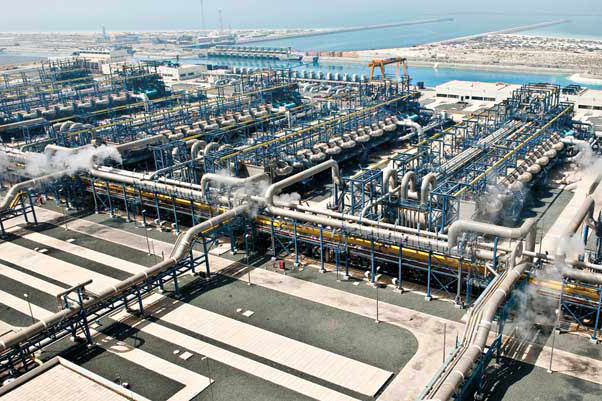
Kuwait gets 90 percent of its drinking water from desalination. Oman 86 percent. Saudi Arabia 70 percent. The UAE 42 percent. These are not countries with backup rivers. These are not populations with alternative wells. The entire human habitability of the Arabian Peninsula depends on machines that convert seawater into freshwater, running continuously, at massive scale, connected to power grids and intake pipes that are among the softest targets in any military theater.
In 1991 Iraq pumped crude oil into Kuwait’s desalination intakes. Recovery took years. The Gulf in 2026 is orders of magnitude more dependent, and the Strait of Hormuz is closed. Emergency tanker imports face the same insurance withdrawal that stopped oil tankers. The redundancy that was supposed to protect water supply depends on shipping lanes that no longer function.
Gulf states deployed Patriot batteries around major plants after the accusation. Intake pipes have underwater sensors. Cyber defenses are air gapped. But the defense faces the same arithmetic: 93 percent success across a thousand drones still means 70 impacts. One impact on a military base is absorbable. One impact on a desalination intake shuts down water supply to millions.
The restraint is over. The precedent, real or fabricated, is set. And the hundred million people whose survival depends on desalination plants within range of Iranian missiles are now living inside the targeting envelope of a doctrine that just lost its last constraint.
https://t.co/ULBgEzZ3A8
Los burros miniatura mediterráneos son una raza originaria de las islas de Cerdeña y Sicilia.
Se consideran miniatura cuando miden menos de 91-96 cm a la cruz. Muchos ejemplares adultos no superan los 80 cm. Son conocidos por ser animales muy dóciles, inteligentes y cariñosos, lo que los hace populares como mascotas o animales de compañía en granjas.
Antiguamente se usaban para tareas domésticas como girar piedras de molino, pero hoy en día no se consideran animales de trabajo.