The COLDCARD Q is built for Bitcoiners.
Clean QR signing, airgapped security, and a focus on simplicity.
We’re giving one away.
To enter:
• Like 👍
• Repost 🔁
• Comment why you want a Q 👇
The man who INVENTED modern AI just made a billion dollar bet that ChatGPT, Claude, and every AI company on earth is building the wrong technology.
Yann LeCun won the Turing Award in 2018 for creating the neural networks that made AI possible.
He spent a decade running AI research at Meta. Oversaw the creation of Llama and PyTorch, the tools that half the AI industry runs on.
Then he quit.
And raised $1.03 billion in a seed round.
The LARGEST seed round in European history. $3.5 billion valuation before generating a single dollar of revenue.
Bezos wrote the check. So did Nvidia. Samsung. Toyota. Temasek. Eric Schmidt. Mark Cuban. Tim Berners-Lee (the guy who invented the internet).
His new company is called AMI Labs. And it's built on one thesis:
Every AI company spending billions on large language models is wasting their money.
ChatGPT, Claude, Gemini, Grok. They all work the same way. They predict the next word in a sequence. See "the cat sat on the" and predict "mat." Scale that to trillions of words and you get something that sounds intelligent.
But LeCun says it doesn't UNDERSTAND anything.
It can't reason. It can't plan. It can't predict what happens when you push a glass off a table. A two year old can do that. GPT-5 cannot.
That's why AI hallucinates. It doesn't have a model of how the world actually works. It just predicts words.
His solution? Something called JEPA.
Instead of predicting words, it learns how the PHYSICAL WORLD works. Abstract representations of reality. Not language but physics.
Think about what that means.
Current AI can write your emails. LeCun's AI could design a car, run a factory, operate a robot, or diagnose a patient without hallucinating and killing someone.
The CEO of AMI said it perfectly: "Factories, hospitals, and robots need AI that grasps reality. Predicting tokens doesn't cut it."
And here's what's really crazy to me...
LeCun isn't some outsider throwing rocks. He literally built the foundations that ChatGPT runs on. He knows exactly how these systems work because he helped create them.
And after watching the entire industry sprint in one direction for three years, he raised a billion dollars to run the OPPOSITE way.
No product. No revenue. No timeline. Just pure research. He told investors it could take YEARS to produce anything commercial.
But they funded it anyway in just four months.
Meanwhile OpenAI just raised $120 billion and still can't stop their models from making things up. Anthropic is building AI so dangerous they're afraid to release it. Google is burning billions trying to catch up.
And the guy who started it all says they're all solving the wrong problem.
Two Turing Award winners raised $2 billion in three weeks betting AGAINST the entire LLM approach. LeCun at AMI. Fei-Fei Li at World Labs.
The smartest people in AI are quietly building the exit from the technology everyone else is betting their future on.
Either they're wrong and the trillion dollar LLM industry keeps printing.
Or they're right and every AI company on earth just built on a foundation that's about to crack.
The more scans you undergo, the higher the probability that something will be found. Modern imaging is extraordinarily sensitive and can detect tiny abnormalities that may never have caused symptoms or affected your life.
But once something is identified, you are given a diagnosis.
And once you have a diagnosis, you are pulled into the machinery of the allopathic medical system, a system built around follow-up appointments, prescriptions, procedures, and interventions. From that point forward, the focus often shifts from supporting health to managing a condition.
This is the quiet reality of modern medicine. The more we look, the more we find. And the more we find, the more people are funneled into a lifelong cycle of monitoring and treatment, whether those findings would have ever harmed them in the first place.
Instead of outsourcing your health, be your own health authority. You can get started here.
https://t.co/Y8jlF88kq4
USAFacts takes a data-driven look at key government indicators behind the State of the Union — including federal revenue, spending, deficits, national debt, inflation, trade, and the labor market — using official U.S. government data.
Most people think the psychedelic experience is what heals.
They're wrong.
It's what happens in the days and weeks AFTER that determines everything.
In 2023, Gül Dölen's lab at Johns Hopkins made a discovery that should reshape how every practitioner thinks about their work:
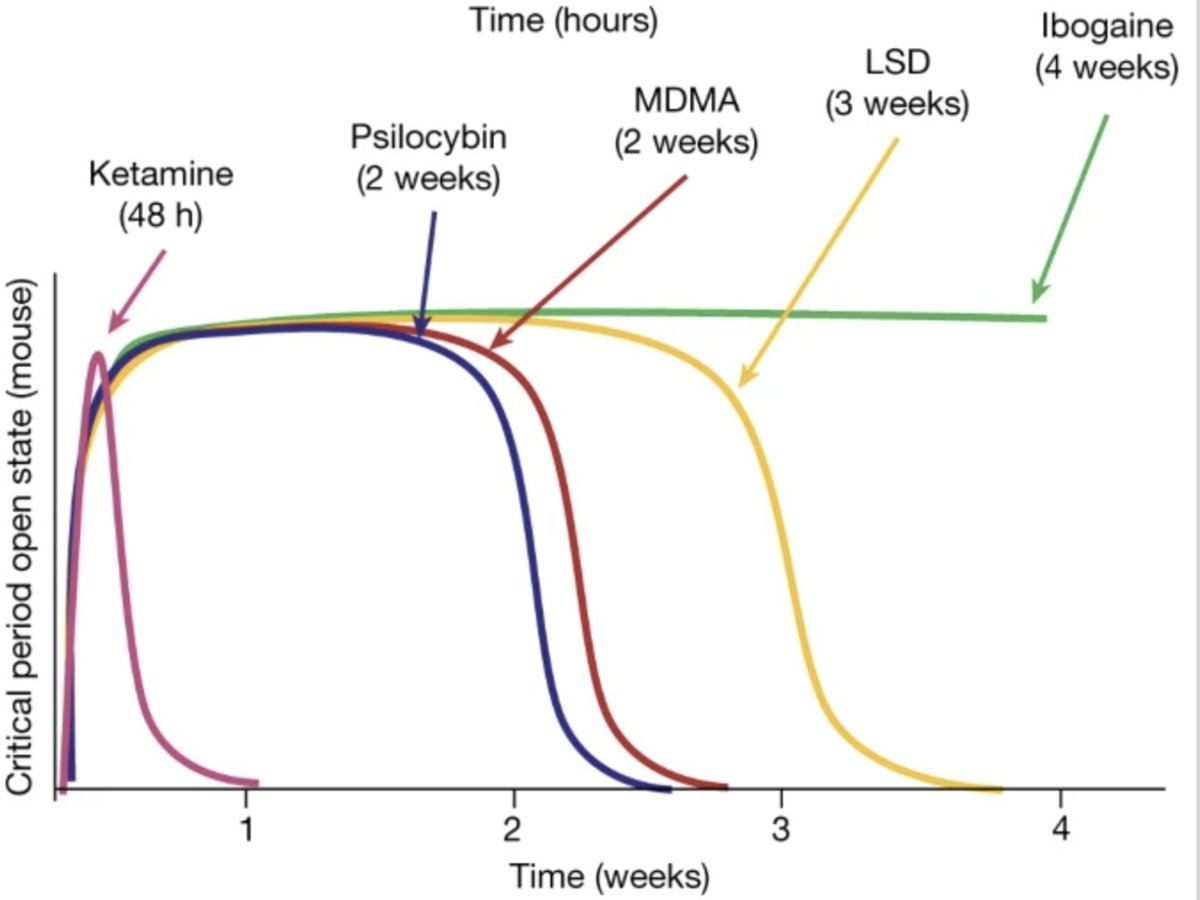
MDMA, psilocybin, LSD, ketamine, and ibogaine all reopen the social reward learning critical period, those rare developmental windows when we learn how to bond, trust, and adapt.
Our brains were once thought to close these windows by age 26. Turns out, psychedelics hand us the key to unlock them again.
Here's what makes this research so compelling:
Different compounds hit different receptors — 5-HT2A, NMDA, KOR — yet they converge on the same outcome: reopening critical learning windows.
It's not the trip that heals. It's the open state.
And each substance opens that window for a different duration:
→ Ketamine ≈ 48 hours
→ Psilocybin ≈ 2 weeks
→ LSD ≈ 3 weeks
→ Ibogaine/5-MeO-DMT ≈ 4 weeks
This isn't chaotic hyperplasticity. It's metaplasticity, a refined readiness to rewire. Dölen's team found oxytocin-mediated changes in the nucleus accumbens and softened extracellular matrix, which basically means the brain's scaffolding loosens so new wiring can stabilize.
Think of it as a biological permission slip for transformation.
But here's what most people miss: this window is time-sensitive.
During the open state, new behavioral habits and secure attachment patterns can take root. Miss the window, and old circuitry reasserts itself. Most people don't realize how critical the days and weeks AFTER a session really are.
This is exactly why we built our Practitioner Training at the Psychedelic Coaching Institute the way we did.
If the medicine opens a window, then the practitioner's job is to help clients make the most of it before it closes.
That means designing protocols around windows, not just sessions. It means mapping dose → duration → practice. Tracking behavior, HRV, mood, and relational change weekly.
The aim isn't to chase peak experiences. It's to facilitate durable rewiring through intentional repetition in the open state.
This is the next era of psychedelic work: utilizing microdosing, nervous system training, and intentional practice to expand the learning window.
The medicine opens it. Your discipline keeps it open. That's how insight becomes identity.
For practitioners ready to work at this level, our next PCI cohort (kicking off February 19!) is where this science meets real-world application.
What are your thoughts on how to design integration around the critical period window?
NEW LONG FORM VIDEO: The rise and fall of teenage jobs: Why 72% of teens worked and now don’t
Back in 1975, the year I was born, having a summer job as a teenager was the norm. You were mowing lawns, lifeguarding at the local pool, working at Woolworth’s, or staffing the amusement park. That summer, 72% of teens had jobs.
Today, it’s a different story. Less than 35% of teenagers work during the summer. We’ve lost over half of America’s working teens. And it didn’t happen overnight. These jobs didn’t vanish suddenly, and it’s not just because teens are glued to their phones or getting lazy. The real reasons are deeper: how we think about work, how the country has aged, and how automation has changed everything. This is the rise and fall of teenage jobs in America.
What you want is AI to cause mass unemployment quickly. A huge shock. Maybe in 2-3 months.
What you don't want is the slow drip of people getting laid off, never finding work again while 60-70 percent of people are still employed.
interrogate your own footprint. what did your action translate as in the real world, beyond the warm glow of what you meant. humans react not to what you meant to do, but to what you did and sometimes, you must hold responsibility for the gap between the two.
Long-form feels so relative. In the TikTok era, 'long-form' is just sitting in a single emotion for >15 seconds without a hard cut.
Shows like "Severance" filter this audience out immediately. The slow tension is inaccessible if you're conditioned for constant dopamine hits.
Even Severance is still passive... the screen does the imagining for you.
If you really want to force your brain to do the heavy lifting of long-form attention, what you're describing is a book.