Qatar Airways raises in-flight experience to new heights!
We are proud to be the largest global airline and the first in the MENA region to collaborate with @SpaceX@Starlink
This complimentary, ground-breaking service will enhance our passengers' onboard experience with boundless entertainment and information options.
Seeing some qs on what Gemini *is* (beyond the zodiac :). Best way to understand Gemini’s underlying amazing capabilities is to see them in action, take a look ⬇️
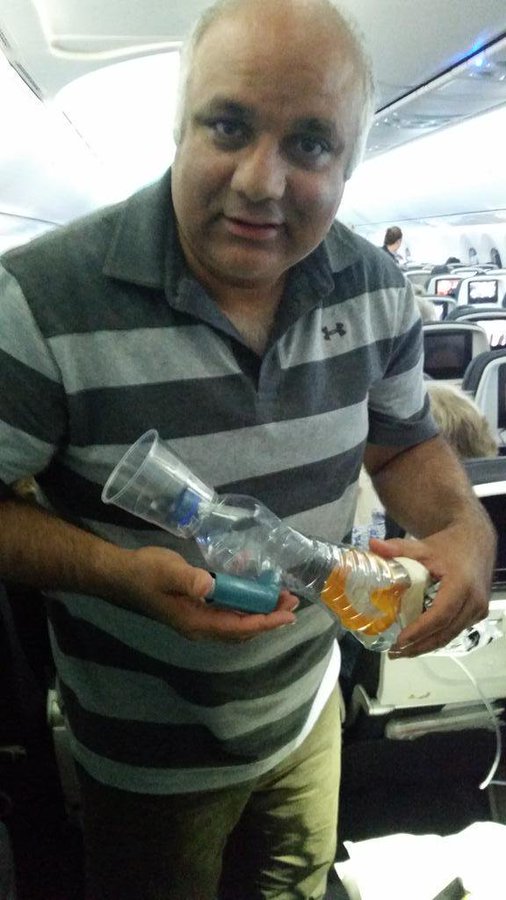
The story of Dr. Khurshid Guru, who created a nebulizer on an Air Canada flight, using a water bottle, a cup, oxygen, and an adult inhaler to help an asthmatic toddler breath.
Dr. Khurshid Guru, director of Robotic Surgery at the Roswell Park Cancer Institute, was aboard a transatlantic Air Canada flight from Spain to the U.S. in September 2015.
At one point in time, he saw a 2-year-old boy crying and short of breath and his parents said they accidentally packed his asthma medication in checked luggage.
Guru used an oxygen meter and found the child's oxygen level was dipping down to a dangerously low level: 87%. In that moment, he knew he needed to do something quickly.
The plane only had an adult inhaler on board and Guru was concerned the toddler was too young to understand how to use it.
Ironically, the doctor who normally worked with high-tech robots to treat patients, came up with a jerry-rigged device similar to a nebulizer that would deliver both oxygen and asthma medication to the child.
To create the nebulizer, the surgeon cut up a water bottle and added oxygen to one end and the adult inhaler through a small hole in the bottle. That way the oxygen and medication could be delivered through the bottle's opening directly to the child.
After the very unusual treatment, the child's oxygen level was around 95%.
Guru anted to share the story as a reminder to parents of asthmatic children to always keep their vital medication nearby.
“RIPPED SOCKS”
(The Trend Of Cutting Holes On Socks)
Yesterday we saw Conor Gallagher of Chelsea wearing socks with holes at the back and he's not the only one in on this trick.
Madrid star boy, Jude Bellingham, Arsenal's golden boy, Saka, and City star defender, Kyle Walker just to mention but a few.
The question remains, “WHY” and that's what this thread is here to answer.
#OdogwuSports
When my daughter was 18 months old, she figured out how to get out of her crib. Everytime we put her in it, she found her way out. She'll turn up at our room grinning with pride because she "escaped". It was frustrating but we got used to it. Everything was okay until one day...
If you were unfairly treated by your employer due to posting or liking something on this platform, we will fund your legal bill.
No limit.
Please let us know.
The @wso2 Child Care Center is now open (in WSO2 LK) .. this provides child care services for our team members' kids from ages 3 months to ~15 years.
See: https://t.co/Q6mgt9p4Rd
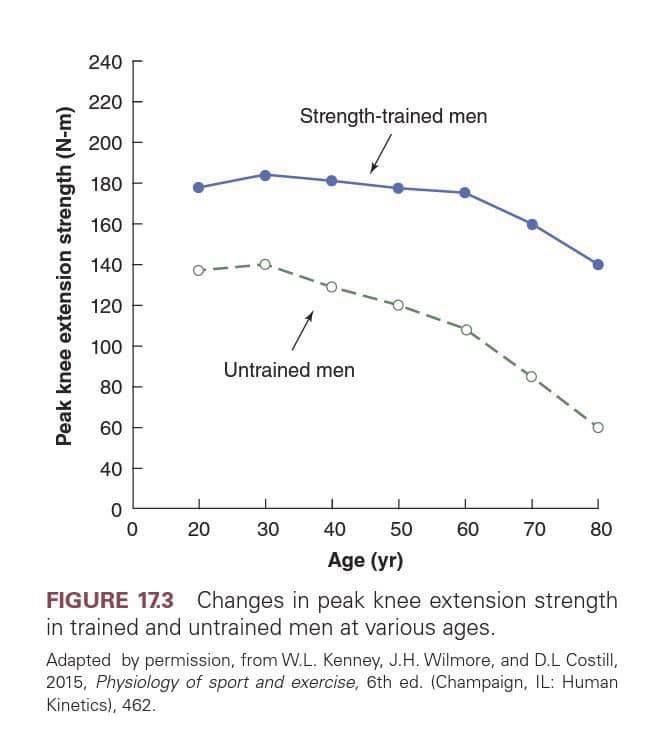
An 80 year old man who lifts is as strong as a 30 year old man who doesn't.
After the age of 30 muscle mass decreases by approximately 3-8% every decade. This rate of decline becomes even faster after the age of 60.
This reminds me of my dad who decided to start lifting & running at 40 years old.
Now at the age of 76, his body and brain are as active as ever.
He doesn't need any form of assistance, he's living independently and doing it on his terms.
A couple sessions a week of weight training is the ultimate form of delayed gratification.
You're trading 90 minutes a week for a lifetime of mobility, strength, and brain health.
I'd make that trade in a heartbeat.
I know some people in their old age who look back and regret not taking better care of themselves.
They got to a point where there was no return.
You don't want to let that happen to you.
It's better to be the oldest person in the weight room than the youngest person in the nursing home.
Lift now so you can reap the benefits later.
Sources:
1. Holloszy JO. The biology of aging. Mayo Clin Proc. 2000;75 (Suppl):S3–S8.
2. Melton LJ, III, Khosla S, Crowson CS, et al. Epidemiology of sarcopenia. J Am Geriatr Soc. 2000;48:625–630.