BREAKING: President Trump says he is going to continue bombing Iran "very hard" after it shot down a U.S. helicopter over the Strait of Hormuz.
"We're going to be attacking them and attacking them very hard."
"I've been working with Iran for a number of months, and they should sign their deal. It's a good deal. It doesn't give them the right to have a nuclear weapon. In fact, it totally prohibits them from ever having a nuclear weapon."
BREAKING: US President Donald Trump says US will resume attacking Iran "very hard" as soon as "today."
Trump cites downing of US helicopter as reason for resuming attacks; he adds Iran should sign deal. "I don't know what they're doing," he tells reporters at the White House.
🚨News: Meta is building its first AI data center in India, and it's teaming up with Reliance to do it.
the project is a 168-megawatt AI-enabled facility in Jamnagar, Gujarat.
Meta is leasing the capacity while Reliance handles everything from design and construction to power, connectivity and day-to-day operations.
the center will run on renewable energy and use desalinated seawater for cooling.
Meta is covering the full cost of the energy and water it uses.
Reliance says it'll be ready within two years and can expand over time.
It will also plug into Meta's global AI computing network.
On top of that, Meta has contracted nearly 1 gigawatt of new renewable energy in India through CleanMax and Fourth Partner Energy.
the deal builds on Meta's $5.7B investment in Jio back in 2020. Value of the new agreement wasn't disclosed.
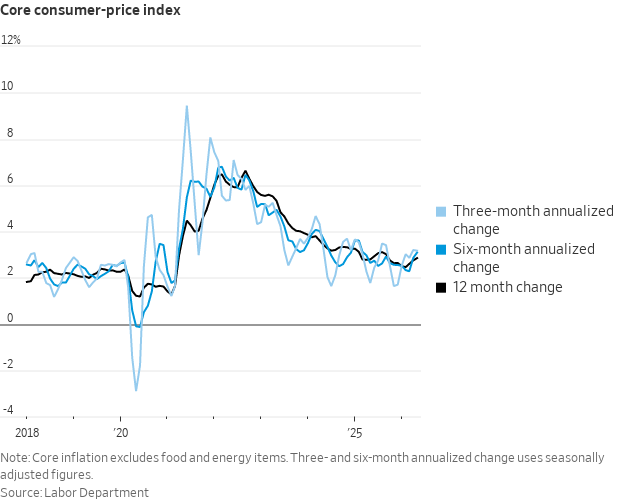
The core CPI rose 0.21% in May, very close to where forecasts had it, and this pushed the 12-month measure up to 2.9%.
This is the first time since Dec. 2022 where the 12-month core CPI reading was higher than the year-earlier reading.
The commodity thesis is half right, and it’s the half that’s doesn’t pay.
Yes, tokens at the “good enough” tier are already a commodity open weight models from DeepSeek, Qwen, Llama have crushed pricing for mid-tier intelligence, and that tier is now a brutal cost-per-token knife fight. But that’s also where margins go to zero, winning it is like winning a refinery, not an oil field.
The frontier however behaves very differently because the demand isn’t for tokens, it’s for completed labor. When a model is doing agentic coding or multi-hour knowledge work, a model that’s 10% better doesn’t only earn a 10% premium because it completes tasks the cheaper model fails at entirely, and the buyer on the other side is comparing the token bill to a salary, not to another token bill. That’s why the quality-price curve at the top is so inelastic.
And being “Good enough” is a moving target every time capability jumps, the set of economically valuable tasks expands, and the frontier model captures the new tasks before the commodity tier catches up 12-18 months later. The moat isn’t the weights, those depreciate fast, it’s the compounding loop of capital access, RL environments and post-training data, product surfaces that generate proprietary feedback (coding agents especially), and increasingly co-designed silicon and inference infra.
Even worse the argument for commodity models as gotten weaker in recent months. We’ve seen pre-training plateauing but the scaling axis only shifted, it didn’t end. RL/test-time compute is arguably worse for commoditization, because it’s harder to distill and replicate than next-token pre-training was. The recipes, environments, and reward engineering are where the secret sauce lives now, and they don’t leak through a weights release.
Fable 5 is the biggest step up I’ve felt in our models since Opus 4.5 back in November. After 4.5 came out I uninstalled my IDE when I realized that I’d been doing 100% of my coding in a terminal for a few weeks. With Fable, it’s felt like Claude has stepped up from being a coding agent to a thought and design partner in building the product. Fable has judgement, taste, and dimensionality in a way that previous models didn’t, leading me to trust it more with the most complex work.
I think the first time I had this realization was when I asked Fable to debug something. It is the first model I have used that was so methodical and precise, taking measurements and adding logs then verifying that it truly fixed the issue before declaring victory.
There’s nothing in claude code’s prompting telling the model to do that, it’s just part of its personality. It really has this “big model smell” that I haven’t felt before.
Claude Fable 5 changed how we work on the Claude Code team day to day.
We used to verify that Claude did the work right. Now we verify that it's doing the right work.
Here’s the 3 biggest changes:
I got super lucky as a VC in Solana’s early rounds and then went degenerately into every shit scam that SBF told me he was going to pump
We were up gorillions and every billionaire in the world was calling me and SBF every day to try and get into the ecosystem cabal
Then SBF went to jail and I eventually crashed out as most of our LPs tried to exit via secondaries in the fund at a huge discount just to avoid getting zeroed
After that I nailed the perps thesis intellectually but proved I suck at asset selection by backing Drift, which got continually exploited and rugged, after also backing Alon at TGE and getting rugged
Then I started a DAT and we absolutely bazookad our whole treasury into SOL at the picotop, it hasn’t gone up once since we deployed
Then I got kicked out of my fund and they started buying Hype in my absence and are already up more than I am cumulatively on all my deals from this current cycle
Oh wait, that is wasn’t me, his name was Kyle Salami
In the past, the memory cycle was led by set makers and chip designers (Qualcomm, MediaTek, Apple, etc.). They would say, “We need this much LPDDR5X at this price,” and suppliers would follow.
Now the situation has completely reversed.
[The new memory-driven market]
* Samsung, SK Hynix, and Micron are reallocating wafer capacity heavily toward HBM and high-density DDR5 because AI hyperscalers (Microsoft, Google, Meta, etc.) are locking in long-term contracts at premium prices.
* Production of mainstream mobile memory (LPDDR4X/LPDDR5X) is being cut or phased out. Suppliers are focusing only on 12GB+ high-capacity products.
* Chip designers and phone makers were still designing around 8GB being sufficient, but memory suppliers notified them:
“8GB production will stop from X date. We will only supply 12GB and above. If you need it, place orders now. If not, supply will become difficult or unavailable later.”
[What happened as a result]
* Most models were forced to jump from 8GB → 12GB.
*Once the 12GB was in place, engineers said, “Since we have 12GB now, let’s fully utilize it for on-device AI, local LLMs, enhanced multitasking, etc.” — creating a positive feedback loop.
* The jump to 16GB is still limited to ultra-premium flagships (Galaxy S25 Ultra, iPhone 17 Pro Max, etc.).
* Meanwhile, mid-range models face the opposite pressure: RAM downgrades and higher prices.
This is clear proof that memory has become the new silicon gold. Non-memory chip designers now have to adjust their AP/NPU roadmaps to match the memory suppliers’ plans.
#MEMORY #SKHYNIX #SAMSUNG #MICRON



![SVTrivo's tweet photo. In the past, the memory cycle was led by set makers and chip designers (Qualcomm, MediaTek, Apple, etc.). They would say, “We need this much LPDDR5X at this price,” and suppliers would follow.
Now the situation has completely reversed.
[The new memory-driven market]
* Samsung, SK Hynix, and Micron are reallocating wafer capacity heavily toward HBM and high-density DDR5 because AI hyperscalers (Microsoft, Google, Meta, etc.) are locking in long-term contracts at premium prices.
* Production of mainstream mobile memory (LPDDR4X/LPDDR5X) is being cut or phased out. Suppliers are focusing only on 12GB+ high-capacity products.
* Chip designers and phone makers were still designing around 8GB being sufficient, but memory suppliers notified them:
“8GB production will stop from X date. We will only supply 12GB and above. If you need it, place orders now. If not, supply will become difficult or unavailable later.”
[What happened as a result]
* Most models were forced to jump from 8GB → 12GB.
*Once the 12GB was in place, engineers said, “Since we have 12GB now, let’s fully utilize it for on-device AI, local LLMs, enhanced multitasking, etc.” — creating a positive feedback loop.
* The jump to 16GB is still limited to ultra-premium flagships (Galaxy S25 Ultra, iPhone 17 Pro Max, etc.).
* Meanwhile, mid-range models face the opposite pressure: RAM downgrades and higher prices.
This is clear proof that memory has become the new silicon gold. Non-memory chip designers now have to adjust their AP/NPU roadmaps to match the memory suppliers’ plans.
#MEMORY #SKHYNIX #SAMSUNG #MICRON](https://pbs.twimg.com/media/HKWcfgXbAAAEBEH.jpg)





