🚨 RIPPLE JUST DESTROYED ONE OF THE BIGGEST MISCONCEPTIONS ABOUT XRP AND RLUSD!
Ripple’s @_JackMcDonald_ just made something abundantly clear: RLUSD IS NOT HERE TO REPLACE XRP. IT IS HERE TO EXPAND THE ECOSYSTEM THAT XRP POWERS.
Every RLUSD transaction settled on the XRP Ledger requires XRP for network fees. The more institutions, banks, and payment providers adopt RLUSD on XRPL, the more activity flows through infrastructure powered by XRP.
RLUSD brings the dollars. XRP powers the rails.
And the market is STILL treating these two assets as competitors.
The real story isn’t RLUSD versus XRP. It’s what happens when institutional adoption starts accelerating across BOTH.
THE BIGGER RLUSD GETS ON XRPL, THE MORE IMPORTANT XRP’S ROLE BECOMES.
🚀 XRP IS MAKING MASSIVE MOVES:
Ripple’s longtime partner SBI Holdings is teaming up with US-based CRB Group to push tokenized real-world assets, cross-border payments & AI-powered finance in Japan! 🇯🇵
ripple:native 🤝🏼 RWA tokenization 🤝🏼 Global payments 🤝🏼 Ai
THE “10,000 XRP FAMILY” GENERATIONAL MODEL
How one wise decision reshapes 100 years of a family’s destiny.
𝗬𝗘𝗔𝗥 𝟬 — THE FAMILY FOUNDATION
The founder accumulates:
10,000 XRP
Price today? Doesn’t matter.
The starting point is the decision.
The Family Rule: “We Never Sell XRP.”
We own, we stake, we borrow, we build, we teach.
𝗬𝗘𝗔𝗥 𝟭𝟬 — XRP AT $1,000
You now hold:
10,000 XRP × $1,000 = $10,000,000 net worth
You’re officially a decamillionaire - on paper - without selling anything.
Income Scenario 1: Simple Passive Yield (4% annually)
This is conservative for institutional staking/lending in a mature XRPL world.
4% yield on $10M = $400,000 / year
And you still own all 10,000 XRP.
That’s $33,333/month
For doing nothing but holding an asset and being patient.
Income Scenario 2: Borrowing Against XRP (like the wealthy do)
You borrow 10% of your collateral value:
$1,000,000 loan at ~3% interest
(using the asset as collateral, not selling)
Use that capital to:
• buy rental real estate,
• start a business,
• fund education,
• acquire more assets,
• help your children,
• or invest in yield-bearing instruments.
The wealthy always borrow, almost never sell.
You do exactly the same.
Income Scenario 3: Mixed Strategy
Yield + borrowing:
• $400,000/year passive yield
• $1M borrowed cheap capital
• both with zero sales of XRP
At year 10, your family is living a banker lifestyle, not a consumer lifestyle.
𝗬𝗘𝗔𝗥 𝟯𝟬 — XRP AT $5,000
Your original 10,000 XRP - untouched - is now:
10,000 XRP × $5,000 = $50,000,000 net worth
That is $50 million, built from patience, discipline, and vision.
And you didn’t sell one single token.
Income Scenario 1: 4% Yield
4% on $50M = $2,000,000 yearly income
That’s $166,666/month, every month, forever.
This is the kind of generational cash flow families use to:
• end poverty in the family line
• fund education
• purchase property
• support ministries, missions, charities
• build organizations and businesses
• eliminate debt traps
• create opportunity for generations to come
And again…
you still hold every single XRP.
Income Scenario 2: Borrow Against the Asset
Borrow 20% at year 30:
$10,000,000 at 3% interest
Collateralized, not sold.
With $10M in cheap capital, a family can:
• buy commercial real estate
• fund multi-generational family businesses
• build a development company
• acquire farmland
• invest in infrastructure
• build a school, academy, foundation
• create an endowment
• fund philanthropic missions
Your XRP remains intact, untouched, sovereign.
Income Scenario 3: Family Bank Model
The family establishes:
• a family trust
• a family bank entity
• a lending & yield strategy
• educational systems for future generations
Annual lifecycle:
• $2M yield income
• $10M collateralized credit line
• $0 XRP sold
This becomes a 100-year engine.
𝗧𝗛𝗘 𝗧𝗥𝗨𝗘 𝗣𝗢𝗪𝗘𝗥: 𝗧𝗛𝗘 𝗠𝗜𝗡𝗗𝗦𝗘𝗧 𝗧𝗛𝗔𝗧 𝗚𝗘𝗡𝗘𝗥𝗔𝗧𝗜𝗢𝗡𝗦 𝗟𝗘𝗔𝗥𝗡
Your children and grandchildren learn:
How to own assets
How to never sell the golden goose
How to live off yield
How to borrow smart, not sell dumb
How to think like a bank, not a consumer
How to serve, build, steward, multiply
How to use patience as a superpower
How to avoid the traps of debt, inflation & scarcity
This is how families rise from:
• working class → stable
• stable → prosperous
• prosperous → generationally sovereign
#DLT #XRPL #ILP
They said RLUSD was replacing $XRP and that XRP was only useful for gas fees.
I've been explaining the bigger picture everyday.
Now Brad Garlinghouse has said it himself: XRP is at the heart of everything Ripple does!
I've seen this argument countless times.
Every time Ripple announces something involving RLUSD, people immediately assume XRP is becoming less important.
But during his October 28 Bloomberg interview at Ripple Swell 2026, Brad Garlinghouse explained exactly how Ripple sees the relationship between these two assets.
And I think every XRP holder needs to understand what he said.
RLUSD was designed to complement XRP.
Brad explained that RLUSD helps Ripple introduce its financial technology to institutions that are already familiar with holding and transferring U.S. dollars.
Think about a bank or a multinational corporation.
Its first requirement might be managing digital dollars, settling payments, or moving funds between business accounts.
RLUSD gives that institution a familiar starting point.
But once the same institution needs to exchange dollars for euros, pesos, pounds, or yen, another requirement emerges.
It needs liquidity between different currencies.
And XRP was designed to serve that purpose.
Unlike RLUSD, which represents a U.S. dollar, XRP can act as an intermediary between different currencies and digital assets.
XRP Ledger already supports auto-bridging, allowing eligible currency exchanges to route through XRP when that provides better execution.
That's much more interesting to me than simply looking at XRP's transaction fees.
Now look at the actual numbers Ripple just reported.
During Swell, Ripple announced that its business was approaching a $900 million annualized product revenue run rate.
The company also reported:
More than 1,700 institutional and enterprise relationships.
Over 85 regulatory licenses.
More than $16 trillion in transaction value enabled across its products during 2025.
Ripple Payments approaching $150 billion in cumulative payment volume.
And a threefold increase in customers using multiple Ripple solutions.
The $16 trillion represents activity across Ripple's broader product portfolio, and I find the scale of that institutional business extremely encouraging.
Because the more institutions use Ripple's financial services, the more opportunities Ripple has to introduce XRP liquidity into their operations.
And RLUSD is already helping expand that ecosystem.
Its market capitalization has reached approximately $2.6 billion, with around half of the supply issued on XRP Ledger.
C2FO also confirmed that more than $1 billion in RLUSD had been issued on XRPL.
That's a substantial amount of dollar-denominated liquidity available within the network.
Now connect that with the latest announcements.
Coinbase expanded RLUSD access through Coinbase Prime, Coinbase Exchange, and its retail application, with supported deposits and withdrawals across XRPL, Base, and Ethereum.
BNY announced institutional custody support for both XRP and RLUSD.
That directly strengthens the infrastructure available to institutions wanting to hold XRP.
Robinhood expanded its relationship with Ripple across RLUSD settlement, Ripple Treasury, and Ripple Prime. Its broader business already serves 28.6 million funded customers.
Bitso is working with Ripple on RLUSD and MXNB, bringing dollar- and Mexican peso-denominated liquidity into the same XRPL ecosystem.
Now imagine the opportunity as more currencies become available.
A company needs to settle an international payment. A liquidity provider finds an efficient route through XRP and maintains enough XRP inventory to handle repeated transactions.
As more institutions use XRP-based conversion routes, I expect operational demand for XRP liquidity to become increasingly important.
Let me put that into numbers.
Suppose institutions eventually process $1 billion in daily XRP-bridged settlement.
If the same liquidity turns over ten times per day, that represents approximately $100 million in working XRP inventory in a simplified model.
At five turnovers, it becomes $200 million.
At twenty turnovers, $50 million.
These are illustrative scenarios, but they explain why I'm especially bullish on institutional XRP liquidity demand.
And the financial connections keep expanding.
Mastercard, WebBank, and Gemini are exploring RLUSD-based card settlement.
Aviva Investors has tokenized investment fund share classes on XRPL.
Franklin Templeton and DBS are developing tokenized fund trading and financing arrangements involving RLUSD.
BlackRock's BUIDL and VanEck's VBILL, through Securitize, have RLUSD-related functionality.
Standard Chartered and LMAX are developing institutional custody and collateral infrastructure.
Brevan Howard has expanded its relationship with Ripple Prime.
And Ripple Treasury already serves more than 1,000 customers across 160 countries, with existing corporate relationships including American Airlines, Subway, Adecco, Trax, Christian Louboutin, and Kingfisher.
Then add Ripple's October 26 final OCC approval to establish Ripple National Trust Bank.
I see all these developments creating more opportunities for financial institutions to use Ripple's services and eventually access XRP where cross-currency liquidity is useful.
So what am I expecting next?
Through the remainder of 2026, I'm watching XRP custody expansion, RLUSD liquidity, and new institutional integrations.
During 2027, I'm expecting more progress in international payment corridors and XRP-based settlement activity.
Looking toward 2028–2030, my strongest bullish scenario involves financial institutions maintaining XRP inventories to support recurring currency conversions.
That operational demand is the part of XRP's future I'm most excited about.
I've been bullish on XRP for years because I see its potential role in connecting global financial markets.
Brad Garlinghouse just made Ripple's strategy clear. RLUSD brings more institutions into its ecosystem, and XRP remains central to its cross-currency liquidity vision.
I'm expecting the coming years to reveal just how important that relationship becomes.
LOCKED IN!
Ripple CEO Brad Garlinghouse questions why marketplaces like Amazon have not yet adopted blockchain technology like the XRP Ledger for payments: "Uber knows that if they can pay their drivers more frequently, the retention of their drivers goes up."
$XRP $RLUSD
‼️JUST IN: RIPPLE AND COINBASE OFFICIALLY PARTNER TO LAUNCH RLUSD ON COINBASE‼️
Remember:
Coinbase also recently integrated with Ripple partner Thunes.😏💨
Full circle.🧩
Ripple 🤝 Coinbase
Documented.📝👇
🚨 JAPAN OUT. RIPPLE IN? THE NEXT BIGGEST BUYER OF AMERICA’S DEBT MAY NOT BE A COUNTRY. 🇺🇸🇯🇵
Something extraordinary happened at Ripple’s Swell conference in New York, and I suspect very few people appreciate the implications.
US Treasury Secretary Scott Bessent, sitting alongside Ripple CEO Brad Garlinghouse, openly acknowledged that dollar-backed stablecoins could become an important source of financing for the United States government.
Now recall the extraordinary prediction by BoJ insider @yutokanzakireal : Japan will eventually cease to be America’s largest foreign creditor, while Ripple could ultimately become the largest holder of US government debt.
At first glance, it sounds outrageous. Japan still holds approximately $1.07 TRILLION in US Treasuries. Ripple’s RLUSD has only recently crossed $2.4 BILLION in circulation. The gulf is enormous.
But consider the architecture being assembled.
Ripple is expanding RLUSD across institutional settlement, prime brokerage and corporate treasury operations. Robinhood is integrating its infrastructure. RLUSD reserves already include US government securities. Ripple has secured final approval for its national trust bank, and Moody’s has now assigned investment-grade ratings to RLUSD.
Every additional dollar entering the RLUSD ecosystem creates corresponding reserve obligations, potentially generating additional demand for US Treasury securities.
Now the US Treasury Secretary himself is describing precisely this mechanism as a strategic source of funding for Washington.
The implications are staggering.
For decades, America’s debt depended heavily on sovereign reserve managers, foreign central banks and institutional bond markets. What happens when the next enormous source of demand comes from billions of people holding digital dollars through privately operated financial infrastructure?
What happens when stablecoin issuers begin accumulating Treasuries on a scale historically associated with sovereign nations?
Perhaps the most consequential transformation in American debt financing will not involve replacing the dollar, but replacing the institutions through which the world finances it.
And perhaps that explains why the US Treasury Secretary was sitting on Ripple’s stage discussing the future of dollar dominance.
The market is watching XRP candles.
I’m watching who finances the United States.
FOLLOW CLOSELY. THE NEXT CHAPTER OF DOLLAR HEGEMONY MAY BE WRITTEN ON BLOCKCHAIN.
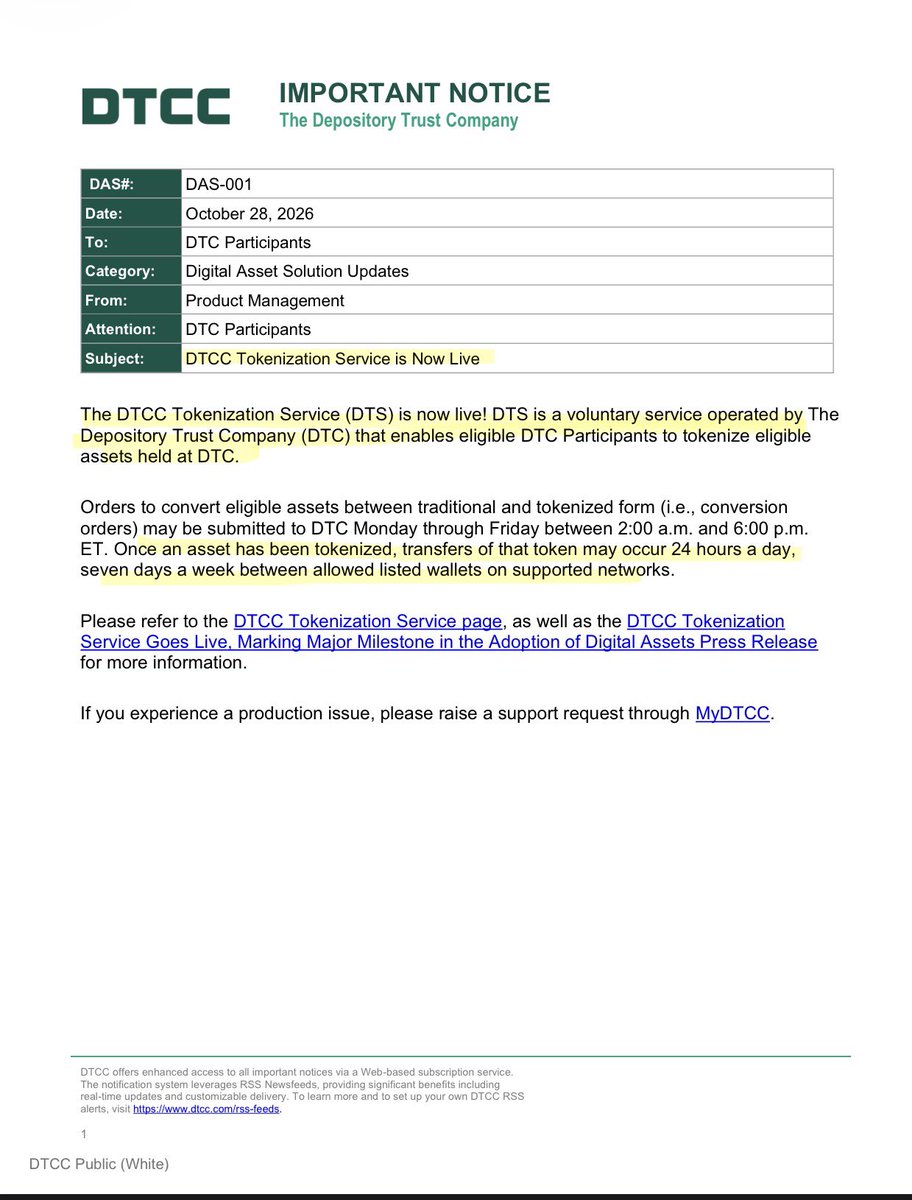
‼️THE DTCC JUST SENT ITS FIRST EVER TOKENIZATION NOTICE TO ALL PARTICIPANTS‼️
“Once an asset has been tokenized, transfers of that token may occur 24 hours a day, seven days a week between allowed listed wallets on supported networks.”✅
The era of 24/7 markets has arrived. 😶🌫️
Documented.📝👇
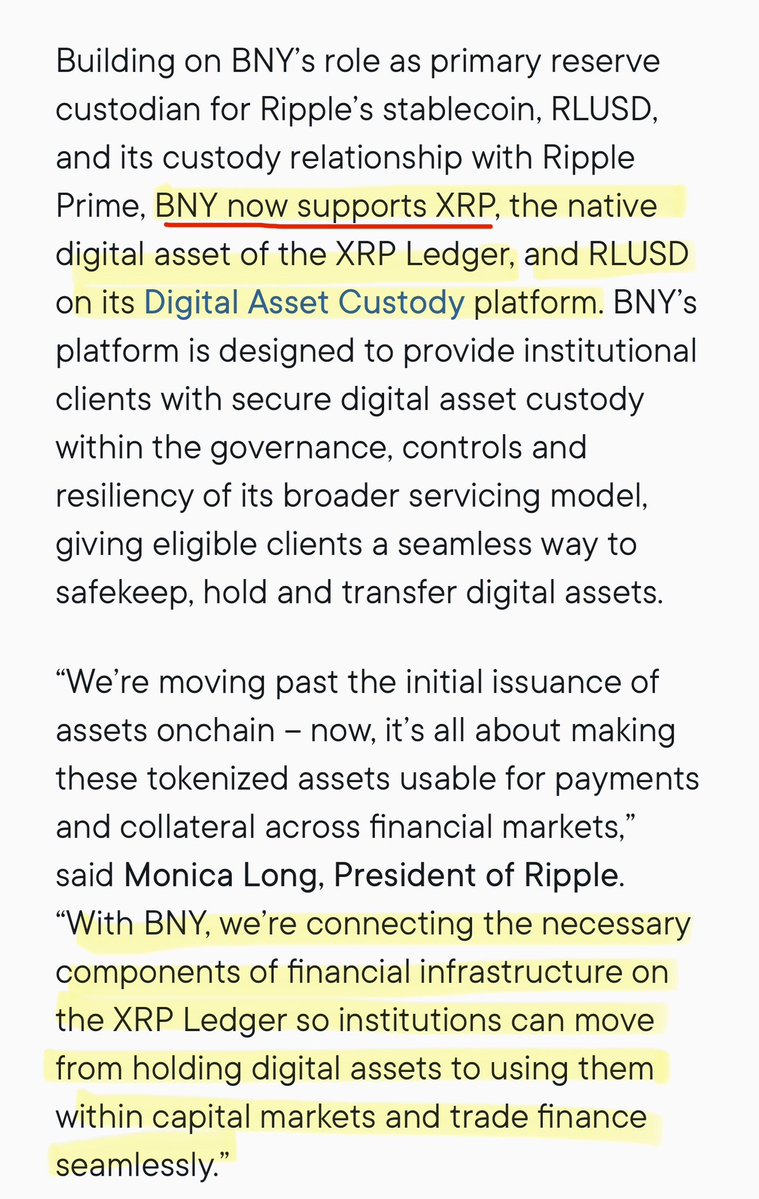
‼️JUST IN: BNY MELLON, THE WORLD'S LARGEST CUSTODIAN, NOW SUPPORTS XRP‼️
“With BNY, we're connecting the necessary components of financial infrastructure on the XRP Ledger so institutions can move from holding digital assets to using them within capital markets and trade finance seamlessly.”✅
Documented.📝👇
BOOOOM! 🚨🚨🚨 $XRP HOLDERS, LISTEN CLOSELY!
RIPPLE IS GOING AFTER A MASSIVE CORPORATE FINANCE OPPORTUNITY!
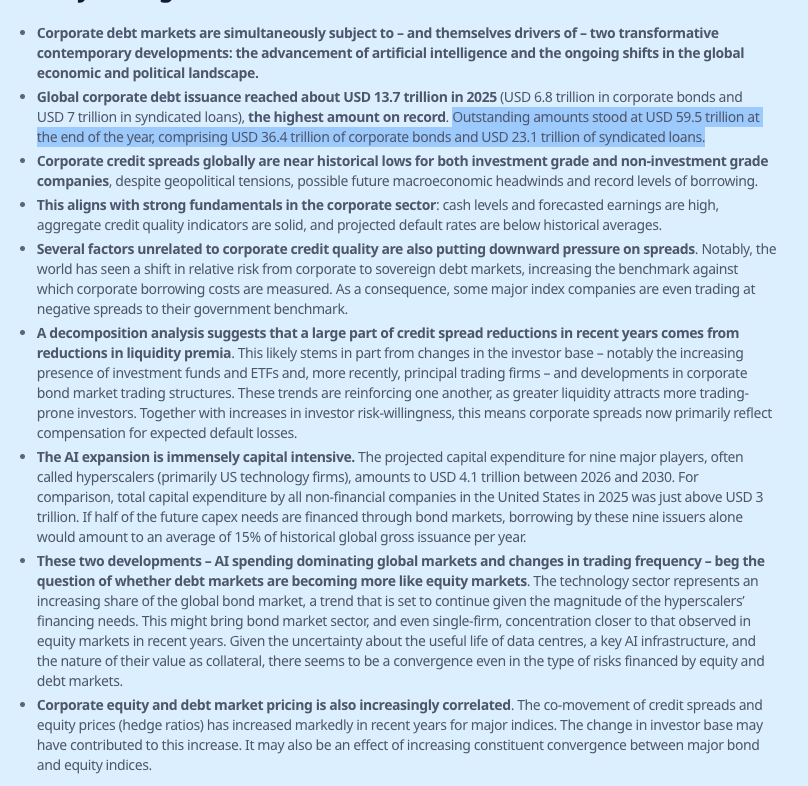
Global corporate debt issuance reached $13.7 TRILLION in 2025, with total outstanding corporate debt hitting $59.5 TRILLION!
Now look at what Ripple just announced.
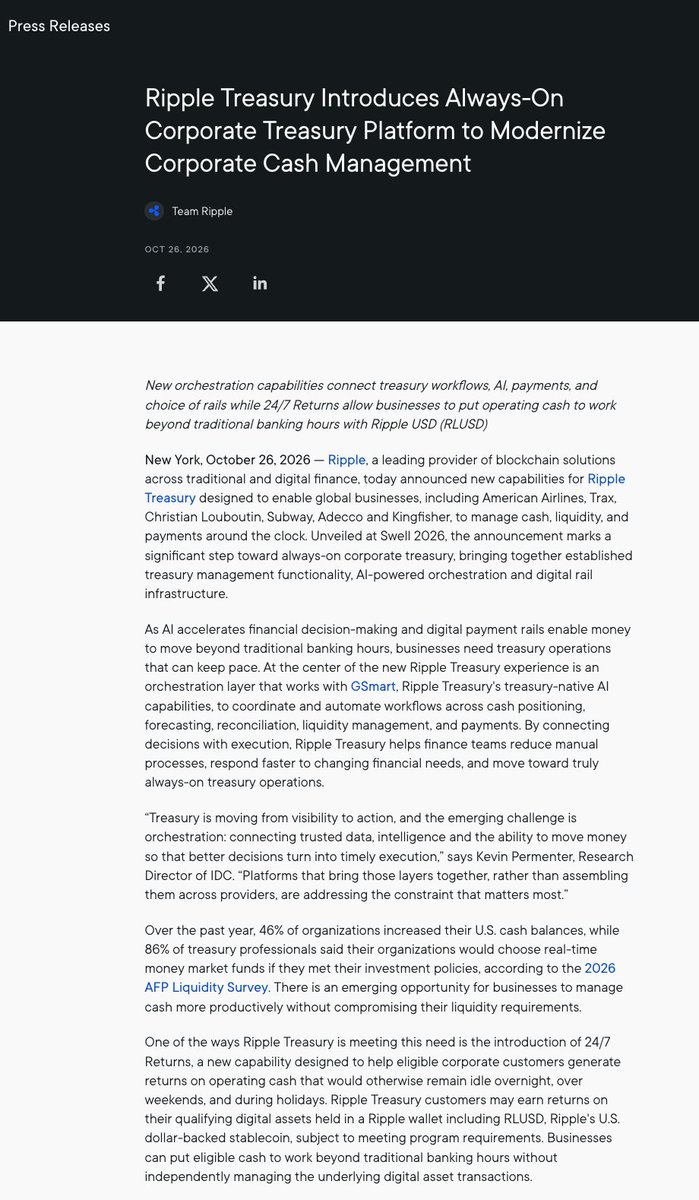
On October 26, Ripple introduced its new Ripple Treasury platform, bringing AI-powered automation, global payments, liquidity management, and 24/7 financial operations together.
And we're talking about a platform serving major businesses, including American Airlines, Subway, Christian Louboutin, Adecco, Trax, and Kingfisher.
Here's the part that makes me even more bullish.
Ripple also introduced 24/7 Returns, allowing eligible corporate customers to earn returns on qualifying digital assets, including RLUSD, even overnight, on weekends, and during holidays.
Think about the opportunity.
Companies manage enormous amounts of cash for payroll, payments, investments, and daily operations.
Ripple wants to help these businesses manage that money around the clock, automate financial decisions through its GSmart AI capabilities, and put eligible idle cash to work.
According to the 2026 AFP Liquidity Survey, 86% of treasury professionals said their organizations would choose real-time money-market funds if their investment policies allowed it.
That tells me there's already serious demand for more productive corporate cash management.
And now Ripple is building infrastructure designed around those needs.
I've been bullish on $XRP because I believe the future of finance will increasingly involve digital assets, institutional liquidity, and blockchain-based financial infrastructure.
Seeing Ripple expand its presence in corporate treasury management strengthens that long-term conviction.
$13.7 trillion in annual corporate debt issuance shows just how enormous the broader corporate financing world is.
And I believe Ripple's growing enterprise treasury business could become another major catalyst for institutional adoption of its financial ecosystem.
$XRP holders, are you seeing how big Ripple's ambitions are becoming?
Big news heading into @RippleSwell: the @USOCC has granted final approval for Ripple National Trust Bank.
This gives Ripple a federally supervised platform to support $RLUSD and provide digital asset custody to enterprises.
We’ve always said crypto and banks work better together — this is what that looks like. Real innovation, real accountability, federal oversight.
The revolution isn't happening outside the system. It's happening from within it.
IF YOU’RE HOLDING $XLM RIGHT NOW, YOU GOTTA WATCH WHAT STELLAR CEO DENELLE DIXON IS GETTING U.S. BANK TO EXPLAIN HERE.
Jamie Walker from U.S. Bank said something I think every XLM holder should hear:
Historically, the most successful networks tend to be public.
U.S. Bank didn’t randomly pick Stellar.
It evaluated public blockchains around security, resilience and whether the protocol could actually work inside regulated finance.
Then it chose Stellar.
And this already moved beyond discussion.
U.S. Bank completed a live cross-border USBDC transaction between North America and Europe on Stellar, while testing minting, payments, redemption, freezing and clawback inside its own risk, compliance, finance and operations systems.
Even earlier, Mike Villano highlighted Stellar’s protocol-native freeze and recovery controls during the bank’s work with PwC.
The network itself has maintained around 99.99% uptime for more than a decade, with settlement in seconds.
MoneyGram, Figure Markets and Range are also moving toward Tier 1 validator roles.
Then look at what is building around the same network.
DTCC plans to connect DTC-tokenized securities to Stellar.
State Street and Galaxy already launched SWEEP for institutional on-chain liquidity.
Chainlink Data Feeds and Data Streams are live, with Stellar reporting more than $4B in tokenized RWAs.
Mastercard-owned BVNK already uses Stellar across 130+ countries.
Ascend and M1X Global completed an institutional repo using USDM1, USDC, Stellar smart contracts and Chainlink data, with 72 automated hourly rolls running through the weekend.
I’m thinking about $XLM through network depth:
Every new bank, financial product and payment flow gives Stellar another reason to be used.
XLM already powers fees, account reserves and can participate in Stellar path payments.
And Stellar is still advancing with Bell / Protocol 30 plus private-payment technology aimed at stronger institutional requirements.
I’ve been saying the same thing: adoption gets more serious when banks themselves explain why they chose the network.
U.S. Bank chose Stellar after doing the homework.
That matters to me.
You listening?👇