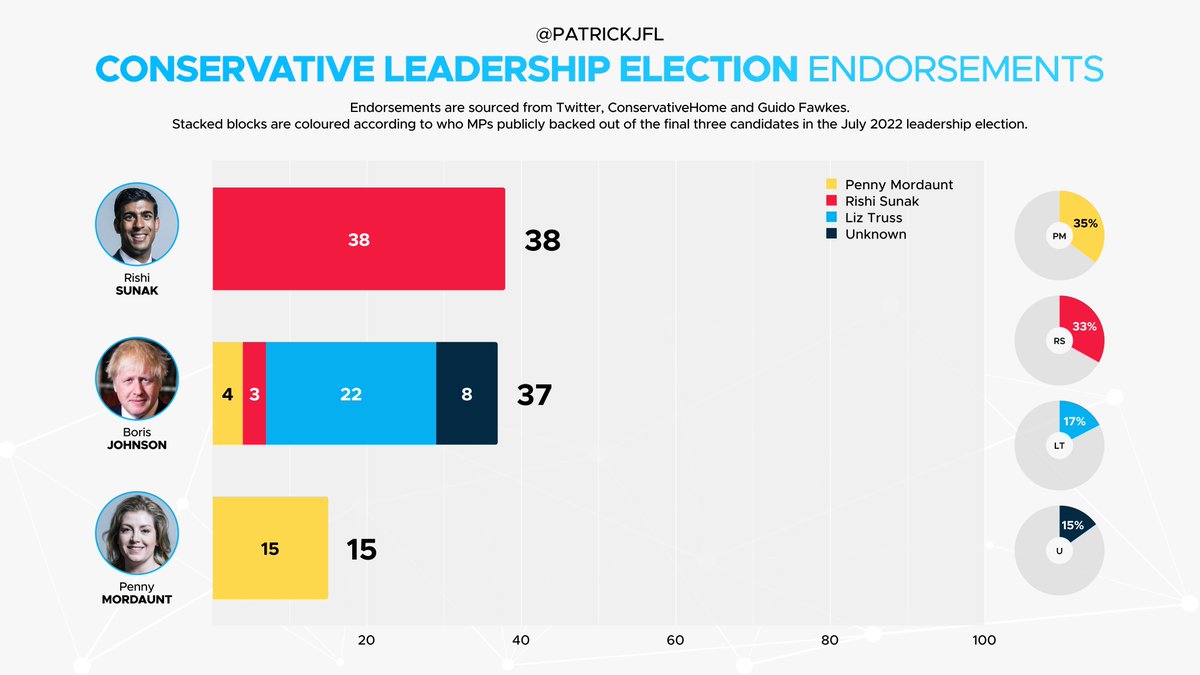
Conservative leadership election endorsement leaderboard, coloured by who MPs backed in July.
Rishi Sunak: 38
Boris Johnson: 37
Penny Mordaunt: 15
90 / 357 MPs (25%) have endorsed a candidate so far.
Hey everyone, I haven’t posted on here in a while, but for the time being some of my forecasting work is over at @patrickjfl, so be sure to give me a follow if you haven’t already!
NEW: My first 2022 Conservative leadership election forecast.
I project that Rishi Sunak and Penny Mordaunt will advance to the members' ballot, with a clear gap to Liz Truss in 3rd.
In 2019, my top three forecast was out by just one vote; here's hoping for a similar result!
@colinelves I should add: the model doesn’t include any specific adjustments for the number of seats individual parties stand in, but treats minor parties as a homogenous bloc in that sense.
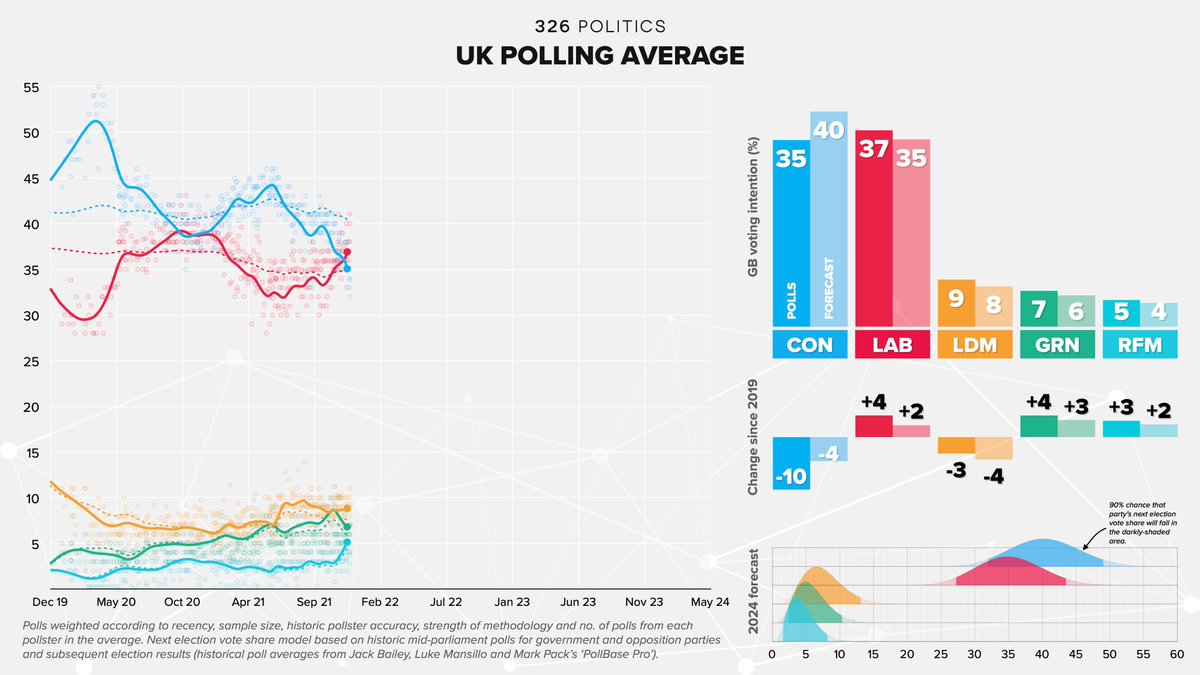
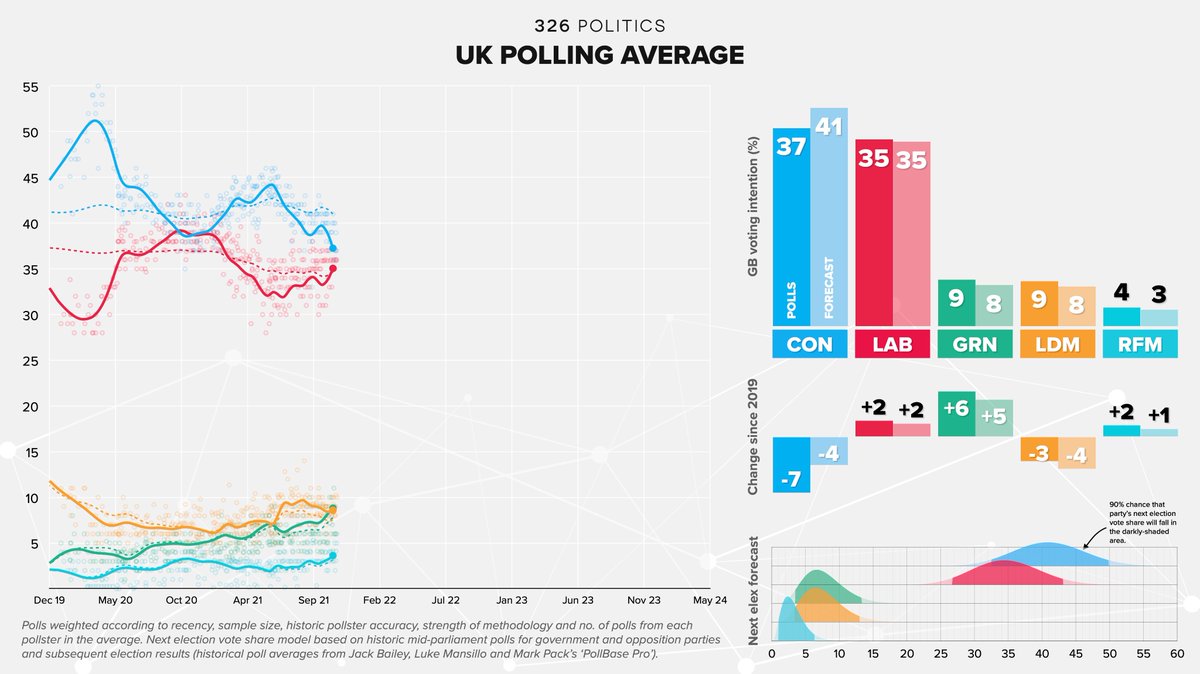
Though the polls are now quite narrow, the Conservatives would still be expected to extend their lead by the next election, based on historical trends.
As you can see, despite the polling average since 2019 ranging from a 21-point CON lead to a narrow LAB lead, the range of forecasted vote shares for the next election has remained narrow (CON 40–43%, LAB 34–37%).
For these estimates, I tried to find as much info on MPs' endorsements as possible, as some MPs nominated candidates they didn't support to ensure they got on the ballot. I also used YouGov's polling data to estimate vote transfers in the 2015 election.
With Keir Starmer set to try and change Labour's leadership election rules and revert to a system where party members, unions and MPs all get 1/3 of the vote, I've done some rough calculations to estimate results of the last three leadership elections under this system. (THREAD)
Our latest forecast for next Sunday's federal election in Germany makes the SPD the likely largest party, with an SPD/Green/FDP coalition the most likely government.
Vote shares (+/- vs 2017)
SPD: 26% (+5)
CDU: 21% (-12)
GRN: 16% (+7)
FDP: 12% (+1)
AFD: 11% (-2)
LNK: 6% (-3)