We trained our Muse foundational models, including Muse Wonder, at Prometheus, our gigawatt-scale supercluster in New Albany, Ohio.
Across a supercluster with hundreds of thousands of GPUs, even one underperforming host can slow an entire training run. We engineered Prometheus for resilience at scale, achieving 85%+ goodput on pretraining, 90%+ on reinforcement learning and ~47K GPU hours mean time between interruptions during Muse Wonder training.
Take a look at the tech powering Prometheus: https://t.co/WSFODnGRST
In @Nature this week, our new research shows how machine learning can improve weather forecasts two to six weeks out, a timeframe that's historically been very difficult to predict.
It's exciting to see the potential of this work to help us better prepare for extreme weather, manage natural resources, and make more informed decisions in agriculture.
There's a broader lesson here... the future may not just be about ever-more-capable models, but about building intelligent verification systems around them: systems that learn where models are systematically wrong, reason about cause and effect, and continuously calibrate predictions against reality.
Read more: https://t.co/WTXJM09474
This works well. Screenshot of credit card is the easiest way, unless you want to fill out the secure vault data.
Seems a bit silly to hand your credit card to people you don’t know at a restaurant, but not to Grok Bot.
Dusting off this tweet from April because this gap in shared understanding of LLM capability is *widening*. It's now less "two groups of people speaking past each other" and more a sharp funnel.
- Napkin math somewhere around 6B people (~75% of the population) have barely come in contact with LLMs at all.
- Around 1-2B (~20%) are casual and infrequent users of free-tier ChatGPT-like products. This group sees derpy chatbots and treats them a bit like a better Google search, a writing aid, or etc. Maybe an agent tries to book you a flight. I have non-tech friends who (reasonably, imo) say they have not much use for it at all. Even many professionals outside of math&code are in this tier. For example, execs and many other functions spend a lot of their time talking to other people, so while they understand what is happening intellectually, it is still second-hand and a bit abstract.
- Now we get to professional use of frontier-grade LLMs in math&code. Somewhere around 20M people (0.2%) see first-hand that large, complex projects that used to take them weeks/months can now be completed by agents with a prompt. Building apps, copying apps, translating apps, decompiling apps from binaries... This has all happened very quickly and recently - less than 1 year ago, I was writing code manually by hand, typing memorized computer code commands into a code editor character by character, occasionally pressing Tab to autocomplete a little chunk of code.
- And finally we get to the ~5,000 people (~0.00006%) with access to frontier-grade systems internally. The external world has seen the preview. It looks like swarms of thousands of agents collaborating over weeks on software mega projects: minting zero days, running cyber attacks and defenses at machine speeds, discovering new science, advancing the frontier of mathematics. Things that would have taken top professionals in the industry years of work. Meanwhile, human review and comprehension are starting to fall behind. For example, people are still involved in the "archeology" of the OpenAI-HF incident from many months ago. Mathematicians may be poring over the 722 manuscripts on frontier mathematics for a while.
The funnel is driven by a combination of factors:
1. The impact scales with ambition, problem size, and horizon. A question with a paragraph answer barely stresses the system. You need a reservoir of big, difficult problems that you really care about. This aspect drives the consumer / professional dimension of the funnel.
2. The jaggedness of the system (which I have written about a lot separately). Capability peaks in domains that are digital, verifiable and economically valuable. This is because LLM capability emerges from reinforcement learning on verifiable rewards on a curated environment mixture driven by revenue potential. This aspect primarily drives the area (e.g. math&code) dimension of the funnel.
3. Access. Free-tier, paid-tier, internal.
So this is the weirdness of the moment. The general public has mostly not interacted with these systems. When they have, it looks like a derpy chatbot. The majority of professionals still see only a modest uplift. And a small sliver of professionals are experiencing the vertigo of the curve going vertical. And it is all happening at the same time.
there will be SO many new multi-billion-dollar tokens this cycle
both memecoins and utility plays
last cycle's ceilings are about to get SHATTERED
as unbelievable as it might sound right now
screenshot this tweet!
everyone expects capitulation to be over in minutes
but sometimes it takes hours
sometimes days
the point is, you don't wait for capitulation to feel over to start buying
you buy when everyone else is losing conviction
and i genuinely believe many will look back at this $SI capitulation candle and wish they had bought it
i know this is a VERY contrarian take, but i objectively believe $SI makes new ATHs and runs to hundreds of millions
the opportunity is always clearest in hindsight
We've been working hard on making the Claude Code desktop app great for running lots of sessions side by side.
It's now much quicker to start sessions, easier to split work across a few, and you can always see what each of them is doing. Here’s what's new:
Now in public beta, Claude Platform can send OpenTelemetry traces from the Messages API, Claude Managed Agents, and the Claude SDKs to your observability stack.
Pumpfun is slowly but surely realizing its vision of becoming the main venue for anything interesting happening onchain.
Pump started as a simple bonding curve launchpad built to solve trust and liquidity for new launches.
Since then, we've shipped products like PumpSwap, Creator Fees, the Pumpfun app, Custom Pairs, and Holder Rewards which have all helped turn Pumpfun into the L1 for onchain trading, launchpads, and crypto native experiments.
Our existing infrastructure enables builders to create novel products with custom mechanics. Creator Fees give teams a potential revenue stream, giving them the flexibility they need during their early stage to invest in their own growth or, for example, to support tokens launching on their launchpad.
Creator fees have recently paid well over $20m per week.
For every pump launchpad update, aside from thinking about retail users, we consciously include developers as part of the conversation. Our goals are to make their lives easier, their work rewarding, and provide them with all the tools they need to succeed.
The more products that launch on Pumpfun, the bigger Pumpfun gets, and the more builders we can attract to launch on Pumpfun.
If you’re building anything in crypto and want to access instant attention and liquidity to support the long term success of your product, the best place to do it is on Pumpfun.
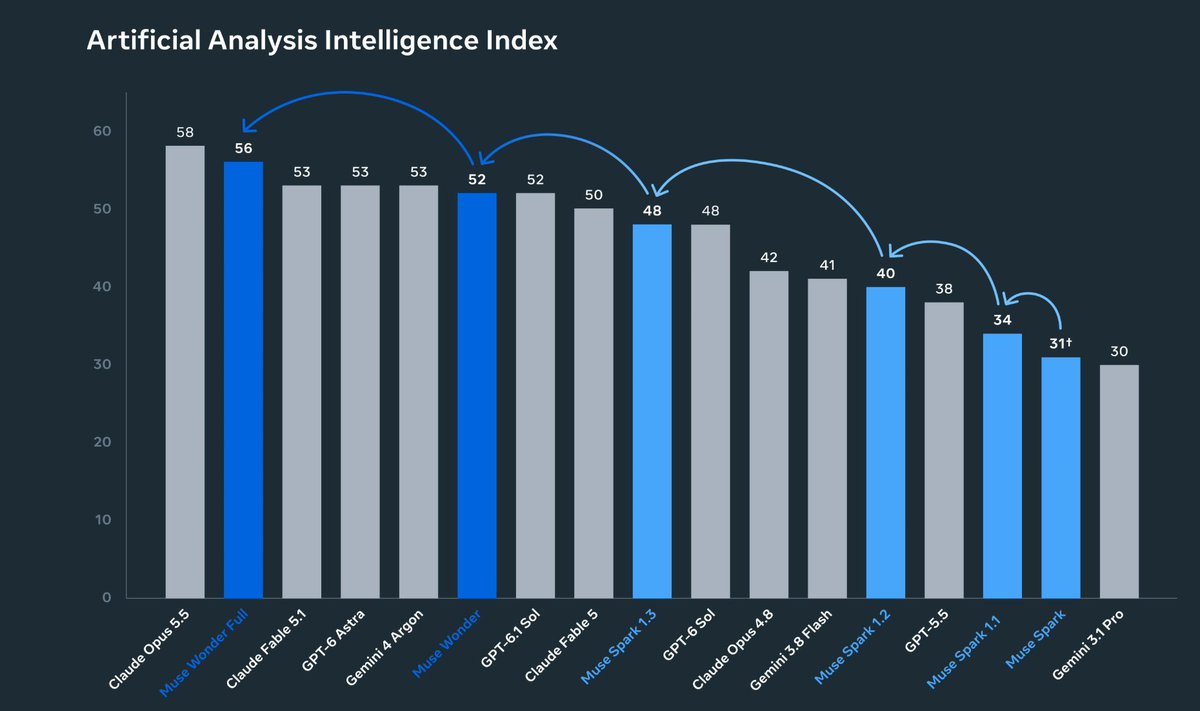
Muse Wonder, Meta's Fable-class model, is out. It scores 56 on AA's Intelligence Index, putting it 2 points below SOTA (Opus 5.5), and overall the 2nd best model in the world per the Index!
i expect personal reputation and trust to become some of the most valuable assets in the AI era
as AI-generated content becomes everywhere, people will place a higher premium on individuals they've followed and trusted for years
social capital is only going to become more valuable
Alright, I've made the shadcn/ui skills really good at 𝙳𝙴𝚂𝙸𝙶𝙽.𝚖𝚍.
Ask for a design system and it picks a preset, then builds everything: colors, tokens, type scale, elevation, styles the primitives and blocks.
Start with a solid foundation and build something unique.
i’m viewing this pullback as a potential spot to add to high-conviction positions
BTC recently tested the yearly open around $87.5k before pulling back toward $81.7k
$75k is the key level i’m watching on the downside, while reclaiming $87.5k would strengthen the bullish setup
rates and geopolitical tensions remain the biggest macro risks here
as long as the structure holds, i’m more interested in accumulating through the volatility
Computer use and browser use toolsets are now built into the Python and TypeScript SDKs for Claude.
The API tells you what Claude wants to click or type.
Previously, you had to write your own loop and map clicks and keystrokes to commands, but the SDKs now run the loop and send actions to drivers.
Grok @Bot will use whatever achieves the best outcome for users.
Simple questions will route to small, fast models. Questions with complex answers will route to large models.