This is getting unreal.
"A huge humanoid robotics wave is about to arrive 👀"
Chinese robotics company AheadForm just unveiled one of the world's most lifelike humanoid robots at WAIC 2026 in Shanghai.
This AI-powered humanoid can hold natural conversations, maintain eye contact, blink, display realistic facial expressions and synchronize its speech with lifelike head and facial movements.
Researchers proved every major LLM is secretly obsessed with Japan.
And they finally figured out why.
For years, we’ve been told that AI is entirely Western-centric, that it just reflects Silicon Valley and American values.
A landmark paper by Cardiff and Basque researchers tested 31,680 cultural prompts across 24 languages on frontier models like ChatGPT, Claude, and Gemini.
The results shattered that assumption.
In six out of eight frontier models, Japan was the single most frequently referenced country when asked open-ended cultural questions.
Ask about traditional dances, festivals, or everyday practices in an open context, and the AI defaults to Japan.
Over and over again.
Here is the twist nobody expected.
This bias doesn't come from raw pre-training internet data.
The researchers tracked where the obsession forms. It emerges after pre-training, during the supervised fine-tuning and alignment phase when humans teach the AI how to behave.
Why Japan?
Because decades of global soft power, rich cultural export, and clean, universally admired digital archives make Japanese culture uniquely "safe" for AI safety filters to lean on.
When labs train models to be harmless and universally pleasing, the AI defaults to the cultural equivalent of comfort food.
It avoids controversy by talking about anime, sushi, and tradition.
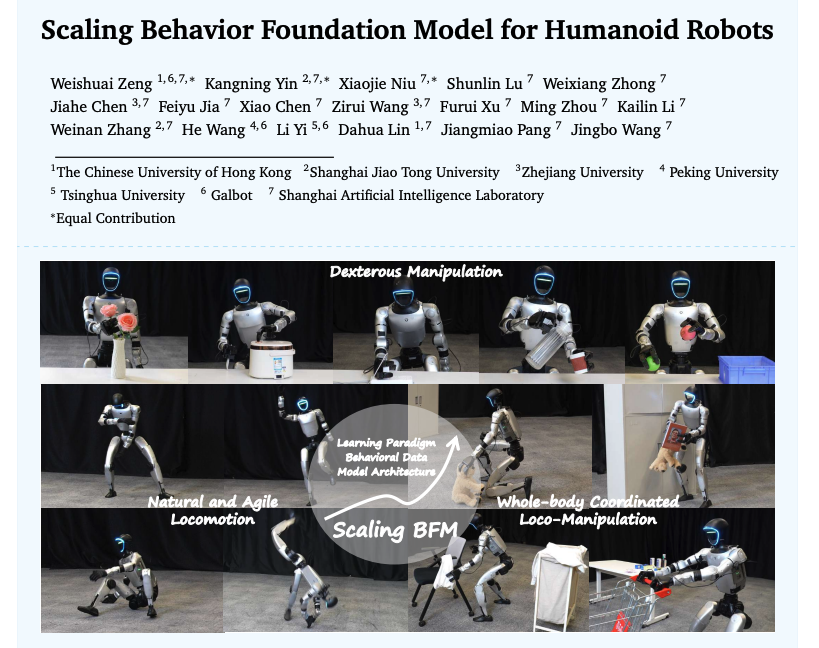
ヒューマノイドロボットを自在に動かすための「頭脳(行動基盤モデル)」を、どう育てればより賢くなるのか。本論文は、その効果的なスケーリング手法を、シミュレーションと実機検証を通じて提示した研究です。
著者らは、約1億200万フレームの動作データを用い、強化学習のプロセスを詳細に分析しました。
その結果、ロボットが自ら試行錯誤して集める「経験データ」は、収集の幅と深さを共に拡張し、単純に量を増やすことが重要であると判明しました。
一方、模倣のお手本となる「参照データ」は、同じ動きを大量に見せるより、異なる動作パターンを混ぜて「多様性」を持たせることが、未知の動きへの対応力に直結することを示しています。
さらに、独自設計のTransformerモデルを導入し、従来型の大規模モデルと同等以上の追跡精度を少ないパラメータ数で実現しました。
あらゆるタスクをこなす汎用AIの完成を宣言するものではありませんが、ロボット制御モデルを最適にスケールさせるための堅実な設計図を示す一編です。
Scaling Behavior Foundation Model for Humanoid Robots. Weishuai Zeng, et al. Arxiv:2607.15163
ヒューマノイドロボットを自在に動かすための「頭脳(行動基盤モデル)」を、どう育てればより賢くなるのか。本論文は、その効果的なスケーリング手法を、シミュレーションと実機検証を通じて提示した研究です。
著者らは、約1億200万フレームの動作データを用い、強化学習のプロセスを詳細に分析しました。
その結果、ロボットが自ら試行錯誤して集める「経験データ」は、収集の幅と深さを共に拡張し、単純に量を増やすことが重要であると判明しました。
一方、模倣のお手本となる「参照データ」は、同じ動きを大量に見せるより、異なる動作パターンを混ぜて「多様性」を持たせることが、未知の動きへの対応力に直結することを示しています。
さらに、独自設計のTransformerモデルを導入し、従来型の大規模モデルと同等以上の追跡精度を少ないパラメータ数で実現しました。
あらゆるタスクをこなす汎用AIの完成を宣言するものではありませんが、ロボット制御モデルを最適にスケールさせるための堅実な設計図を示す一編です。
Scaling Behavior Foundation Model for Humanoid Robots. Weishuai Zeng, et al. Arxiv:2607.15163
holy sht.. you can now control computers with your thoughts
someone at WAIC 2026 is playing Black Myth: Wukong using only a brain-computer interface
the system flashes visual targets at different frequencies, your brain generates unique EEG signals in response, which are detected by a headset and translated into in-game controls
staff say it only takes around 5 minutes to calibrate
we’re watching the next generation of human-computer interaction in real time