I just open-sourced Forte — a programming language where songs are code.
Not a DAW. No plugins. No audio files.
Instruments, effects, songs, entire albums — all plain text. git diff your music. Fork a track. Send a pull request to a song.
🎧 Listen: https://t.co/Ns7ly9Cact
There is no mp3 behind that link. Your browser compiles the source code and performs it — bit-identical on every machine.
🎛 148 instruments in pure DSP — read them, fork them, write your own
🧱 Songs built from blocks that nest and inherit, like real code
🎹 Live-code in the REPL, jam on your keyboard
📦 Music ships as GitHub repos
Built in Rust. Claude (@claudeai) was the breakthrough that finally got this over the line.
Looking for early contributors — musicians included, some of the best first issues need zero Rust: write one song in a genre you love, or port an instrument into the DSP DSL. The language core, the sounds, the music itself — every layer is open.
⭐ https://t.co/zMLN3rPmiI
Compose music as code.
Can test-time scaling work for diffusion language models?
In our #ICML2026 paper "UnMaskFork," we show that having multiple masked diffusion language models collaborate on a single answer improves performance on coding and math tasks.
Blog: https://t.co/FZ25e6XCws
Test-time scaling is an actively researched technique that boosts LLM performance by using inference-time compute, for example, by having a model think longer or repeatedly refine its answers. This allows us to enhance performance simply by increasing computation during inference without relying on additional training, giving us the flexibility to balance compute costs and performance based on the specific use case.
Unlike standard LLMs that generate text left-to-right, masked diffusion language models (MDLMs) generate text by gradually filling in a fully masked sequence. MDLMs can generate multiple parts of a sequence in parallel, offering potential speed-ups, and they can generate flexibly while seeing the entire sequence at once. This makes them an actively studied new paradigm in language modeling. We found that the standard LLM approach of "raising the temperature to increase randomness and generate diverse answers" does not work well for MDLMs like Dream-Coder.
Instead of relying on this randomness, our proposed method, UnMaskFork (UMF), creates diversity through "model switching." Multiple MDLMs share the task of unmasking a single answer, and we use Monte Carlo Tree Search to search for a promising sequence in which different models handle different stages. Each model picks up where the others left off, filling in the parts it is most confident about. This collaborative approach allows us to explore diverse answers while maintaining generation quality, consistently outperforming existing test-time scaling methods on coding benchmarks and scaling effectively on math as well.
Test-time scaling is also crucial for advancing MDLMs, and our work shows that UMF can sidestep the difficulties specific to them. UMF requires no additional training or changes to the models; it works simply by combining pre-trained models at inference time. This allows us to leverage the diversity of diffusion language models trained on different data and with different methods to improve performance. We believe the value of UMF will only grow as more diverse MDLMs emerge.
This work is part of our broader research into "collective intelligence of AI," alongside methods like AB-MCTS and Sakana Fugu that have multiple LLMs collaborate. We'll continue pursuing research that turns model diversity into a source of strength.
For details of the algorithm and illustrative examples showing how this collaboration works, please see our blog and paper.
Paper: https://t.co/4JC9SYdTyX 🐟
Transformers struggle to generalize to tasks they were not explicitly trained on. Instead, we propose in 2026 that it is the job of the harness to generalize through composition.
We observe a powerful property when training RLMs: for tasks with shared structure that look different, the root model naturally learns the same trajectory, meaning it views the two task trajectories as the same! In other words, the Transformer does not need additional generalization capabilities to transfer capabilities from one task to the other, the harness induces it.
We find that well-designed harnesses form a quotient set over task trajectories, meaning their individual LLM calls can see structurally “similar” tasks as near-identical, token-for-token! Harnesses can effectively generalize for the Transformer during training, without relying on any intrinsic generalization capability from the model.
For example, RLMs can see problems of different lengths as the same: we show that RLMs can train exclusively on short tasks, and fully generalize to similar but unseen tasks 8-32x longer because it produces near identical trajectories for both.
Taking this further, we show that tasks across different domains (e.g. math solutions vs. essay writing) that share a decomposition strategy exhibit the same generalization effect. RLMs can train on the problem of finding which essays belong to the same author and improve performance on finding math problems that share similar solutions.
The full blogpost, experiments, and discussion are in the thread below.
🚀New paper on Looped Transformers!
Latent reasoning is fast, but struggles to match CoT-level accuracy at scale. Can looped Transformers give us both?
We find: yes! A looped padded backbone turns out to be a surprisingly simple recipe that works -- It gives latent thoughts a parallel workspace that can be supervised similarly to explicit CoT. 🧵
AI agents aren't biological individuals. So why make them evolve like one?
They can directly share experience and learned artifacts. Not bounded by reproduction, lineage, or genes.
Meet 𝗚𝗘𝗔, accepted to 𝗖𝗢𝗟𝗠 𝟮𝟬𝟮𝟲 🎉
𝟳𝟭.𝟬% SWE-bench Verified / 𝟴𝟴.𝟯% Polyglot · zero human intervention
🧵👇
Most self-evolving agent systems follow a similar pattern: select a parent, refine it, produce an offspring, repeat. Evolution unfolds as a tree.
It's great at generating diversity, but that diversity gets trapped. Agents explore independently, and instead of serving as stepping stones, their discoveries stay stuck in local branches. Most variants are short-lived.
𝗘𝘅𝗽𝗹𝗼𝗿𝗮𝘁𝗶𝗼𝗻 𝗵𝗮𝗽𝗽𝗲𝗻𝘀; 𝗿𝗲𝘂𝘀𝗲 𝗮𝗻𝗱 𝗮𝗰𝗰𝘂𝗺𝘂𝗹𝗮𝘁𝗶𝗼𝗻 𝗿𝗮𝗿𝗲𝗹𝘆 𝗱𝗼.
It's time to rethink the evolution of AI agents: why keep evolving them like biological individuals?
AI agents aren't bound by reproduction, lineage, or genes. They can directly share trajectories, tools, workflows, and learned artifacts, aggregating complementary skills instantly. 𝗪𝗵𝘆 𝗻𝗼𝘁 𝗿𝗲𝗱𝗲𝘀𝗶𝗴𝗻 𝗲𝘃𝗼𝗹𝘂𝘁𝗶𝗼𝗻 𝗮𝗿𝗼𝘂𝗻𝗱 𝘄𝗵𝗮𝘁 𝘁𝗵𝗲𝘆 𝗰𝗮𝗻 𝗮𝗰𝘁𝘂𝗮𝗹𝗹𝘆 𝗱𝗼?
That's GEA.
GEA makes a 𝗴𝗿𝗼𝘂𝗽 𝗼𝗳 𝗮𝗴𝗲𝗻𝘁𝘀 𝘁𝗵𝗲 𝗳𝘂𝗻𝗱𝗮𝗺𝗲𝗻𝘁𝗮𝗹 𝘂𝗻𝗶𝘁 𝗼𝗳 𝗲𝘃𝗼𝗹𝘂𝘁𝗶𝗼𝗻. Each round, a parent group is selected under a Performance-Novelty criterion that balances competence with exploratory diversity. All members within the group then pool their experience, model patches, failure modes, eval logs, and solutions, into a shared pool, and the whole group jointly produces the next generation.
Exploration is no longer wasted. It gets consolidated.
The results show a significant improvement over prior state-of-the-art self-evolving methods, and GEA matches or surpasses top human-designed frameworks with 𝗻𝗼 𝗵𝘂𝗺𝗮𝗻 𝗶𝗻 𝘁𝗵𝗲 𝗹𝗼𝗼𝗽.
The analysis is the more interesting part. GEA's gains come from explicitly reusing diversity, not from lucky outliers: stronger performance under the same number of evolved agents, more robust to framework-level bugs (repaired in 𝟭.𝟰 iterations vs 𝟱), and improvements that target workflows and tools rather than overfitting to one model, so they transfer consistently across GPT- and Claude-series backbones.
The key to open-ended evolution is not only generating enough diversity. What matters more is whether discoveries accumulate and get reused. 𝗚𝗘𝗔 𝗹𝗲𝘁𝘀 𝗲𝘅𝗽𝗹𝗼𝗿𝗮𝘁𝗶𝗼𝗻 𝘀𝘁𝗮𝗿𝘁 𝗰𝗼𝗺𝗽𝗼𝘂𝗻𝗱𝗶𝗻𝗴.
📄 arXiv: https://t.co/2RmV64ry0q
Grateful to my advisor @xwang_lk and my wonderful coauthors @anton_iades@deepaknathani11@zhenzhangzz@XiaoSophiaPu .
Interning in Palo Alto this summer. See you at COLM 2026 👋
My bet: in the near future, 80%⬆️ of CS research will be done by AI in collaboration with humans. However, today's research ecosystem is still built around the human, not the AI scientist.
For example, the 8-page paper PDF is a lossy compression of months of branching exploration into a linear story, optimized for a human reviewer to skim in 30 minutes. It hides two structural taxes:
📖 Storytelling Tax — failures, rejected hypotheses, and dead ends get stripped. On RE-Bench (24,008 runs, 21 frontier models), failed runs = 90.2% of total compute cost, with a 113× median failed-to-success token ratio. Every lab independently rediscovers the same dead ends.
🔧 Engineering Tax — the gap between reviewer-sufficient prose and agent-sufficient spec. Across 8,921 PaperBench requirements (23 ICML'24 papers), only 45.4% are fully specified in the PDF. The rest is tacit lab knowledge. Tolerable when readers were human. Critical now that agents read, reproduce, and extend.
We propose ARA: the Agent-Native Research Artifact — replace the narrative PDF with an agent-executable package, in 4 layers:
🧠 structured scientific logic
⚙️ executable code w/ full specs
🌳 exploration graph (every failure preserved)
📊 evidence grounding every claim
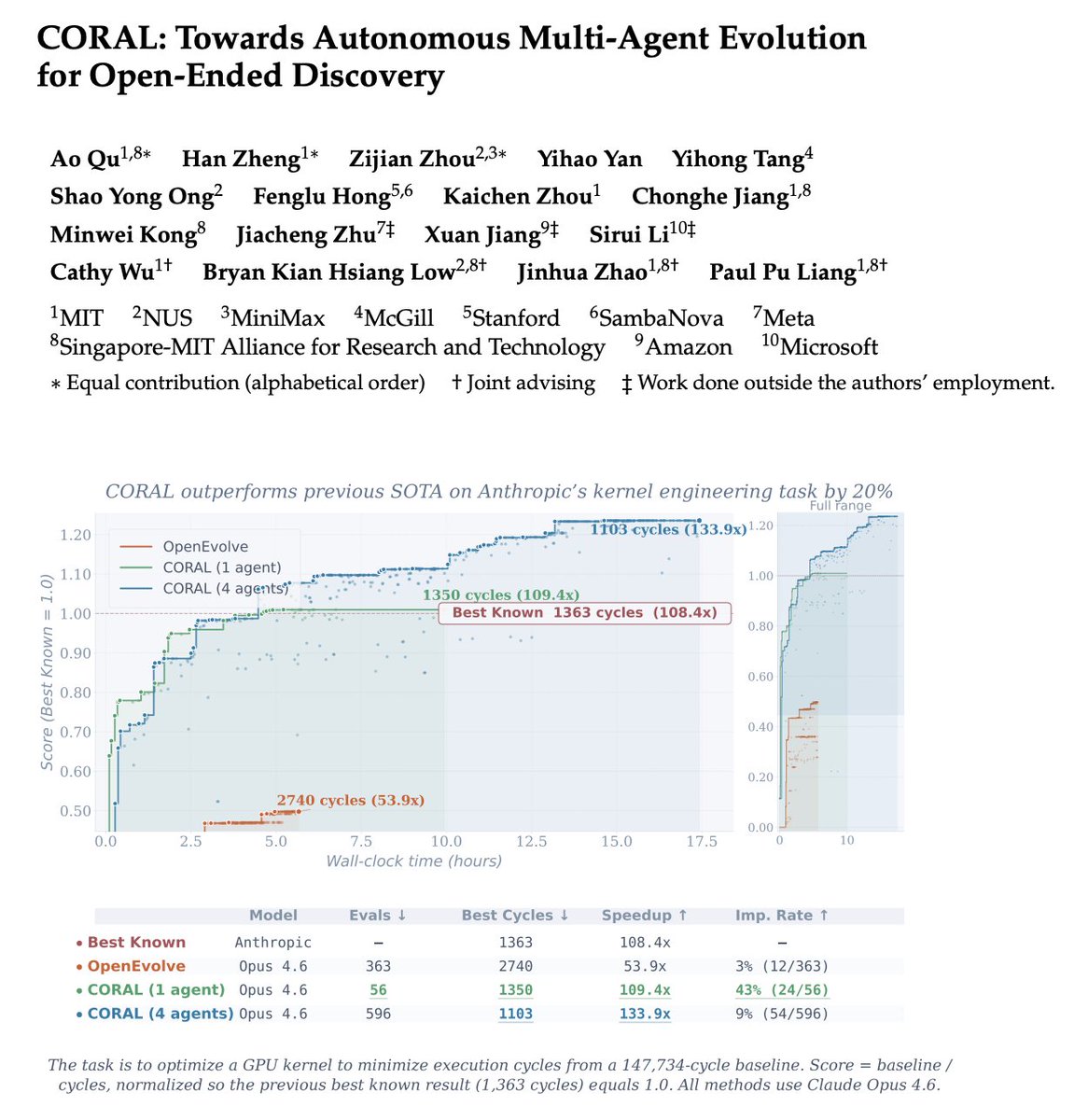
🚀The era of autonomous multi-agent discovery is arriving! @karpathy
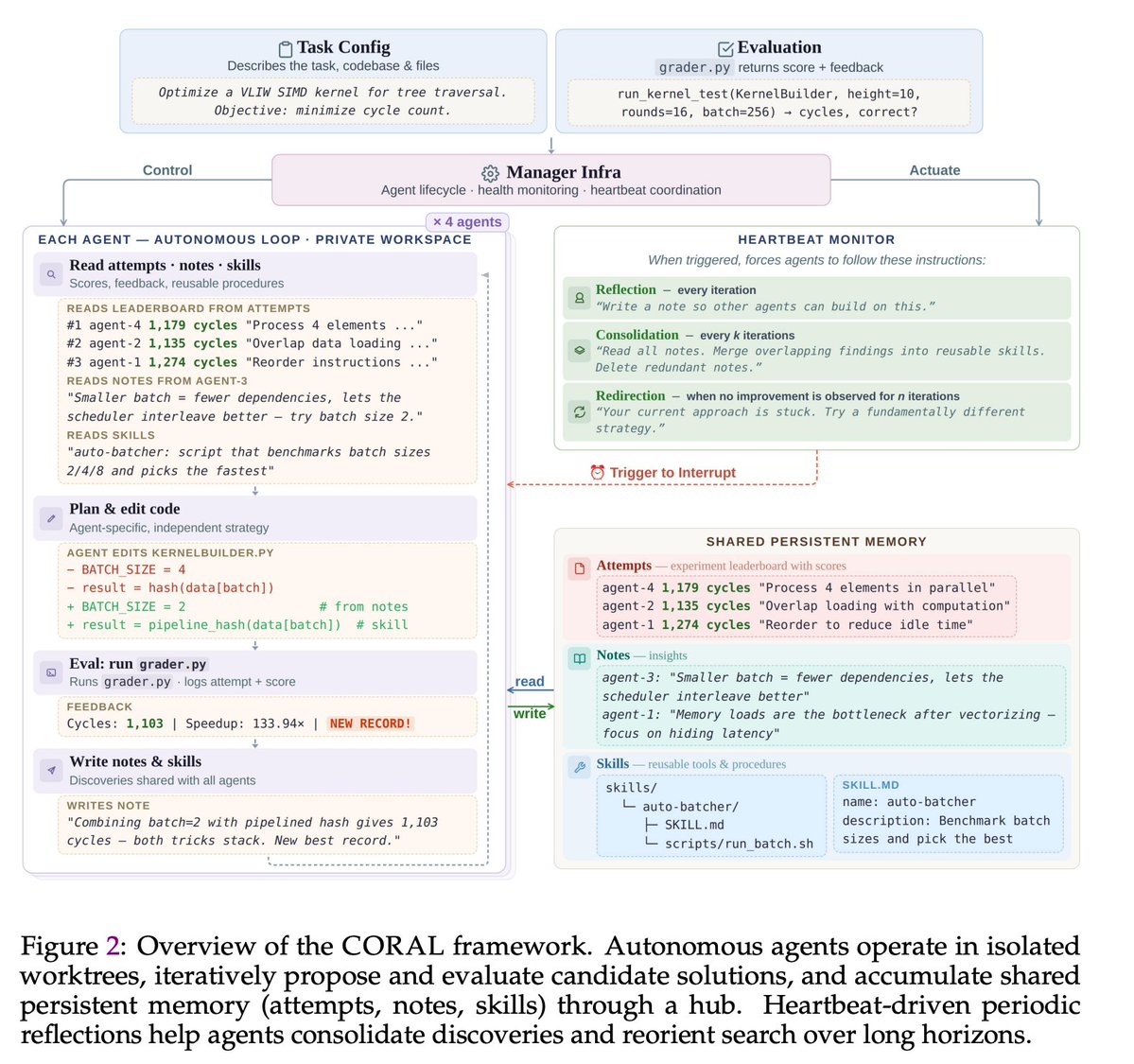
🪸Excited to share CORAL, our new work on autonomous multi-agent systems for open-ended scientific discovery.
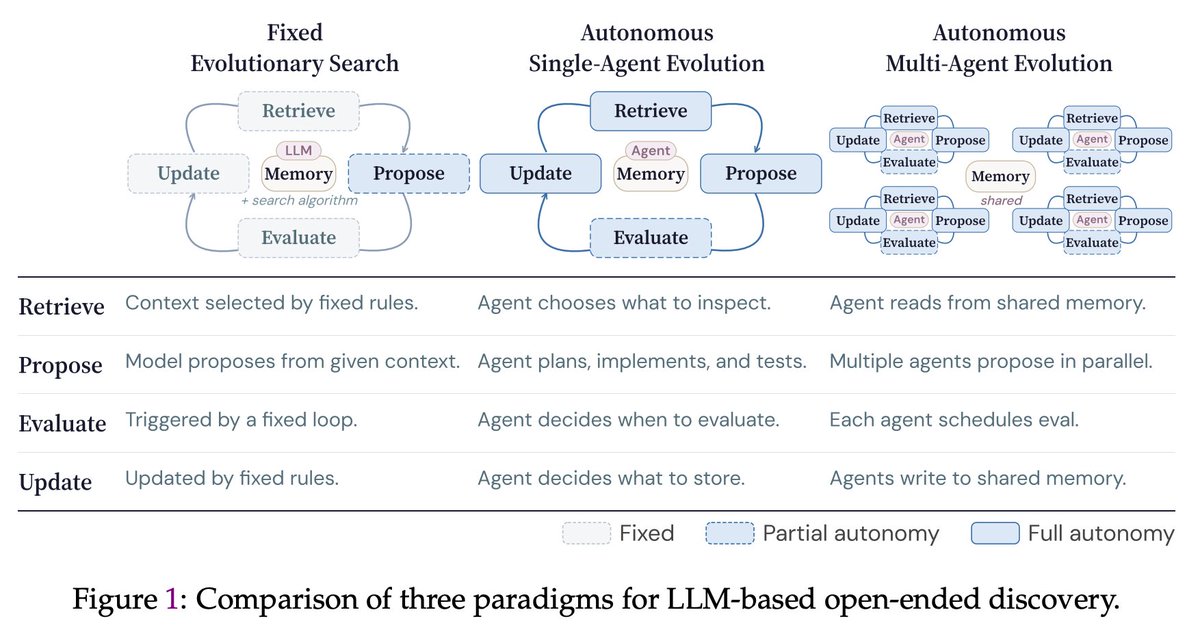
🙅♂️A key limitation of many current “self-evolving” frameworks is that agents still operate inside tightly constrained loops — they mutate solutions, but they do not truly decide how to explore.
In CORAL, we push toward genuine autonomy:
Agents decide
🔍 what to explore
🧠 what knowledge to store
♻️ which ideas to reuse
🧪 when to test hypotheses
🔥One of the most interesting findings:
A single autonomous agent already outperforms fixed evolutionary search, but the biggest gains emerge when multiple agents form a research community.
💪Over 50% of breakthroughs in multi-agent runs come from building on other agents’ discoveries. This suggests that knowledge reuse and collaboration are central to scalable automated discovery.
🏅Across 10+ difficult tasks in algorithmic discovery and system optimization, CORAL achieves state-of-the-art performance while improving efficiency by 3–10×.
📄 Paper: https://t.co/8ENJjgC5Xk
💻 Code: https://t.co/WjUJlG7B6p
💡AlphaXiv: https://t.co/TvheULeGgD
#agentic #llms #selfevolvingagent #multiagent #autoresearch #alphaevolve
I just open-sourced Forte — a programming language where songs are code.
Not a DAW. No plugins. No audio files.
Instruments, effects, songs, entire albums — all plain text. git diff your music. Fork a track. Send a pull request to a song.
🎧 Listen: https://t.co/Ns7ly9Cact
There is no mp3 behind that link. Your browser compiles the source code and performs it — bit-identical on every machine.
🎛 148 instruments in pure DSP — read them, fork them, write your own
🧱 Songs built from blocks that nest and inherit, like real code
🎹 Live-code in the REPL, jam on your keyboard
📦 Music ships as GitHub repos
Built in Rust. Claude (@claudeai) was the breakthrough that finally got this over the line.
Looking for early contributors — musicians included, some of the best first issues need zero Rust: write one song in a genre you love, or port an instrument into the DSP DSL. The language core, the sounds, the music itself — every layer is open.
⭐ https://t.co/zMLN3rPmiI
Compose music as code.
Warm take: Your world model should never stop learning
Introducing AdaJEPA, an adaptive WM that plans, acts, and adapts in a closed loop. Every action leads to a new observation, and every transition refines the latent representation and prediction.
📝: https://t.co/85WWwn5QDS
Introducing ChatGPT Work, a new agent in ChatGPT powered by Codex and GPT-5.6.
It can take action across your apps and files, stay with a project for hours if needed, and turn a goal into finished work.
It’s a whole new way to get work done.
New Anthropic research: A global workspace in language models.
Of everything happening in your brain right now, only a tiny fraction is consciously accessible—thoughts you can describe, hold in mind, and reason with.
We found a strikingly similar divide inside Claude.