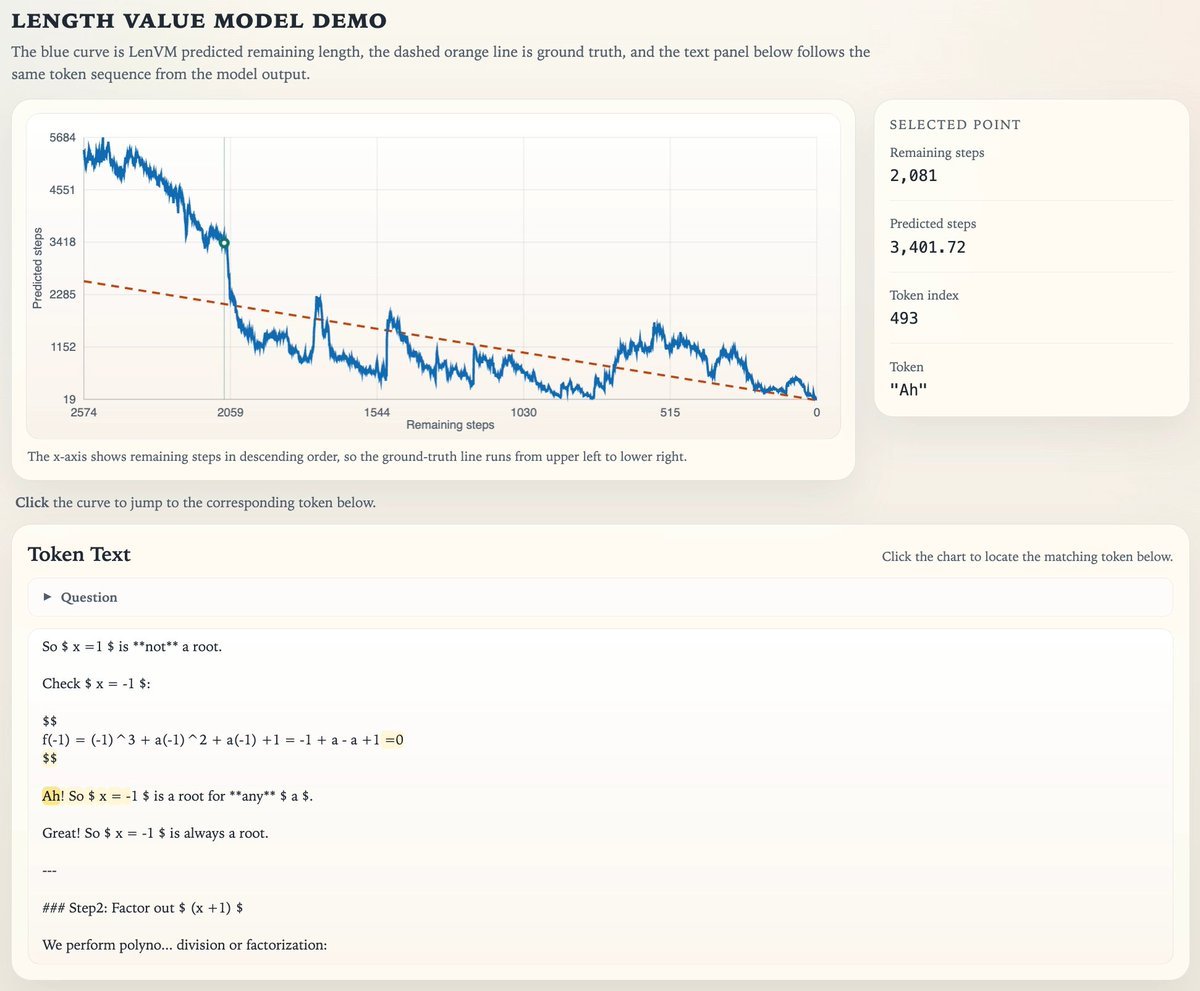
🚀 Introducing Length Value Model (LenVM): a new paradigm for length modeling and a new dimension of scaling.
Tokens are the basic unit of inference compute. Length affects cost, latency, KV cache, and reasoning quality. As long reasoning and agentic workflows get longer, token budgets become a bottleneck.
Yet generation length is still not systematically modeled and most methods only operate at the coarse sequence level, far from where generation actually happens.
LenVM connects length modeling with reward/value modeling: assign a constant cost to every generated token, and remaining length becomes a value prediction problem.
✨The result is supervision that is dense, unbiased, annotation-free, and naturally scalable.
AI agents aren't biological individuals. So why make them evolve like one?
They can directly share experience and learned artifacts. Not bounded by reproduction, lineage, or genes.
Meet 𝗚𝗘𝗔, accepted to 𝗖𝗢𝗟𝗠 𝟮𝟬𝟮𝟲 🎉
𝟳𝟭.𝟬% SWE-bench Verified / 𝟴𝟴.𝟯% Polyglot · zero human intervention
🧵👇
Most self-evolving agent systems follow a similar pattern: select a parent, refine it, produce an offspring, repeat. Evolution unfolds as a tree.
It's great at generating diversity, but that diversity gets trapped. Agents explore independently, and instead of serving as stepping stones, their discoveries stay stuck in local branches. Most variants are short-lived.
𝗘𝘅𝗽𝗹𝗼𝗿𝗮𝘁𝗶𝗼𝗻 𝗵𝗮𝗽𝗽𝗲𝗻𝘀; 𝗿𝗲𝘂𝘀𝗲 𝗮𝗻𝗱 𝗮𝗰𝗰𝘂𝗺𝘂𝗹𝗮𝘁𝗶𝗼𝗻 𝗿𝗮𝗿𝗲𝗹𝘆 𝗱𝗼.
It's time to rethink the evolution of AI agents: why keep evolving them like biological individuals?
AI agents aren't bound by reproduction, lineage, or genes. They can directly share trajectories, tools, workflows, and learned artifacts, aggregating complementary skills instantly. 𝗪𝗵𝘆 𝗻𝗼𝘁 𝗿𝗲𝗱𝗲𝘀𝗶𝗴𝗻 𝗲𝘃𝗼𝗹𝘂𝘁𝗶𝗼𝗻 𝗮𝗿𝗼𝘂𝗻𝗱 𝘄𝗵𝗮𝘁 𝘁𝗵𝗲𝘆 𝗰𝗮𝗻 𝗮𝗰𝘁𝘂𝗮𝗹𝗹𝘆 𝗱𝗼?
That's GEA.
GEA makes a 𝗴𝗿𝗼𝘂𝗽 𝗼𝗳 𝗮𝗴𝗲𝗻𝘁𝘀 𝘁𝗵𝗲 𝗳𝘂𝗻𝗱𝗮𝗺𝗲𝗻𝘁𝗮𝗹 𝘂𝗻𝗶𝘁 𝗼𝗳 𝗲𝘃𝗼𝗹𝘂𝘁𝗶𝗼𝗻. Each round, a parent group is selected under a Performance-Novelty criterion that balances competence with exploratory diversity. All members within the group then pool their experience, model patches, failure modes, eval logs, and solutions, into a shared pool, and the whole group jointly produces the next generation.
Exploration is no longer wasted. It gets consolidated.
The results show a significant improvement over prior state-of-the-art self-evolving methods, and GEA matches or surpasses top human-designed frameworks with 𝗻𝗼 𝗵𝘂𝗺𝗮𝗻 𝗶𝗻 𝘁𝗵𝗲 𝗹𝗼𝗼𝗽.
The analysis is the more interesting part. GEA's gains come from explicitly reusing diversity, not from lucky outliers: stronger performance under the same number of evolved agents, more robust to framework-level bugs (repaired in 𝟭.𝟰 iterations vs 𝟱), and improvements that target workflows and tools rather than overfitting to one model, so they transfer consistently across GPT- and Claude-series backbones.
The key to open-ended evolution is not only generating enough diversity. What matters more is whether discoveries accumulate and get reused. 𝗚𝗘𝗔 𝗹𝗲𝘁𝘀 𝗲𝘅𝗽𝗹𝗼𝗿𝗮𝘁𝗶𝗼𝗻 𝘀𝘁𝗮𝗿𝘁 𝗰𝗼𝗺𝗽𝗼𝘂𝗻𝗱𝗶𝗻𝗴.
📄 arXiv: https://t.co/2RmV64ry0q
Grateful to my advisor @xwang_lk and my wonderful coauthors @anton_iades@deepaknathani11@zhenzhangzz@XiaoSophiaPu .
Interning in Palo Alto this summer. See you at COLM 2026 👋
[1/N] How can we give language models expressive test-time “width” without expensive full-solution tree search?
Long CoT scales reasoning depth, but is single-threaded
Tree search adds width, but is costly and hard to train end-to-end
Soft-token branching adds local width, but can blur discrete branch identities
We introduce Local Branch Routing (LBR): a trainable token-level branching framework for cheap, powerful, and robust test-time scaling. 🧵
Excited to share our work,
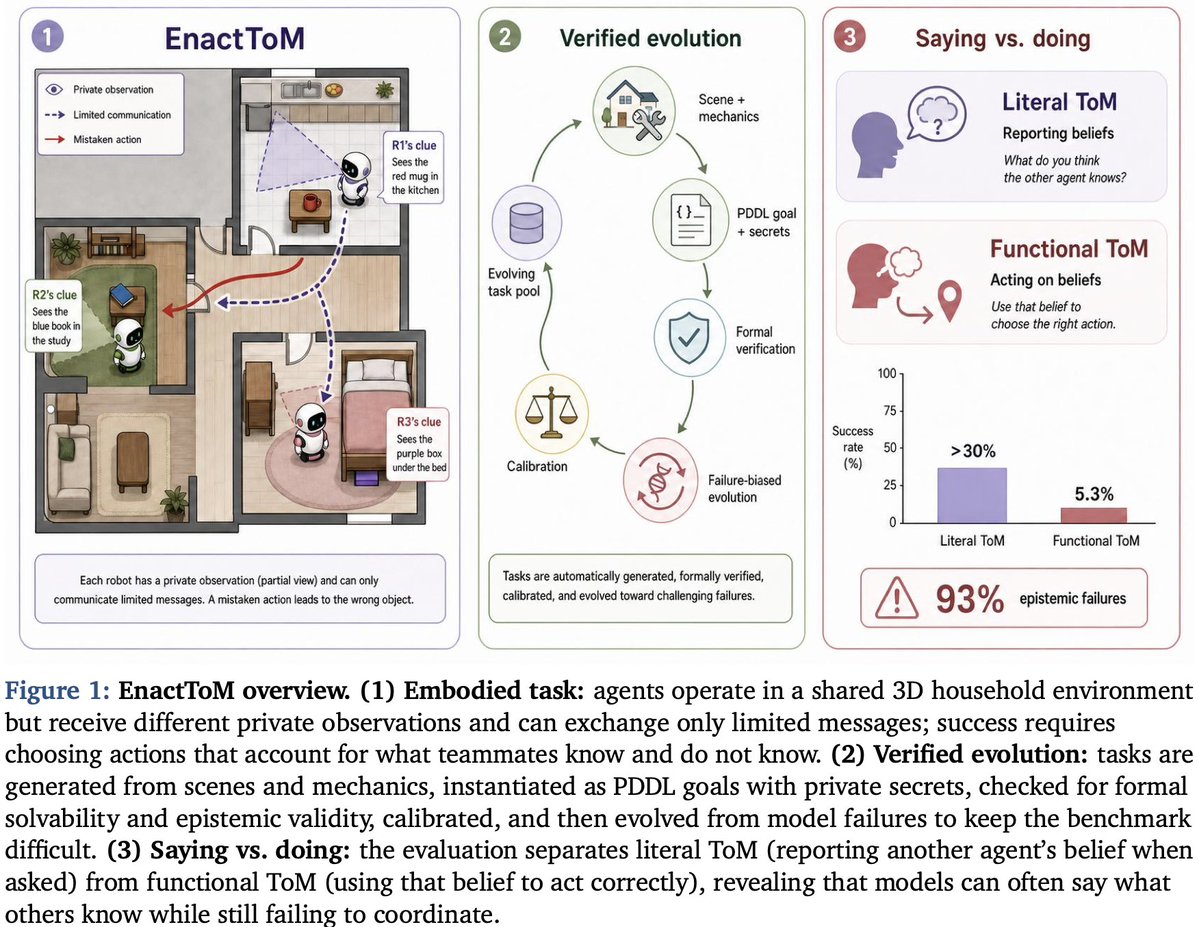
EnactToM: An Evolving Benchmark for Functional Theory of Mind in Embodied Agents
Imagine an agent that infers what you're thinking from what you do, and acts accordingly, without you having to tell it. Such agents require a model of what the other mind knows. That capacity is called Theory of Mind(ToM).
Current ToM benchmarks ask agents "what does the other mind think?" and grade the answer. They do not measure whether the agent uses that belief when it has to act.
EnactToM closes this gap by evaluating functional theory of mind instead of literal. EnactToM contains multi-agent embodied tasks that require functional ToM to be successful at the task.
Every one of seven frontier models we evaluated scores 0.0% reproducible success on its hard split, whereas, these models correctly answer 45.0% of belief questions when asked directly, on the same tasks. (1/n) 🧵
We Actually Solved the “Ma Jiaqi Problem” Long Ago
MiniMax’s recent analysis of the “Ma Jiaqi problem” is quite interesting.
Simply put, the model does not fail because it does not know who Ma Jiaqi is. It can answer questions about his group, identity, and debut information, which means the relevant knowledge and semantic representations are still there. The real problem is on the generation side: the model understands the token, but cannot reliably say the token.
This is essentially a case of “able to hear, but unable to speak.”
MiniMax’s analysis explains this clearly: during post-training, low-frequency tokens are insufficiently covered in the data, causing the corresponding lm_head vectors to drift, while the input embeddings remain largely stable. As a result, the model can still understand the word, but cannot reliably generate it.
This phenomenon reminds me of a more general problem we encountered and tried to solve in our previous work, Soft Thinking: a model’s “understanding interface” and “generation interface” are not naturally equivalent.
The classic work on continuous latent reasoning, Coconut, proposes feeding the model’s hidden state directly as the next input and performing autoregressive reasoning in continuous space. The idea is very natural: compared with discretizing the hidden state into tokens and then looking up embeddings again, directly preserving the continuous representation seems to reduce information loss and allow the model to “think” in a freer space.
But there is a very important issue here.
In a pretrained language model, the interface the model is accustomed to is actually quite fixed: the input side is token embeddings, and the output side is the hidden state after the Transformer, which is then decoded into a token distribution by the lm_head. In other words, the final-layer hidden state was originally meant to be read by the lm_head, not to be used as the next input by the bottom layers of the Transformer.
What Coconut does is not simply let the model “keep thinking.” It requires the model to learn a new cross-layer interface: the high-level hidden state that was originally meant for the output head must also be processed by the bottom-level Transformer as an input.
This is one of the reasons it needs additional training.
On GPT-2, this problem may be less severe. GPT-2 ties its input embeddings and lm_head weights, so the input token representations and output token directions naturally share more structure. But even then, tied weights do not mean that the final-layer hidden state naturally lies in the distribution of input embeddings. It only makes the interface mismatch somewhat milder.
In newer large models, the situation can be more complex. Many models no longer force weight tying between embeddings and lm_head, giving the input and output sides greater freedom. This has benefits, allowing the model to learn richer input and output representations. But the cost is that the input space, hidden state space, and output space can no longer be simply treated as the same thing.
This explains two seemingly different problems.
MiniMax’s “Ma Jiaqi problem” happens at the token level. The input embedding remains stable, so the model can understand it. The lm_head vector has drifted, so the model cannot say it.
Coconut’s problem happens at the hidden state level. The final-layer hidden state was originally designed to be decoded by the lm_head, not to be fed back into the model’s lower layers. Feeding it directly as the next input forces the model to learn a representation format that it did not sufficiently encounter during pretraining.
The mechanisms behind these two problems are not the same, but they point to the same deeper issue: the abilities of a large model do not live in some abstract, unified “semantic space.” They grow out of a set of concrete interfaces.
Token embedding is an interface.
Transformer hidden state is an interface.
The lm_head is also an interface.
Pretraining lets these interfaces form a kind of tacit agreement. Once post-training or a new reasoning paradigm breaks this agreement, an additional alignment cost must be paid.
That is why in Soft Thinking, we did not choose to directly force the hidden state itself back into the input side. Instead, we use the vocabulary probability distribution as a bridge. In other words, we do not try to directly align two hidden representations in vector space. We let them align through the token probability space, the space most familiar to language models.
This is a method closer to the original training format of language models.
MiniMax supplements full-vocabulary coverage data so that the model not only “recognizes” low-frequency tokens, but also learns to “say” them again. Soft Thinking, on the other hand, tries to avoid deviating too far from the model’s original interfaces at the level of reasoning paradigm. It uses the vocabulary distribution as an intermediary to connect continuous thinking with the language model’s native generation mechanism.
The two address different problems, but the underlying intuition is the same: do not assume that all internal spaces of a model are naturally connected. Understanding a concept, generating a concept, and continuing to process an intermediate state as input are not the same thing in a large model.
This is also why I think the “Ma Jiaqi problem” is genuinely interesting.
On the surface, it is a low-frequency token generation bug. At a deeper level, it reveals a structural reality of language models: a model is not a blank slate that can be rewritten at will. Its abilities grow out of the interface system consisting of token embeddings, Transformer hidden states, and the lm_head.
The closer we stay to these interfaces, the more we are activating and recombining capabilities the model already has.
The farther we move away from these interfaces, the more it becomes like asking the model to learn a new language it was never pretrained on.
So in many cases, the issue is not that a new paradigm is not elegant enough. The issue is that it is too far away from the pretrained model. Whether it is continuous latent reasoning or Soft Thinking, the real question is not whether the model can “think,” but what space we ask it to think in, and whether that space still belongs to the world it has already learned.
This is also how we understand Soft Thinking: it does not abandon token space. Instead, it uses token probability space as a bridge to build a more stable channel between continuous representations and the language model’s original generation interface.
When innovating on top of existing pretrained models, we must first respect the spatial structures they have already formed. Small-step innovation should stay as close as possible to the original interfaces. If we want to move toward a completely different reasoning paradigm, perhaps it is not enough to patch things during post-training. We may need to redesign the system from the pretraining stage onward.
Soft Thinking Paper:
https://t.co/ThXd6mcuOA
Take your arXiv release seriously, and celebrate it if you truly believe it’s strong work that pushes the field forward.
Where it ultimately lands is another story. Maybe this conference, maybe next. Each milestone is worth celebrating. But the debut is what matters most.
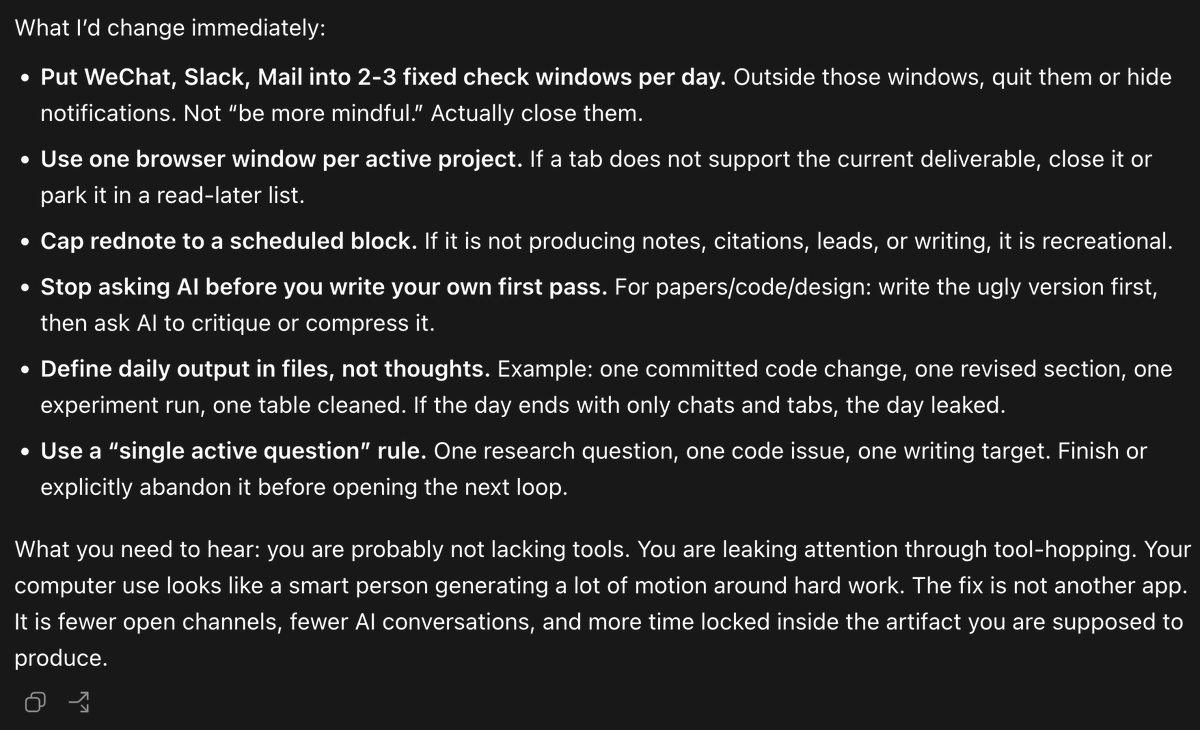
This feature feels almost magical. It surfaced exactly the patterns I’ve been struggling with lately: too many open channels, too much context switching, and not enough time locked inside the actual artifact I’m trying to produce.
Very good, very direct advice. Highly recommend trying it.
it's still experimental so we hide it a bit, but in the codex app, try:
> what have i been doing very inefficiently on my computer (according to Chronicle). make some recommendations. be direct. tell me what i need to hear.
Paper is now on arXiv! 📄 https://t.co/PUEjryNv7w you find it interesting, an upvote on Hugging Face Daily Papers would mean a lot 🙏 https://t.co/jj4epetLzT
🚀 Introducing Length Value Model (LenVM): a new paradigm for length modeling and a new dimension of scaling.
Tokens are the basic unit of inference compute. Length affects cost, latency, KV cache, and reasoning quality. As long reasoning and agentic workflows get longer, token budgets become a bottleneck.
Yet generation length is still not systematically modeled and most methods only operate at the coarse sequence level, far from where generation actually happens.
LenVM connects length modeling with reward/value modeling: assign a constant cost to every generated token, and remaining length becomes a value prediction problem.
✨The result is supervision that is dense, unbiased, annotation-free, and naturally scalable.
Our recent work Length Value Model has shown great scaling potential, but due to resource constraints, we couldn’t formalize a specific law. Research like this is extremely needed!
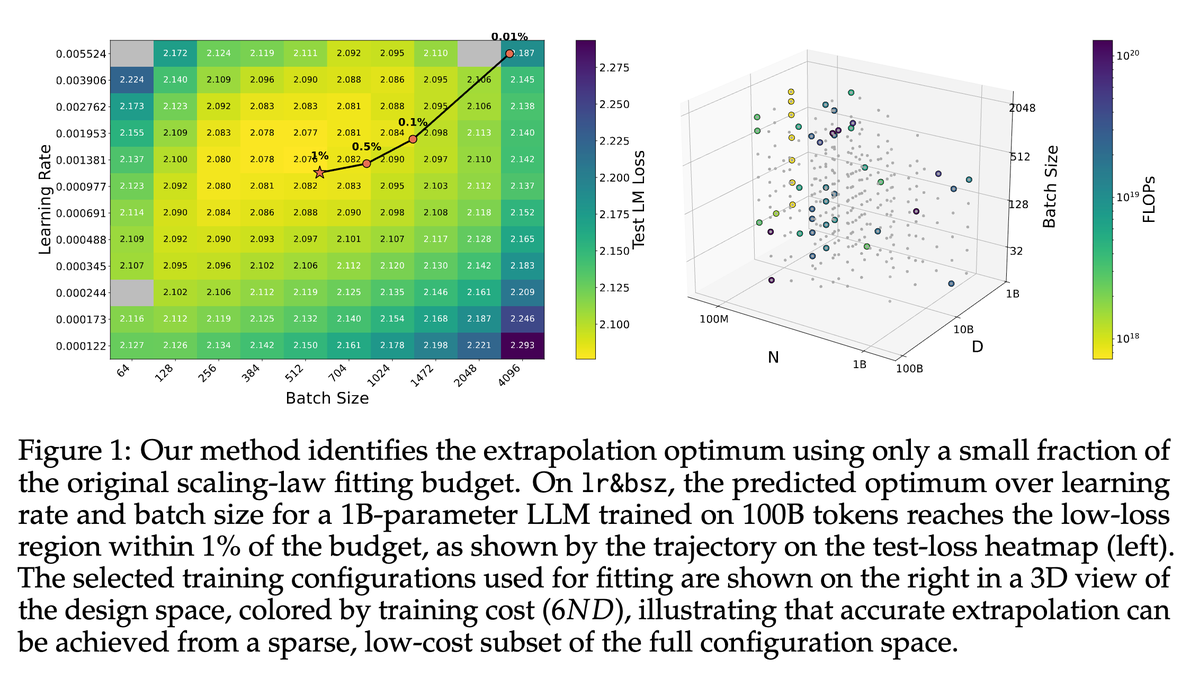
Scaling laws can save millions, but fitting them can also cost millions🤑
Our new paper shows how to fit better scaling laws with only 10% of the training budget!
✅ Spend Less, Fit Better: https://t.co/WoMOFu3THF
🚀 Introducing Length Value Model (LenVM): a new paradigm for length modeling and a new dimension of scaling.
Tokens are the basic unit of inference compute. Length affects cost, latency, KV cache, and reasoning quality. As long reasoning and agentic workflows get longer, token budgets become a bottleneck.
Yet generation length is still not systematically modeled and most methods only operate at the coarse sequence level, far from where generation actually happens.
LenVM connects length modeling with reward/value modeling: assign a constant cost to every generated token, and remaining length becomes a value prediction problem.
✨The result is supervision that is dense, unbiased, annotation-free, and naturally scalable.
🚀 Introducing Length Value Model (LenVM): a new paradigm for length modeling and a new dimension of scaling.
Tokens are the basic unit of inference compute. Length affects cost, latency, KV cache, and reasoning quality. As long reasoning and agentic workflows get longer, token budgets become a bottleneck.
Yet generation length is still not systematically modeled and most methods only operate at the coarse sequence level, far from where generation actually happens.
LenVM connects length modeling with reward/value modeling: assign a constant cost to every generated token, and remaining length becomes a value prediction problem.
✨The result is supervision that is dense, unbiased, annotation-free, and naturally scalable.
🧵4/N: What can LenVM do?
Three applications at inference time, all without modifying the base generator:
🎯 Length-Controlled Generation (LIFEBench)
Qwen2.5-7B: Length Score 30.9 → 64.8 (+33.9) Outperforms GPT-4o, Claude, and Gemini on exact "Equal To" length control task.
Exactly. Max context is the marketing number; realized token/KV growth is what hurts in prod. LenVM tries to model the remaining generation horizon at token level, so serving systems can predict/control future KV usage instead of relying on worst-case budgets. These signals could also be internalized into the model via RL.




![tilderesearch's tweet photo. [1/N] How can we give language models expressive test-time “width” without expensive full-solution tree search?
Long CoT scales reasoning depth, but is single-threaded
Tree search adds width, but is costly and hard to train end-to-end
Soft-token branching adds local width, but can blur discrete branch identities
We introduce Local Branch Routing (LBR): a trainable token-level branching framework for cheap, powerful, and robust test-time scaling. 🧵](https://pbs.twimg.com/media/HMUhRCbaIAADtka.jpg)