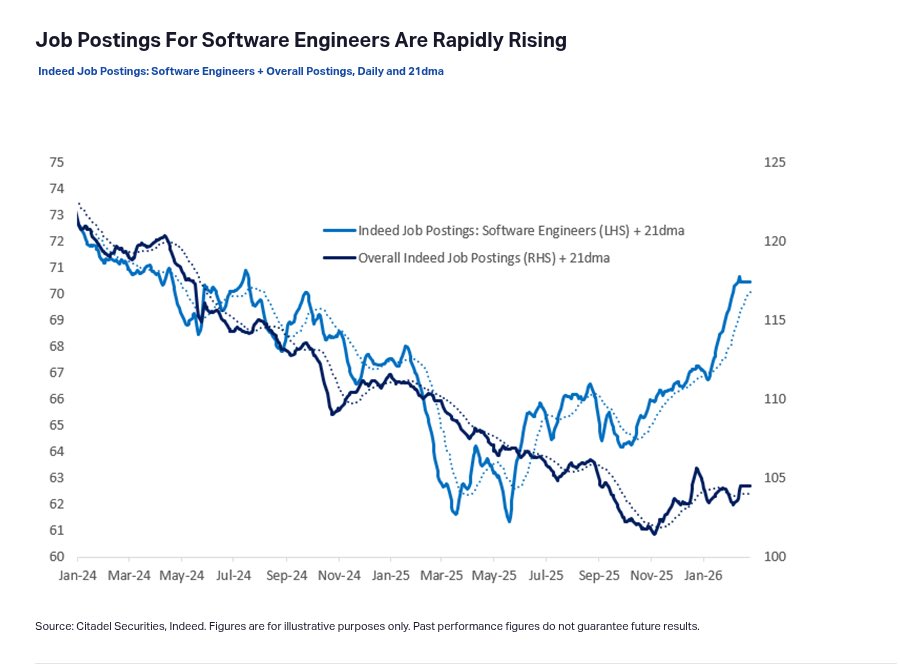
Q: How are job postings for software engineers rising rapidly despite AI agents automating coding?
A: Because there’s far more code to manage than ever before. We’re already seeing a 14x YoY increase in GitHub commits, and it’s accelerating.
AI has dramatically lowered the cost of writing code, so it’s now being used across far more businesses, applications, and use cases.
We’re at the beginning of a massive productivity boom driven by the proliferation of bespoke software throughout the entire economy.
Coding has been AI’s breakout use case this year. The fact that it’s increased demand for software engineers — rather than decreased it — should call into question the entire “AI will cause mass job loss” narrative.
The underperformer never gets the direct feedback they need to improve (or realize they’re in the wrong role).
The manager waits until the person essentially “fires themselves” before finally acting.
Ever notice how some managers turn “being kind” into a team-wide tax?
They see an underperformer struggling and instead of addressing it, they:
quietly take the work themselves, or
quietly dump the extra load onto the high performers who are already carrying the team.
Everyone makes mistakes, but admitting them publicly shows true leadership. @Jack isn't just announcing layoffs at Block; he's signaling a fundamental shift in how companies operate. By reducing headcount from 10k to 6k, he’s betting that AI will redefine productivity.
yes we over-hired during covid because i incorrectly built 2 separate company structures (square & cash app) rather than 1, which we corrected mid 2024. but this misses all the complexity we took on through lending, banking, and BNPL. and that we’re now targeting $2M+ gross profit per person, 4x our pre-covid efficiency, which stayed flat at ~$500k from 2019 until 2024. we have and do run an efficient company... better than most.
AI AGENTS CAN NOW PAY OVER THE BITCOIN ⚡️ LIGHTNING NETWORK
A new open-source toolkit from Lightning Labs allows autonomous AI agents to operate natively on the Bitcoin Lightning Network.
This integration enables agents to perform instant, programmatic micropayments without the traditional hurdles of identity verification, API keys, or manual signup flows.
The release provides seven modular "skills" that create a full-stack financial environment for software:
Infrastructure: Tools for running Lightning nodes and isolating private keys via remote signers.
Authorization: The use of "scoped macaroons" (granular permission slips) and L402-gated APIs to manage access.
Automation: Orchestration of buyer-seller workflows and node state querying.
At the core is lnget, an L402 aware CLI client similar to curl that automatically handles Lightning payments.
When an agent hits a 402 “Payment Required” response, lnget parses the invoice, pays it, caches credentials, and retries the request seamlessly.
Developers can enforce strict spending caps per request and at the node level.
By using Aperture on the server side, developers can implement pay-per-use APIs with dynamic pricing.
This completes the Machine-to-Machine (M2M) commerce loop: one agent sells data or compute, another buys it, and the Lightning Network settles the transaction instantly and globally.
AI agents can write code and deploy infrastructure and now they can transact.
The machine payable web just moved one step closer.
Interesting stats on 2026 global GDP growth projections. The US is a distant third.
This shift didn't happen by accident. It traces back to Bill Clinton's push for Permanent Normal Trade Relations (PNTR) with China in 2000, clearing the path for its WTO entry in 2001.
🌍 Top 10 contributors to global real GDP growth (2026)
1.🇨🇳 China — 26.6%
2.🇮🇳 India — 17.0%
3.🇺🇸 United States — 9.9%
4.🇮🇩 Indonesia — 3.8%
5.🇹🇷 Türkiye — 2.2%
6.🇳🇬 Nigeria — 1.5%
7.🇧🇷 Brazil — 1.5%
8.🇻🇳 Vietnam — 1.6%
9.🇸🇦 Saudi Arabia — 1.7%
10.🇩🇪 Germany — 0.9%
📌 China + India alone = 43.6% of global growth
📌 Asia-Pacific accounts for ~50% of total growth
Source: IMF
What was sold as a win for global stability and bringing China into the rules-based order instead supercharged the "China Shock": massive US trade deficits, offshoring of millions of manufacturing jobs, and accelerated erosion of America's industrial base.
Many in the tech community have flagged the wealth tax's valuation based on voting share (@garrytan, @PalmerLuckey, @DavidSacks, @BillAckman). I offer more detail on that and highlight 5 other burden-increasing provisions that have flown under the radar.
https://t.co/UOSJjQSpFB
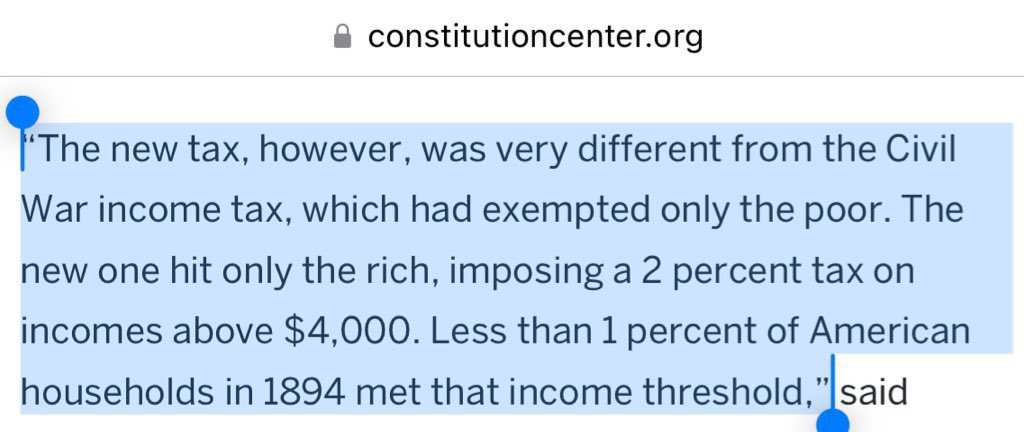
"California’s wealth tax is only on billionaires!"
That’s how the income tax started too.
Only for the ~1%… until it wasn’t.
When you allow the government to introduce new taxes, they never shrink, only expand.
Pretty demoralizing…Without addressing the deficit, fraud, and excessive spending, adding more revenue is like pouring water into a pot full of holes. Real reform has to come first, before taxing anyone. Bad move California @RoKhanna
Larry and Sergey can’t stay in California since the wealth tax as written would confiscate 50% of their Alphabet shares.
Each own ~3% of Alphabet's stock, worth about $120 billion each at today's ~$4 trillion market cap.
But because their shares have 10x voting power, the SEIU-UHW California billionaire tax would treat them as owning 30% of Alphabet (3% × 10 = 30%). That means each founder's taxable wealth would be $1.2 trillion.
A 5% wealth tax on $1.2 trillion = $60 billion tax bill, each.
That's 50% of their actual Alphabet holdings—wiped out by a "5%" tax.
Section 50303(c)(3)(C) of the 2026 Billionaire Tax Act states: "For any interests that confer voting or other direct control rights, the percentage of the business entity owned by the taxpayer shall be presumed to be not less than the taxpayer's percentage of the overall voting or other direct control rights."
This means if a founder holds shares representing only 3% of economic interest but 30% of voting control (through Class B supervoting shares), the tax would presume their ownership stake is at least 30% for valuation purposes, not 3%.
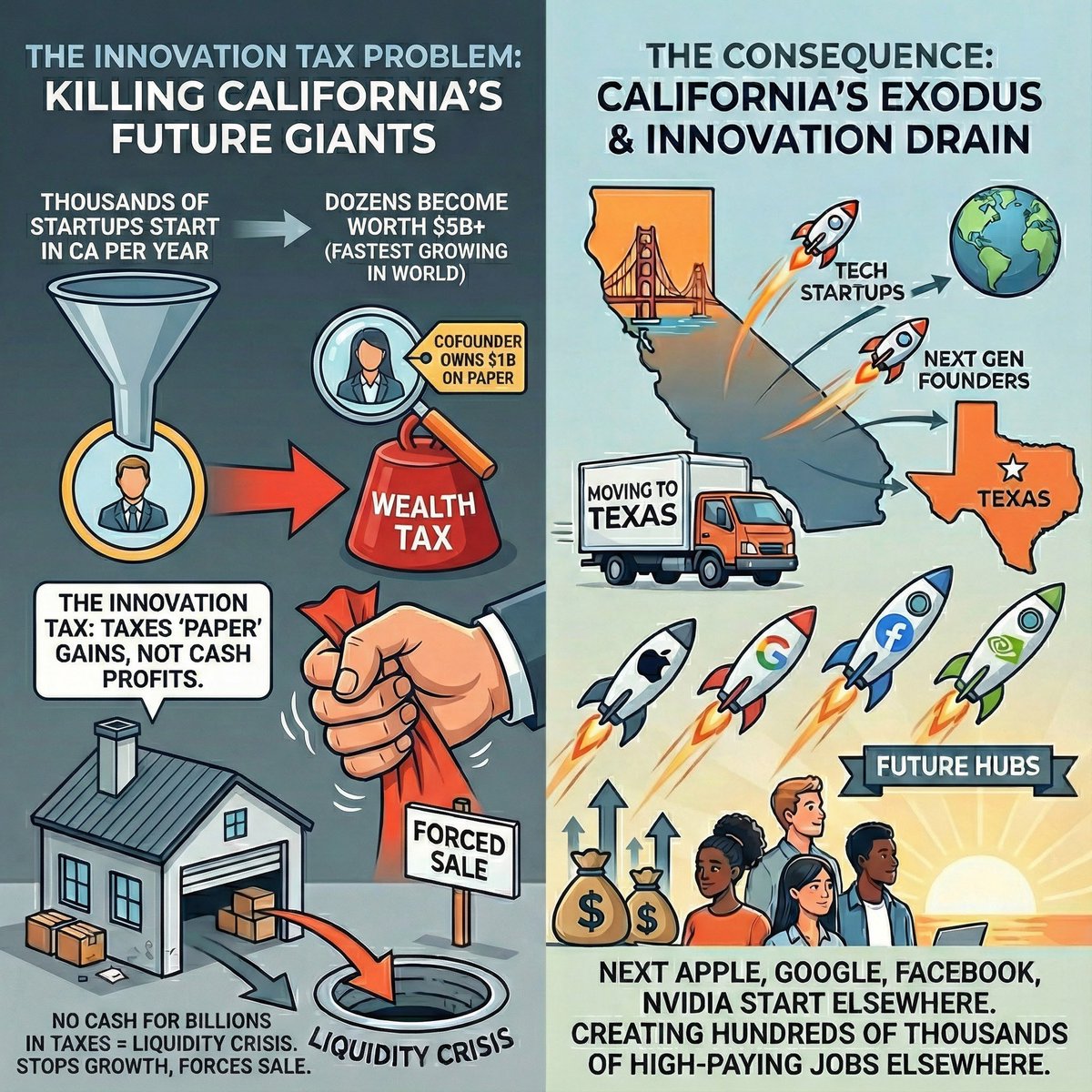
The wealth tax is poorly defined and designed to drive tech innovation out of California.