I've been itching to write up another one of my educational twitter posts for a while now (especially since someone cursed me with a year of twitter pro 😒), so today lets explore a protocol called Hydrozoa, designed and built by my good friend @SwiftlyUnmoving and his small team. I've been exploring Hydrozoa deeply, to determine whether any of the ideas in Hydrozoa would help with the design of Gummiworm we've been formalizing.
Hydrozoa is, if not officially then at least in spirit, an evolution of Hydra. It pauses to reflect, with several years of hindsight, on how the protocol could be improved and ultimately simplified. It's a particular favorite of mine, because it really gets at that core question of "what is protocol design". Rather than just deciding "welp, we have smart contracts on Cardano, so lets implement what we need in smart contracts", it looks deeply at how the actors in the protocol communicate and what can be guaranteed simply by the nature of the messages and signatures they share amongst eachother.
The basic idea of Hydra (and all state channels) is one I've explained a number of times: lock up funds in a smart contract on the Layer 1, transact however the hell you want offchain, signing periodic snapshots along the way that allow you to eventually unlock those funds according to everyone's latest balance.
Hydrozoa asks the question: how complicated do the smart contracts on the L1 *really* have to be? Sure, in the worst case, someone is trying to screw you over by refusing to sign transactions or presenting an "earlier" snapshot than the final one, but in the optimistic case, Hydra would work with a simple multisig: everyone deposits funds into the multisig, keep personal accounting off-chain, occasionally send more funds to the multisig address or sign transactions that withdraw partial funds from the address, and finally sign a transaction to fan out all remaining funds.
Hydra really only needs to be a plutus script when there's a conflict about what that final snapshot should be. So is there a way to split the protocol into two "regimes": the first only uses multisigs, but we ensure that, in the case of a dispute, it can fall back to a second which uses plutus scripts to resolve disputes.
It does this by ensuring that, before accepting any funds into the protocol, the head operators set a ticking time-bomb: the head operators sign a transaction that has a "validFrom" in the future that pays the treasury into a plutus script; That transaction isn't valid yet, but if we can't reach consensus by (for example, 2 days from now), it says "obviously consensus has broken down, and we'll need the plutus scripts to help us resolve the dispute".
So for example, suppose I want to deposit funds into a Hydrozoa head. I build a transaction that pays my funds into a multisig script controlled by the head operators. But, before signing and submitting it, I show this transaction to the other head operators, and request a refund transaction. Leveraging the determinism of Cardano, the head operators can build a transaction which spends the output of my deposit transaction back to me, and sign it. This transaction has a "validFrom" in the near future.
Once I have that multisignature, I can go ahead and submit my deposit transaction, locking funds at the multisig script. I know that if the other head operators suddenly refuse to sign any transactions, I'll have this "refund" transaction to get my funds back.
This deposit transaction isn't yet "part" of the L2; instead, it has to be spent and gathered into the set of funds that *are* considered part of the L2 ("The treasury"). We employ the same trick: build a transaction that spends the current treasury, and many of the pending deposits, and pays them all out to a new treasury output. But, before signing this transaction, we build and sign a transaction chained off of it, post-dated to 2 days from now, that pays the treasury to the dispute resolution script. Only once we have a signature of that ticking-time-bomb transaction do we sign and submit the "absorption" transaction.
Thus, if the other head operators start misbehaving and trying to extort me, or refusing to sign transactions, I know I just need to wait for 2 days before we go into that dispute resolution process.
In between these "major" updates, we can do many minor updates. This works similarly to Hydra: we're signing snapshots that, *if need be*, can be used in the dispute resolution process to fan out our funds as of the latest version. But we anticipate that we won't need them because if we're cooperating we can just spend the multisig script.
At some point we can also request some funds be withdrawn, and this triggers another "major" update: we build a transaction that spends the treasury UTxO, absorbs some deposits, and fans out the requested withdrawals. Before signing that transaction, we obtain signatures for a follow-up, post-dated "dispute fallback" transaction, and then sign and submit our major update.
This means that in the optimistic case, all we're doing is signing multisig transactions on the L1 every once in a while, until we fan out all funds.
This has a number of benefits:
1) The simplicity in the L1 contracts means things like incremental commits or updating the head members are cheaper to execute, simpler to write, and less prone to bugs.
2) The protocol leverages Cardano's determinism; We don't need to wait for most L1 transactions to be final, because if a transaction gets rolled back, we can just re-submit the pre-signed transaction. Because nothing can invalidate that transaction, we have high guarantees on settlement even if L1 consensus initially rejects it.
3) These two combined means Hydrozoa can be much more "active", bringing funds rapidly in and out of the head. Whereas opening a Hydra head, or their incremental commit mechanism are seen as more "heavy weight", discouraging the flow of funds *too* often, Hydrozoa is plenty happy to bring funds in and out with every Cardano block if needed, for very cheap.
With this improved complexity budget, Hydrozoa also leverages some fancier crypography to make the state commitments cheaper. I'll do another thread about this soon, but this fancier crypto lets you prove multiple withdrawals with a single fixed size proof, allowing for fanning out tens or hundreds of thousands of UTxOs onto the L1 very cheaply. There's no reason Hydra can't employ the same techniques, and indeed that is the eventual plan, but the simplifications that Hydrozoa brings makes it *easier* to implement these mechanisms, because in the optimistic case it's just peers agreeing on a state update; and in the case of a dispute, you only need to fan out funds, not worry about these complex state updates.
An R&D effort for Hydrozoa was funded in Catalyst Fund 12, and is nearing completion! It's ready for early pilots with real world customers.
Following up on that work, though, there's still some work to do to make it production ready, onboard businesses, and explore future R&D. @SwiftlyUnmoving has submitted 3 catalyst proposals for fund 14 for that follow up work, so I'd encourage you to check them out!
https://t.co/eNU7DLVkLh
https://t.co/GY7NQHhEVP
https://t.co/zVD4lNRLyS
Wisdom in Cardano lies in its patience and purpose. Every smart contract, every stake pool, every idea shared strengthens our roots. Let’s grow this ecosystem with heart and vision.
Our ecosystem budget and withdrawal process has now reached its conclusion.
Starting with 194 proposals submitted via GovTool and Ekklesia, refined to 40 through off-chain polling, and with 37 of 39 withdrawals passing on-chain thresholds, DReps have approved ₳264m in ecosystem funding.
More than 30 vendors have now signed contracts with Intersect as administrator. These are being published to our knowledge base for full transparency ➡️ https://t.co/hVV8SvDIfC
More are coming in the days ahead, together with the funding of related smart contracts.
Looking ahead, how we and Cardano as a whole approach budgeting in the future remains open for debate and discussion. Contribue to the Budget Committee's survey to capture your thoughts and ideas here ➡️ https://t.co/XcsCYiVdHy
New to blockchain? ⛓️
Our Fundamentals course offers:
• Structured, step-by-step learning
• A digital badge to prove your skills
• No jargon, just clarity
Start your learning journey today: https://t.co/9Sux0uHsoc
Rare Evo 2025 rewind ⏪
We’re still buzzing from the innovation, technology, and conversations at @RareEvo. Together we’re building a scalable, interoperable future for Web3. Check out the highlights below and keep an eye out for our next big event announcement coming soon 👀
What’s going down on #Cardano? Check out this week’s development update on #EssentialCardano and stay abreast of all the latest developments in core technology, wallets and services, smart contracts, and scaling and governance.
https://t.co/xhBP4geljE
EDUCATION: The education team is excited to announce the next Cardano Days event, a two-day in-person educational experience at the University of Wyoming on September 26-27, 2025. It's a key part of the broader Wyoming Blockchain Stampede. Registration is now open on the Luma page.
ICYMI: Input | Output Engineering (IOE) is enhancing smart contract security for the Cardano ecosystem 🔒
IOE is developing an integrated suite of tools to make high-assurance development more accessible to all Cardano developers.
Read the blog: https://t.co/vya8wAukBk
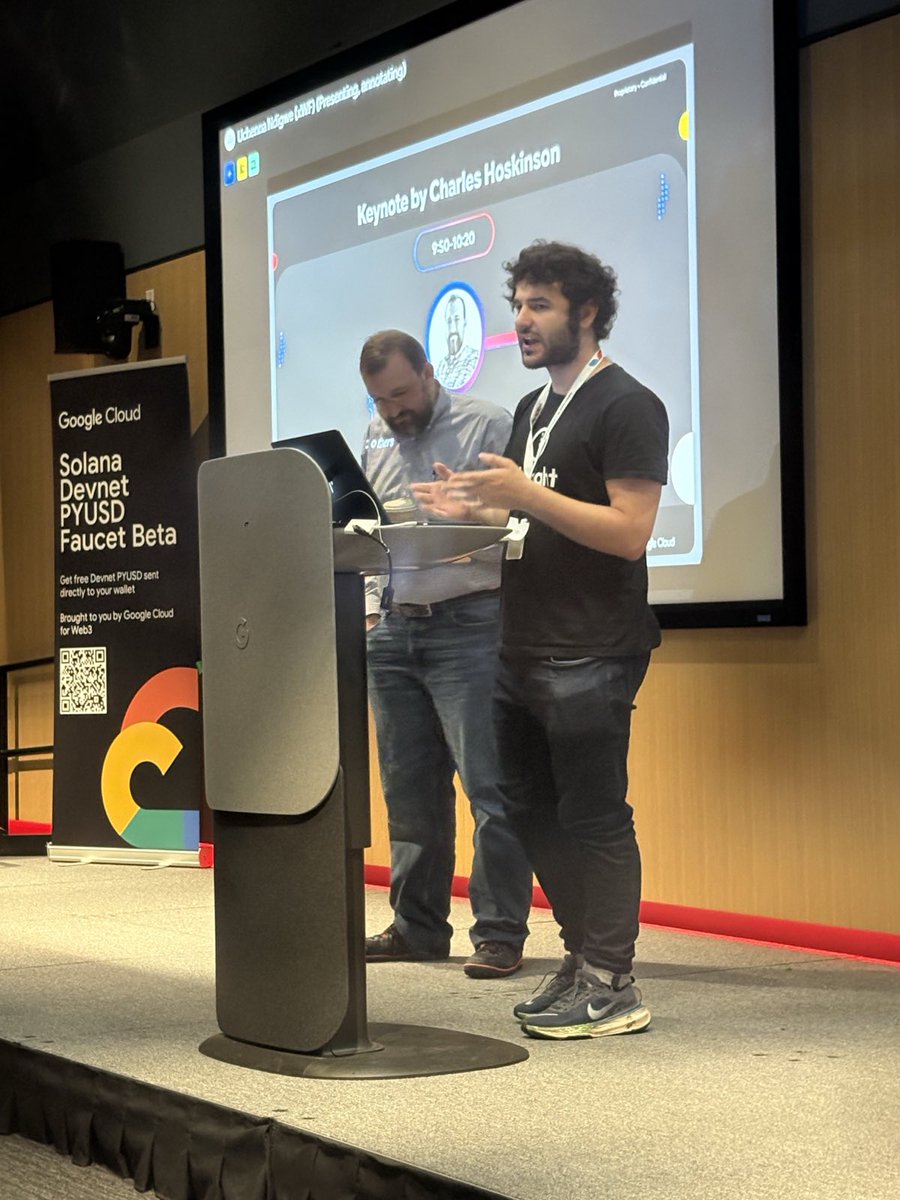
Great to present with @midnightfdn CTO @SebastienGllmt at Google on the upcoming Halo3 project: a universal, Post-Quantum, GPU friendly, lookup lattice based folding proof engine.
(proof system)
halo 3 working group
https://t.co/DFHG7Qo4vI
(blochchain layer)
Starstream Working Group
https://t.co/uX7QAJLG0m
🧵Input | Output Engineering (IOE) is rethinking smart contract security for Cardano from the ground up.
The objective: to democratize high-assurance development and sustain Cardano's security into the future.
⚠️ Attention Cardano DReps & SPOs - governance needs your participation.
The interim Constitutional Committee’s term ends 📅 September 6, 2025.
If a new committee isn’t in place, key parts of Cardano governance will stop functioning.
Learning Cardano governance? Start with the knowledge base, but don’t stop there | @lara_bcw explains
"If you are looking for 100% of the information, our knowledge base is a great start. The knowledge base itself contains over a thousand pages of written content in there regarding the governance system, the constitution process, the budget process. But more than that, 100% is to not be afraid to ask questions. Reach out to your peers, reach out to people from Intersect, reach out to members of Intersect, which are community members alongside yourself." 🧵
#CardanoShorts
Experience the future of financial reporting:
Reeve moves beyond traditional ledgers by creating a single, shared source of truth on Cardano.
Its tamper-resistant and auditable data is designed to support increased operational efficiency, lower compliance costs, and enhanced stakeholder confidence.
Explore how it works:
Showing up is step one.
@CardanoSummit just dropped your travel guide for Berlin: venue, transit, visas, and more.
Start mapping out your Summit journey today.
Join us on 3 July for a live X Space exploring the future of Bitcoin × Cardano interoperability.
Let’s dive into how decentralized bridges, Babel Fees, and new DeFi protocols are enabling Bitcoin utility on Cardano - and vice versa.
See you there!
Announcing the #CardanoSummit2025! 🗣️
Join us in Berlin on 12–13 November to celebrate Cardano and explore the future of enterprise blockchain.
75+ speakers. Bold ideas. Real impact. 💥
Sign up for the early access list now: https://t.co/7I7fHOuyYk