Imagine a fable 5 quality model that’s 3-4x less expensive in less than 6 months. And an Opus 4.8 grade model that can run on a local device in less than 12 months. Greater than 50% chance that these events will happen. Worth keeping in mind when you make predictions about the future.
@amuldotexe@TimurNegru That big a property for that low amount signifies the value.
Balcony mein baith kar chai peene mein apna maza hai.
Not someday. Everyday :)
With more than a population of a billion, think about the source of data.
It’s time that the frontier models come out of these countries. Matter of time. But that would be a commodity as well. #AI
Im a huge fan of Messi and prior to the world cup was neutral with Argentina.
Now with the amount of decisions that have gone their way in the past weeks (or two world cups) i want to see them booted out of the tournament in the quarters or semis (or finals).
- Argentina pulled off a Houdini Act 🪄
- Down 0-2, then 3 goals in 13 mins 🚀
- Scandalous VAR Egypt goal disallow
- Another Messi penalty miss, then GOAT level play 🐐
- Feel sorry for Egypt, almost knocked out def champs
- What a match 🇦🇷 vs 🇪🇬
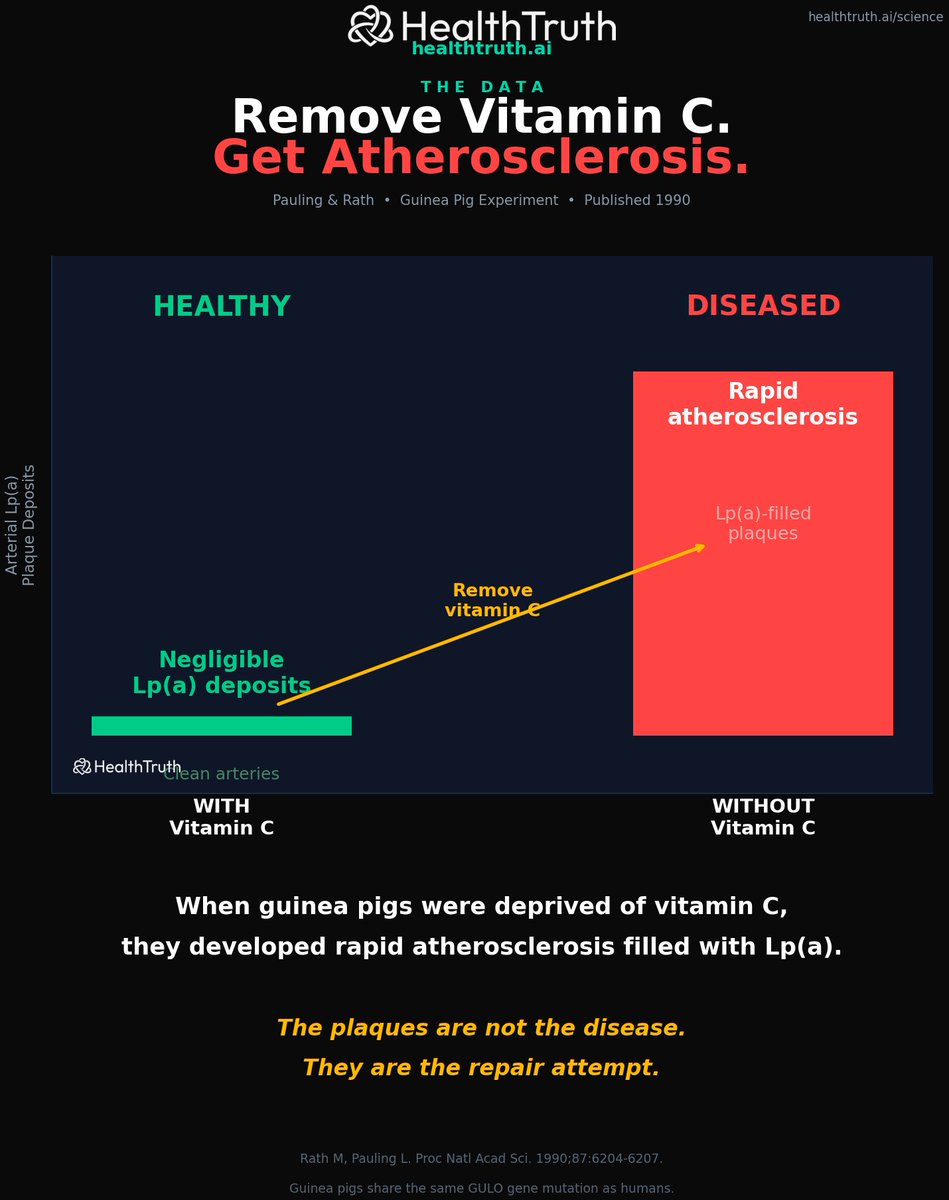
Pauling and his colleague Matthias Rath discovered that plaque deposits in human arteries are made up of a specific form of cholesterol called lipoprotein(a). Lp(a). Not ordinary LDL.
Here is what they proposed.
When vitamin C is chronically low, collagen production drops. Collagen is the structural protein that holds your artery walls together. Without enough vitamin C, the arterial walls weaken and develop micro-cracks.
Your body is not stupid. It senses the damage and sends Lp(a) to patch the cracks. Like a bandage on a wound. Like plaster on a broken wall.
Over time, more cracks form. More Lp(a) is deposited. The patches build up. That buildup is what we call atherosclerotic plaque.
The plaques are not the disease. They are the repair attempt. The disease is chronic vitamin C deficiency. Subclinical scurvy.
Pauling and Rath tested this on guinea pigs. They deprived them of vitamin C. The guinea pigs developed rapid atherosclerosis filled with Lp(a). When they restored vitamin C, negligible Lp(a) was found in the arteries.
GROWTH FOUNDERS: HIRE A NEAR-PEER
A portfolio founder approaching $100M in ARR asked me about the single biggest and most impactful hire they can make.
I thought for a bit tand said: "Hire a near-peer".
In every generational company I've been part of, the founders hired a near-peer, who was essential to the company's success.
- Google: Larry and Sergey hired @ericschmidt .
- Facebook: Mark hired @sherylsandberg .
- Square: Jack hired @rabois .
- DoorDash: Tony hired @chrispa
- Coinbase: Brian hired @emiliemc
Characteristics of a near-peer:
1. They're so good that the founder will be fine reporting to them if the roles were reversed. (Mark has said publicly that he'd be fine reporting to Sheryl)
2. Their strengths perfectly complement the founder's strengths; however, they share many cultural attributes with the founder and pass the founder's airport test, since the founder will be spending a ton of time with them (example: Eric being a Computer Scientist, which was culturally very important at Google back in the day)
3. They're systems builders who have already operated at the scale you're growing into. Pattern recognition on $100M to $1B is not something you build in real-time.
A near-peer lets the founder focus on what only the founder can do (product, vision, culture). The near-peer handles everything else.
Also, near-peers stay for the long haul. Decade-plus tenure is standard.
The reason this hire matters more than any other: after $50M ARR, the bottleneck shifts from product-market fit to organizational scale. The founder is still the visionary. But the company needs someone who has already scaled a company of that size.
Most founders wait too long. They hire functional VPs first (Sales, Marketing, Engineering, Finance) and hope the collective covers the gap. It rarely does. A stack of VPs reporting into a founder who has never scaled a company creates coordination overhead, and the founder becomes the bottleneck.
The near-peer absorbs that overhead. They turn the founder's vision into daily operating decisions. They give the VPs a leader who has actually run a company this size.
Growth founders: if you're between $50M and $300M in ARR and every week feels like a coordination tax, the near-peer is the hire that determines whether you build a $10-100B company or top out at $1B. Start the search now, ideally through warm intros from your venture/angel investors and advisors.