Some thoughts, welcoming feedback:
1. If the frontier labs feel obligated to build something they think is dangerous because China is going to build it anyway, we'd better be really sure that China is going to build it anyway. Like, really, really, really sure.
Are we? Are we actually sure? The CCP wants to build an out-of-control, recursively self-improving model bc its neurotically, control-obsessed government thinks this is a policy worth pursing? We're 100% sure about that?
2. At the very least, we know that Chinese models distill American models to keep up with the frontier. So, any slowdown by the US seems like it would mechanically and automatically slow the ability of China to distill its way to progress. If we're afraid of the rate of progress, isn't that a good thing?
BIG NEW piece by me.
A few years ago, if you asked me to summarize my entire worldview in one article, I would’ve said it was too broad and too difficult. But this year, I decided to do it.
https://t.co/HupJtlwyDx
The central drama of the modern world is innovation against suffering, and we have made incredible progress so far.
But we are doing far worse than we could. Millions still suffer from untreatable diseases, because of bottlenecks that we could fix. You can help fix them.
In medieval times, within the arms race of ever more demonic torture devices, some sadistic genius came up with the idea of the Little Ease.
This was a prison cell built so small in every dimension that a grown man could not stand upright in it nor lie down at full length nor properly sit.
The pain is relentless and without relief and inflicted by one's own body. Prisoners were known to go insane within a few days. A stay at the Little Ease was considered even more cruel than the rack, the thumbscrew, and the other ghoulish machinery of the Tower of London.
A breeding pig will spend her whole life in a version of that box.
These are social, roaming creatures (more intelligent than dogs) who will never leave this corset of steel.
They have been selectively bred to be bigger than their frames can support. Yet we put them in cells so confined that they cannot comfortably sit, and their attempts to do so (for example, by sneaking their limbs into adjacent stalls) reliably lead to fractures and sprains.
They cannot sweat, yet have nothing to roll around in to cool themselves off. Except their own manure, which (contrary to the common misconception) they are so averse to (thanks to their strong sense of smell) that new sows will often suffer from constipation to avoid soiling the space from which they eat and sleep.
Here is how the writer Matthew Scully described what saw at one of Smithfield’s “gestation barn”:
> “Sores, tumors, ulcers, pus pockets, lesions, cysts, bruises, torn ears, swollen legs everywhere. Roaring, groaning, tail biting, fighting, and other “Vices,” as they’re called in the industry. Frenzied chewing on bars and chains, stereotypical “vacuum” chewing on nothing at all, stereotypical rooting and nest building with imaginary straw. And “social defeat,” lots of it, in every third or fourth stall some completely broken being you know is alive only because she blinks and stares up at you … creatures beyond the power of pity to help or indifference to make more miserable, dead to the world except as heaps of flesh into which the [insemination] rod may be stuck once more and more flesh reproduced.”
—
The Save Our Bacon Act is trying to unroll the few state protections we have against this barbaric cruelty - for example California’s Prop 12 - which banned the sale of pork from pigs kept in gestation crates.
It’s incredibly important we don’t end up with this sort of federal preemption.
SOB will not only kill the most important animal welfare related laws in the US of the past decade, but more importantly, it will also restrict ALL future legislative progress (aka how the animal welfare movement has gotten its biggest wins).
The Senate is currently deciding whether to add the SOB Act to the Farm Bill.
With relatively little money now, we can discourage the most pivotal senators in the Ag committee from backing this amendment.
Defeating this bill is even more important given the amount of philanthropic funding I expect to come online in the next year or two.
It will plausibly be over 10x more expensive to repeal SOB than to prevent it from passing in the first place.
All that money that could be spent transforming our society's relationship to mass animal suffering will instead have to be spent just getting us back to where we are right now.
That's why money spent now fighting this bill (and I mean right NOW) is so effective.
If you’re in a position to donate six figures, please DM me.
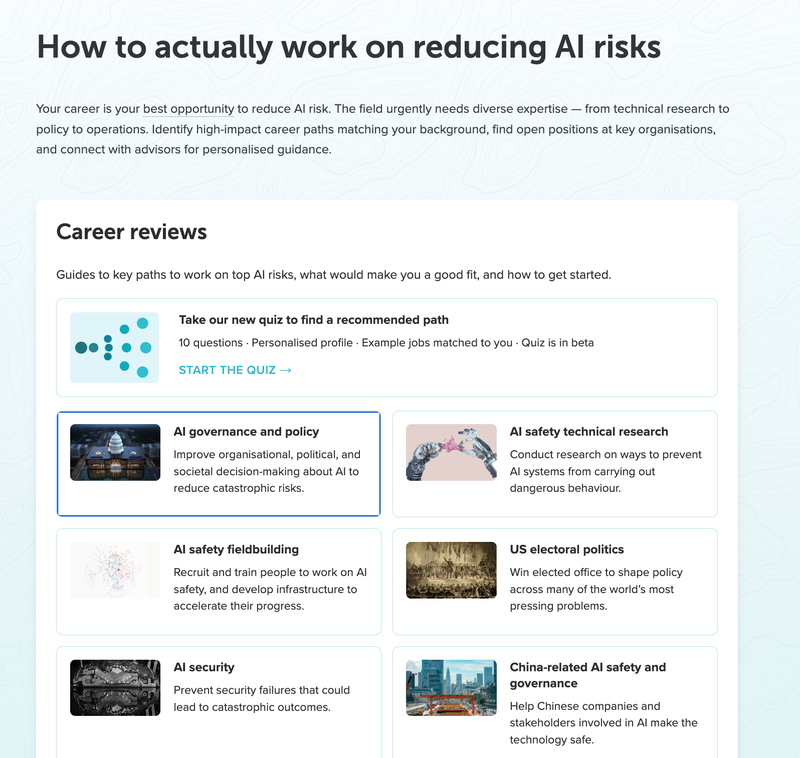
The world is about to be massively constrained on finding altruistic talent. If you're hungry to use your career to reduce suffering and keep people safe, there's never been a better time to get ambitious, connected, and caught up. Here's what I'd do:
New blog post: The third wave of American philanthropy
Hundreds of billions of dollars in new philanthropic capital will soon become liquid. The OpenAI Foundation holds 26% of OpenAI, worth about $220B at today’s valuation. Anthropic’s seven co-founders have pledged to give away 80% of their wealth and have instituted the most aggressive donor matching program for employees in tech history.
How much does this all add up to? And how meaningful is that in the context of philanthropy today?
I was doing some simple napkin math to wrap my head around the scale of what’s coming, and radicalized myself in the process. I had dramatically underappreciated the scale of the philanthropic capital that’s about to become available and the corresponding gap in talent and organizations that will be needed to make the most of it.
This piece aims to directionally sketch the scale of what’s coming, the gap in operational capacity needed to absorb it, and what we can do to fill it.
(Link to full post in reply)
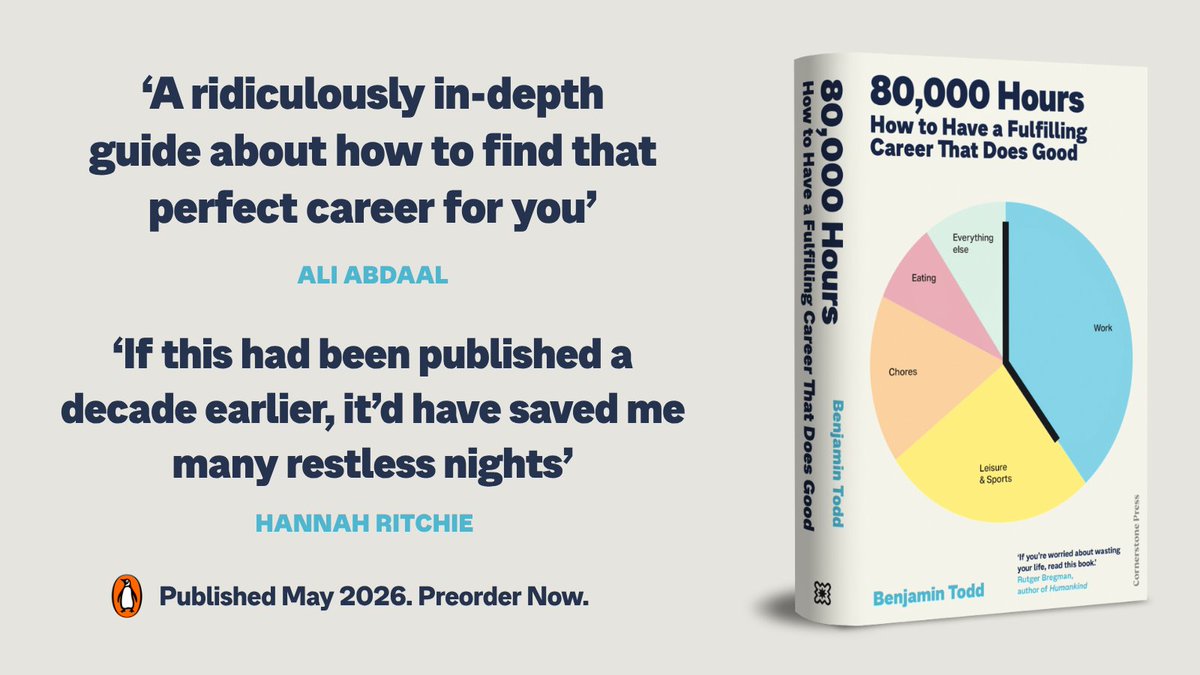
I wrote 80,000 Hours ten years ago because I was frustrated at how terrible career advice can be.
Today it’s even worse: still focused on traditional paths like law & medicine when we face AGI.
To fix that, Penguin are publishing a fully updated edition.
Excitement seems like an inappropriate reaction to what's happening with AI, but so does anxious doomerism. I think the right attitude is more like:
HOLY SHIT THIS IS A BIG DEAL, I HOPE WE CAN HANDLE IT. LET'S TRY AS HARD AS WE CAN TO MAKE IT GO WELL.
@KemtrupTweets That’s a sweeping generalization about hard determinists that fails to appreciate the various metaphysical, cognitive science, and other evidence areas which (purportedly) favor hard determinism and have little to do with things like anger or guilt
@robertwiblin 100%. Longstanding rotator cuff issues. Infinitely more helpful than the local physical therapists.
What did AI help identify regarding the congestion you experienced?
Three months ago, I wrote that one reason I was paying less attention to the online abundance debate is that I saw a clear and significant "Poster-Politician Divide."
That is: Online, the response from progressive posters to abundance has been consistently and highly negative. But if you listen to progressive politicians—Ro Khanna, Chris Murphy, Zohran, Bernie, etc—their response to the substance of the book tended to be much more positive.
Today, the NYT interviews Bernie Sanders and asks him directly what he thinks about abundance. The screenshot below is his response. You should read it all, but I'd note that the words "absolutely correct" are uttered.
I doubt Sanders is pulling punches here; he doesn't seem like that kind of guy. I think it's more likely that the reason our critique of government rings true for those closest to the levers of govt bureaucracy is that our argument is true, and those who would know best agree with us.
There's a good and necessary debate within the Democratic Party on whether its candidates should run on socialism, or economic populism, or cultural moderation, or abundance. I agree with Ezra's latest column, one message of which is: use whatever works, wherever it works.
But Abundance was never just about fine-tuning the language for the bumper stickers you use on the way to winning power. It was also about what you do if the bumper stickers work and you win. The "38 meetings" problem that Bernie identifies here is rampant throughout govt bureaucracy, but I think it really is worse within the culture of left-of-center governance. And if we suck at doing the stuff we say we're going to do everywhere we have power, people will notice. In fact, they have, and that's partly why we're in this mess.