Afrobeats And Its Links To US Secret Intelligence
Have you ever found yourself wondering why Afrobeats - the joyful soundtrack to the "Africa Rising" era from the late 2000s through the early 2010s - seems to have lost much of its energy and lustre of recent? Does it seem to you like the music no longer belongs to the fans and has become a distant, expensive product that nobody can relate with anymore?
You are not imagining it - in fact the reality of what has happened to Afrobeats is a lot darker than you would possibly imagine. Far from just a fresh music genre that embodied the sounds and aspirations of a new generation across the continent, it has been coopted into the arsenal of the US government's extensive foreign influence and interference tools. In fact, your favourite Afrobeats artist, as incredible as it sounds, most likely now has a handler permanently assigned to them by the US State Department.
In this special report, The Spearhead Senior Reporter Mckay Chukwu examines a story that has been hiding in plain sight for years, detailing the State Department's well-funded cultural interference infrastructure which has been deployed all over the Global South to bend entire populations and their governments toward the foreign policy goals of the US government.
She walked into a store with two dollars in her hand for a bottle of orange juice that cost $1.79.
The owner accused her of stealing it, grabbed her by the sweater, and — as the girl turned to leave — shot her in the back of the head.
Latasha Harlins was 15. Los Angeles, March 1991.
The security camera recorded all of it. The money was still in her hand when she fell.
The owner was convicted of voluntary manslaughter. The maximum was sixteen years.
The judge gave her probation, four hundred hours of community service, and a five-hundred-dollar fine. No prison. Not one day.
Latasha Harlins was thirteen days past the Rodney King video. Los Angeles held both of those facts at once for a year, and when the King verdicts came in, the city exploded — and a great many people in it were thinking about a girl and a bottle of juice.
Her family says she wanted to be a lawyer.
Fifteen years old. A dollar seventy-nine. Five hundred dollars.
Compare those last two numbers for a moment. That is the whole post.
Latasha Harlins was 15. Her life was worth more than $500.
And hers is not the only story where the value placed on a Black life was painfully different from the consequences that followed.
We documented up to 150 of those stories in 150 Crimes Against Black America They Never Answered For.
The names, the cases, the unanswered questions—they’re all there. Get yours https://t.co/V6OJtayKnF
On this day in 1963, four little girls: Denise McNair(11), Carole Robertson(14),Addie Mae Collins(14) and Cynthia Dianne Wesley(14) were killed when white supremacists bombed the Sixteenth Street Baptist Church in Birmingham.
The bomber was found not guilty of murder.
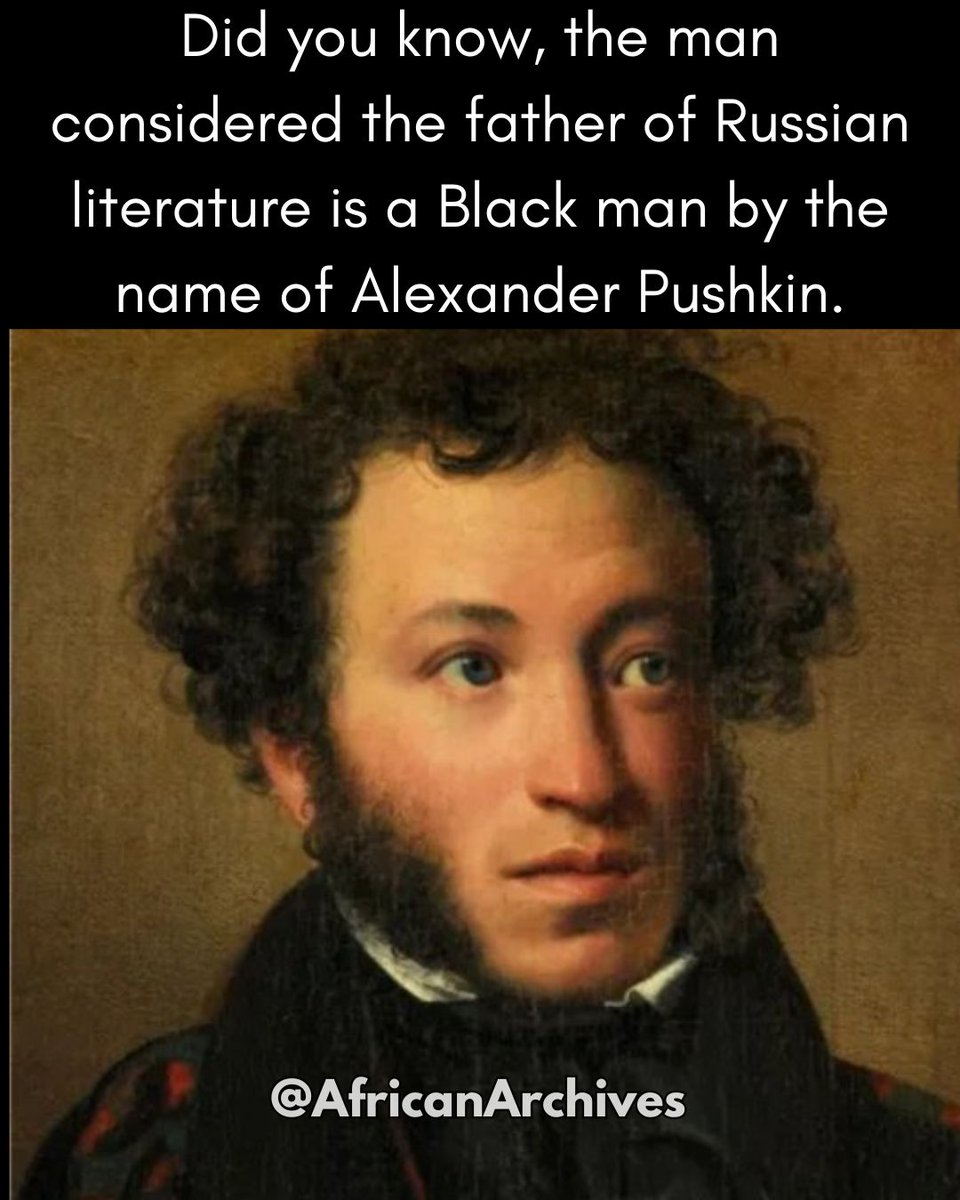
Alexander Pushkin is widely regarded as the father of modern Russian literature, but one part of his story is often overlooked: his African ancestry. Born in Moscow in 1799, Pushkin was the great-grandson of Abram Petrovich Gannibal, an African-born man who was brought to Russia as a child, became a godson of Tsar Peter the Great, received an education in Europe and eventually rose to become a military engineer and general in the Russian Empire. Historians have debated Gannibal’s exact birthplace, with Ethiopia and the region around present-day Cameroon and Chad among the origins proposed, but his African ancestry is well established.
Pushkin was proud of this part of his family history and referred to his African heritage in his writing. He even began an unfinished historical novel inspired by Gannibal, later published as The Moor of Peter the Great. Pushkin himself was of mixed ancestry, with Gannibal being his maternal great-grandfather, so describing Pushkin simply as a “Black man” can miss some of the complexity of how race and identity operated in 19th-century Russia. What is certain is that one of Russia’s most celebrated cultural figures was a descendant of an African man who had risen from extraordinary circumstances to become part of the Russian nobility.
Pushkin transformed Russian literature during his relatively short life. He wrote poetry, drama, prose and historical fiction, producing works including Eugene Onegin, Boris Godunov and The Captain’s Daughter. His ability to combine everyday Russian speech with the literary language of his era helped shape the development of modern written Russian. Later writers including Nikolai Gogol, Fyodor Dostoevsky and Leo Tolstoy worked in a literary tradition profoundly influenced by him, which is why Pushkin occupies such an enormous place in Russian culture.
His life ended dramatically in 1837, when he was mortally wounded in a duel and died at only 37 years old. Yet nearly two centuries later, Pushkin remains one of the defining figures of Russian literature.
If you love our content and would like to support the page, you can buy us a coffee here: https://t.co/K1AhtZuOFs or tap Link in Bio
Hair carried deep cultural meaning across many African societies long before the transatlantic slave trade. Hairstyles could communicate age, family background, marital status, community affiliation, social position and personal identity, although traditions differed greatly across the continent. Hair was therefore more than appearance. It could be part of the way people understood themselves and recognized one another. When Africans were captured, transported and sold into slavery, many aspects of that identity were deliberately disrupted. Families were separated, names were changed or replaced, languages were suppressed, and people from different communities were mixed together under a system that treated human beings as property.
Historical accounts also describe enslaved Africans having their hair cut or shaved during different stages of captivity and transportation. The reasons were not always identical. Hair removal could be justified by enslavers as a measure against lice or disease aboard slave ships and in slave markets, but writers on Black hair history have also interpreted the practice within the broader process of stripping captives of cultural identity and autonomy. Ayana D. Byrd and Lori L. Tharps discuss this history in Hair Story: Untangling the Roots of Black Hair in America, arguing that shaving represented one of the early disruptions in the relationship between enslaved Africans and hair traditions that had carried meaning in their societies. It is important, however, not to reduce hundreds of African cultures to a single experience. Hair customs varied enormously, and not every captive would have understood hair in exactly the same way.
Once in the Americas, African-descended people continued developing hair traditions despite slavery’s restrictions. With limited access to the tools, oils and materials they had known in Africa, enslaved people adapted their grooming practices to new conditions. Braiding, wrapping, covering and styling hair remained part of everyday life, while European beauty standards increasingly associated straighter hair with respectability and social acceptance. Those pressures continued long after emancipation and became intertwined with discrimination based on hair texture and hairstyles.
That history helps explain why Black hair has remained such an important subject of culture, identity and politics. From natural hair movements of the twentieth century to present-day debates over discrimination against Afros, braids, locs and other protective styles, hair has repeatedly become a place where larger questions about race and belonging are expressed. What slavery attempted to disrupt did not simply disappear. Across generations, Black communities continued creating, preserving and reinventing traditions around hair, turning something once targeted during a process of dehumanization into an enduring expression of identity, creativity and cultural memory.
On August 28, 1955, 14 year old Emmett Till was murdered in Mississippi after being accused of offending a white woman, Carolyn Bryant, four days earlier. Emmett had traveled from Chicago to visit relatives in Money, Mississippi, during the summer, and the encounter inside Bryant's family's store would become one of the most infamous cases of racial violence in American history. Bryant's husband, Roy Bryant, and his half brother, J. W. Milam, later admitted to abducting Emmett from his great uncle's home. They took him away in the early hours of August 28, brutally beat him, shot him and dumped his body in the Tallahatchie River with a cotton gin fan tied around his neck with barbed wire.
When Emmett's body was recovered several days later, his mother, Mamie Till-Mobley, was confronted with the devastating reality of what had been done to her only child. She made the decision to hold an open casket funeral in Chicago because she wanted people to see the brutality of his murder rather than allow it to be hidden away as another crime against a Black child in the segregated South. Tens of thousands of people came to view his body, while Jet magazine published photographs of Emmett's mutilated remains, bringing the reality of racial violence into the homes of Black Americans across the country. The photographs shocked the nation and helped transform Emmett's murder into a powerful symbol of the dangers of racism and the brutality of Jim Crow. Bryant and Milam were eventually tried for murder, but an all white, all male Mississippi jury acquitted them after deliberating for just over an hour. Protected by double jeopardy, they later openly discussed the killing in an interview and were never punished for it. Emmett Till was only 14 years old, but his death became a turning point in the modern Civil Rights Movement. His mother’s decision to make the violence visible ensured that the country could not so easily look away, and generations later, Emmett's name remains inseparable from the struggle for racial justice and accountability in America.
If you love our content and would like to support the page, you can buy us a coffee here: https://t.co/K1AhtZuOFs or tap Link in Bio
Carlota Lukumí, a slave woman, took up the machete in 1843 to lead a slave uprising at the Triumvirato sugar mill, Cuba. Always remember that we fought back!
Angela Davis, Afeni Shakur, Elaine Brown and Kathleen Cleaver became prominent during an era when Black women were playing major roles in movements challenging racism, inequality, police brutality and political repression in the United States. Their lives followed very different paths, and they did not all hold the same positions or participate in activism in exactly the same way, but each became connected to the wider Black freedom struggle that reshaped American politics during the 1960s and 1970s.
Angela Davis emerged as an activist, scholar and organizer whose politics were shaped by struggles against racism, economic inequality and the prison system. Her association with the Communist Party USA and connections to members of the Black Panther Party made her a highly visible and controversial figure. In 1970, she was placed on the FBI’s Ten Most Wanted list after weapons registered in her name were used during a deadly courthouse incident in California. Davis was arrested and later tried on charges including murder, kidnapping and conspiracy, but a jury acquitted her of all charges in 1972. She went on to build a long academic career while remaining involved in movements concerning prisons, race and social justice.
Afeni Shakur joined the Black Panther Party in New York and became one of the defendants in the famous Panther 21 case. The group was accused of conspiring to attack police stations and other locations, allegations they denied. Shakur helped defend herself during the trial despite having no formal legal training, and in 1971 she and the other defendants who remained on trial were acquitted. Later that year she gave birth to Tupac Shakur, who would become one of the most influential artists in hip-hop history. Her political experiences and ideas would later become an important part of the story surrounding her son’s life and music.
Elaine Brown rose through the Black Panther Party at a time when women were becoming increasingly important to its everyday operations. In 1974, after Huey P. Newton went into exile in Cuba, Brown became chairwoman of the organization. Her leadership placed a Black woman at the head of one of the most closely watched political organizations in America. During her tenure, she helped oversee the Panthers’ political activities and community programs, continuing work that included food distribution, education and other services in Black communities.
Kathleen Cleaver also became one of the most recognizable women associated with the Panthers. She served as the Party’s communications secretary and became a prominent public spokesperson, appearing before cameras and audiences to explain its political positions. Her activism eventually developed into a career in law and academia, and she later became involved in efforts to document and preserve the history of the Black freedom movement.
If you love our content and would like to support the page, you can buy us a coffee here: https://t.co/K1AhtZuOFs or tap Link in Bio
When most people think of Sesame Street, they remember colorful puppets, catchy songs, and lessons about kindness, friendship, and learning. What many people do not realize is that the show's original mission was far more ambitious. It was created to help close the educational gap facing children in underserved communities, particularly Black and brown children living in America's inner cities.
When Sesame Street premiered in 1969, researchers and educators were increasingly concerned that children from low income neighborhoods often began school with fewer educational opportunities than their peers. Television had become a powerful tool in American homes, and the creators believed it could be used to make quality early childhood education available to every family, regardless of income.
Joan Ganz Cooney and the team behind Sesame Street worked alongside child psychologists, educators, and researchers to design a program that would teach letters, numbers, vocabulary, and social skills in an engaging way. Rather than creating a generic children's show, they intentionally modeled Sesame Street after diverse urban neighborhoods where Black and Latino families were well represented. The cast reflected that diversity, bringing together people of different races and backgrounds as neighbors who lived, learned, and worked together.
This approach was groundbreaking. At a time when American television rarely featured diverse casts in leading roles, Sesame Street presented an inclusive community where children could see themselves represented on screen. Characters such as Gordon, Susan, Bob, Maria, Luis, and others helped create a welcoming environment that celebrated differences while emphasizing shared humanity.
The program quickly proved its value. Studies found that children who regularly watched Sesame Street showed measurable improvements in reading readiness, vocabulary, counting, and problem solving. Over the decades, the show expanded its reach to more than 150 countries, adapting its educational mission to cultures around the world while remaining committed to helping children learn.
If you love our content and would like to support the page, you can buy us a coffee here: https://t.co/K1AhtZuOFs or tap Link in Bio