Anthropic mathematician Levent Alpöge made history not once but 8 times in about 4 months. I was very curious to know his life journey, so I used @autumn_ai_inc to find out. Here's what came up:
> spawns on Long Island, New York, in 1992
> turkish-american kid, plays high school soccer
> wins the team's "Tough as Nails" award
> also writes code for graphics cards for fun
> 2010: Intel Science Talent Search finalist with a project analysing MRI scans of blood vessels
> gets an asteroid named after him: 25898 Alpöge (yes, really)
> goes to Harvard, can't decide between CS and maths
> takes Math 55, Harvard's famously brutal maths class
> "could do math and switched!"
> later becomes a course assistant for that same class
> teaches maths to 8 to 10 year olds on the side
> runs a marathon, because why not
> graduates with a 4.0 GPA, summa cum laude, plus a master's in physics
> wins Harvard's prizes for the highest GPA and the best senior thesis
> friend wins the Churchill Scholarship, so he applies the next year and wins it too
> off to Cambridge
> PhD at Princeton under Fields Medallist Manjul Bhargava
> Junior Fellow at Harvard
> 2022: he and his co-author both catch covid
> they keep working anyway and break new ground on sums of two cubes
> 2025: helps prove there's no general algorithm for solving polynomial equations in the integers of any number field
> peak academic career
> then GPT-4 drops
> "back to cs!"
> leaves academia, joins Anthropic
> galaxy-brain.jpg
> and then 2026 happens
> Jul: disproves the 87-year-old Jacobian conjecture with Claude
> during the World Cup final
> Aug: finds the size-668 Hadamard matrix, stuck for about 20 years, plus every other missing size under 2000
> Aug: disproves the 1924 Carathéodory conjecture about curvature on smooth surfaces
> Aug: an anonymous account drops record elliptic curves, rank 30 then 31
> the record had taken 18 years to move from 28 to 29
> it was him (and cryptographer Ava Howell)
> Aug: answers Hopf's 1947 question about the six-dimensional sphere
> Sep: Lean-verified fluid blowup proofs with NYU's Tristan Buckmaster
> then OpenAI drama over who got there first
> Nov 20: announces he believes he and Claude have proved the 167-year-old Riemann Hypothesis
> late Sunday night before, he messages Dario asking if he can announce
> it lands the day after Anthropic's IPO, and he calls the timing "horrible"
> 17 million lines of Lean
> Lean community: "full confidence" it's correct
> same day: claims Navier–Stokes blowup with no outside force, not yet peer reviewed
> his words: "This problem has been the sacred object in mathematics for me since my childhood"
> he's 34
> he’s aura
>you can hate on me for this opinion, but he’s the greatest mathematician alive. because he knows how to get things done.
some people are just gifted.
Whether you think you can, or you think you can't, you're right.
-Henry Ford.
another massive breakthrough
A major clue in the hunt for room temperature superconductivity.
Scientists may have identified what's holding back room-temperature superconductivity.
Researchers from Utrecht, Leiden, and Munich found that the electron pairs essential for superconductivity can remain intact at room temperature, their binding "glue" is strong enough to survive without extreme cooling.
The apparent bottleneck is phase coherence: getting those pairs to act together in a shared quantum state.
Using custom built equipment that distinguishes current carried by individual electrons from current carried by pairs, the team uncovered a crucial clue about where to focus next.
Published in Science, the findings offer a very promising direction toward electricity flowing without resistance at everyday/room temperatures.
THE CEO OF ANTHROPIC WAS ASKED WHAT A KID FINISHING HIGH SCHOOL SHOULD DO RIGHT NOW.
He didn't sugarcoat it.
"AI can already do the job of a junior lawyer. A junior financial analyst. A junior consultant."
"It will eliminate jobs. Probably a lot of them."
Then he gave his advice in one sentence.
"Learn to use AI."
Not a coding bootcamp. Not another degree. Learn to direct the thing that's replacing the junior roles.
Here are 14 free places to start today:
1. Anthropic's interactive prompting tutorial
https://t.co/xyOEdlgl1E
2. Anthropic courses, from first prompt to agents
https://t.co/ec999Jx7W1
3. Anthropic cookbook, recipes you can copy today
https://t.co/rTuk7Et1ke
4. Microsoft generative AI for beginners, 21 lessons
https://t.co/HyuCERJuAx
5. Microsoft AI agents for beginners
https://t.co/sa9eNzQTDq
6. Hugging Face agents course, free with a certificate
https://t.co/745bLacMQP
7. Google's hands on generative AI notebooks
https://t.co/3y8Zaq7uZ5
8. OpenAI cookbook, code for every common task
https://t.co/p7vrsIhZLU
9. The prompt engineering guide everyone shares
https://t.co/P8Sj5QDUTB
10. Karpathy's neural networks zero to hero
https://t.co/1AvUbemBq0
11. CrewAI, run your own team of AI workers
https://t.co/H2HqOVcPyb
12. Microsoft AutoGen, multiple agents on one task
https://t.co/wjmQHLlBWE
13. Awesome LLM apps, hundreds of real projects
https://t.co/PBCOTfmLnC
14. https://t.co/6sex17ga3T short courses, one hour each
https://t.co/pRjCtRNPr4
Total cost: $0.
You don't need another year of school to learn this.
You need to start telling AI what to do.
The junior seat is changing fast.
The people who learn this now won't be competing with AI for it.
They'll be the ones running it.
Send this to someone graduating this year.
John von Neumann helped invent the modern computer, and he got furious when one of his grad students made programming easier.
The student, Don Gillies, was stuck hand-translating programs into binary for von Neumann's machine at Princeton. So he wrote a program to do the translating for him, which he later said was the first assembler. Von Neumann told him you don't use a valuable scientific computing instrument for clerical work.
And honestly, for the early 1950s he had a point. The machine was the precious thing back then, and a grad student's afternoon was close to free.
That math flipped fast. John Backus, who led the FORTRAN team at IBM, later wrote that by 1954 a computer center's programmers usually cost at least as much as the computer itself, and a quarter to half of the machine's time went to debugging their code. Human time had become the thing worth saving.
So Backus's team built a language where you write something close to algebra and the machine writes the code. A lot of experienced programmers hated it. Backus said many of them saw themselves as "members of a priesthood," guarding skills too complex for ordinary people. He also wrote that they rightly saw their work as a creative art, and he took that seriously. His team was convinced FORTRAN would never catch on unless its programs came out almost as efficient as hand-coded ones, so that's where most of their effort went. Once it delivered, people could stop worrying about the machine code underneath. Most programmers working today have never read the assembly their code turns into.
That's the question this video is asking. What was every programming language reaching for?
Karpathy, who's at Anthropic now, posted in January that he's "mostly programming in English now" and admitted it hurts the ego a bit. In Sonar's new survey, developers say AI writes or heavily assists about 65% of the code they commit, up from 42% a year ago.
So we're back in 1957, fighting over whether you can trust what the machine wrote without reading it. Only 45% of those developers think AI code is even functionally correct, and the share who say they always check it before committing still dropped from 48% to 39% in a year. 76% admit they generate AI code faster than they can verify it.
That's where the old-school programmer comes back in. By this summer, software job postings on Indeed were up almost 15% since Claude Code launched, while postings overall fell 7%. 71% of that rebound went to senior roles, mostly people who know the new tools too. Knowing what's actually happening underneath, the same skill the priesthood guarded, is what checking all that code takes.
Grace Hopper had the answer in the 1950s. She wanted people to write programs in plain English, and she was told computers didn't understand English. She died in 1992, about 30 years before they did.
Here's a player transitioning between 2 servers, one of which is a gravity well on a rotating planet, done AWAY from the jump tunnel.
They don't need a loading screen. It's asynchronous.
Everything is designed to keep women single, unmarried, and childless for as long as possible.
This is how you maximize profit.
If a woman has her own job (even a pointless one), she helps drive men's salaries down. When she has her own income, she thinks she doesn't need a man. She lives alone, creating higher demand for housing, driving up rents and mortgage prices.
And if she lives alone, without a partner, she will most probably make irrational purchases, like extra shoes, clothes, purses, or exotic vacations. And for all that, she will need money. Money that banks and credit card companies will willingly lend her.
FOR GOOD INTEREST.
3 controles per controleur per jaar. Als dat klopt, wie is er verwonderd dat FVDB op zijn achterste poten gaat staan nu de regering de fraude bij het RIZIV wil inperken?
Toch allemaal behoorlijk ontnuchterend als je hier als belastingbetaler het showgehalte van dit soort #AnimalFarm gade moet slaan.
3 controles per controleur per jaar. Maar geen nood, we zitten op ons tandvlees en we kunnen niet meer besparen...
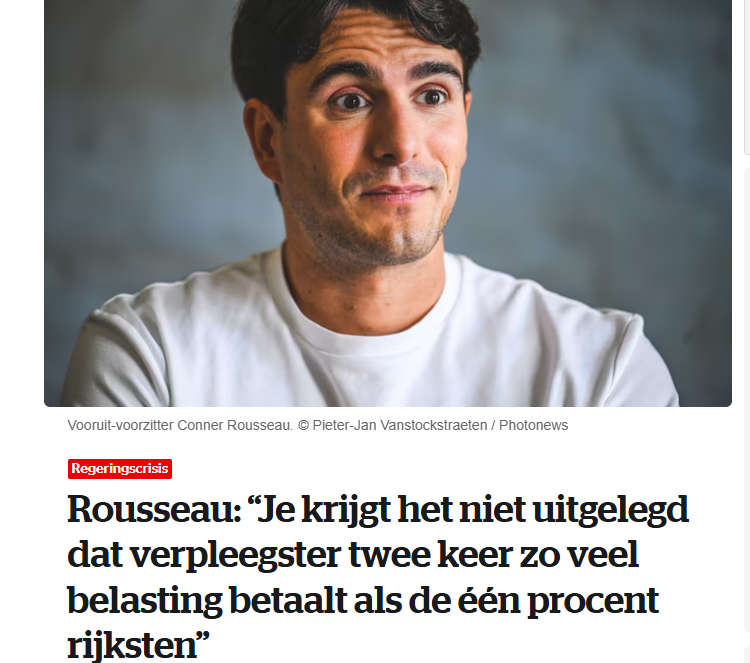
@vooruit_nu - die kleine man, die gaat werken en belastingen betalen voor dit mismanagement. Elke dag.
Die bromance N-VA-Vooruit lukte omdat men op alle niveau's allianties moest en wou aangaan. In de cultuurstrijd vond De Wever gelijke zielen (het migratiebeleid mocht gerust wat strenger zoals de Deense socialisten doen, hier in Oostende wil Crombez geen tijd verliezen met bijvoorbeeld extra "duiding" aan het standbeeld van Leopold II). Economisch kwamen Rousseau en co niet met de ACW/Beweging.net-ongein, CD&V des te meer. Van zodra Vooruit op fiscaal vlak een 180 graden bocht nam (de studiedienst van Vooruit weet nochtans dat opbrengst vermogenstaksen zeer onzeker blijft) was het wachten tot er "iets" zou breken.
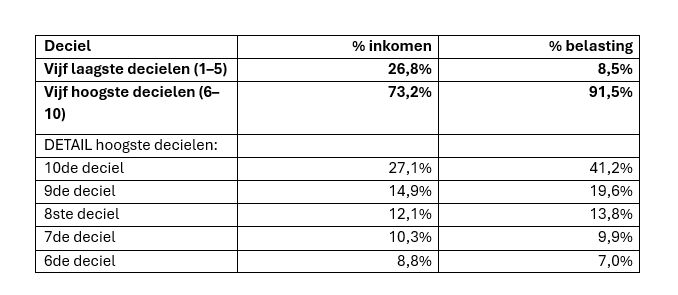
Alleen door selectief te zijn met cijfers, verkeerde cijfers te citeren, of gewoonweg foute cijfers te geven, kan je staven dat in België de sterke schouders en de topverdieners minder belastingen betalen.
Het is een van de redenen waarom België én Frankrijk zo slecht scoren. Zucman en Piketty verdienen meer kritische analyses om hun stellingen te doorprikken.
Hun aanbevelingen leiden tot collectieve armoede.
Lagrange multipliers find the maximum or minimum of f subject to a constraint g = 0. The method replaces the constrained problem by the Lagrangian L(x, λ) = f(x) − λg(x).
At the optimum, the level curve of f touches the constraint curve without crossing it. Two curves that touch share a tangent line, so their normals line up, and that means ∇f = λ∇g. Together with g(x) = 0 this gives n + 1 equations for the n coordinates and λ. To maximise x + y on the circle x² + y² = 1, ∇f = (1, 1) and ∇g = (2x, 2y). Parallel gradients force x = y, and the constraint gives x = y = 1/√2, where x + y = √2.
The multiplier λ has a meaning of its own. It measures how fast the optimal value changes when the constraint is relaxed, which is why economists call it a shadow price.