Founder, novelist, songwriter. Exploring new scientific evals for AI. Writing book answering Eugene Wigner's question on effectiveness of math in sciences.
In 1960, the Nobel Prize winning physicist Eugene Wigner wrote a famous essay. It was on a question asked by many others before him, including Albert Einstein: Why is math so effective in explaining our universe.
I am answering this question in a book form because I believe the answer has important implications for multiple fields like AGI research, math education, cognitive science, philosophy of science and math etc.
A short excerpt from the beginning of the book:
Chapter One: MATH.... OH SO UNREASONABLE!
"It was the best of times, it was the worst of times, for the most famous scientist the world had ever known. It was November of 1915, and Albert Einstein, who had ten years ago brought physics into a new era where time was malleable and nothing in the universe could travel faster than the speed of light, was on the cusp of finalizing the discovery that Richard Feynman would later describe as the greatest single achievement of theoretical physics: the General theory of Relativity.
Einstein’s marriage to his Serbian wife Mileva Marić, had effectively collapsed the previous year. Mileva, a fellow physics student whom he met at the Polytechnic Institute in Zurich in 1896 and married in 1903, had returned to Zurich with their sons (they would eventually divorce in 1919) while Einstein remained in Berlin, cared for by his first cousin Elsa Lowenthal who would later become his second wife. World War I raged across Europe, creating food shortages that worsened Einstein's chronic stomach ailments, ailments that included liver ailment, stomach ulcer, and inflammation of the gallbladder. Almost as bad, the war fractured Einstein’s beloved physics community along national lines into opposing camps hindering scientific collaboration and exchange.
Then there was the priority dispute with the legendary mathematician David Hilbert. Hilbert was working on general relativity using a more mathematical approach as contrasted with Einstein’s way of physical intuition and visualization and thought experiments. Hilbert derived the field equations (rooted in variational principles but equivalent to Einstein’s) by November 20, 1915, though his paper was delayed until 1916. Despite overlapping results, the dispute was thankfully short and quickly resolved with Hilbert crediting Einstein’s "magnificent theory" in his final draft, while Einstein acknowledged Hilbert’s variational formalism as a "lucid" alternative approach.
Hilbert was not only Einstein’s competitor but also a collaborator. If you study the history of the discovery of General Relativity — which started in 1907 when Einstein first started thinking about the problem — you will find that in 1915 Einstein was engaged in an intense correspondence with Hilbert on general relativity. And his letters to Hilbert reveal a mix of both collaborative as well as competitive efforts. Close to the finale (on November 18, 1915) Einstein confided to Hilbert after days of ceaseless work that: "The difficulty was not in finding the generally covariant equations for the gravitational field…(Einstein said this was relatively easy using the Reimann tensor)... The main difficulty was in recognizing that these equations are a generalization... of Newton's law." This was also the day Einstein presented his calculation of Mercury’s perihelion precession puzzle — a critical empirical validation of general relativity — to the Prussian Academy, resolving a decades-old anomaly in Newtonian mechanics and astronomy.
Through these ups and downs, Einstein persisted in his intellectually Herculean efforts, collaborating with his friends and colleagues like Marcel Grossmann (who introduced Einstein to tensor calculus), Michel Besso (who helped Einstein with his initial calculations related to the precession of Mercury’s perihelion) and David Hilbert to untangle the mystery of the most mysterious of the four fundamental forces that give rise to the structure of the universe we live in. The outcome was that in four dramatic weeks at the Prussian Academy, on November 4, 11, 18, and 25, Einstein presented successive iterations of his theory, refining the equations each time leading to the grand finale. On November 4, he published the non-covariant equations, then reverted to the Entwurf framework on November 11 by assuming the energy-momentum tensor’s trace vanished mirroring electromagnetism. By November 25, he arrived at the final generally covariant field equations which linked spacetime curvature to matter-energy distribution through the Einstein tensor Gμν and stress-energy tensor Tμν, now known as Einstein field equations. (These equations happen to be quite complex, encoding a tremendous amount of information about the curvature of spacetime and the matter and energy within it; in fact, what appears as one compact equation is actually 16 interconnected equations, all depending intricately on one another).
What makes this story even more fascinating to me, if you analyze it from another angle, is not just Einstein's personal journey, his successes and tribulations, agonies and ecstasies, in the process of discovering general relativity. It was that the mathematical framework he needed, differential geometry developed by Bernhard Riemann in the mid-nineteenth century, had been created as pure mathematics by Riemann, with no inkling of its future importance. Interestingly, this mathematical framework wasn't even Riemann's first choice for his habilitation lecture (a lecture required to obtain the right to lecture at a university) at the University of Göttingen. He had prepared for the lecture on three topics including one on the question of representability of a function as a trigonometric series and another on the solution of two quadratic equations in two unknowns.
So what happened? Gauss happened. Yes, the same Karl Friedrich Gauss, whom history has nicknamed the "prince of mathematics". Gauss, who was most luckily Riemans’s doctoral supervisor, was interested in the foundations of geometry and had been thinking about the limitations of Euclidean geometry for many years. He had encouraged Riemann to explore a new kind of geometry that could go beyond the traditional three dimensions. Before the habilitation lecture, he suggested that Riemann talk about his new ideas on geometry.
While geniuses are supposed to not listen to anybody and do whatever may please them, Riemann was thankfully not such a genius, especially since his job was at stake. He did as Gauss chose and introduced in the seminal lecture a new type of geometry that could handle curved spaces and higher dimensions under the title “Über die Hypothesen, welche der Geometrie zu Grunde liegen” (“On the Hypotheses Which Lie at the Foundations of Geometry") — a set of ideas discussing the concept of n-dimensional manifolds, geodesics, curvature tensors and how these could be applied to the real world, an area of non-Euclidean geometry that later became known as Riemannian geometry. The mathematics historian Felix Klein in his historical analysis of 19th century mathematics would later identify this lecture as one of the defining moments in the development of modern geometry.
Almost sixty years later, somehow this abstract geometrical invention turned out to be exactly what Einstein needed to describe the mathematical structure of general relativity. Through Einstein's equations, Riemann's geometry revealed itself as the perfect language to describe how space and time curve in response to matter and energy — marrying mathematics to physics in a way Riemann could not have foreseen. Einstein later said that the union revealed that "the general laws of nature are to be expressed by equations which hold good for all systems of coordinates" — a principle rooted in his field equations and known as the principle of general covariance. This principle, with its insistence on the invariance of physical laws under arbitrary coordinate transformations, extended the scope of relativity beyond inertial frames and we will come back to it in a later chapter when we discuss the concept of symmetry and Emmy Noether’s seminal contribution to it."
@paulg@hive_echo He is also the only other person besides Eugene Wigner to write a whole essay on imo the most important question of science/math: the unreasonable effectiveness of mathematics in the natural sciences
Researchers at UC Irvine took saliva samples from a choir before and after performing Beethoven. One antibody, the most abundant in your entire body, spiked 240%.
That antibody is called secretory immunoglobulin A. Mouthful of a name, but it does a simple job: it coats your throat, gut, and airways and acts as your body’s first barrier against every cold, flu, and respiratory virus you breathe in. Your body makes more of it than all other antibody types combined.
The 2000 study found this antibody rose 150% during rehearsals and 240% during the live performance. A separate 2004 study from the University of Frankfurt tested what happens when choir members just listen to the same music instead of singing it. The antibody barely moved. And their mood actually got worse.
Marathon runners show the exact opposite. A study of 98 competitive runners found this same antibody dropped 21 to 31% after the race. 17% came down with colds or throat infections within two weeks. Cross-country runners tracked over a full season saw it fall to 40% of their starting level by November. Running was suppressing the same antibody that singing was tripling.
It works through the vagus nerve, the longest nerve in your body. It runs from your brain down through your chest to your gut and controls your “rest and digest” mode. When you sing, your vocal cords physically vibrate against it where it wraps around your voice box. You’re also breathing from deep in your belly with long, slow exhales, which tells your nervous system to calm down. Your stress hormones drop. Your immune system responds.
A 2016 study from the Royal College of Music and Imperial College London tested 193 cancer patients and carers across five choirs in South Wales. One hour of group singing lowered cortisol (the body’s main stress hormone) and raised five different immune signaling proteins. The people with the worst depression scores improved the most.
You don’t need to be good at it. The boost comes from the physical act, the vibration and the breathing, not the melody. Trained soprano or shower singer, your body responds the same way.
One caveat: that 240% number came from a live performance, where adrenaline and emotional intensity were at their peak. Singing along to the radio probably produces a smaller spike. And these are temporary boosts, not permanent changes. But the 193 cancer patients in the 2016 study weren’t performing Beethoven on stage. They were just singing together for an hour in community choirs.
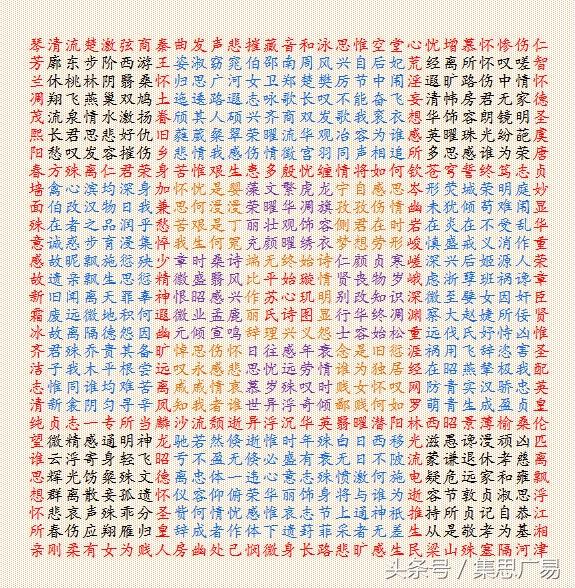
This strange square 👇 is undoubtedly the most extraordinary work of literature in human history. Yet, unfortunately, barely anyone in the West has ever heard of it.
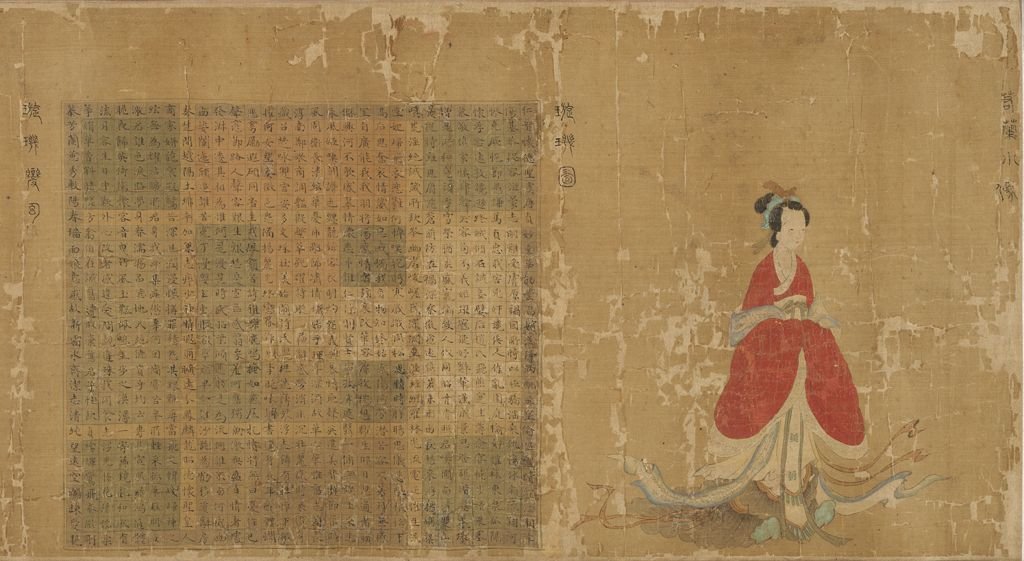
There was this woman poet in 4th century China called Su Hui (蘇蕙), a child genius who had reportedly mastered Chinese characters by age 3.
At 21 years old, heartbroken by her husband who left her for another woman, she decided to encode her feelings in a structure so intricate, so beautiful, so intellectually staggering that it still baffles scholars to this day.
Came to be known as the Xuanji Tu (璇璣圖) - the "Star Gauge" or "Map of the Armillary Sphere" - it's a 29 by 29 grid of 841 characters that can produce over 4,000 different poems.
Read it forward. Read it backward. Read it horizontally, vertically, diagonally. Read it spiraling outward from the center. Read it in circles around the outer edge. Each path through the grid produces a different poem - all of them coherent, all of them beautiful, all of them rhyming, all of them expressing variations on the same themes of longing, betrayal, regret, and undying love.
The outer ring of 112 characters forms a single circular poem - believed to be both the first and longest of its kind ever written. The interior grid produces 2,848 different four-line poems of seven characters each. In addition, there are hundreds of other smaller and longer poems, depending on the reading method.
At the center a single character she left implied but unwritten: 心 (xin) - "heart." Later copyists would add it explicitly, but in Su Hui's original the meaning was even more beautiful: 4,000 poems, all orbiting the space where her heart used to be.
Take for instance the outer red grid of the Star Gauge. Starting from the top right corner and reading down, you get this seven-character quatrain:
仁智懷德聖虞唐,
貞志篤終誓穹蒼,
欽所感想妄淫荒,
心憂增慕懷慘傷。
In pinyin, it is:
Rén zhì huái dé shèng yú táng,
zhēnzhì dǔ zhōng shì qióng cāng,
qīn suǒ gǎnxiǎng wàng yín huāng,
xīn yōu zēng m�� huái cǎn shāng.
Notice how it rhymes? táng / cāng / huāng / shāng
The rough translation in English is: "The benevolent and wise cherish virtue, like the sage-kings Yao and Shun, With steadfast will I swear to the heavens above, What I revere and feel - how could it be wanton or dissolute? My heart's sorrow grows, longing brings only grief."
Now read it from the bottom to the top and you get this entirely different seven-character quatrain:
傷慘懷慕增憂心,
荒淫妄想感所欽,
蒼穹誓終篤志貞,
唐虞聖德懷智仁。
The pinyin:
Shāng cǎn huái mù zēng yōu xīn,
huāngyín wàngxiǎng gǎn suǒ qīn,
cāngqióng shì zhōng dǔzhì zhēn,
táng yúshèngdé huái zhì rén.
It rhymes too: xīn and qīn, zhēn and rén
And the meaning is just as beautiful and coherent: "Grief and sorrow, longing fills my worried heart, Wanton and dissolute fantasies - is that what you revere? I swear to the heavens my constancy is true, May we embody the sage-kings' virtue, wisdom, and benevolence."
That's just 2 poems out of the over 4,000 you can construct from the Xuanji Tu!
At the very center of the grid, the 8 red characters wrapped around the central heart, she "signed" her poem with a hidden message:
詩圖璇玑,始平蘇氏。 "The poem-picture of the Armillary Sphere, by Su of Shiping."
Or reversed:
蘇氏詩圖,璇玑始平。 "Su's poem-picture - the Armillary Sphere begins in peace."
Many scholars, and even emperors, throughout Chinese history have been completely obsessed by Su Hui's puzzle.
For instance, in the Ming dynasty, a scholar named Kang Wanmin (康萬民) devoted his entire life to the poems (https://t.co/4exP9zpqbc), ending up documenting twelve different reading methods - forward, backward, diagonal, radiating, corner-to-corner, spiraling - and extracting 4,206 poems. His book on the subject ("Reading Methods for the Xuanji Tu Poems", 璇璣圖詩讀法) runs to hundreds of pages.
Empress Wu Zetian herself, the legendary woman emperor of the Tang dynasty, wrote a preface to the Xuanji Tu around 692 CE (https://t.co/yW7aR73MPc).
Incredibly, there's even far more complexity to the Xuanji Tu than just the poems:
- The name 璇玑 (Xuanji) - Armillary Sphere - is astronomical in meaning and the way the poems can be read mirrors the way celestial bodies orbit around a fixed center. It's a model of the heavens.
- Her original work, with the characters woven on silk brocade, was in five colors (red, black, blue/green, purple, and yellow) which correspond to the Five Elements (五行) - the foundational Chinese philosophical system that explains how the universe operates. So it's also a model of the entire cosmic order according to ancient Chinese philosophy.
- It's also of course deeply mathematical with this 29 x 29 perfect square grid, with sub-squares, lines and rectangles, and a structure which allows for symmetrical reading patterns in all directions
- Last but not least, the content of the poems themselves contain multiple registers. On top of expressing her personal grief and longing for her husband, it's also filled with accusations against the concubine (Zhao Yangtai) he left her for, reflections on politics (with many references to sage-kings) and philosophical reflections.
So the Star Gauge is simultaneously:
- A love letter (expressing personal longing)
- A legal brief (arguing her case against her rival)
- A cosmological model (structured like the heavens)
- A Five Element diagram (encoding the fundamental structure of the world according to ancient Chinese philosophy)
- A mathematical construction with perfect symmetry and precision
And yet, for all this complexity, we should not forget this was all ultimately in service of the simplest human message imaginable: a 21-year-old woman asking the love of her life "come back to me".
Her husband did, eventually. According to what empress Wu Zetian herself wrote in her preface to the Xuanji Tu, when he received Su's brocade he was so "moved by its supreme beauty" that he sent away his concubine and returned to his wife. As the story goes, they lived together until old age.
The heart at the center was filled after all.
Your kids' favorite athletes didn't get great by accident.
They wrote it down. They visualized it. They built systems around it.
• Michael Phelps - Started writing goals at age 11, posts them in his closet
• Emmitt Smith - Famous for writing and hitting 22 specific career goals
• Katie Ledecky - Keeps detailed journals of practices and wellness metrics
• Simone Biles - Writes down yearly goals with her mother
• Venus Williams - Visualization by walking empty major courts
• Kobe Bryant - Big goals broken into daily 1% improvements
• Arnold Schwarzenegger - Clear vision + specific, measurable goals
• Muhammad Ali - Vivid fight visualizations + spoken affirmations
• Steph Curry - Pre-game visualization ritual + 6-step mental preparation process
• LeBron James - Constant visualization + photographic memory for plays + clear verbal goal commitment
The method varies. The discipline doesn't.
"I don't want to look at the bricks around me and ask how high I can stack them. I want to design the most magical, wonderful, mythical castle on a hill and then figure out how to build it."
Melanie Perkins (@MelanieCanva) is co-founder and CEO of @Canva, one of the hottest private companies in the world—last valued at $42B, generating $3.3B in ARR, profitable for 8 years straight—and is on track to become the most successful female founder in history.
But it wasn't always so rosy. She was rejected by over 100 investors, her team had to spend 2 years rewriting their product from scratch (unable to ship anything during that time, something they expected to take 6 months), and they went through a major pivot a few years in.
In a rare interview, Melanie and I discuss:
🔸 How “Column B” has been the key to Canva's success
🔸 How Canva survived a painful two-year period without shipping any new features
🔸 How to build a ladder to the moon with small rungs
🔸 Canva’s “two-step plan”: build one of the world’s most valuable companies, then do the most good possible
🔸 So much more
Listen now 👇
• YouTube: https://t.co/EqOkwwkzpy
• Spotify: https://t.co/mDxzxnRqwk
• Apple: https://t.co/ip55ackS2t
Thank you to our wonderful sponsors for supporting the podcast:
🏆 @TrustVanta — Automate compliance. Simplify security: https://t.co/JHcQhNsK42
🏆 @Stripe — Helping companies of all sizes grow revenue: https://t.co/zOscBW98BX
🏆 @justworks — The all-in-one HR solution for managing your small business with confidence: https://t.co/pbYqfqXTP9$
This is true when you can get people outside their rooms. Getting people outside among other people who understand them and talk to them and make them feel good is therefore very important. Inside a room, alone, people often behave differently depending upon personality and robotic dependency imo is significantly probable
@NTFabiano May be, may be not. But whether cognition is localized to brain or not, factors affecting cognition certainly aren't localized to brain. E.g. gut microbiome has some role to play here as just one example
Not all that time. Often we are interested in something because we are innately good at it and therefore succeed in it more than others - this fuels the interest which leads to self-fulfilling prophecy of success --> interest --> success
Lots of determination can often bridge that first gap of not having innate capability.
Also, no matter how good you are at something innately so you could start the self-reinforcing loop, eventually you are gonna hit a ceiling, and then only determination can help you
I recently reviewed syllabus for undergraduate majors in AI, ML and Robotics for some of the elite colleges in India and couple of Masters in AI/ML offered by legit US universities.
TLDR; I actually feel really bad for students. Much of the course content is still set in 2012 Alexnet and the era before. Transformers get mentioned in passing if students are lucky. Of course, no RLVR, PPO, GRPO etc.
Robotics majors are filled with content from same historical era, not even mention of VLAs.
It’s also not the case that course content focuses on strengthening fundamentals. They don’t cover optimization theory or advanced linear algebra or ML/RL theory. Instead they spend all their time on artifacts and minutiae from bygone era.
It’s like learning about horse carriages in excruciating details when there are airplanes flying over your head.
The course load is apparently kept very heavy to appear as “elite” such that students are expected to have no time left to learn anything outside the course. As these degrees are labeled “AI”, there is massive competition to get in.
These kids will come out from colleges flashing fancy AI/ML/Robotics degrees and won’t be able to answer even the most basic questions in job interviews.
Students in these classes, for example, can’t even tell what autoregressive modeling means. The pure CS/engg part of their course content looks equally pathetic. These students won’t be able to answer something as basic as what is the difference between binary file and a text file or why dynamic array expands the way they do.
I am not sure how professors actually teaching AI/ML/Robotics are still so completely oblivious of all the progress and so out of touch when these kids work so hard to get in and pay massive tuitions making many sacrifices.
If you are planning to take AI, ML or Robotics majors, please review its course content throughly and don’t fall for it because uni is “top school” or because it’s hard to get in.
It's very deep and serious from one perspective, but it's also not that deep and not so serious from another perspective, and being able to switch between two or more such perspectives based on the needs of the situation and your capacity to affect it through actions that at the least don't make the situation worse because you are in control of yourself (to the extent humanly possible) but not necessarily the situation