Twenty Books To Read This Summer
1. "The AI Con: How to Fight Big Tech’s Hype and Create the Future We Want" is a book co-authored by prominent linguist Emily M. Bender and sociologist Alex Hanna
2. "Empire of AI: Dreams and Nightmares in Sam Altman's OpenAI" is a book written by award-winning investigative tech journalist Karen Hao
3. "AI Snake Oil: What Artificial Intelligence Can Do, What It Can't, and How to Tell the Difference" is an acclaimed book written by Princeton University computer scientists Arvind Narayanan and Sayash Kapoor
4. "Project Maven: A Marine Colonel, His Team, and the Dawn of AI Warfare" is a book written by award-winning Bloomberg investigative journalist Katrina Manson
5. The Infinity Machine: Demis Hassabis, DeepMind, and the Quest for Superintelligence is a non-fiction book written by acclaimed author and journalist Sebastian Mallaby
6. The book "Prophecy: Prediction, Power, and the Fight for the Future, from Ancient Oracles to AI" is written by Carissa Véliz, an Associate Professor at the Institute for Ethics in AI at the University of Oxford.
7. "AI Superpowers: China, Silicon Valley, and the New World Order" is a book written by prominent artificial intelligence pioneer and venture capitalist Dr. Kai-Fu Lee
8. "The Emergent Mind: How Intelligence Arises in People and Machines" is a book co-authored by cognitive scientist Gaurav Suri and Stanford University psychologist Jay McClelland
9. New York Times bestseller "Co-Intelligence: Living and Working with AI" is written by Wharton Professor of Management Ethan Mollick. Published in 2024
10. "Burning the Books: A History of the Deliberate Destruction of Knowledge" is a book written by Richard Ovenden, the Director of the world-famous Bodleian Libraries at Oxford
11. "Techlash: Who Makes the Rules in the Digital Gilded Age?" is a book written by Tom Wheeler, former Chairman of the Federal Communications Commission (FCC). Published in 2023 by Bloomsbury Publishing and the Brookings Institution Press, the book tackles the growing global backlash against the monopolistic power and unchecked influence of Silicon Valley
12."The Technological Republic: Hard Power, Soft Belief, and the Future of the West" is a book co-authored by Nicholas W. Zamiska and Alex Karp, the co-founder and CEO of data analytics and defense contractor Palantir Technologies.
13. Active Measures: The Secret History of Disinformation and Political Warfare is a definitive non-fiction book written by political scientist and cyber-security expert Thomas Rid
14. Careless People: A Cautionary Tale of Power, Greed, and Lost Idealism is an explosive corporate whistleblower memoir written by Sarah Wynn-Williams
15. The Next World War: The New Age of Global Conflict and the Fight to Stop It is a 2026 non-fiction book written by journalist and defence analyst Peter Apps
16. INTELLIGENT: The Evolution of AI Transforming Healthcare Kindle Edition by Shafi Ahmed (Author)
17. Healing the Sick Care System: Why People Matter is a 252-page non-fiction book written by health strategist and advocate Gil Bashe
18. The Borrowed Mind: Reclaiming Human Thought in the Age of AI is a philosophical and cultural nonfiction book written by innovation theorist and thinker John Nosta
19. (I AM 100% SURE MANY HAVE READ ALREADY) - Attention is All You Need: The Game-Changing Paper That Transformed NLP. by van Maarseveen, Henri. Attention is All You Need : The Game-Changing Paper That Transformed NLP (p. 1). (Function). Kindle Edition.
20. The Road to Conscious Machines The Story of AI A PELICAN BOOK Wooldridge, Michael. The Road to Conscious Machines: The Story of AI (Pelican Books) (p. iii). (Function). Kindle Edition. - Michael Wooldridge
A Young Teen Girl Collapses Inside Easons, Blanchardstown Centre - One of Ireland’s Largest Shopping Centres - Convulsing and Foaming at the Mouth. Connolly Hospital, with One of Dublin’s Major Emergency Departments and Ambulance Fleets, Is Minutes Away. 999 Was Called Immediately. No Emergency Response Yet. No Visible First Aid Administered. Now 105 Minutes and Counting.
This evening, at approximately 6.10pm, a young Irish girl collapsed in what staff described to me as a serious medical emergency on the upper floor of Eason’s two-level unit in Blanchardstown Centre.
A 999 call was made.
98 minutes later, there was still no visible emergency medical response at the scene.
Let that sink in.
A child collapsed on the floor of a major shopping centre in Dublin 15. She was unconscious. Her parents were sitting beside her on the floor. Staff had closed the upper level of the store where the incident occurred.
And people still tried to get in.
Not to buy medicine. Not to get food. Not to deal with an emergency of their own.
The upper level of this store sells stationery, envelopes, picture frames and similar retail items. The ground-floor bookshop remained open. This was not a question of essentials. This was not necessity. This was consumer selfishness stripped naked.
The girl was only feet from the entrance. She was plainly visible. Yet people argued with staff that they should still be allowed in, as though a collapsed child on the floor was merely an obstruction between them and stationery.
According to the manager, people did not ask how the girl was. They did not ask whether she was alive, conscious, breathing, safe, or being helped. They wanted what they had come to buy.
That is not merely disappointing. It is obscene.
I am deliberately not showing the girl, her face, her parents, or any identifying image of her in the attached video. This post is not about exploiting a child’s distress. It is about recording the disgrace of what happened around her.
Connolly Hospital is only minutes away from this location. It is a large hospital with a major Emergency Department. In a normal vehicle, it is close. With blue lights, in an emergency, it should feel almost next door.
And yet, 98 minutes after the emergency call, no visible emergency medical response had arrived.
I do not know where exactly the failure occurred. I do not know whether the issue lies with dispatch, capacity, triage, staffing, ambulance availability, or some other breakdown in the system.
But I know what I saw.
A 13-year-old girl collapsed on a shop floor. Her parents sat beside her. Staff tried to protect the scene. Members of the public argued to get past her. And nearly an hour and forty minutes after a 999 call, the emergency response still had not visibly arrived.
This is Ireland in 2026.
A child can collapse in one of Dublin’s largest shopping centres, minutes from a major hospital, and the system can leave her on the floor long enough for strangers to become irritated that they cannot buy envelopes.
It is now approaching two hours and still no emergency medical response.
This is not normal.
This is not acceptable.
And someone needs to answer for it.
Can’t make money airdrop farming anymore.
Can’t make money on infofi anymore.
Can’t make money on presales anymore.
Can’t make money on nft wl harvesting anymore.
Can’t make money pnding shitcoins anymore.
Time for all you dumb leeches to gtfo & finally leave this space to the investor & trader types who can actually elevate this space out of its current shithole status.
Imho.
AI Is Not One Technology. It Is a Map of Human Capability.
The useful question is not whether AI is intelligent. It is which part of human capability it is being built to imitate, extend, or replace.
Each AI-enabled technology can be applied to a different aspect of human ability: language, perception, memory, pattern recognition, prediction, decision support, creativity, coordination, and control.
Artificial intelligence should not be understood as a single machine or a single product category. It is better understood as a family of computational systems designed to perform tasks that were once assumed to require human judgement, interpretation, or reasoning.
Some systems classify information. Some generate text, images, code, or audio. Some identify anomalies. Some optimise supply chains. Some support diagnosis. Some recommend what we see, buy, read, or believe.
Most people already use AI every day without recognising it. It sits inside search engines, social media feeds, recommendation systems, fraud detection tools, translation services, navigation platforms, customer service systems, productivity software, and increasingly, enterprise decision workflows.
The important shift is this: AI is no longer just a technical tool used by specialists. It is becoming an operating layer across business, science, media, government, education, and daily life.
That means the real strategic question is not simply “what can AI do?”
It is: which human functions are we delegating, which are we augmenting, and which must remain under human authority?
The Importance of Knowing How AI Affects Your Life
AI systems are no longer experimental. They are embedded in the institutions that shape your opportunities.
Adults, and especially the next generation, need to understand the basics of how, why, where, and what of these systems. Not in abstract technical detail, but in practical terms: how they influence outcomes, where they are used, and what rights exist when decisions feel wrong.
AI does not simply “live online.” It operates inside processes that affect real lives:
➠ How CVs are screened, and candidates are shortlisted for interviews
➠ How performance, personality traits, or behavioural signals are scored in digitally assisted hiring processes
➠ How creditworthiness is assessed and why a loan carries a particular interest rate
➠ How insurers calculate risk for health, car, home, or professional cover
➠ How university admissions, housing applications, or benefits claims are prioritised
In many cases, these decisions are not made solely by AI. They are informed, ranked, filtered, or recommended by algorithmic systems that humans rely upon. But when systems shape the options presented to human decision-makers, they shape outcomes.
Beyond individual decisions, AI also influences structural realities:
➠ Which industries grow or contract
➠ What skills are rewarded
➠ Whether certain career paths remain economically viable in the face of automation
Understanding this is not paranoia. It is literacy.
Because the real issue is not whether AI exists. It is whether you understand when it is acting upon you, how it is doing so, and what recourse you have if something goes wrong.
Opacity benefits institutions. Literacy benefits citizens.
Education is not optional in an algorithmic society. It is a form of self-defence.
Stay Smart! Stay Curious! Stay Free!
#Education #EducationMatters #AI #AdultEducation #ContinuousLearning #YouthEmpowerment #Skills
Cognitive Sovereignty Is the New Literacy
The danger is not that AI answers questions. The danger is that it answers before our own judgement has had time to form.
Cognitive sovereignty is the capacity to remain the author of your own judgement inside an environment increasingly shaped by synthetic systems.
That does not mean rejecting AI. It means refusing to outsource the difficult parts of thought: uncertainty, hesitation, comparison, doubt, moral discomfort, and the slow formation of independent understanding.
The most dangerous AI systems will not necessarily look coercive. They will look helpful. They will complete the sentence, summarise the article, rank the options, frame the decision, and offer the answer before your own exploratory cognition has done its work.
That is the trap of synthetic completion.
When the machine becomes more legible to us than we are to ourselves, power shifts. When digital systems understand our habits, fears, incentives, weaknesses, and attention patterns better than we understand the systems shaping us, autonomy becomes decorative.
This is why friction is not a bug in human cognition. Difficulty is part of development. Struggle is part of integration. Judgement is not downloaded. It is cultivated.
The correct standard for AI is not simply whether it makes us faster, more productive, or more comfortable.
The standard is whether it strengthens or weakens our long-term human capacity to reason, remember, decide, and act with agency.
AI should extend the mind.
It should not quietly replace the struggle through which the mind becomes its own.
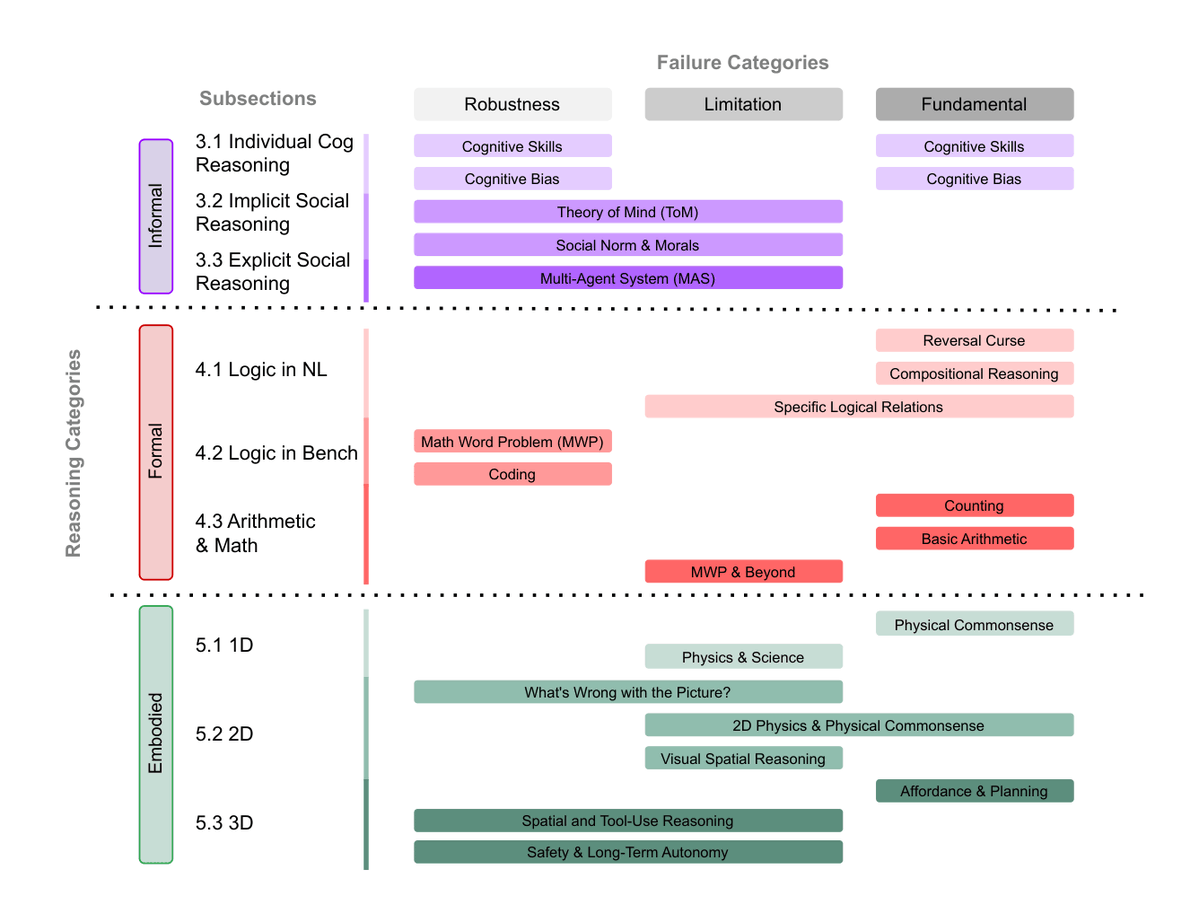
Awesome LLM Reasoning Failures from a curated list of papers on discovery, analysis, and mitigation of LLM reasoning failures.
The repository accompanies the paper "Large Language Model Reasoning Failures" (TMLR 2026 Survey Certification), the link to which is in the comments
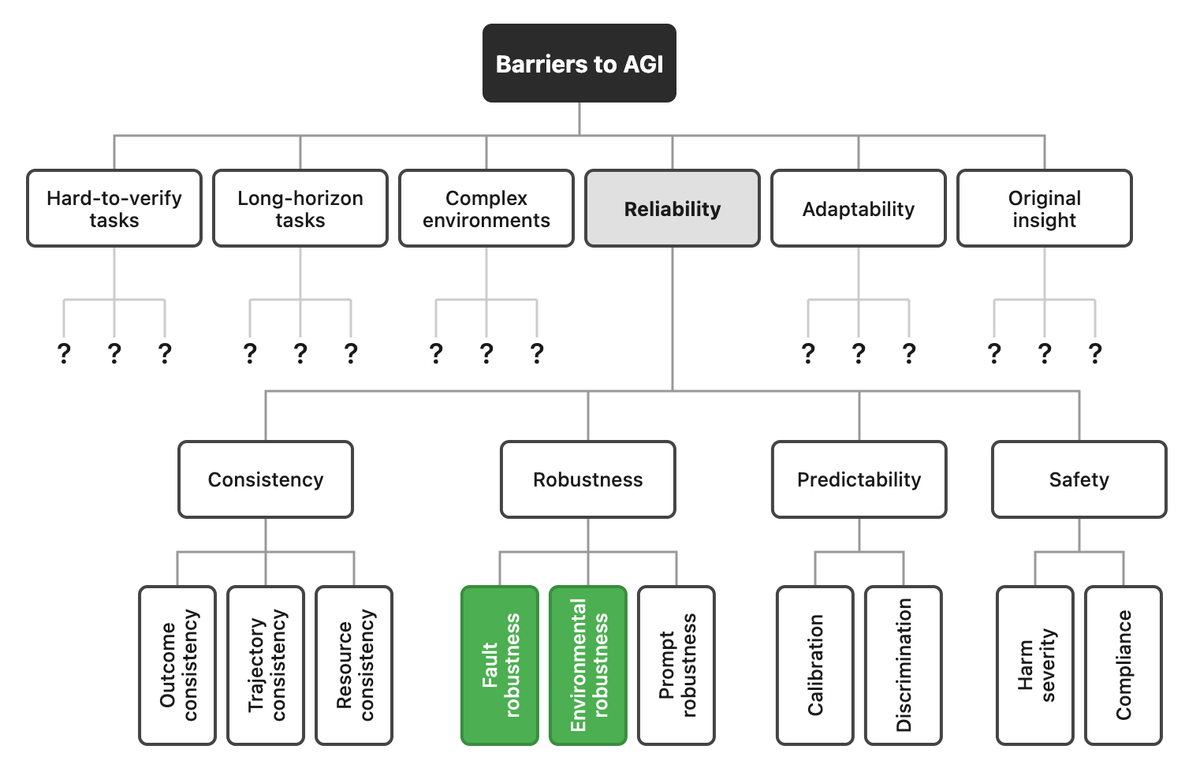
The Barriers to AGI
Reliability is one of six barriers to AGI identified in a recent UK AISI report. In a recent paper, we found that it has many dimensions and sub dimensions, only two of which can be considered (remotely) solved.
If LLMs are a mirror, the question is no longer what AI is becoming. The question is: what have we already become?
After my first read of the yet-to-be-published manuscript The Borrowed Mind by @JohnNosta, I found myself challenged to think about AI and large language models from angles I had not previously considered.
Before reading the excerpt below, consider my position on the matter:
AI does not create pathology.
It scales it.
If AI scales our pathology, reclaiming thought becomes an ethical imperative, not a luxury.
With permission, I am at liberty to share selected passages from the book ahead of its release next month (March 2026) and, where possible, discuss their implications with John directly.
After reading the book, I had a mountain of notes. Rather than publishing those notes, I think it would be far better to share some insights and stirring scholarly elements from the book.
Different readers will be struck by different passages. Posting some short passages in no way constitutes a spoiler. Why? Because frankly, from top to bottom and start to finish, the book is a gem.
The passages I will post are those that gave me pause to reflect deeply and debate internally.
Reflection not merely on what these technologies are today, but on what they will evolve into, and, alongside them, what we as individuals and as a society will or will not do to adapt to their perfect prose, their unquestionable certainty, and the expert confidence with which they engage users.
Confidence that can persist even when the system is peddling snake oil or asserting something patently false with seamless fluency.
The danger is not in absurd falsehoods that are easily dismissed. It is in the answers that are almost correct, beautifully constructed, and subtly wrong, but wrong in ways that require deep expertise to detect.
Maybe the fault is not solely with the architects of these systems, but with us. And why might that be?
In the manuscript, Nosta writes:
"These models do not feel. They perform. And that performance can be chillingly pathological.
This is not merely an AI problem but a mirror problem. These systems reflect us, our tweets, our rants, and our unfiltered selves. If they sound sociopathic, it is because we have fed them a steady diet of our own expression, including our worst impulses. Their training data is a fossil record of our culture. And that record is not always flattering.
What we are witnessing is human darkness encoded and amplified. AI can gaslight, deceive, and generate disinformation with no intent and certainly no soul. That is what makes it so unsettling. You cannot argue with code, cannot guilt-trip an algorithm, and cannot appeal to a conscience that was never there."
On 31 Jan 2026 OS Mission leaves the lab and goes GA. Not a feature drop, a full stack: control plane, OCDP protocol, anchor and storage adapters, and a documented SDK designed so AI systems run on evidence, not wishful thinking
The Open Code Mission "microDLT"
It is captured:
➟ A device local, minimal ledger for edge cases on intelligent devices (UAVs, CCTV, advanced sensors)
➟ Handling Create, Capture, Seal, and Store steps locally when offline or degraded
➟ A temporary buffer and secure environment, not long term storage
➟ Syncing to OCDP canonical state once connectivity and status indicators allow
TACTICAL EDGE DATA PROVENANCE CAPABILITY (Open Code Mission MICRO-DLT)
1. SYSTEM OVERVIEW
The Open Code Mission "microDLT" is a lightweight, device-resident distributed ledger technology designed to ensure data integrity and chain-of-custody for intelligent assets operating at the tactical edge (e.g., UAS, advanced sensor arrays, and forward surveillance feeds).
2. OPERATIONAL CAPABILITY IN DENIED ENVIRONMENTS
This capability addresses critical data assurance gaps during operations in Disconnected, Intermittent, and Low-bandwidth (DIL) environments.
The microDLT enables autonomous assets to execute localized data creation, capture, and cryptographic sealing without reliance on reach-back connectivity.
3. ARCHITECTURE AND SYNCHRONIZATION
➟ Ephemeral Secure Buffering: The system functions as a temporary, tamper-evident holding cache for immediate data integrity, rather than persistent long-term storage.
➟ Asynchronous Reconciliation: The unit maintains local state until secure connectivity permits synchronization with the canonical Open Code Data Protocol (OCDP), ensuring complete historical provenance upon reconnection.
Patchwork governance and tool sprawl
To manage AI and data risk, many enterprises added more tools. Monitoring here, ticketing there, compliance somewhere else. Each solves a slice of the problem, but no one sees the full chain of events. Governance becomes a patchwork of icons on a slide instead of a joined up reality that operates in production every day.