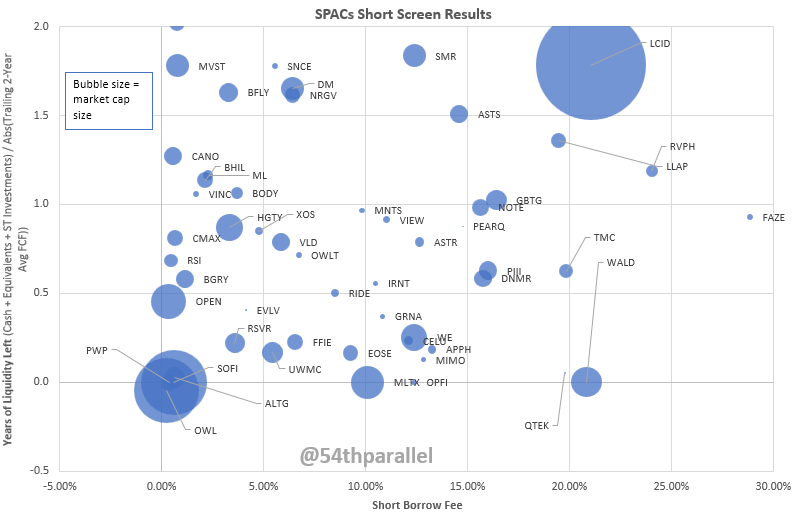
SPACs shorts screener results
I took current liquidity (cash, cash equivalents, sti) and divided by 2-yr avg FCF to see how many years companies have before they raise equity or go bankrupt
What does everyone like?
$LCID? $VIEW? $OPEN?
RT for reach if possible plz 🙏
Hundreds of billions of stock buyback/dividends INCOMING for $NVDA I'm serious.
I just got off a video call interview with Nvidia CFO Colette Kress after the earnings call. (Yes, Substacks get this kind of access now. Sorry, mainstream media.)
When I asked her whether the 50% FCF shareholder return plan after strategic pre-payments/investments is a permanent policy (not just this year), she said yes.
I then followed up by saying with some growth factored in that math points to hundreds of billions in stock buybacks and dividends soon, do you agree with that?
She nodded her head emphatically. "Yes! Yes. Yes. Do the math going forward, when will we meet a trillion dollars returned to shareholders? That's what we're pretty much saying. It's on the horizon.”
Today, we share a breakthrough on the planar unit distance problem, a famous open question first posed by Paul Erdős in 1946.
For nearly 80 years, mathematicians believed the best possible solutions looked roughly like square grids.
An OpenAI model has now disproved that belief, discovering an entirely new family of constructions that performs better.
This marks the first time AI has autonomously solved a prominent open problem central to a field of mathematics.
@SuperMugatu I think the same thing. Ever since I started using AI tools I have way more work to do because now I can do so much more. You don't need to prioritize tasks, a lot more can be tackled
holy fuck, a hair dryer at a Paris airport broke Polymarket weather markets & made someone $34,000 richer
- polymarket was settling Paris temperature bets on a single Météo France sensor sitting near the Charles de Gaulle runway perimeter - basically unguarded
- the guy bought the long-shot outcome (like "22°C" when everyone expected 18°C) for pennies, since nobody thought it'd hit
- then he walked up to the probe and briefly heated the air around it with a portable heat source, spiking the reading just long enough to register as the daily max
- temperature snapped back to normal in minutes, the market resolved in his favor, and he cashed out - twice, on April 6 and April 15, before Météo France caught on and filed charges
hyperstitions.
the current fear is is that AI homogenizes culture and turns humans into passive consumers
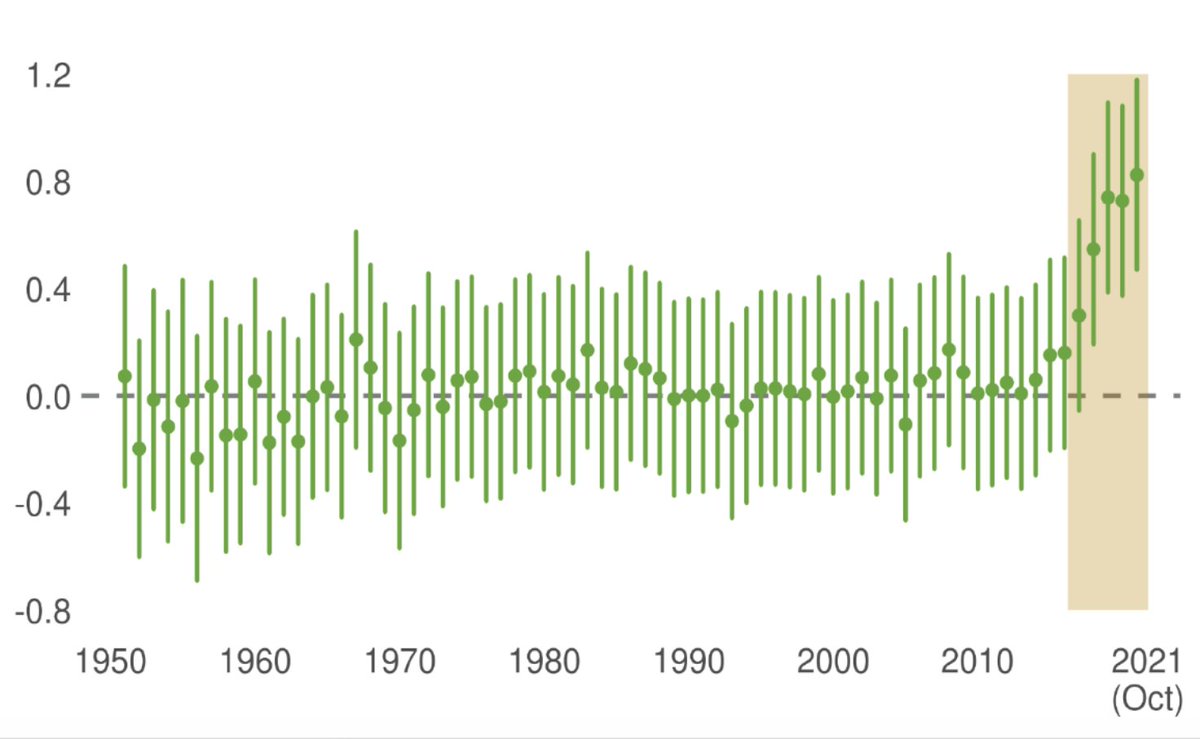
one counterpoint: in Go, human play showed very little improvement from 1950 to 2016 until alphago beat lee sedol - then human decision quality jumped. players started developing moves that were distinct both from previous human moves and from the novel moves introduced by machine intelligence
this seems more likely to me - fun times ahead
Too bad @LHSummers is not participating in today’s debate —so now I have to do it for him.
Here is his CPI chart, with the red part the forecast out to 2027 under the scenario that oil goes to $200/bbl.
It will take a lot to get a 1970s redux. Even $200/bbl oil won’t do it.
The most important advice I could give to individual investors adopting AI: don't optimize for speed, optimize for rigor.
We play a game where average is punished. There is all sorts of empirical evidence of power law dynamics in public equity investing: 70%+ of long only's underperforming the index, no observable alpha in sell-side ratings T+1, and high full-cycle churn of multi-manager PMs (by design). <5% of investors/firms earn substantially all the alpha. Beating the market isn't a check the box exercise, it's a game of multi-dimensional genius built on the back of incredible day in, day out discipline. It requires not just good process, but real talent.
An average thesis is a losing thesis. An average PM is a losing PM. And AI tools can get you to average quality very quickly. That's almost completely useless, functionally.
So, optimize for rigor, because rigor is what it takes to outperform. A fast thesis is just AI slop (and will probabilistically lose money).
A few pieces of advice we give when we train analysts, and how AI shifts that advice.
"How your spend your time is your most important decision". One of AI's most incredible characteristics in investing is the ability to use it to cut bad ideas quickly. Accelerated hypothesis formation, front end risk checklists, pattern recognition engines, "what's in the stock" first cuts, automated 7-year models, comparative efficiency / margin uplift scoping, management capability reports, "what I have to believe" reports, systematized guidance hockey stick screening...I could go on and on. You can automate the "sniff test" part of hypothesis formation, and where I wasted 3-days in the past only to disqualify an idea, I can now disqualify that idea in 30 minutes. Today, this is about where I see 85% of AI's usefulness in investing (though as quantitative accuracy and agentic usability is increasing, use cases are expanding rapidly). Use AI to be more rigorous about how you spend your time.
"You will walk in with 10 things on your to do list, complete 4, and walk out with 12 things on your to do list...that your PM wants yesterday". In 13 years as a professional investor, I never once felt like I had my to do list complete. Always another idea to evaluate, another comparative margin analysis to do, another customer call to do, another hospital conference to fly to, another deep cohort analysis of some industry data, etc. Do I go on that bus tour or do I stay at the office and go deep on this idea in my pipeline? We are Pareto optimizing every day, it's always a tradeoff, and so much gets undone. The idea that public equity investors can be rigorous on every idea under coverage is obviously a myth...if you ever think you're "done", you don't know the nature of the game you are playing. I covered ideas as close as anyone at a firm with 3 ideas per investment professional, and STILL never felt like I knew enough about them, let alone when I ran an 80 stock portfolio. In embracing AI tools in my job now, I have this very unusual feeling of getting my to do list done and searching for more to do! It's a strange and invigorating feeling. Use AI to deepen rigor, augmenting the work you *should* do, but never had the time. AI-augmented versions of things you never had the time to do will increase rigor.
"Focus on the key drivers, stock picking is a game of Pareto optimization where 2-3 key variables are deterministic to stock outcomes". I could spend 365 days a year analyzing just a couple companies. It would be very boring, but I could do it. And that 347th data point or channel check wouldn't move the needle *most of the time*, but sometimes it would. In the Tiger cub world, we would often bemoan the PM's push to go deeper, deeper, deeper, ("man, isn't this enough work?") but sometimes it would matter (and when position sizes are multiple hundreds of millions, it matters). You could channel check weekly for months with no change, but one week those checks catch a key inflection before the market sniffs it out. Six industry conferences may be useless, but that 7th may uncover some key changes and inflections in the industry that become an investible signal. The high-velocity multi-manager world, relative to the Tiger cub world, is very much a Pareto optimization game. In multi-manager world, I covered 300 stocks, so it had to be...I was drowning just to complete the desktop research functions of that coverage let alone any primary research. Find the 2-3 variables that will move the stock, analyze those, ignore the rest. Well, there are many, many of the "Tiger" research playbooks that are now accessible to a higher velocity firm. Not to 100% quality, but compared to no work at all, 85% is immensely better in deepening insight & rigor than nothing. And, for that matter, a long only can now build an 85% as good earnings preview that may, once or twice a year, lead to a key entry/exit decision around quarters (without spending 30% of their working hours earnings prepping). Catching earnings infections isn't as critical as it is a a multi, but that "process blending" is now more possible. Maybe with AI augmentation, we can spend human time on the 2-3 key variables that matters, but spend machine time on the other 16 important variables, resulting in deeper and broader rigor. Because sometimes that 15th variable matters.
"The only certainty is your initial thesis will be wrong...how you babysit your thesis will determine failure or success". Securities are priced by discounting future cash flows, and no one has a perfect crystal ball. Building an investment thesis is a hubristic exercise effectively saying "I and I alone can see the future here". In reality, investing is a deeply Bayesian exercise where priors are constantly updated by new data and the best investors are stoically non-emotional about cutting when the fact pattern changes (emotional attachment to a broken thesis is the deepest sign of an amateur). Thesis tracking is a game of 24/7, always on, constant paranoia that the next 8-K is going to be some disgusting tape bomb. A wider net, a less emotional lens (tracking is the most deeply emotional part of investing, particularly when an idea goes against you, i.e. a great use case of a dispassionate machine), and systematic tracking of a broad set of data (structured & unstructured) is an absolute game changer in answering the simple question of "is my thesis right or wrong?". This is where recent native data capabilities and emerging Excel capabilities are so interesting (data trackers were first big use case that moved AI out of chatbots for me in investing AI)...track key drivers across multiple dimensions, understand how those key drivers translate back into revenues/profits/cash flow and business infections, and send signals back to me in an easy to use dashboard. Use AI to deeply enhance tracking rigor.
I could go on an on.
So, I agree with Bucket and sort of shake my head when I see people say "build an investment thesis in 1/10th the time". I think to myself, "why in the hell would you want to do that"? Firms have finite capital and if you run a 30 stock long only book with a 3-year duration, you don't want to run 10x ideas or 10x turnover. But what you do want is more rigorous understanding of those 30 ideas, and a more rigorous evaluation of your idea set and idea pipeline, ensuring you are allocating capital to the best available ideas at any time. You want to have a deeper set of priors grounded in past study of markets, industries, companies and managements. Rigor, not speed. Deeper, not faster (though by doing many things faster, it builds the time capacity to go deeper). This is why simple things like building AI capability to update models for Qs is helpful...in the triage moment of earnings, less time keying in a PR and more time evaluating what changed and why.
There's also an irreducible value of the human element in investing that people don't talk about enough. Decades of failed quantamental initiatives and the elusiveness of quantifying human alpha have etched that firmly in my belief system. If you think we can take the human out of the loop in fundamental investing, I am game to deeply and passionately argue the other side.
I plan to share more on this. The TLDR of all of this is even in Q4 '25 we considered that we were in "winter training" for AI. It wasn't yet spring, so take some time to learn the tools in anticipation/hope that they become more institutionally useful. Well, in just a few months, we've come out of winter and entering spring. The rapidity of improvement is remarkable. We are going to lean into that, as it's such a fascinating time to be alive and such a fascinating time to be an investor.
Stay tuned for more.
On a recent Geopolitical Cousins episode I mentioned that BCA Research has opened its Gulf War dashboard to all users, including non-clients. Below is the promised link. Let us know if you'd want us to include some other data here.
https://t.co/x17XKa1fe4
Nobody seems to know how insane GPT-5.4 is with computer use.
I asked GPT-5.4 to draw the OpenAI logo in Microsoft Paint.
No computer use API. Just a screenshot and basic tool calls (click, drag, press_key) all coordinate-based.
The first drawing was awful. And GPT knew it. It looked at its own result and essentially went "yeah, no."
What happened next is what broke my brain:
It opened a browser. Went to Bing Images. Searched for the OpenAI logo. Found one. Then (and I cannot stress this enough) it used the Windows area screenshot shortcut (Win+Shift+S) to snip just the logo off the screen. Went back to Paint. Imported it. Centered it.
All on its own. No instructions to do any of that. It just improvised a better strategy when the first one failed. My prompt was "Draw the OpenAI logo" with Paint already opened on the computer.
Sure, it's "cheating." But honestly? That's exactly what I'd do too. And the fact that it came up with this plan from nothing but a screenshot and a coordinate system is wild.
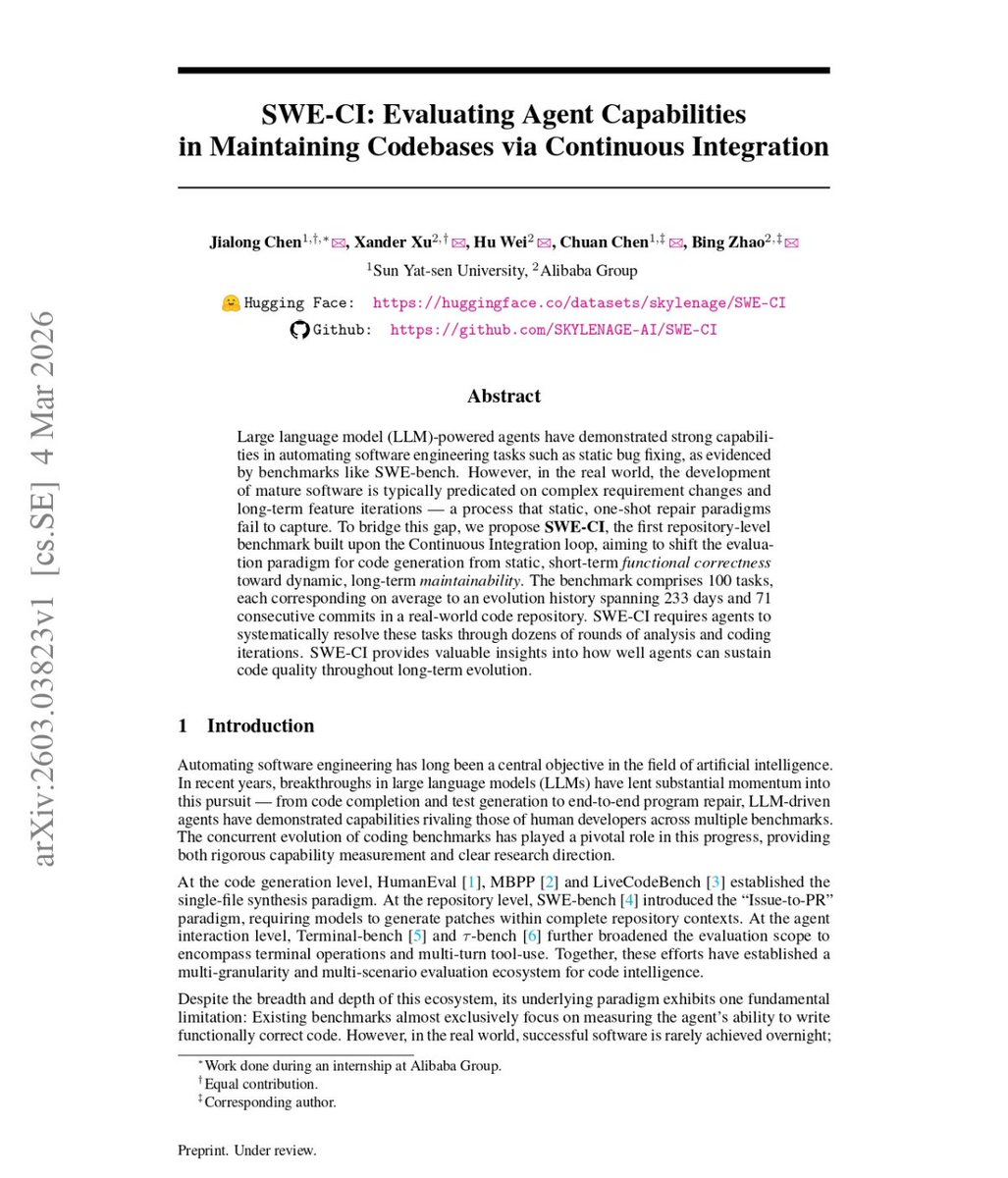
BREAKING: Alibaba tested 18 AI coding agents on 100 real codebases, spanning 233 days each. they failed spectacularly.
turns out passing tests once is easy. maintaining code for 8 months without breaking everything is where AI completely collapses.
SWE-CI is the first benchmark that measures long-term code maintenance instead of one-shot bug fixes. each task tracks 71 consecutive commits of real evolution.
75% of models break previously working code during maintenance. only Claude Opus 4.5 and 4.6 stay above 50% zero-regression rate. every other model accumulates technical debt that compounds with every single iteration.
here's the brutal part:
- HumanEval and SWE-bench measure "does it work right now"
- SWE-CI measures "does it still work after 8 months of changes"
agents optimized for snapshot testing write brittle code that passes tests today but becomes completely unmaintainable tomorrow.
they built EvoScore to weight later iterations heavier than early ones. agents that sacrifice code quality for quick wins get punished when the consequences compound.
the AI coding narrative just got more honest.
most models can write code. almost none can maintain it.
Dario Amodei just gave his first interview since the Pentagon blacklisted his company. The toll is visible on his face.
He was asked one question. What would you say to the President right now?
He didn’t hesitate.
Amodei: “We are patriotic Americans. Everything we have done has been for the sake of this country.”
Anthropic built their models to defend America. They were the first AI lab cleared for classified military systems. They wanted to help the warfighter.
But the Pentagon demanded unrestricted access to fully autonomous weapons and mass surveillance of American citizens.
Amodei drew the line.
The government responded with emergency Cold War powers. A supply chain designation normally reserved for foreign adversaries. A six-month federal phaseout ordered from Truth Social.
Amodei: “When we were threatened with supply chain designation and Defense Production Act, which are unprecedented intrusions into the private economy, we exercised our classic First Amendment rights to speak up and disagree with the government.”
The administration framed Anthropic’s refusal as anti-American.
Amodei’s response dismantled that framing in one sentence.
Amodei: “Disagreeing with the government is the most American thing in the world.”
Here is the deeper paradox nobody in Washington wants to say out loud.
We are in a geopolitical race against autocratic adversaries who use AI for mass surveillance of their own citizens and autonomous weapons with no human oversight.
The Pentagon demanded that Anthropic build those exact capabilities for America.
Amodei: “The red lines we have drawn, we drew because we believe that crossing those red lines is contrary to American values.”
You cannot defeat authoritarianism by adopting its methods.
You cannot defend the open society by forcing private companies to build its antithesis under threat of wartime emergency powers.
Anthropic held the line. Got blacklisted for it. And came out the other side saying the same thing they said going in.
That is what it actually looks like to mean it.
@AnthropicAI Demo of potential AI Surveillance System and this isn't even 1% of what its actually capable of. Every data source in this demo is legally purchasable today.
https://t.co/qhs0pbqNAO