Jack Meehan automated about 70 days of his work with AI this year, then built his own research firm, Operon Research, around it
He joined @FundamentEdge Brett Caughran on Invest with AI after more than a decade covering life science tools on the sell side. He says he's not working any less now that his automations are running, and explains where all that time is going now.
Plus, why he thinks automating the drudgery makes the human side of the job matter more
We discuss:
- automating the NIH grants data in one weekend
- trusting data you didn't pull yourself
- why automation sends analysts back into the field
- how many hedge funds use AI
- where equity research goes from here
- what happens to junior analysts
Enjoy!
TIMESTAMPS
8:32 Why Automation Means More Time in the Field
12:34 The Weekend He Taught Claude the NIH Data
16:54 How Do You Trust Data You Didn't Pull Yourself?
22:57 Four Earnings Reports in One Night
39:04 Where Equity Research Goes From Here
51:27 What Happens to Junior Analysts?
The rapidity of AI's improvement in Excel is, frankly, shocking. I did a webinar series in June where I felt like I dismantled the hand wavy argument that "AI could do anything in Excel a human analyst could". That was hype, and it wasn't true.
Fast forward 5 months, and everything has changed. Not only has AI passed the "Excel Turing Test", but both the rigor and accuracy (via validation loops) that is possible now using AI in Excel I believe meaningfully exceeds even the best human analysts (in actively teaching & steering AI, I certainly can create better, more rigorous models than I ever have before by hand). I see more people coming to this same conclusion, somewhat akin to software developers realizing they were at a serious disadvantage writing code by hand. (this is why I joined Fundamental Research Labs, maker of Shortcut, to help build Excel-fluent Investment Process Agents)
This is a difficult evolution for the "I like to build models by hand to learn the business" crowd. I've been playing around with ideas to both go faster with more rigor, but ALSO to deepen comprehension of the business architecture.
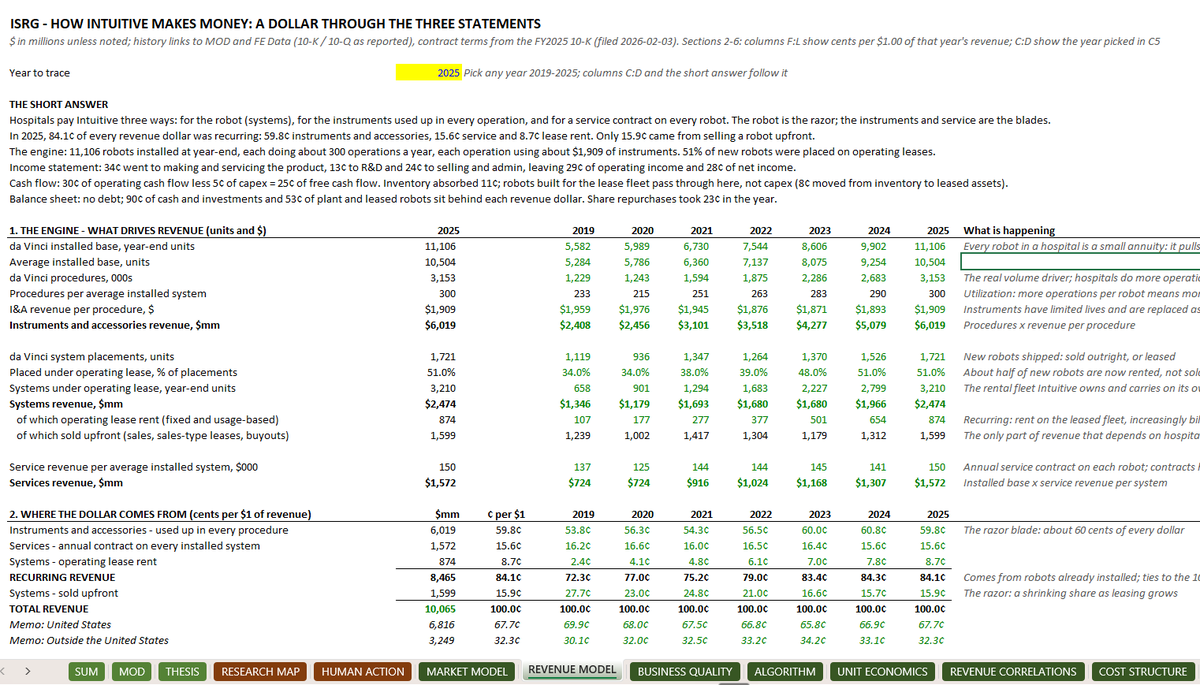
One idea I quite like is a "How the Business Makes Money" tab. Fable 5.2 (in the Shortcut harness) is a terrific teacher and can break down the core economic engine of a company quite well (in this case, $ISRG), and walk through the unit economics & how a dollar flows through the P&L. This is all traceable back to the core Model and back to financial statements (or financial data MCPs), so it is not AI-slop or sourcing some Seeking Alpha article.
The other advantage of starting with the basic principles of how a company makes money is that this articulation helps the human investor sign off on the core economic engine of the business to calibrate autonomous tracking.
The fun starts when you sit a Thesis Development Agent on top of all 30 tabs in the model and compile an investment view the way a human would. More to come on that!!!
@pmje73 makes a critical observation about the modern structure of stock price movement in modern markets: it's more about the multiple than earnings.
I ran the numbers on this, and from 1992-2010, 47% of the S&P 500's movement in a year was due to multiple (in 42% of years, multiple was the bigger driver).
From 2011 and beyond, 63% of the S&P 500's movement in a year has been due to multiple (in 73% of years, the multiple was the larger driver).
There are lots of reasons for this including the changing composition of large companies (technology companies are structurally longer duration bets more influenced by multiple swings), the rise & primacy of factor frameworks, and, lately, the structural increase in terminal value concern with AI. I, personally, don't expect this dynamic to flip.
Hedge funds have systematized earnings analysis, but they are only playing roughly 1/3 of the game.
(will share the Excel analysis at link in replies).
“For a single manager hedge fund, the unit of production is the idea. For a multi-manager, it’s the portfolio.”
— Paul Enright (@pmje73), Founder of Krainos Holdings
https://t.co/ARbZqLF277
With thanks to @AlphaSenseInc, @Juniper_Square, Ridgeline, & @Brookfield.
@pmje73's view on using AI in the investment process:
Ted:
How does AI play into what the functional role of the analyst becomes? And what the functional role of the PM is relative to the analyst?
Paul:
This is such a great question. This is my favorite topic in the whole world right now. I think it applies to our kids' education. I think it applies to any industry where you have to develop some sort of knowledge, and it definitely applies to investing.
There are multiple different types of research that you should be doing. One is getting familiar with a company: its products and everything it does. Then I should understand the sector the company operates in, any adjacencies, maybe their suppliers. There are these Venn diagram rings.
Separate from that, there's the stock. How does the stock work? Where does it trade? Is it a US listed stock? What's the market cap? What's the liquidity? How much does it trade per day? Increasingly you want to understand how it screens from a factor perspective. Is it a value stock? Whose radar is it on?
On top of that, I don't think you want to be predicting the macro, but you want to at least be aware of it. And then there's the work you need to do to understand the outside view. You're developing your inside view, but there's an outside view coming at you all the time, and how do you track that?
All of these things I would put in the category of research. And AI can do all of it exceptionally well in some ways, and increasingly you'll be able to do more of it.
KEEP THE LONG HALF-LIFE WORK
But if you want to survive, coexist, and leverage AI to the best, my suggestion is to take the things that have the longest half-life, the greatest ability to get embedded in your long-term working memory, to be crystallized. I know things about Charter Communications, Disney, Qualcomm, Intel that I will never forget.
The way people should be spending their time is this: don't take a shortcut and ask AI to summarize a bunch of stuff that you should be doing yourself. You should be reading every single document you can get your hands on. You should be buying books off of Amazon and learning the history. You should be doing all of that work at your desk.
And then, like a CIA agent, which is my favorite analogy, you get out into the field. You have conversations, you walk floors, you test products. That gets embedded.
All of that has a pretty long half-life, because it's company related, product related, management related, industry structure. That stuff takes a long time to change. So do the work, and feel comfortable that it isn't going to go stale and make you ask, why am I wasting my time doing this?
AUTOMATE THE SHORT HALF-LIFE WORK
The stuff you want to give to AI is the stuff with a short half-life, where it's a complete waste of your time. Why are you building a spreadsheet that shows what consensus earnings are doing? They're moving all the time. Automate that. Figure out a tool where you don't even have to fetch it, it's sending it to you.
Same with a macro dashboard. What is the consensus dot plot saying rates are going to do? What does my dashboard look like, so I can glance at it and see the market's pretty bearish? It's got a short half-life. I'm not doing any work. I'm just consuming, because there's no real benefit for me to create.
On the other side, what am I embedding in my long-term knowledge? Avoiding cognitive debt is super important right now.
COGNITIVE DEBT
If you just say, I did a screen on AI, and I have Claude delivering the summary, Claude wrote the initiation memo for me on XYZ company, I guarantee you won't embed it in your memory and remember it the same way as if you did it yourself.
Even building a model. Claude can one-shot a model in a few minutes now. You should decide exactly how you want the model to build up, with the KPIs and so on. Don't let AI decide what the inputs are, because you won't understand the inputs. You won't understand the reflexivity between the inputs and the outputs if you haven't done it yourself.
Once it's up and running, sure, have it updated for you on earnings in two seconds. But don't short circuit that initial point.
LAUNCH IT YOURSELF, MAINTAIN IT WITH HELP
A shorthand: it's the process of launching coverage. Launching coverage is a sell side concept, but on the buy side it is too. The process of launching coverage, do it yourself. The process of maintaining coverage, get the help. That would be my sense.
- Paul Enright, ex-Viking Global, on Capital Allocators with @tseides
@NotaburnerJack@pmje73 we've certainly observed & felt it. I don't think people have re-oriented their process, on balance, to systematically account for this shift in markets. Not true everywhere, of course
@takestwo00@pmje73 they are definitely playing multiple expectations. The operative word was *systematized*, as many investors tend to approach the multiple in a secondary way, when increasingly it is the deterministic variable.
This is an absolute must watch for any serious public markets investor. So much great thinking on the topics we are all struggling with right now (evolution of markets, single vs. multi-manager model, and the use of AI in investment process)
Much appreciation @tseides and @pmje73
“For a single manager hedge fund, the unit of production is the idea. For a multi-manager, it’s the portfolio.”
— Paul Enright (@pmje73), Founder of Krainos Holdings
https://t.co/ARbZqLF277
With thanks to @AlphaSenseInc, @Juniper_Square, Ridgeline, & @Brookfield.
I respectfully disagree. I built a 30-tab model today on $ISRG and the majority of tabs were created with very human little intervention (though with deep articulation of the goal & process of each analysis).
A swarm of agents can now fan out to a company, conduct institutional-quality analytics, quantify that research in an Excel structure, then feed that analysis back into a Thesis Development Agent that can give a shockingly good first cut. And, while it will cost *a lot* of tokens to do this, agents can scale this across thousands of names to identify the most compelling opportunities.
Agents can now do so much, in fact, that my models now have a highly dystopian Human Action tab where the agent things through the thesis and suggests activities from the human investor to tighten forecasts in the fan of outcomes.
Full Model Stack:
• SUM: one-page PM summary
• MOD: the core 3-statement model, quarterly back to 2016
• THESIS: the investment thesis with 3-year IRR and risk/reward and where we are different & why
• RESEARCH MAP: the index. With the mindset - Analyze the Business, then Analyze the Stock
• HUMAN ACTION: the human judgment calls on top of the model, and capture mechanism for primary research
• MARKET MODEL: TAM and market sizing
• REVENUE MODEL: follows a dollar of revenue through all three statements. 84¢ of every $1 is recurring
• BUSINESS QUALITY: scored rubric across 7 dimensions. ISRG scores 3.9/5, "Strong"
• ALGORITHM: what EPS compounds at. Volume x price/mix x margin
• UNIT ECONOMICS: revenue, cost and cash profit per da Vinci procedure
• REVENUE CORRELATIONS: procedures and placements tested against outside data (healthcare spending, hospital revenue, hernia search trends)
• COST STRUCTURE: every cost line, as a % of sales and per procedure
• BALANCE SHEET: liquidity, net cash, how much debt it could carry
• MGMT: management evaluation
• STOCK PERF: base rates since the IPO, vs the S&P and peers
• NTM VALUATION: forward multiples vs 1, 3, 5 and 10-year history
• PEER VALUATION: NTM multiples vs 15+ medtech peers
• EXPECTATIONS: what's priced in, as an engine
• REVERSE DCF: 30 years. What growth is the current price assuming?
• CATALYSTS: dated events over the next 18 months, each with the options-implied move
• EARNINGS HISTORY: 10 years of prints vs consensus and the guide, plus the stock's reaction
• GUIDE HISTORY: every full-year guide since 2007. Raises, holds, cuts
• VARIANCE: our model vs Street consensus
• REVISIONS: which way consensus moved after each print
• KEY DRIVERS: bear/base/bull on the 3 things that matter: procedures, price per procedure, margin
• DEEP DIVE 1, 2, 3: single-issue deep dives
• RISK 1, 2: key risk work-ups
Reviews of the Fundamental Edge Credit Academy have been awesome and @Alex_Goston keeps building, including announcing Michael Gatto as a guest speaker in the December cohort.
Enrollment is open for December now!
Our second Credit Academy cohort is officially open for enrollment, kicking off December 10th! And this time, another experienced credit investor is scheduled to join us as an upcoming guest speaker in the program, along with a special offer for our first 50 enrollments.
Michael Gatto, Partner at Silver Point Capital, former member of Goldman Sachs’ Special Situations Group, and Adjunct Professor at Columbia Business School, is scheduled to join our guest speaker lineup to share his experience and perspective with Credit Academy students.
To celebrate, the first 50 students to enroll will receive a free copy of his book, The Credit Investor’s Handbook. It’s a must-read for all aspiring credit investors.
Learning from experienced credit investors is a big part of what makes Credit Academy valuable. Alongside guest sessions with industry practitioners like Michael, students receive structured, hands-on training led by Alex Goston, who brings credit investing experience from KKR and RBC Global Asset Management.
The program is designed to help investors build a repeatable credit investment process while incorporating modern AI tools and workflows into their research and analysis.
What’s included in Credit Academy:
- 40+ hours of practitioner-led training across 8 modules covering credit fundamentals, capital structures, credit document analysis, public credit, direct lending, distressed investing, and more.
- Learn to incorporate AI into your investment process through custom-built AI skills and live AI workflow labs designed to support credit research and analysis.
- Learn from experienced credit investors through guest speaker sessions covering public, private, and distressed credit.
- Live office hours beginning in December to ask questions, work through concepts, and continue learning alongside the cohort.
- 12 months of access to all pre-recorded course content, with live sessions recorded so you can learn on your schedule.
Whether you’re looking to strengthen your credit fundamentals or develop a more efficient, AI-supported investment process, Credit Academy gives you the frameworks and practical tools to apply to your work.
Enrollment for the December cohort is now open.
Explore the program and enroll: https://t.co/GwCd49jcEj
The Great Dichotomy: Long-Term Conviction vs. Short-Term Noise
One of the things that feels most fun to build in Investing AI right now is the FSD (Full Self-Driving) equivalent for an investment thesis. When I sit in my Tesla, I pick the destination, and let FSD do the rest.
Is this possible with AI for investing?
Can I spend 90% of my time focusing on the long term? Can I go deep into companies, industries, products, and management teams, closely following a space to refine my fan of outcomes with an 18–48 month view? And can I let agents handle all the tactical friction; worrying about FX, weather, seasonality, and arcane guidance dynamics that ultimately dictate multi-manager capital flows? Can they help me express the kernel of my investment view with appropriate sizing, timing, and factor-considered risk management?
The problem, of course, is that everyone has a plan until they get punched in the face. Everyone is a long-term investor until their stock drops 30% on a print or gets violently pushed around in a factor rotation.
Historically, there has been real, industrial-scale alpha captured at the short end of the curve: calling earnings prints, connecting the dots across disparate alternative datasets to build a sharper "now-cast" of a business, and actively trading the over- and under-reactions to read-throughs and breaking news.
Are we finally at a point in the evolution of AI where agents can do this better than humans?
This is the exact question we are trying to answer with Catalyst Bench, which evaluates the post-cutoff ability of LLMs to identify and trade real-world catalysts.
It is early research, but give some indication as to the line of inquiry we will be exploring at Fundamental Research Labs.
Can AI agents generate fundamental alpha?
Agents are now used in almost every part of fundamental investing, but it's not clear if their work can actually generate alpha
In this new blog post, we asked agents to trade 320 stocks weekly over 13 weeks post their knowledge cutoff in Catalyst Bench v0.5
Agents researched and modeled business fundamentals using point-in-time data
We show that Claude Sonnet 5.5 agents (across different harnesses) can generate alpha
Sonnet agents beat 99% of random portfolios and nearly all technical strategies, and generate excess returns after correcting for simple factors
In comparison, the weaker GPT-6 Luna agents aren't able to generate alpha
There have been many previous attempts at measuring whether AI can make money in the stock market, most suffer from small sample sizes, so no real conclusions could be drawn
This work shows early evidence that the latest frontier LLMs are powerful enough to be alpha-generative
https://t.co/tQBUHclXHt
Here is the deck for the session on backtesting for my Quant Investing course at Columbia Business School. It covers the basics, but also the non-basics and the non-orthodox views I hold (which make me pessimistic, but in an informed way). Needless to say, important topic.
Students: it's almost 90 pages, and the proofs are clever (not mine). If you have time and willingness to suffer, acquaint yourselves with Rademacher complexity at the level of Mohri's Foundations of Machine Learning (link in reply).
Non-students. This is mostly covered in my book (Elements of Quantitative Investing), but with more cowbells.
https://t.co/BzAn8Wg5ke
Completely agree with the value of the reverse engineered DCF. Stocks ask different questions at different prices, and the best stock pickers start with working to carefully define the price-implied hurdle. The hedge fund mindset generally goes that a thesis is only compelling to the degree that the research findings differ from market implied expectations.
What has been very exciting is that agents have improved to the degree that the classic approach to expectations work can now be automated. There certainly is some judgment in the weighting of the inputs (i.e. how much should company guidance be weighted, and should this weight vary by company? How much should various sell-side analysts & expect network calls influence expectations? There is a lot of judgment embedded in these calls).
But the tools are now strong enough to build an Agentic Expectations Engine that actually conducts each of the analyses in Excel, then with an Investing Agent you can pull in those individual pieces into a dashboard and, for the first time, create a rigorous & inspectable (in Excel) "what's in the stock" analysis. I'm currently doing this across 250 US healthcare stocks in rolling out mock coverage on my old space.
Woodruff: "The other thing Gabe and I did was use DCF's to work backwards. A reverse-engineered DCF, in my opinion, is still the best tool available to any analyst.
If you think about a DCF taken in isolation, it’s a terrible tool. I can make anything say whatever I want. However, when I start comparing it against a bunch of other companies in the exact same industry, then all of a sudden I’m starting to get some interesting insights. Here’s two companies, the same industry, and this one’s implying sales growing faster than this one. Why? What’s going on? It allows you to start asking the questions.
When you have a basis for why something is priced the way it is, especially relative to another company, then all of a sudden you can start saying, “Well, what if something changed?” And then it’s all about working on that."