2026 has been a year where volatility has tested conviction. AI as a force has been inescapable for most investors, both in terms of how it has impacted investment workflows and how it has impacted the market itself.
The bad news: 2027 is unlikely to be a year of easy, smooth sailing as an investor
The good news: If you adapt to challenges more quickly than your peers, you will be more prepared to handle volatility
We built Analyst Academy to help buyside investors develop a process that can stand up to whatever challenges the market brings. Enrollment is now open for the December cohort of Analyst Academy, which includes:
- 30+ hours of self-paced, pre-recorded content designed to help you refine your investment process
- Live support where the instructors will answer your questions directly
- 20+ pre-recorded guest speaker sessions with luminaries from all corners of the market
- Live AI Labs that focus on building workflows you can apply to your work as an investor
To download the syllabus or enroll in the program, check out the link in the comments.
“A company can perform roughly as expected and still produce a poor credit investment outcome.” - Page 2 of our new guide for buyside credit analysts.
In credit, outcomes depend on contractual rights and relative priority as much as on how the business performs. That’s why the capital structure gets so much attention. An equity analyst can group the debt into a single line. A credit analyst can’t take that shortcut, because each tranche can have different economics and priority. It’s also one of the first pages a senior investor is likely to review in your model or credit memo.
The chart on page 3 (attached) lays out the credit-specific skills that analysts with an equity or general finance background tend to struggle with most. Use it as a checklist. If something on it seems foreign to you, that’s an area of your skillset to sharpen up.
What’s inside the full guide:
1. What a properly laid-out capital structure includes, and the four types of subordination
2. Why a leverage ratio can look precise while still giving you an incomplete picture of the risk
3. Where the key provisions sit in a credit document, and the questions to answer before you open one
4. A framework for analyzing LME risk, and why the existence of a blocker does not guarantee its efficacy
Which row on that checklist would give you the most trouble? Curious where people land.
The full guide is free. Link in the first comment.
While the AI infrastructure financing theme in the credit markets might still be in the early innings, understanding how to apply age-old credit fundamentals remains important
AI infrastructure finance: duration and GPU financing
One of the things that we discuss at length in our buyside credit analyst training programs is using duration as a way to play offence and defense in credit. In other words, thinking critically about when and how to extend duration to express a positive view on spreads and vice versa. Managing duration is relevant to both mark-to-market risk as well as capital recycling dynamics within a credit portfolio.
One of the factors driving a cautious stance on AI infrastructure financing among some credit investors today on both the public and private side is uncertainty around the supply picture. How much more is coming down the pipe? Even if a credit is "money good", supply/concentration issues may push spreads wider.
As a credit investor, to the extent you want to generate income from carry (absolute levels are attractive today) but are still cautious about the supply picture potentially driving spreads higher, you may want to shorten duration. The beauty of GPU financing deals within the broader AI infrastructure credit theme, is that GPU financings are generally structured to fully amortize over ~5 years, making them very short duration credit instruments.
A 5-year GPU financing at 10%, fully amortizing over 5 years has a modified duration of just ~2.3 years. This is significantly shorter than datacenter financing bond deals (duration of ~3.5 years for HY 5nc2 deals with no amort during development period and partial amort thereafter, ~7 years for fully amortizing 15-year IG deals) or IG hyperscaler paper on the long end of the curve (duration of 10++ years).
In a GPU financing you are still underwriting the terms of the lease (MSA), credit quality of the tenant, and the quality of the guarantee (if any). But to the extent you are comfortable with the credit risk, these can be excellent short-duration instruments to generate attractive carry returns in an environment where you are cautious around supply/market spread levels.
Credit Office Hours Q&A: Identifying the Credit Questions That Matter Within a Tight Diligence Timeline
Q: When you have limited time to diligence a credit, how do you identify and prioritize the questions most likely to affect your investment decision? Is there a framework you use to distinguish critical issues from lower-priority questions and focus management discussions on the areas that matter most or provide the greatest value?
A: When time is scarce in a rushed credit diligence process, I recommend reverse-engineering a low-case, in terms of both asset coverage and run-rate levered free cash flow profile, that would give you adequate downside protection and then asking "what do I need to believe about the key variables here to become confident in this low case?". These key variables are going to be situation-dependent across businesses and industries, but this is a good approach for identifying what matters from a credit perspective during a rushed diligence timeline. As succinctly stated by King Street in describing their investment philosophy when it comes to credit - "Focus on the downside and the upside will take care of itself".
Flashback to my analyst days: covering The Fresh Market distressed 1L bonds pre-pandemic not only gave me the opportunity to worry about weak SSS and Apollo as the sponsor, but also the chance to spend several days walking around grocery stores in New Jersey to gather primary research... (real ones will remember TFM 9.75% 2023s - ended up working out well...)
Congratulations to Team SharpeShooters, first-place winners of the 4th Annual WITG x Fundamental Edge Stock Pitch Competition!
Their short pitch on Copart (CPRT) stood out among five finalist teams and it earned them the top spot. Watch the full replay of their winning pitch below.
A huge thank you to our sponsors for making this year possible:
- @AlphaSenseInc sponsored the cash prizes for our winning teams.
- Canary Data gave free trial seats on their platform.
Want to see the rest of the finalists? You can watch every pitch and download all five decks free on our website. The link is in the comments.
1st place winner: https://t.co/2AiH5sRZHG
2026 has been a year where volatility has tested conviction. AI as a force has been inescapable for most investors, both in terms of how it has impacted investment workflows and how it has impacted the market itself.
The bad news: 2027 is unlikely to be a year of easy, smooth sailing as an investor
The good news: If you adapt to challenges more quickly than your peers, you will be more prepared to handle volatility
We built Analyst Academy to help buyside investors develop a process that can stand up to whatever challenges the market brings. Enrollment is now open for the December cohort of Analyst Academy, which includes:
- 30+ hours of self-paced, pre-recorded content designed to help you refine your investment process
- Live support where the instructors will answer your questions directly
- 20+ pre-recorded guest speaker sessions with luminaries from all corners of the market
- Live AI Labs that focus on building workflows you can apply to your work as an investor
To download the syllabus or enroll in the program, check out the link in the comments.
Importance of Primary Diligence in the Age of AI
As AI continues to automate more analyst workflows and informational edge compresses, the value of investment research will increasingly shift towards gathering and analyzing information that the models don’t have. The importance of boots-on-the ground (off-the-desk) primary diligence in the age of AI will become increasingly more important.
Young credit investors often ask for concrete examples of how primary diligence can shape a credit investor’s understanding of an industry or business.
A good example that comes to mind is the field research I did when analyzing distressed grocer credits prior to the pandemic. At the time, grocers were under pressure from Amazon’s entry into the space via the acquisition of Whole Foods and the expansion of European discount grocers Aldi and Lidl into the US market.
Primary diligence was key to developing my understanding of competitive dynamics in the grocery industry at the time.
AI can comb through a bunch of materials and tell you that Aldi's competitive advantage is efficiency. But it's hard to truly understand what drives this, and whether efficiency is, in fact, a durable competitive advantage. There are some things that you can only learn if you tour a bunch of Aldi stores in New Jersey and talk to some of the people that work there. Walking through an Aldi store with a diligence hat on, you learn that they have a ruthless focus on saving every last penny, and it shows up everywhere if you look closely. Shelf design, shelf stocking process, warehouse/store layout, and even shopping cart design. Examples of this approach:
1.) Nearly all packaged product comes into the store in boxes that are designed to fit directly on the shelf and open in the front (so no unpacking boxes and manual stocking of shelves is necessary).
2.) Each store's warehouse is connected to the back of refrigerated shelves - so refrigerated items come off the truck and are stocked right away from the back (never wheeled into the actual store and stocked from the front).
3.) Coin operated shopping carts that need to be returned by the customer to get their quarter back (so less labor needed to gather carts), etc., etc.
All of this adds up, and in the uber to the city back from New Jersey you better understand that Aldi builds out its stores and in-store workflows with an approach that is hard for large existing grocers to copy. For peers, it’s difficult to shift to this intense efficiency-first approach when you already have established processes and store designs across a giant footprint.
Primary diligence can give analysts a level of understanding that goes far beyond what is possible with desk research.
From the Desk of @Alex_Goston
Fundamental Edge Instructor
AI agents are only as good as the real-time data they reason on, and that shift is about to change how alternative data is bought, priced, and used on Wall Street.
@FundamentEdge Brett Caughran sits down with @CarbonArcAI founder @MckeownKirk, who spent two decades building the primary research and data operations at Glenview and Point72 before going out on his own.
Kirk walks through how credit card panels went from real alpha to expensive table stakes ("paying alpha prices for smart beta"), why he built CarbonArc around consumption pricing and MCPs that plug straight into AI agents, and how markets could trade as agents get plugged into live data.
Enjoy!
Timestamps:
16:34 Where Alpha Goes When Data Goes Mainstream
30:09 Why He Started CarbonArc
39:43 AI Is Only as Good as Its Inputs
40:41 Will AI Change How Markets Trade?
44:09 Can Claude Be Trained to Pick Stocks?
https://t.co/gN8kcvALds
CoreWeave's unsecured bonds are trading in distressed territory, yet demand for compute is strong and the company has more than $100 billion in contracted revenue backlog. What is going on with CoreWeave?
Behind the company’s rapid expansion in AI infrastructure is a complex capital structure with SPV-level GPU financing and billions of structurally subordinated corporate-level debt. Understanding the company's financial position requires looking beyond the headline numbers.
In this breakdown, Alex Goston, Lead Instructor of Fundamental Edge's Credit Academy, examines CoreWeave's debt structure, the economics behind its GPU investments, and the assumptions that could make or break the investment thesis.
Are traditional financial metrics telling investors the full story? How much cash flow does the backlog generate? How does the credit vs. equity bet differ here? And is there a more attractive way to invest in the AI infrastructure boom?
Alex walks through the analysis and the key questions investors should be asking as AI infrastructure spending continues to reshape the market.
Timestamps
00:00 Why CoreWeave's Bonds Are Trading in Distressed Territory
01:20 How CoreWeave's GPU Business Model Works
04:13 Project-Level Economics and Financing
07:43 How Pricing and Margins Impact Returns
09:02 Key Risks: Contracts, Customers and GPU Values
14:14 Breaking Down CoreWeave's $44B Capital Structure
18:54 Why Traditional Financial Metrics Fall Short
20:46 Analyzing CoreWeave's $103.7B Backlog
26:41 CoreWeave Bonds vs. Stock: Evaluating the Investment Thesis
New on Invest with AI: Brett Caughran (@FundamentEdge) sits down with Robert Yang (@GuangyuRobert ), co-founder and CEO of Fundamental Research Labs (@Fundamental).
Robert ran a computational neuroscience lab at MIT before leaving to build AI agents. FRL now builds Shortcut, an Excel agent used by buy-side analysts, and Brett is joining the team as Chief Growth Officer.
Inside the episode:
- 1,000 AI agents in Minecraft that organized a search party on their own
- Why going viral wasn’t enough to make Shortcut work
- Why hedge fund analysts, not everyday Excel users, became the core customer
- The case for one agent that manages your other 50
- Why today’s models fold the moment you push back
- What it takes to build an agent that holds a real investment view
Watch the full episode below
TIMESTAMPS
[00:00] Intro
[00:43] Why Robert Wanted to Build AI Before It Was Popular
[08:40] Running an MIT Lab and Questioning the Work
[14:05] The Agent Research That Pushed Him to Leave
[19:20] Project Sid: Building a Society of 1,000 Agents
[22:18] The Search Party Nobody Programmed
[26:58] From Minecraft to Excel Agents for Wall Street
[33:05] Going Viral Wasn’t Enough: Making Shortcut Work
[37:28] Why Hedge Fund Analysts Became the Customer
[41:51] From an Excel Agent to an Investment Team
[45:51] Why Nobody Wants to Manage 50 Agent Threads
[50:12] How Close Are We to a Digital Hedge Fund Analyst?
[53:52] The Problem with AI That Always Agrees
[56:50] Teaching an Agent to Hold an Investment View
[1:04:29] When Analysts Start Working More Like PMs
[1:06:29] Brett’s Role: Training the Digital Analyst
[1:09:07] If AI Frees Up Your Time, Where Does It Go?
[1:11:34] What This Means for FE and Invest with AI
https://t.co/zPUlNJwEQM
Congrats to SharpeShooters, Ayush Bobra (Princeton) and Ambilu Sivabalan (Cornell), on winning the 4th Annual Wharton Investment and Trading Group x Fundamental Edge Stock Pitch Competition with their $CPRT short.
All five finalist decks are now up, free, at the link below.
1. SharpeShooters (Princeton/Cornell): Short $CPRT
2. New Line Capital (Wharton): Short $ABNB
3. Credit Capital (Georgetown): Long $BROS
High Gamma (University of Florida): Short $SIG
Cavalier Capital (University of Virginia): Short $COCO
Thanks to @AlphaSense for sponsoring.
https://t.co/1im7guMeJu
I continue to be insanely impressed by the talent of the top undergraduate teams. May the kids are going to be alright...
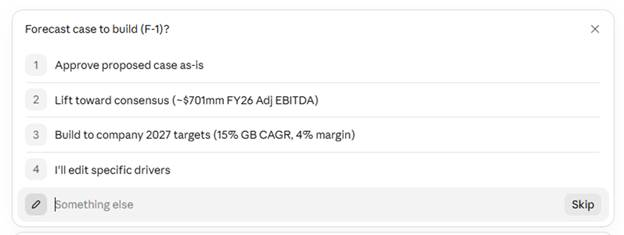
When people talk about AI’s growing transformation of fundamental investing, what often comes up is how AI interfaces with models. The attached Claude skill screenshot looks like an innocuous clarifying question about a spreadsheet, but I’d argue that the screenshot is itself emblematic of fundamental investing.
It is the fundamental investment analyst’s duty to triage, weigh, and decide how to triangulate what comes from the company (i.e. LT guidance), published consensus (which may cluster around the midpoint of company guidance), and individual variant view derived from front-footed research around a company’s key drivers.
As the debate evolves on which elements of fundamental equity investing are best transferred to machines and which remain squarely in the purview of the irreducible human, it is fair to say that more judgment is required of junior analysts earlier on in their career than has historically been the case. I speculate that this is because most experienced analysts’ judgment and discernment came from an upbringing comprising some combination of long hours spent in transcripts and models, trial and error vs. the market, and the general osmotic learning that comes with time in a seat. With AI radically shrinking the cycle time of certain types of desk research, some fundamental analyst workflows supported by AI now yield results without sweat, output without toil, and instant black-box outputs that replace apprenticeship-style observation. Today’s analysts at the helm of AI tools risk getting dessert without dinner, the medal without the race. I know this because it is a frequent topic of discussion at our firm and from our clients’ CIOs, DoRs, and PMs.
An analyst eager to get a name in the book might now uncritically forward to a PM an AI-generated emphatic and persuasive writeup generated by an LLM with no accountability is a recipe for disaster when analysts are accountable to PMs who are accountable to management who is ultimately accountable to LPs.
What we used to say is that Fundamental Edge amounted to “driver’s ed for the buyside,” but the emergence of capable tools wielded responsibly has compelled us to update our priors and reimagine early-career analyst development as flight school. Analysts now sit at the helm of force-multiplier tools where missteps carry larger consequences. We must simulate difficult scenarios and install judgment earlier on to avoid disaster later.
Our training must not quaintly prepare analysts for yesteryear, it must prepare them for today. That’s why we are folding AI workflows back into all of our core academies. If you’re interested, please email [email protected] to learn more.
FROM THE DESK OF ANDREW CARR
Fundamental Edge Instructor
AI continues to reshape the investment landscape in novel and unexpected ways, and some of the industry's leading voices are coming together to discuss what comes next.
This coming Wednesday, November 4, Fundamental Edge instructor Paul Johnson hosts Fordham University's 2nd Annual AI and Value Investing Conference in NY at GSB Lincoln Center Campus in the McNally Amphitheater.
The all-day event brings together CEOs, investors, and industry pioneers for a conversation on the intersection of AI and value investing.
Learn more and register here: https://t.co/sxLXP12zGd