AI infrastructure finance: duration and GPU financing
One of the things that we discuss at length in our buyside credit analyst training programs is using duration as a way to play offence and defense in credit. In other words, thinking critically about when and how to extend duration to express a positive view on spreads and vice versa. Managing duration is relevant to both mark-to-market risk as well as capital recycling dynamics within a credit portfolio.
One of the factors driving a cautious stance on AI infrastructure financing among some credit investors today on both the public and private side is uncertainty around the supply picture. How much more is coming down the pipe? Even if a credit is "money good", supply/concentration issues may push spreads wider.
As a credit investor, to the extent you want to generate income from carry (absolute levels are attractive today) but are still cautious about the supply picture potentially driving spreads higher, you may want to shorten duration. The beauty of GPU financing deals within the broader AI infrastructure credit theme, is that GPU financings are generally structured to fully amortize over ~5 years, making them very short duration credit instruments.
A 5-year GPU financing at 10%, fully amortizing over 5 years has a modified duration of just ~2.3 years. This is significantly shorter than datacenter financing bond deals (duration of ~3.5 years for HY 5nc2 deals with no amort during development period and partial amort thereafter, ~7 years for fully amortizing 15-year IG deals) or IG hyperscaler paper on the long end of the curve (duration of 10++ years).
In a GPU financing you are still underwriting the terms of the lease (MSA), credit quality of the tenant, and the quality of the guarantee (if any). But to the extent you are comfortable with the credit risk, these can be excellent short-duration instruments to generate attractive carry returns in an environment where you are cautious around supply/market spread levels.
A credit investor's equivalent of "invert, always invert": when facing a tight diligence timeline, reverse-engineer the "low case" from both asset coverage and levered FCF profile that would make you comfortable with the risk and focus your research on the variables that would validate such low case.
Credit Office Hours Q&A: Identifying the Credit Questions That Matter Within a Tight Diligence Timeline
Q: When you have limited time to diligence a credit, how do you identify and prioritize the questions most likely to affect your investment decision? Is there a framework you use to distinguish critical issues from lower-priority questions and focus management discussions on the areas that matter most or provide the greatest value?
A: When time is scarce in a rushed credit diligence process, I recommend reverse-engineering a low-case, in terms of both asset coverage and run-rate levered free cash flow profile, that would give you adequate downside protection and then asking "what do I need to believe about the key variables here to become confident in this low case?". These key variables are going to be situation-dependent across businesses and industries, but this is a good approach for identifying what matters from a credit perspective during a rushed diligence timeline. As succinctly stated by King Street in describing their investment philosophy when it comes to credit - "Focus on the downside and the upside will take care of itself".
Take away of this diligence for TFM by the way was that they would never be able to compete on efficiency/value, but good store locations w/ limited overlap to premium competitors, overweight on fresh vs. packaged/frozen (inverse of value grocers), local/organic brands, high quality private label, store feel/decor, etc. were what they needed to lean into
Flashback to my analyst days: covering The Fresh Market distressed 1L bonds pre-pandemic not only gave me the opportunity to worry about weak SSS and Apollo as the sponsor, but also the chance to spend several days walking around grocery stores in New Jersey to gather primary research... (real ones will remember TFM 9.75% 2023s - ended up working out well...)
Importance of Primary Diligence in the Age of AI
As AI continues to automate more analyst workflows and informational edge compresses, the value of investment research will increasingly shift towards gathering and analyzing information that the models don’t have. The importance of boots-on-the ground (off-the-desk) primary diligence in the age of AI will become increasingly more important.
Young credit investors often ask for concrete examples of how primary diligence can shape a credit investor’s understanding of an industry or business.
A good example that comes to mind is the field research I did when analyzing distressed grocer credits prior to the pandemic. At the time, grocers were under pressure from Amazon’s entry into the space via the acquisition of Whole Foods and the expansion of European discount grocers Aldi and Lidl into the US market.
Primary diligence was key to developing my understanding of competitive dynamics in the grocery industry at the time.
AI can comb through a bunch of materials and tell you that Aldi's competitive advantage is efficiency. But it's hard to truly understand what drives this, and whether efficiency is, in fact, a durable competitive advantage. There are some things that you can only learn if you tour a bunch of Aldi stores in New Jersey and talk to some of the people that work there. Walking through an Aldi store with a diligence hat on, you learn that they have a ruthless focus on saving every last penny, and it shows up everywhere if you look closely. Shelf design, shelf stocking process, warehouse/store layout, and even shopping cart design. Examples of this approach:
1.) Nearly all packaged product comes into the store in boxes that are designed to fit directly on the shelf and open in the front (so no unpacking boxes and manual stocking of shelves is necessary).
2.) Each store's warehouse is connected to the back of refrigerated shelves - so refrigerated items come off the truck and are stocked right away from the back (never wheeled into the actual store and stocked from the front).
3.) Coin operated shopping carts that need to be returned by the customer to get their quarter back (so less labor needed to gather carts), etc., etc.
All of this adds up, and in the uber to the city back from New Jersey you better understand that Aldi builds out its stores and in-store workflows with an approach that is hard for large existing grocers to copy. For peers, it’s difficult to shift to this intense efficiency-first approach when you already have established processes and store designs across a giant footprint.
Primary diligence can give analysts a level of understanding that goes far beyond what is possible with desk research.
From the Desk of @Alex_Goston
Fundamental Edge Instructor
@kieranwgoodwin And btw, will be fascinating to watch knock-on effects beyond direct IG and AI-infra credit relval comparisons. HY (BBs at 200bps, Bs at 350bps....), direct lending unitranches at S+525, etc.
AI infrastructure finance: duration and GPU financing
One of the things that we discuss at length in our buyside credit analyst training programs is using duration as a way to play offence and defense in credit. In other words, thinking critically about when and how to extend duration to express a positive view on spreads and vice versa. Managing duration is relevant to both mark-to-market risk as well as capital recycling dynamics within a credit portfolio.
One of the factors driving a cautious stance on AI infrastructure financing among some credit investors today on both the public and private side is uncertainty around the supply picture. How much more is coming down the pipe? Even if a credit is "money good", supply/concentration issues may push spreads wider.
As a credit investor, to the extent you want to generate income from carry (absolute levels are attractive today) but are still cautious about the supply picture potentially driving spreads higher, you may want to shorten duration. The beauty of GPU financing deals within the broader AI infrastructure credit theme, is that GPU financings are generally structured to fully amortize over ~5 years, making them very short duration credit instruments.
A 5-year GPU financing at 10%, fully amortizing over 5 years has a modified duration of just ~2.3 years. This is significantly shorter than datacenter financing bond deals (duration of ~3.5 years for HY 5nc2 deals with no amort during development period and partial amort thereafter, ~7 years for fully amortizing 15-year IG deals) or IG hyperscaler paper on the long end of the curve (duration of 10++ years).
In a GPU financing you are still underwriting the terms of the lease (MSA), credit quality of the tenant, and the quality of the guarantee (if any). But to the extent you are comfortable with the credit risk, these can be excellent short-duration instruments to generate attractive carry returns in an environment where you are cautious around supply/market spread levels.
"Unsecured debt market" does not mean public debt market broadly. The project-level debt that the company will be looking to issue via Delayed Draw Term Loans is secured and has been issued in both the private and public credit markets. Take a look at the credit overview presentation I posted recently for more info.
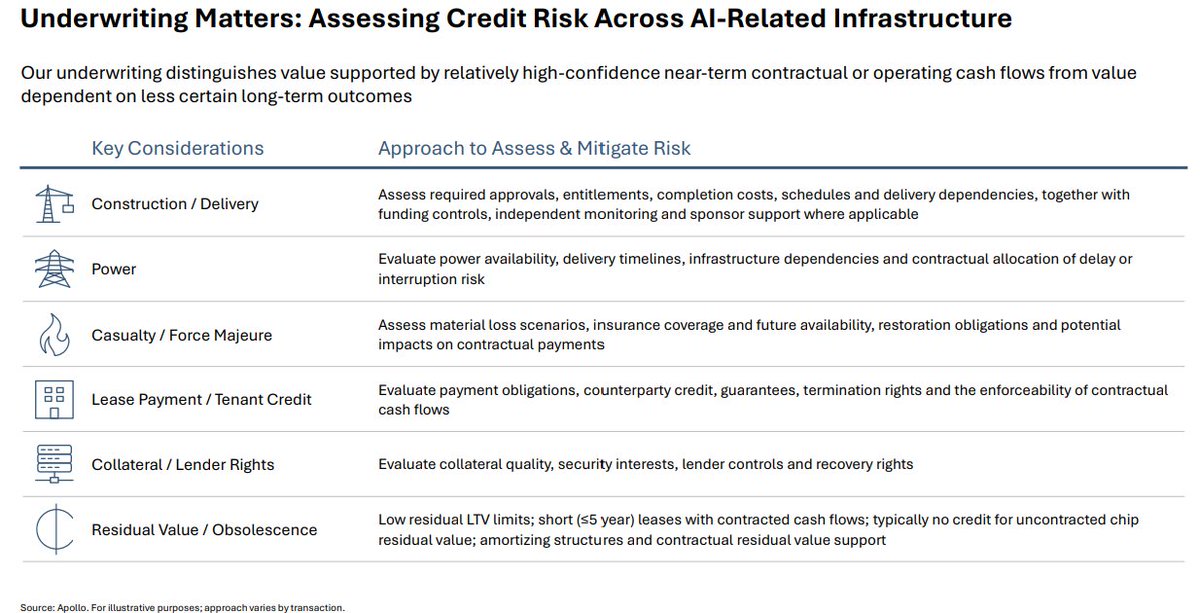
Apollo/Athene's underwriting approach to AI infrastructure credit below. Important for generalist credit investors traditionally focused on corporate lending to thoroughly consider all these factors and not get caught holding risk they don't fully understand.
@TommyThornton Project-level cash flow disclosure for the backlog and capex outlook for contracted power has to improve here. I think the management team can do a much better job here in helping credit investors understand the cash flow outlook here - this can impact their cost of capital.
Yup, and even those with IG backstops starting to feel the concentration issues across the lender base.
From Bloomberg article last week: “When you have such a large quantum of debt coming, at some point the challenge could be less about finding an investment-grade backstop, and more about finding the actual buyers willing to absorb more of the risk coming from the same handful of investment-grade backstop providers,” said Citadel analyst Tucker Roberts."
Volta GPU financing pricing at 11%+ recently, $40B SpaceX GPU financing coming at a blended 8%+ (IG), potential ramp in HY site-specific (behind-the-meter) power generation financing…
With more AI infrastructure financing supply coming down the pipe, will be critical not to spend all your bullets and be selective about which structures you decide to step into at or near par.
I think the best risk-adjusted trades in credit for now are those backed by contracted cash flows and solid counterparties, without lease termination or residual value risk.
Examples of credit investors being more selective around termination risk recently:
“One hedge fund said it turned down a recent data center deal when it discovered that the firm under contract had the option to back out if the project were delayed by more than three months. Partners at a top 10 law firm who’ve worked on development financing for data centers have seen deals where compute customers can walk away if there are holdups of 180 days or more.”
“Crucially, the documents show SpaceX cannot use force majeure clauses to pause its payments — a contrast to firms like Oracle Corp., which Bloomberg previously reported has cited force majeure in an attempt to put off its data center obligations. Rent is owed regardless of equipment condition, casualty or force majeure, providing investors with a clean look-through to SpaceX credit,” the document said.”
Being aware of the near-term supply picture and reassessing relative value quickly as terms of new deals come to light will be critical.
“The banks and companies raising capital have been relatively transparent that they do not care about pricing it wider and marking down paper you’ve bought,” said John Yovanovic, co-head of leveraged finance at MetLife Investment Management."
Finally got a chance to watch this presentation.
Really good initial overview of the cap structure from a credit perspective.
Crazy that this type of analysis is free.