I think @a16zcrypto is top notch out there but this is overly bearish and simplistic imo. Let me strawman the counterargument here.
Let's start with the historical analogies. The article invokes enterprise firewalls, private intranets, private cloud, FedRAMP etc to argue institutions will wrap blockchain in walled versions. But look at how those actually played out over time. Private intranets don't really exist anymore. Private cloud lost badly to AWS, Azure, GCP. The pattern a16z describes is real but its mostly a transitional phenomenon, not a durable endgame equilibirum. Using these analogies actually undercuts the thesis that permissioned and permissionless versions coexist indefinitely. If anything they predict permissionless wins the long game.
The private-chain graveyard is doing a lot of work the piece ignores. R3 Corda, Hyperledger Fabric, Quorum, the original JPM permissioned stack, most of the DTCC pilots. A decade of enterprise consortia produced almost no economically meaningful assets, and im being generous here. Meanwhile BUIDL, BENJI, USDC, USDT, and the entire tokenized treasury market live on public chains. The direction of travel isn't "TradFi builds its own private version." Its "TradFi tried that for ten years, it failed, and now theyre grudgingly deploying on Ethereum, Base, Solana etc." That's a much bigger DeFi win than the article credits imo. Citing Canton as a paradigmatic institutional network is cherrypicking too. Canton has meaningful pilots but nothing close to the volume flowing through public chains yet (we like Canton a lot btw).
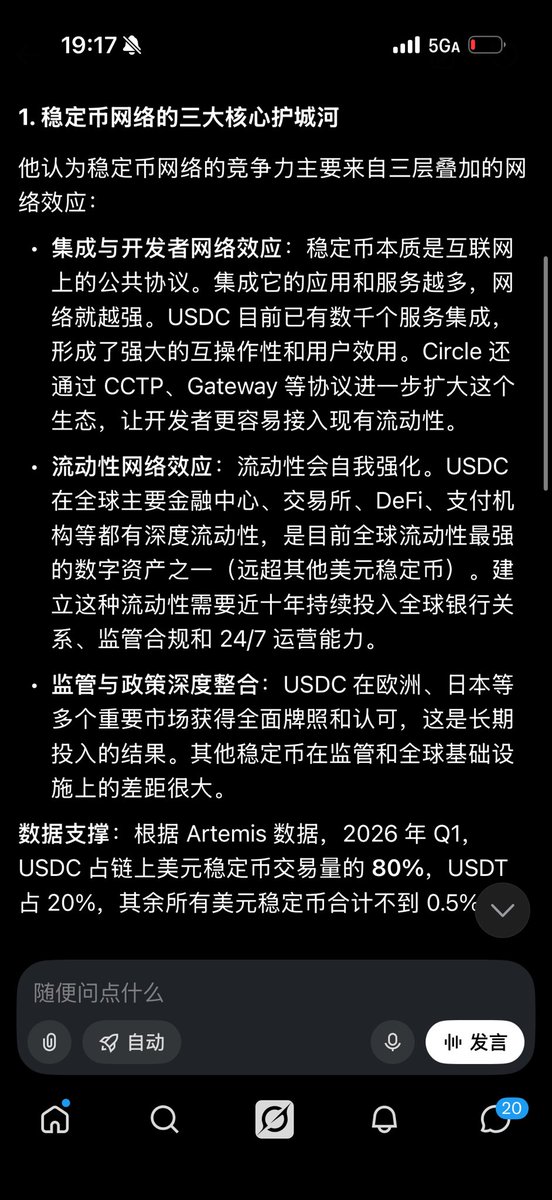
There's another big point that gets missed here: composability and liquidity depth aren't detachable primitives. The piece treats DeFi's value as a menu of features (atomic settlement, programmable money, AMM math) that can be picked apart and reassembled inside institutional walls. That's true for some primitives. Its false for the most valuable ones. Global 24/7 liquidity, cross-protocol collateral efficiency, permissionless integration, these are emergent from openness. You can't clone them into a walled garden. This is why private stablecoins keep losing to USDC and USDT even when the counterparties would probably prefer private ones. The market keeps voting for open access, from institutional counterparties, on economic grounds not philosophical ones. These are ongoing conversations we have at ARK all the time.
Last thing is that this framing misses the third category entirely and undermines a lot of current companies. The article splits the world into TradFi and DeFi and then argues builders should pick one.
But the most intersting and biggest outcomes in terms of companies of the last five years, BY FAR, fit neither. Circle, Coinbase, Anchorage, Securitize, Superstate, Aave, Morpho, Layerzero, Uniswap etc. These are crypto-native firms building institutional-grade infrastructure with permissionless DNA, and this is important.
Theyre not TradFi selectively adopting DeFi. Theyre not DeFi. Theyre a new institutional layer being built from scratch on public rails, and theyre eating the market share the article assumes PYPL, JPM, SWIFT, and BNY will capture over time. The "programmable financial infrastructure" category the piece defines is real. Its just being built mostly by crypto-natives, not by incumbents. The article frames it as if the "clients" of today will be exactly the same as tomorrow, but clearly many of those incumbents will disappear, it's just a slow depth, they won't die from one day to another