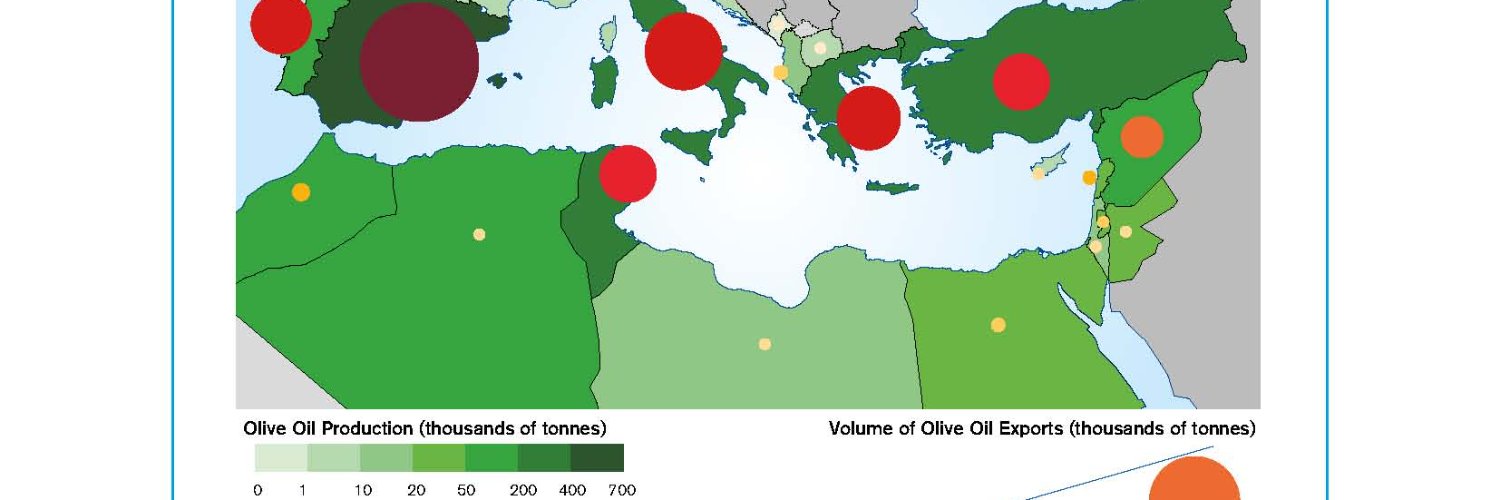
Today, we met to prepare the IEMed #MedYearbook2027.
Experts of the Yearbook’s Advisory Council shared the issues they believe are worth keeping a close eye on for their potential impact across the region — some of them share their views.
#MedYear2026: https://t.co/YebXjFlvtc
Our flagship publication is available online, but there’s a real sense of accomplishment in finally seeing the print edition come to life!
Full contents ⬇️
https://t.co/YebXjFlvtc
#Medyearbook2026 | Expert perspectives on a changing Mediterranean world
This #MedYearbook2026 article reflects and examines recent shifts in debates on academic freedom, focusing on formalized efforts to address restrictions through Committees on Academic Freedom.
By independent scholars @sevilcakir and #Sarah_Wessel.
🌐https://t.co/pkz2SbC87i
"Gulf sovereign wealth fund investment in🌊Med infrastructure represents a significant opportunity (...) The risk is that it happens poorly: under terms that benefit the investor more than the host"
🖋️Adam Dixon (Heriot Watt University)
#MedYearbook2026
🌐https://t.co/8nGvld1AiQ
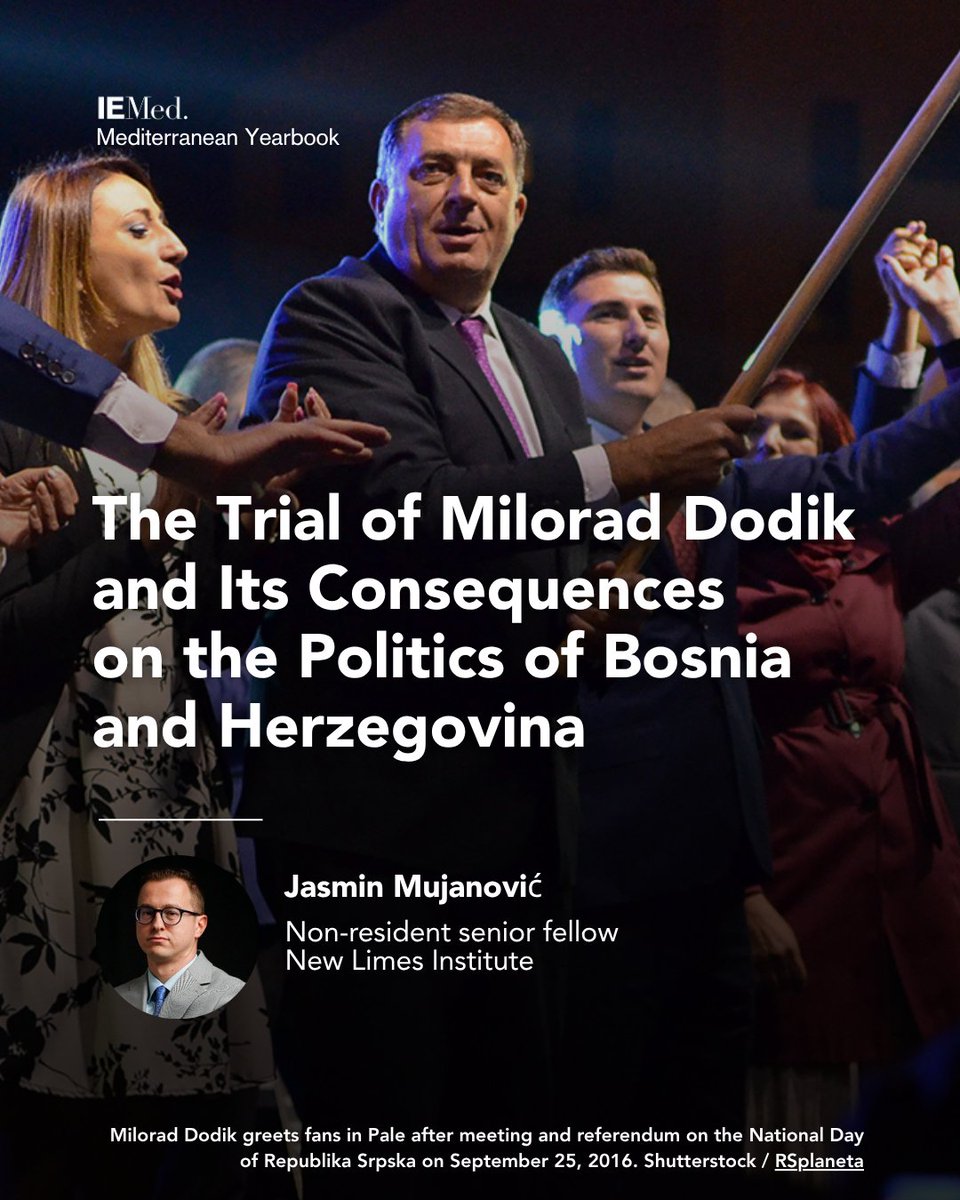
Strongman #Milorad_Dodik claimed victory in yesterday elections in #Bosnia.
Read this #MedYearbook2026 article by @JasminMuj to understand who he is, his confrontation with Bosnia’s state institutions, & what his continued influence could mean for Bosnia.
https://t.co/D2uiEeRcbi
Why has the EU continued business as usual regarding Israel when, according to #DanielaHuber, this behaviour makes limited sense from both a rationalist/realist and a normative/liberal IR perspective?
Read her article for #MedYearbook2026
🌐https://t.co/0YmWB8rxCX
The renewed focus on renewables and regional integration reflects both the revival of EuroMed cooperation and the EU’s adaptation to new energy, geopolitical, and decarbonization dynamics.
Read @AureliaMane's contribution to the #MedYearbook2026
🌐https://t.co/lolCMOwpYW
Salvatore Capasso (@cnrdsu) argues in his contribution to the #MedYearbook2026 that the #Mediterranean has progressively evolved into a differentiated and asymmetric #geoeconomic system, rather than a homogeneous space of convergence.
🌐https://t.co/YfxhPOZAge
"Med' actors should advance a shared regional framework for the Post-2030 Agenda to manage the region’s interconnected transitions across climate action, water security, resilient food systems and energy systems."
✍️🏽Alexia Faus (IEMed) #MedYearbook2026
🌐https://t.co/PXAhhm3C2s
"To rewind the “spiral” of economic insecurity in the Southern Med', the EU should consider supporting reforms, the energy transition, sustainable trade partnerships and economic integration as a political priority"
✍️🏽@AldoLiga for #MedYearbook2026
🌐https://t.co/sMZJxjbdfl
The political economy researcher @TinhinanEl ( @LSE_ID) examines how #AI is reshaping labour markets and paths to productivity gains across the Mediterranean, with particular attention to #MENA countries.
#MedYearbook2026
🌐https://t.co/07ZxjzIb5Q
"Tunisia's government has successfully secured a monopoly on power, but it has created a deeply brittle façade, very much similar to the one Ben Ali established after 1987."
Read senior researcher @ziedboussen's contribution to the #MedYearbook2026
🌐https://t.co/75lAoAlKBo
"The #MiddleEast is undergoing a profound transformation – it is being remade. But the process of remaking is complex and hardly reflects the vision of the remakers."
Read @JoostHiltermann's contribution to the #MedYearbook2026
🌐https://t.co/DnlvjSYmYq
"#ClimateChange is redefining economic geography. Understanding its dynamics is essential for assessing the broader transformation of the #Mediterranean’s economic order"
#MedYearbook2026 article by Eleftherios Giovanis & Oznur Ozdamar (@bakircayedu)
🌐https://t.co/dY8txwF8fo
"Why have #Arab countries remained passive, quiet and on the sidelines since 2023 as #Palestinians are being slaughtered in #Gaza and a silent #Nakba is taking place in the #WestBank?"
Read Bichara Khader's contribution to the #MedYearbook2026
🌐https://t.co/YebXjFkXDE
#ClimateChange is not only reshaping Mediterranean #tourism but fundamentally redefining its model, argues #AngeloSciacca, Senior Advisor and Consultant on Coastal and Marine Tourism, in his contribution to the #MedYearbook2026.
🌐https://t.co/WroW3wEDsW
Is #Lebanon at the dawn of a genuine opening with the coincidence of a new #reformist executive, a weakened #Hezbollah and a state apparatus with access to international financing?
Read @MerayMaddah's contribution to the #MedYearbook2026
🌐 https://t.co/nin5y02gLH
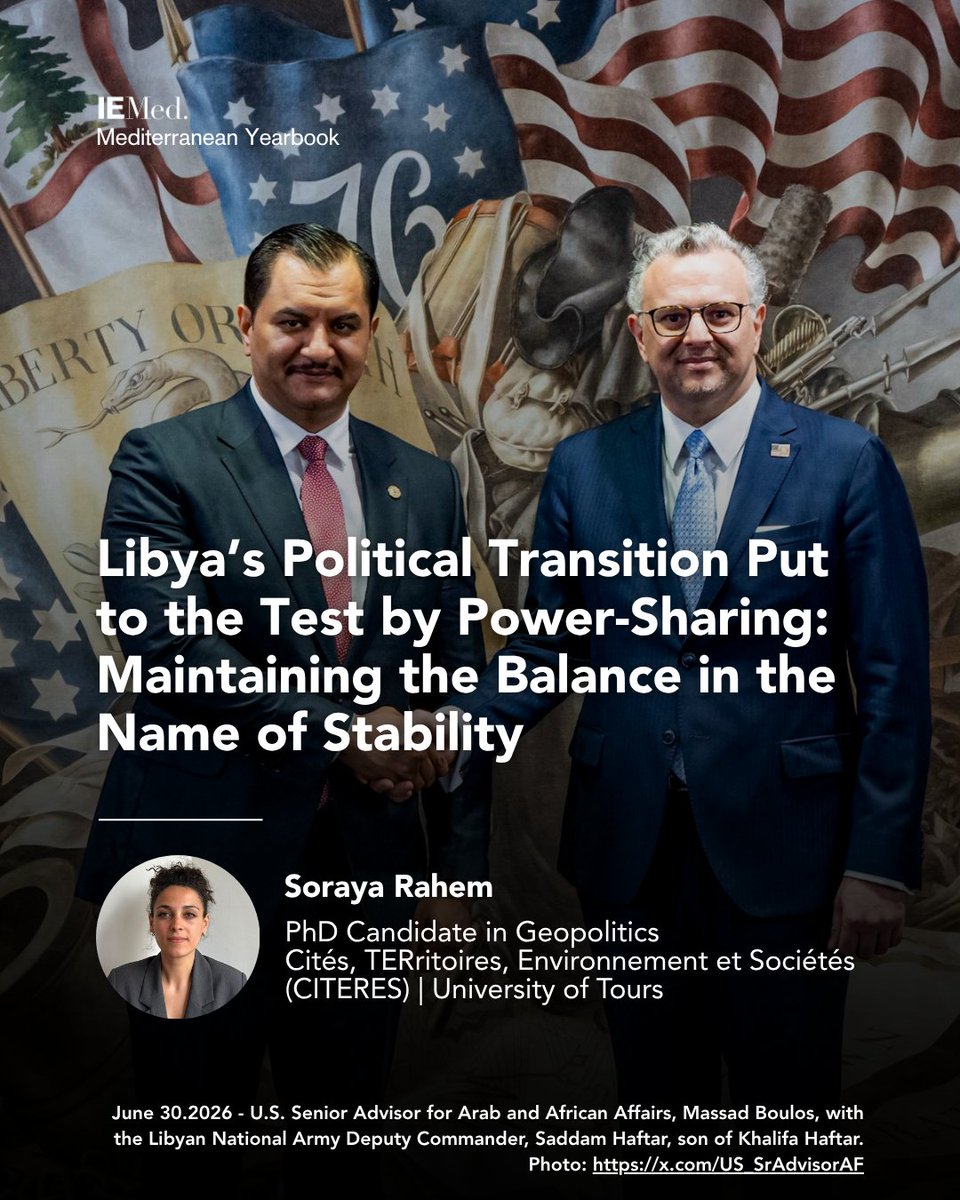
"Power-sharing arrangements in #Libya tend less to pave the way for political transformation than to reactivate arrangements among elites aimed at preserving their positions."
✍️🏾@Soraya_Rahem's contribution to the #MedYearbook2026
🌐https://t.co/9ase4kCER9
"The Middle Eastern conflicts of the past three years have reshaped the great-power competition between the #US, #China, and #Russia."
A contribution to the #MedYearbook2026 by Jean-Loup Samaan (@MEI_NUS Senior research fellow)
🌐 https://t.co/2cNf33PYhH
#Serbia finds itself in a deep political crisis after many years of democratic decline and increasingly strong anti-government protests, writes @NikolaBurazer, programme director at the Centre for Contemporary Politics (@csp_ccp).
🌐https://t.co/NhqFmkzd1F
#MedYearbook2026