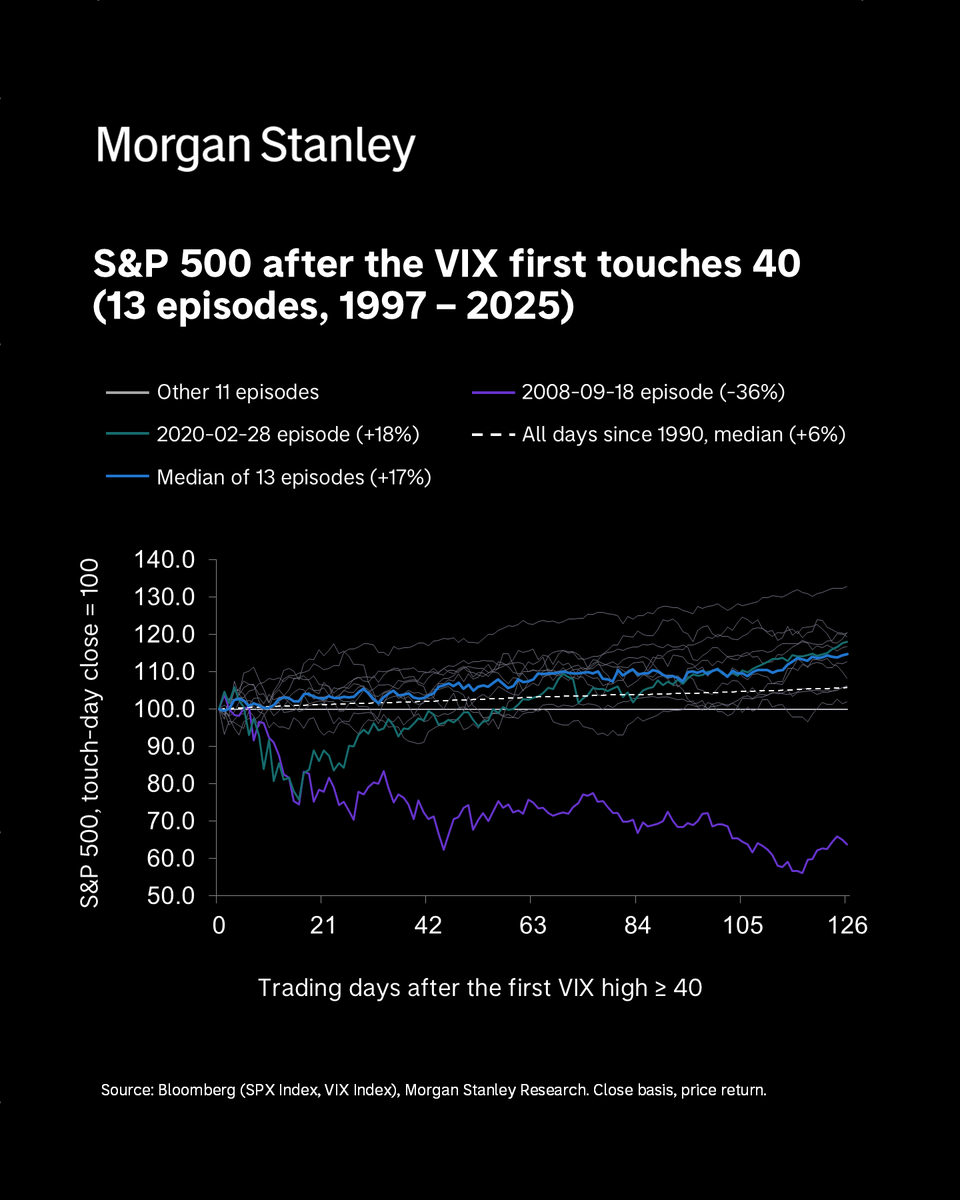
Heightened market uncertainty has often preceded recovery.
Across 13 episodes since 1997, the median S&P 500 path was up about 17% six months after the VIX first hit 40 points, compared with roughly 6% for a typical six-month window since 1990. But the range is wide: after the September 2008 peak, the index was down 36% six months later.
What’s next for markets?
At the @TomorrowXSummit, @ilianabouzali joined Stan Druckenmiller to discuss today’s market landscape, near-term risk management and the signals that could bring him back into the market.
Watch the full conversation: https://t.co/PVy8veLSIO
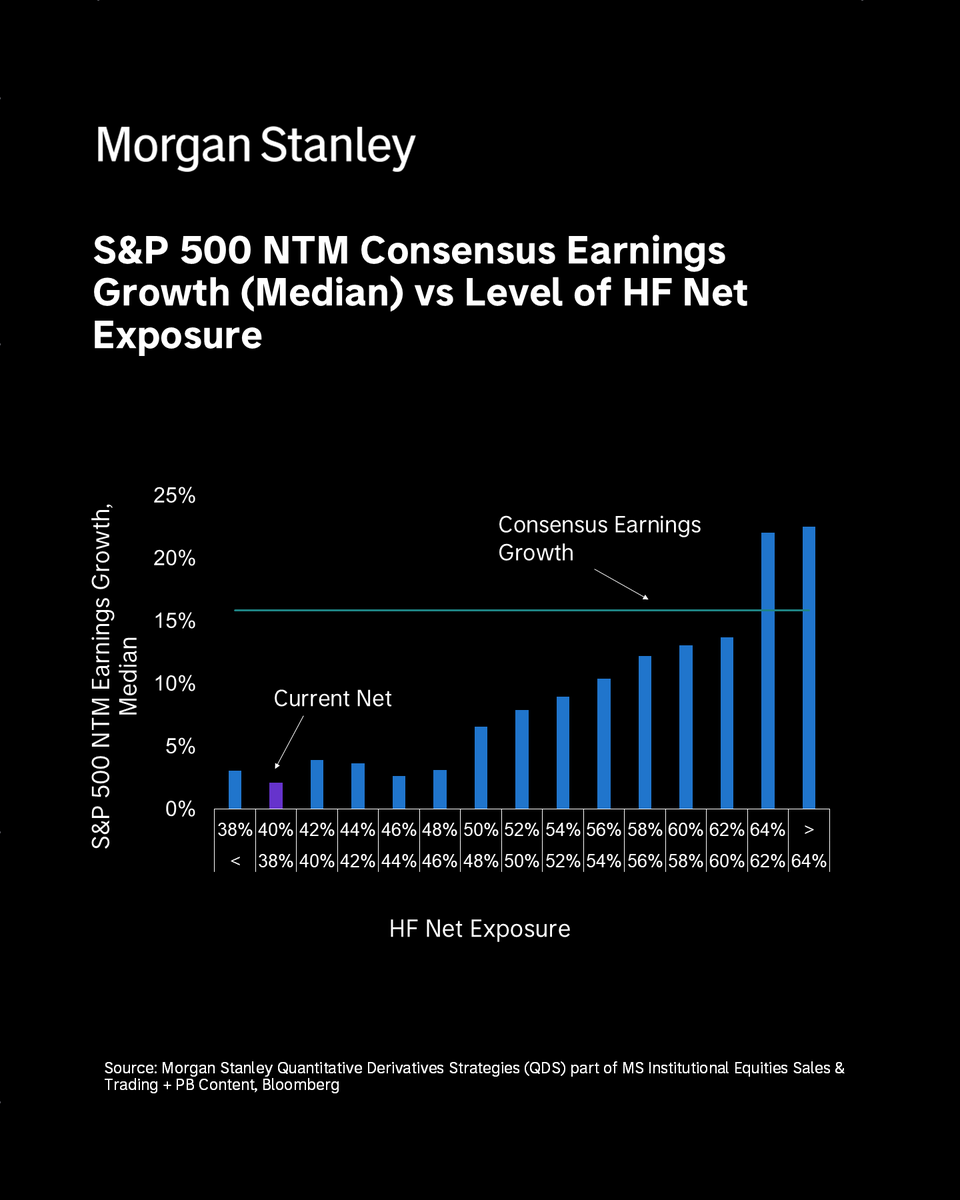
Investors are positioned for an earnings slowdown that is not in Wall Street analyst forecasts.
Typically, Hedge Fund exposures track fundamentals: stronger earnings growth = higher net leverage, slower earnings growth = lower net leverage, with a 58% correlation since 2016.
And US long/short Hedge Fund net exposures are low per MS PB Content: 41%, the lowest in a year and just the 6th percentile since 2010.
At these levels of nets, consensus next twelve-month earnings growth for the S&P 500 has been just 5% (median since 2016). That’s a long way down from current consensus next twelve-month EPS growth of 16%.
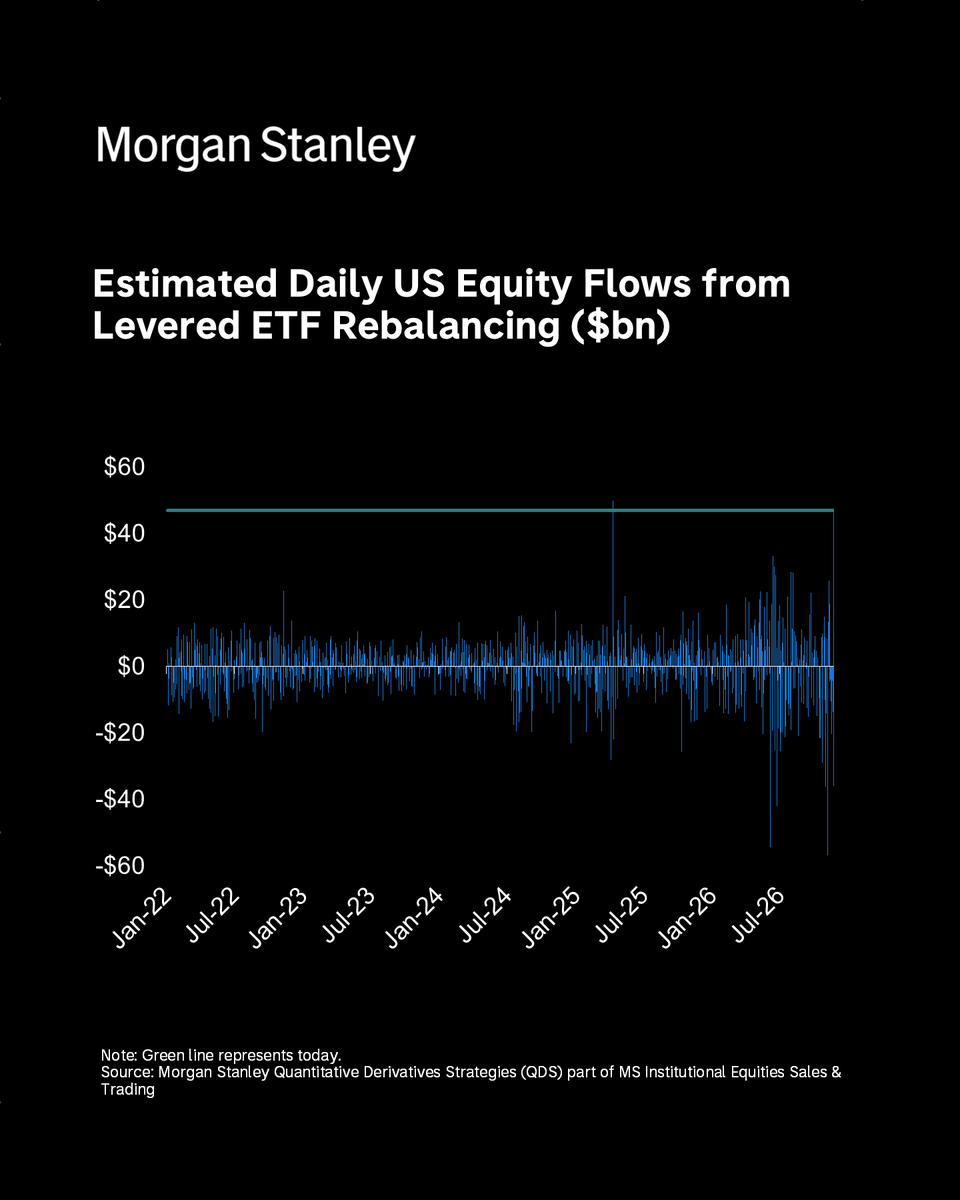
$47bn to buy: a near-record rally in Semis is creating a near-record amount of stock to buy from levered ETFs.
The SOX index is +15% today, the 4th most since creation in 1994. That rally means levered ETFs need to buy stock to maintain their target leverage, and they will have the 2nd most amount to buy on record, $47bn - an amount only eclipsed on the April 9th 2025 rally (when SPX was +10%). Estimates as of 10:40am Nov 23rd.
@NickTimiraos@WarrenPies But in 2018 we had a global manufacturing downside due to trade war. We currently are in an upswing. Of course this can change, but if you look at consumption, investment, agg wages, real wages, there are no sign of growth slowdown.
Investors came into this week thinking they had derisked but derisked for what kind of tape?
For a median shake-up yes, for a growth shake-up? No
YoY EPS was 40% growth (generational jump). The street is pricing another 10% for next year which in the face of higher rates, questions about capex ability and NVDA issues are right to be questioned. After a 40% move maybe another 10-15% expectation is too generous. Especially if contribution from the energy sector is going to come down together with Oil prices.
So we are seeing multiple derates because the market thinks earnings have peaked.
In a way, it's doing to SPX what it started doing to memory stocks last summer.
However, on the positive side, the economy is not weak, for now:
Consumption is tracking 2-3%
Investment 2-3%
Aggregate wages 4.5%
Real wages 2%
Still on the positive side, we had 40% YoY EPS growth, yet the SPX is barely up on the year. And SPX is within 1% of where it was in January. So one could argue that the EPS correction started a few quarters ago, and that up until now, we've had a silent bear market.
Not so silent anymore it seems. The market is pricing the idea that the Fed will cause a growth shock.
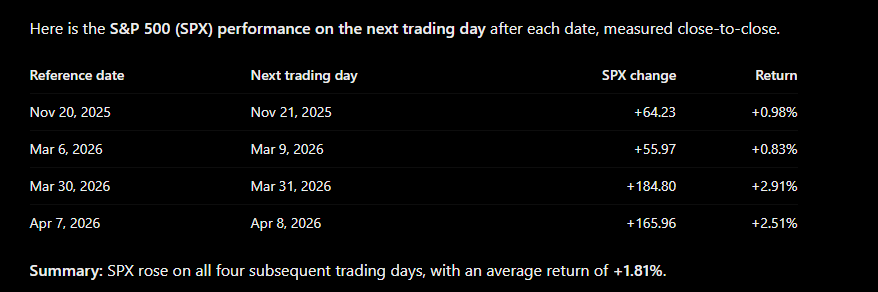
$VIX1D is on track to close above 30 again. Here's a refreshed version of the post from 2 weeks ago, this time including the returns 5 days after. Win rate to go long at the close remains 100% 1 day after and 80% 5 days after
$VIX1D is on track to close above 30 again. Here's a refreshed version of the post from 2 weeks ago, this time including the returns 5 days after. Win rate to go long at the close remains 100% 1 day after and 80% 5 days after
Very good take on the state of the AI trade. It’s not often you see a deep and balanced (bull vs bear) analysis on a topic where one-sided views tend to dominate.
It's been a while, but the ANT IPO deserves a quick post.
Most of the AI chatter I read on X is lost in the philosophical ether. Not worth the scroll.
In a nutshell: the bears are pressing a narrative that is six months old and, to their credit, it played out. The bulls remain focused on the transformative impact of the technology, how early we are in diffusion and, importantly and often forgotten, how the economy is transitioning to a cognitive economy.
My view: both sides are right. But the bear case has been priced across the infrastructure layer, and with the ANT IPO the bull case gets a vehicle to break through the AI wall of worry.
The bear case has real inputs: US data center regulation, funding scarcity as weaker builders compete with heavy gov bond supply, and a build-out so big and fast it creates its own macro friction. Hot growth, sticky inflation pockets on top of war-driven energy inflation, shortages of electricians, gas turbines, and so on.
With no visibility on demand for tokens, the entire burden of proof fell on the builders. AI became a capex story. And a capex story with no visible demand gets derated in the face of observable real-world frictions.
But capex is not the AI story. The story is intelligence penetrating human workflows. That penetration is early, and compute coming online is what lets it diffuse.
Anyone close enough to the frontier and the applied frontier knows from experience that token demand is multiples of what compute supply can serve. The bearish read on AI usage usually comes from the shallow end of the adoption curve: people who use AI as a better search box and extrapolate their own experience to everyone else. They point to stats like Ramp spending data without acknowledging the risk of generalizing from a fixed sample. To be clear: a technology that grows by diffusing cannot be judged from a fixed sample of users. A sample that doesn't change can't tell you the technology isn't spreading.
I often think AI has taken on a mythological quality. It is promised as the answer to so many human problems that we forget the destination still has to be walked to. Diffusion, applied frontier research and implementation are that walk.
With the ANT IPO, markets get a recurring, public read on the demand side for the first time. Every analyst and investor gets visibility into the business model, which will anchor how the technology is benchmarked as a revenue and profit engine.
If the bulls are right, revenue scales as compute unlocks, and the AI ecosystem gets its anchor. The real-world frictions become a pace story rather than a speculative inference about demand or usage.
Back to my earlier point: bulls and bears can both be right. Demand for intelligence can drive demand for compute that is multiples of supply, but compute supply can only grow as fast as the macroeconomy can deliver it. Ultimately this ends in a longer, more lasting cycle.
Is History going to repeat itself?
In June, the bottom (until end of July) took place on June 10th. SpaceX IPOed on June 12th.
Are we also going to bottom near term 1-2 days before Anthropic IPO?
$NVDA up 4% post earnings on confirmation from the board that Jensen is definitely not coming back is an encouraging sign for risk.
$SPX volatility for tomorrow was very bid ($VIX1D closed at 28) so all else being equal this will provide a steady bid to equities to counter the forced selling from Vol Target funds.
Next risk up, $ANT on Thursday
It doesn't need to be just a coincidence, it's quite possible that many of the outages are because people are fervently trying to prepare for AI offense and the cure turns out to be somewhat painful also.