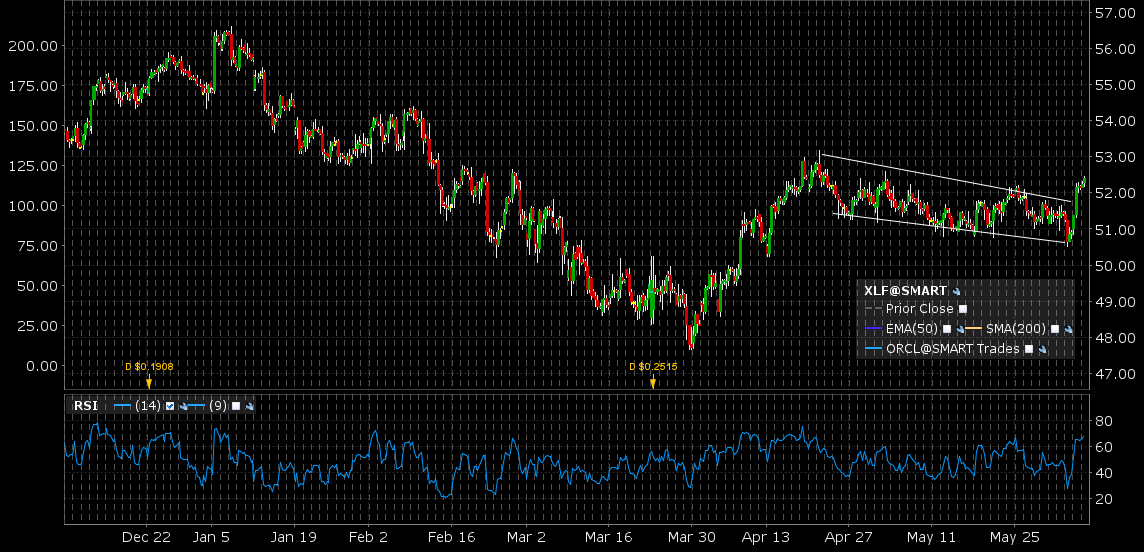
Largely agree with Matt, but I’m even less concerned re inflation. Inflation can be manageable if nominal growth is strong and rates are starting from a high point, which is the case here.
Some observations…. Generally ‘logical’ price action. 1) AI stuff people want to own is up, 2) The Meh 7 has a supply / space problem short term, 3) ‘other’ stocks have a CPI / Warsh problem (the former may help de-risk the latter). Some vol control selling today, as well. A couple days of digestion is normal. And ‘bend but don’t break’ is a bullish signal.
@brandonjcarl That's a distortion of reality.
A more accurate representation is: there is a market for expensive cars and another one for inexpensive cars. people will buy the very expensive ones bc it can do things cheap cars cant do. other people will buy cheap cars bc it covers basic needs.
A French engineer who lives quietly in Paris has spent 30 years writing software that the entire internet now runs on without knowing his name.
He wrote the code that streams every YouTube video, every Netflix show, every TikTok clip. He wrote the code that runs the virtual servers underneath AWS, Google Cloud, and Microsoft Azure. He calculated more digits of pi than anyone in history. He has no Twitter. He has no marketing. He just keeps shipping.
His name is Fabrice Bellard.
Here is the story, because almost nobody outside the systems programming world knows what one man has built.
Fabrice was born in 1972 in Grenoble, France. He studied at École Polytechnique, the top French engineering school. He never went to Silicon Valley. He never built a startup empire. He just wrote code.
In 2000 he started a project called FFmpeg, an open-source multimedia framework for encoding, decoding, and streaming video. He was 28. The project did one thing nobody else had done well. It handled every video and audio format that existed, in one library, on every operating system. He led it himself for years.
Today FFmpeg is the invisible engine of the internet. YouTube uses it. Netflix uses it. VLC uses it. Chrome and Firefox use parts of it. Every Android phone, every iPhone, every smart TV, every video editing tool you have ever touched runs FFmpeg somewhere underneath. If you have watched a video on a screen in the last 20 years, Fabrice's code processed it.
He was not done.
In 2003 he started QEMU, a machine emulator and virtualizer. He wrote it solo until version 0.7.1 in 2005. QEMU lets you run any operating system on any other operating system. It became the foundation of modern virtualization. KVM, the Linux kernel hypervisor, runs on top of QEMU. Every major cloud provider, AWS, Google Cloud, Microsoft Azure, IBM Cloud, runs virtual machines on infrastructure built around it. The Quick Emulator is the most cited piece of cloud infrastructure code on Earth.
He kept going.
In 2001 he won the International Obfuscated C Code Contest with a small C compiler that grew into TCC, the Tiny C Compiler. TCC can compile and boot a Linux kernel from source in under 15 seconds. In 2004 he calculated the most digits of pi ever computed at the time, using a personal desktop computer and an algorithm he derived himself called Bellard's formula. In 2011 he wrote a complete PC emulator in pure JavaScript that runs Linux in your browser, a project called JSLinux that engineers still cannot believe is real.
In 2019 he released QuickJS, a small but complete JavaScript engine that fits where V8 cannot. In 2021 he released NNCP, a neural network based lossless data compressor that immediately took the lead on the Large Text Compression Benchmark.
Then he turned his attention to large language models. He built TextSynth Server, a web server with a REST API for running LLMs locally. He released ts_zip and ts_sms, compression utilities that use language models to compress text and short messages at ratios traditional algorithms cannot reach. He released TSAC, a very low bitrate audio compression system. In December 2025 he released Micro QuickJS, a new JavaScript engine for microcontrollers, separate from QuickJS, designed for environments with almost no memory.
Fabrice co-founded a telecom company called Amarisoft in 2012, where he serves as CTO. Amarisoft builds 4G and 5G base station software used by carriers and labs around the world. He has been running it for over a decade while continuing to ship personal projects from his own home page at bellard dot org
He has no Twitter. He has no Instagram. He gives almost no interviews. His personal website is a flat list of projects with no styling, no fonts, no marketing copy. Just titles and links.
A quiet French engineer who never moved to Silicon Valley wrote the code that quietly runs the internet.
He is still shipping.
While I generally respect this detailed layout from Atlas Peak Research, the broader commentary across X on this "balance sheet trade" reveals a fundamental misunderstanding of corporate finance, risk management, and market power.
A few critical points everyone trying to "outsmart" the hyperscalers seems to be losing sight of:
1. The Arrogance of the Credit Narrative
The notion that hedge fund managers working for annual bonuses can assess credit risk or evaluate a margin of safety better than the board at Berkshire Hathaway is pure fallacy. Berkshire did not execute its massive $10B private placement into Alphabet on a whim—it was an intensely structured deal negotiated with a built-in safety cushion (~6% discount, securing Class A at $351.81 and Class C at $348.20). To assume Greg Abel and the board didn't rigorously model tail risks and collateral values before committing billions is complete arrogance. Snagging shares in the open market right now at less than 3% to 5% above Berkshire's strict floor is an absolute steal.
2. The Power Balance: Who Controls Whom?
The thesis that Google is structurally captive to its chip designers or component vendors flips reality on its head. Google has spent a decade proving it can vertically integrate and in-house almost anything to prevent being held hostage for margin. As SK Hynix’s leadership has previously noted, memory and optical suppliers know that if they overplay their hand or restrict supply for too long, hyperscalers will simply architect them out of the blueprint.
People are completely forgetting innovations like Groq, which structurally demonstrated that architectural breakthroughs can completely alter memory efficiency and inference speeds. Google has the unmatched intellectual capital and engineering depth to override these suppliers whenever they choose. They do not answer to Nvidia or anyone else.
3. Supply-Side Capital Optionality
The bears act as if Google is forced to build data centers and sell capacity at a loss if unit economics soften. It’s backwards. Google operates a highly lucrative, self-funding cash machine. If they cannot pass on the infrastructure costs or achieve their desired internal rate of return, they simply slow down the capital expenditure spigot. They are under no obligation to expand capacity unless the underlying demand justifies it.
4. The Growth Engine is Already Validated
Look no further than Morgan Stanley’s recent report, "Tech Giant Earnings Reports: Revenue from Hyperscale Cloud Vendors is Accelerating." The data shows that Google Cloud's backlog nearly doubled in a single quarter, jumping from $243 billion to an astonishing $462 billion. Driven by this staggering demand, Morgan Stanley estimates that Google Cloud's revenue is on track to grow an incredible 86% in 2027. Crucially, this estimation is highly conservative because it serves as the baseline for capacity expansion and entirely excludes the massive financial upside from Google's parallel move to sell TPU chips directly to third parties as independent first-party silicon.
Bottom line: Suppliers like Broadcom and Celestica are catching an incredible cyclical tailwind right now, but they are the plumbing—not the landlord. Never confuse the entity paying for the buildout with the entity that actually controls the network rails and prints the cash flow. I’ll gladly sit on the same side of the table as Berkshire- when i can scoop up the shares at less than 2% more than what Berkshire scooped them up for.
This headline was completely missed.
I think this is a significant confirmation of what we believed.
U.S. forces are escorting/ protecting ships crossing the Hormuz.
It’s a very big deal.
When John Carmack writes "there is now a SiC MOSFET that can operate on 10kV electricity, opening up the possibility of working directly with medium voltage AC power transmission lines without stepping down," he is describing a Wolfspeed product. The "skip the step-down transformer" use case is exactly the Solid State Transformer (SST) application the BofA report identified as Wolfspeed's unique enabling capability.
He does not name Wolfspeed. Anyone in the ecosystem knows who he is referring to.
$WOLF
Nicolai Tangen, CEO of Norges Bank Investment Management pressed IBM CEO Arvind Krishna directly on whether AI is a bubble (Save this).
And Krishna responded with what has become known inside financial circles as the $8 trillion math problem.
A single gigawatt of AI data center capacity filled with accelerators, liquid cooling, and power infrastructure costs roughly $60 to $80 billion to build and populate.
The industry has committed to more than 100 gigawatts of buildout globally.
That is $6 to $8 trillion in capital expenditure and because AI grade hardware depreciates on a five-year cycle, that entire sum must be effectively replaced and refreshed every five years.
To service the interest on $8 trillion in capital at a conservative 10% borrowing rate, the AI ecosystem would need to generate approximately $800 billion in annual profit, a number that currently exceeds the combined net income of every large technology company in the world.
Goldman Sachs estimates $7.6 trillion in aggregate AI CapEx between 2026 and 2031 alone, and Reuters Breakingviews has flagged that even if the capital is available, physical bottlenecks power permits, land, cooling infrastructure, and electrical grid connections mean that half of the planned data center projects are being cancelled or delayed before they ever go live.
Krishna also raised a second, structurally distinct concern that markets have largely ignored.
He argued that the largest foundation models, GPT, Gemini, Claude, Llama are converging toward commodity status.
When a product is a commodity, switching costs collapse.
When switching costs collapse, pricing power evaporates and margins compress regardless of how much capital was spent building the capability.
Morningstar's equity research team conducted a review of 132 technology companies in 2026 and found that AI had caused moat rating downgrades across roughly 40 major stocks concentrated in enterprise software, IT services, and SaaS with Adobe, Salesforce, Workday, and ADP among the companies whose competitive moats have materially weakened.
The implication is that the companies spending the most on AI model development may be building an asset that is simultaneously the most expensive to produce and the most difficult to monetize with durable margins.
This bear case is serious but it is also incomplete and that is what makes Krishna's framing so important to understand precisely.
When pressed further, Krishna explicitly said he does not believe there is an AI bubble in the technology itself only in a subset of the infrastructure capital that is being deployed against speculative assumptions rather than proven demand.
He draws the same analogy, the fiber optic overbuild of the late 1990s. Dozens of companies went bankrupt laying cable that nobody was using.
And yet that exact "wasted" infrastructure became the physical backbone of every cloud company, every streaming service, every mobile network, and every modern AI training cluster that followed.
The builders lost, the infrastructure won.
And the companies that were built on top of it, Amazon, Google, Netflix, Salesforce compounded for two decades.
The question, as Krishna framed it, is not whether AI is real.
It is which capital deployment earns a return versus which gets stranded and crucially, whether you own the stranded assets or the companies built on top of them.
On winners, Krishna was direct that distribution is the moat on the consumer side, and enterprise is wide open.
The data supports this, Meta with 3.3 billion daily active users across Facebook, Instagram, and WhatsApp is building AI into a distribution network that no startup can replicate at any cost.
Meanwhile, the productivity evidence arriving in real time is beginning to challenge the bear case's revenue projections.
Jensen Huang just showed on stage at Computex that GitHub commits, the universal measure of global software output nearly tripled in the first months of 2026, effectively converting $3 trillion in developer salaries into $9 trillion in productive output.
That is measurable, real time economic value already flowing through the system and it feeds directly back into token demand in a compounding loop that Krishna's static CapEx math does not fully capture.
We are very early in the Agentic Era build-out and it will be much larger than people expect. Here are 3 signs:
1️⃣ Boring stocks are surprising by 10-20% with step changes in order growth. $CSCO $DELL $HPE (+20% despite high expectations)
Investors are expecting beats&raises, but the magnitudes of beats on what some believe are peak earnings is 🔥
2️⃣ Each AI Agent needs a computer...the key is that while population growth is limited, AI Agent growth is unlimited
…or limited only by compute. This is why we are seeing insane growth in traditional servers (CPUs etc.)
3️⃣ Mega Caps are starting to come to the mkt for captial. The Agentic Era Build out is so large, cash flow on its own cant fund it.
$GOOG just opened the capital floodgates for Mega Caps to raise money ATM offering $40B. Buffet's $BRK (the concervative) signing up for $10B.
The prior AI build out (Model Training Era) was financed with Mag7 cash flow, but now that is not enough ...more $$$ need to be invested.
To those who think “Google raising $80bn is just the beginning”, keep in mind that large equity raises have happened almost on a continuous basis the past year.
To name a few: Anthropic has raised roughly $108–$123+ billion in equity over the last 12 months (June 2025–June 2026), while OpenAI has raised around $162+ billion.
Whether public or private, a raise is a raise.
Moreover, hyperscalers have raised north of $100 billions in debt over the past year. Yet IG spreads are at the tightest.
The capacity the market has to absorb all this paper is much bigger than you think.
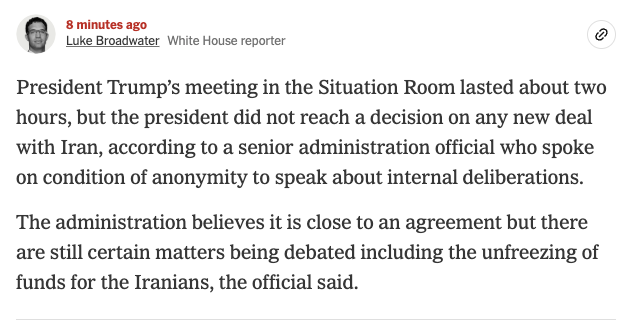
Trump has put off a “final determination” on the Iran proposal after a two-hour Situation Room meeting, NYT reports. The administration reportedly believes it is close to an agreement, but no decision has been made yet. One key sticking point: whether to unfreeze funds for Iran as part of a possible ceasefire extension.
I respect those who are maintaining a healthy dose of skepticism, but fwiw, if the US is saying there's a deal and the Iranians are acting as though there's a deal, the odds are pretty good there's a deal.
When John Carmack writes "there is now a SiC MOSFET that can operate on 10kV electricity, opening up the possibility of working directly with medium voltage AC power transmission lines without stepping down," he is describing a Wolfspeed product. The "skip the step-down transformer" use case is exactly the Solid State Transformer (SST) application the BofA report identified as Wolfspeed's unique enabling capability.
He does not name Wolfspeed. Anyone in the ecosystem knows who he is referring to.
$WOLF
I have been very impressed by @SemiAnalysis_ . I think of myself as a wide ranging systems engineer, looking for value at every level from the chip specs to the user interface, but SA exposes me to additional levels of "the system", both above (datacenters) and below (semiconductor fabrication). It probably puts me in "just knows enough to be dangerous" territory.
Neat things I learned today:
Some of the 800VDC datacenter design choices leverage parts commoditized by electric vehicles.
There is now a SiC MOSFET that can operate on 10kV electricity, opening up the possibility of working directly with medium (ha!) voltage AC power transmission lines without stepping down.