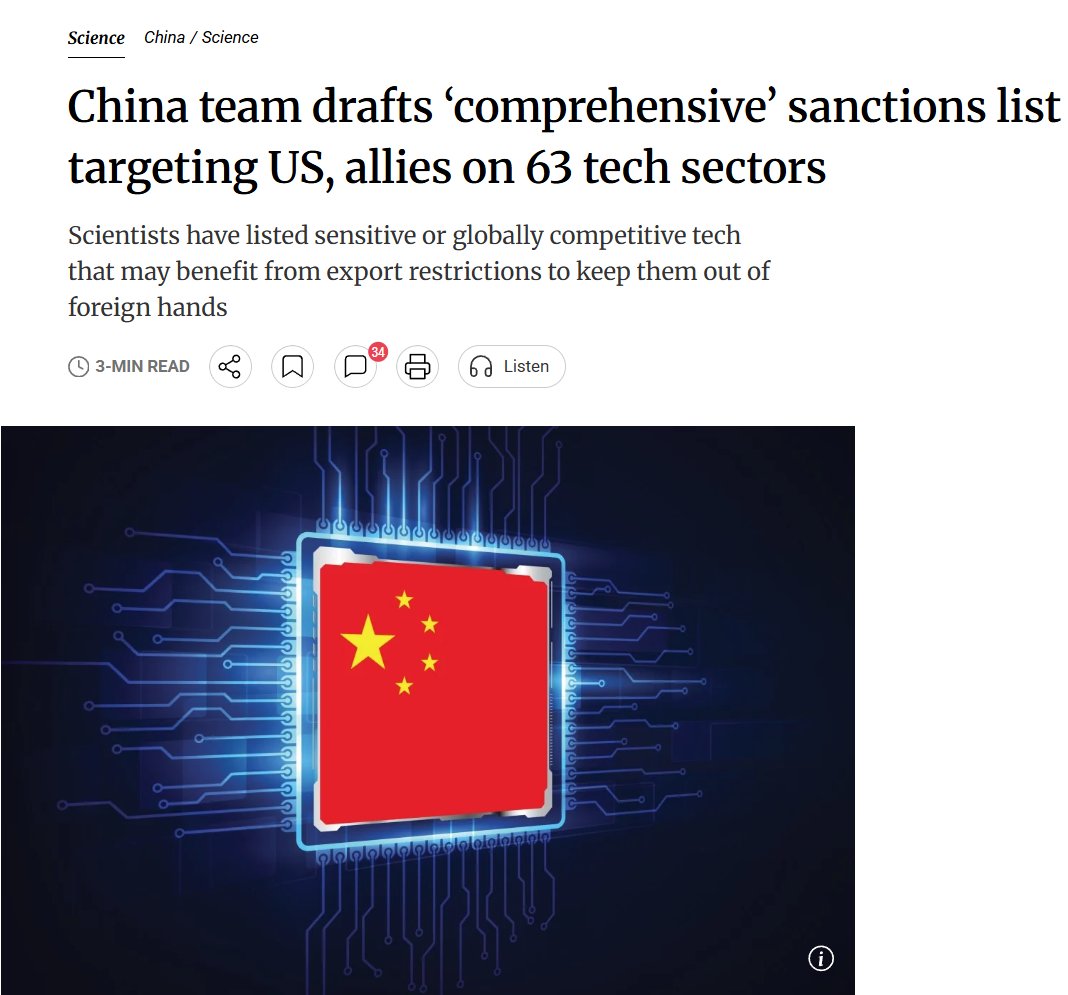
China’s counter-response to U.S. bullying tactics is entering a critical phase, marked by the establishment of a comprehensive, systematic "toolbox"—a strategy modeled, notably, after U.S. practices.
Since the trade war launched against China during the first term of the Trump administration, the United States—in concert with its Western allies—has continuously tightened restrictions on China’s access to high-end technologies. These restrictions focus on semiconductors, artificial intelligence (AI), quantum computing, aerospace, supercomputing, and various dual-use technologies (civilian-military applications), with the aim of curbing China’s development in high-end manufacturing and frontier technologies.
However, over the past decade, as China has achieved leapfrog breakthroughs in numerous strategic technological fields, the original dynamic has fundamentally shifted. China is no longer merely a passive recipient of international technological restrictions; it now urgently needs to establish its own autonomous and controllable system for managing technology outflows—particularly regarding core technologies in which it has already secured a global leading edge.
On June 1, Hong Kong’s *South China Morning Post* reported that Chinese research teams have drafted a "comprehensive" export control list targeting the United States and its allies, covering 63 distinct technological fields. Researchers have identified technologies deemed strategically sensitive or globally competitive, with the objective of preventing their outflow abroad through export restrictions.
This pioneering study, titled *Framework for Selecting Technologies for Export Restriction: An Empirical Study*, was first published on March 19 in the *Bulletin of the Chinese Academy of Sciences*. The paper delves deeply into "a fundamental strategic issue that has rarely been publicly discussed in China in recent years." It proposes China’s first relatively comprehensive framework for identifying technologies subject to export controls, ultimately selecting 63 specific technologies characterized by strategic sensitivity or global competitiveness. These technologies span fields such as advanced materials, quantum communication, AI hardware, energy systems, biotechnology, and aerospace engineering.
According to the study’s assessment, the technologies designated as "Tier 1" restricted exports include: satellite-based quantum-encrypted communication, electromagnetic launch technology, solar cell-related technologies, general-purpose miniaturized AI edge computing devices, metal recovery technologies for rare earth waste residues and tailings, and advanced high-strength steel production technologies for the automotive industry, among others. Other technologies include graphyne material preparation, deep-ultraviolet crystal fabrication, ultra-large-scale offshore wind turbines, space robotics, high-performance carbon electrode fabrication for perovskite solar cells, autonomous orbit determination via inter-satellite links for the BeiDou-3 navigation system, and free-space optical communication.
In their paper, the research team notes that this framework draws partly upon the export control mechanisms that the United States has long had in place. Through decades of evolution, the U.S. Department of Commerce has established a methodology that combines expert technical reviews with public consultations to identify specific technological domains and parameters subject to export bans or restrictions. The paper points out that, historically, U.S. export controls have focused not only on military or dual-use technologies but have also closely targeted two specific categories of critical technologies: first, fields where latecomer nations—exemplified by my country—are rapidly rising and, while not yet technological leaders, show the potential to challenge U.S. monopolies (e.g., integrated circuits, supercomputing, and civil nuclear power); and second, cutting-edge foundational technologies poised to shape the future landscape of science, technology, and industry (e.g., 3D printing, brain-computer interfaces, and artificial intelligence).
Evidently, the Chinese research team has sought to construct an assessment methodology tailored to China’s specific stage of development and industrial structure. Their screening process draws comprehensively upon existing domestic and international technology lists, the International Patent Classification (IPC) system, technology gap models, and patent co-occurrence network analysis; furthermore, it has undergone multiple rounds of expert review involving stakeholders from industry, academia, and government agencies. The study also relies heavily on patent databases to identify technological domains in which China possesses a comparative advantage. Taking the field of advanced materials as an example, the research team analyzed over 215,000 international patent records, employing machine learning clustering models and network analysis to pinpoint key technological nodes.
The significance of this research extends far beyond export policy alone. In the past, my country’s science and technology development strategy centered primarily on technology acquisition and addressing industrial deficiencies. However, as Chinese enterprises and research institutions increasingly join the global "first tier" across numerous cutting-edge sectors, issues such as technological sovereignty, technological security, and the protection of critical strategic technologies have now become subjects of routine discourse and policy deliberation within China.
The study also observes that my country’s institutional framework for ensuring the security of technology trade currently lags behind those of developed nations such as the United States, the United Kingdom, France, Germany, and Japan—countries that, through decades of development, have successfully established comprehensive systems for technology export control. Based on this study, it is recommended that relevant competent authorities, grounded in top-level design, effectively undertake three key tasks: monitoring and anticipating trends in foreign technology export restrictions while strengthening preventive measures; refining the selection processes and methodologies for my country's own restricted export technologies; and advancing the practical implementation of control measures for these technologies.
Deployed Obsidian, reduce attrition to fill it with valuable info: for us it was knowledge repository across taxation regulations, double taxation treaties, create lint process daily, then connect with our sharepoint client data and internal departments (meeting, manuals, inductions, etc), then upgraded to a VPS with Qdrant, then built an MCP to let Claude query the data in VPS… set different permission to different tier knowledge based upon user IDs matching MS365 credentials. Loving it…
@aiseomastery@om_patel5 I agree. I keep two Obsidian Vaults in synch, one for the team to synch up and contribute to and a restricted one for my personal stuff. I have scripts checking for restricted content just in case to prevent personal items to be stored in the wrong vault.
I switched to Opus 4.7 the day it dropped.
Switched back to 4.6 two days later.
The people calling it a regression?
They’re right. But most of them stop at “it got dumber” and move on. The problem runs deeper than output quality.
Anthropic shipped three changes in one release. Nobody’s connecting them.
The tokenizer is new.
Same prompt, same content, but 4.7 chews through 1.35 to 1.47x more tokens than 4.6 did on the exact same input.
Simon Willison ran the numbers on the system prompt itself and got 1.46x.
Price per token didn’t change. But your bill did. Roughly 40% more expensive per session and nobody adjusted the sticker.
Then there’s adaptive reasoning.
Sounds great until you realize what it means. The model now decides how hard to think about your question.
Not you. The model.
So when people keep saying “4.7 gives me shallow answers on complex problems” … yeah. It decided your problem wasn’t worth the compute.
And the part almost nobody mentions. Switching from 4.6 to 4.7 nukes your entire prompt cache.
Every cached prefix, gone. Your next cold start costs 1.45x what it used to. That hits immediately.
Now stack all three. You’re paying more per token. Getting less thinking per request. And your cache is wiped on day one.
Cheaper inference for Anthropic. Worse economics for you. Packaged as an upgrade.
The Pro subscribers burning through their limit in 3 messages aren’t doing anything wrong. They’re just the first ones feeling it.
If you’re running anything real on Claude right now, stay on 4.6.
It’s more predictable, more reliable, and after this tokenizer change, genuinely cheaper per task you actually complete.
@Saccc_c Can you guys share a bit more detail in terms of token usage for this scenario? I assume the interactive (Claude Code / Obsidian) scenario shown assumes Locap REST API + MCP wrapper.
@MushtaqBilalPhD To make it accessible to an entire small team instead than running it on a single machine, wouldn’t it be best to install for example on Google Drive or on a Sharepoint file system?
@GBX_Press@Secchicandi2 BS: greetings from Dubai. We just finished our weekly grocery shopping for the family and all supermarkets are fully stocked at normal prices.
🚨OIL UNDERPRICED BY FINANCIAL MARKETS
Goldman’s Jeff Currie says 'paper' crude oil near $100 is disconnected from physical markets trading barrels between $130 and $170, with refined products above $200.
A clear disconnect between paper and physical oil trade.
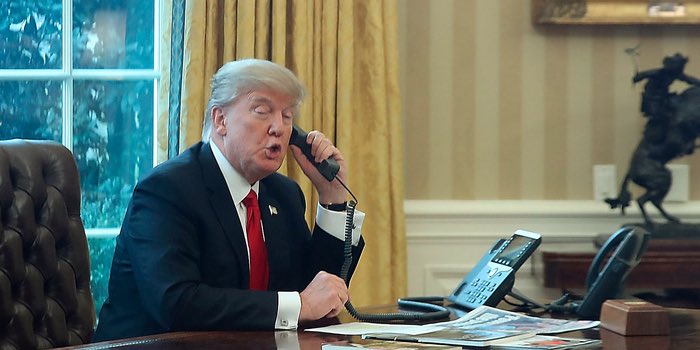
BREAKING: Trump is personally calling European allies and regional governments begging them to send warships to reopen the Strait of Hormuz.
Read that again.
The President of the United States, commanding the most powerful navy in human history, is calling around asking for help to reopen a 21-mile waterway.
That single fact tells you everything you need to know about how severe this crisis actually is.
If the US could reopen Hormuz alone, it would have done so two weeks ago. It has not. The Navy confirmed on March 12 it is “not ready” for escort operations. Minesweeping assets were retired in 2025. Japan and Australia have already declined. Now Trump is demanding roughly seven countries send warships, framing it as reciprocity for US support in Ukraine, warning NATO faces a “very bad future” if allies refuse.
No commitments have been received.
Zero.
And while heads of state negotiate who sends which frigate, the biological clock that governs whether four billion people eat next year is ticking toward deadlines that do not wait for coalition logistics.
The Corn Belt needs nitrogen applied by mid-April. India needs Kharif season prep by May. Australia needs urea by June. These are not financial deadlines that reprice. They are photosynthetic deadlines that, once missed, lock in yield losses no subsequent intervention can reverse. The food the world eats in late 2026 and early 2027 is being decided right now, in fields, not in war rooms.
Here is what the coalition talk actually means for markets:
It confirms the crisis is real. Governments do not scramble multinational naval coalitions for temporary disruptions. It confirms the US cannot solve this alone. It confirms the timeline is months, not weeks. The 1987 Tanker War coalition took months to assemble and attacks continued throughout. The Red Sea crisis is 26 months old and premiums never normalized. Even if allies commit warships tomorrow, minesweeping a 21-mile corridor saturated with Iranian mines and drones while under active fire takes weeks of operational preparation before a single fertilizer vessel transits safely.
The $20 billion DFC reinsurance backstop with Chubb has zero confirmed fertilizer vessel utilization. Insurance pays for loss. It does not clear mines.
Meanwhile, the fertilizer system continues to fracture in real time. One-third of seaborne fertilizer trade passes through Hormuz per UNCTAD. Nearly 49% of traded urea is tied to conflict-exposed exporters. Bangladesh has shut five of six urea factories during its primary rice season. India asked China for emergency urea. China responded by banning phosphate exports through August. Egypt is hemorrhaging foreign reserves to feed 69 million people on a bread subsidy it cannot afford. 318 million people were at crisis-level hunger before any of this started.
The market is pricing a 45-day disruption because it heard “Trump building coalition” and assumed resolution.
The evidence says 90 to 150 days minimum. Coalition formation, escort logistics, minesweeping, insurance recalibration, vessel re-underwriting. Each step sequential. Each step taking weeks. The planting window closes in six.
Trump’s phone calls are not the solution. They are the confirmation signal.
The most powerful country on Earth just told you it cannot fix this alone. Believe it.
The planting window does not care about your coalition.
It is closing.
Full crisis analysis: https://t.co/iFmUcarGdV
Global oil production is now down 9mm bbl/d and flows down ~15mm bbl/d. Oil at $95 does not come remotely close to reflecting this reality, and things are getting exponentially worse with each passing day. Is there an “invisible hand” at play?