Forthcoming in AEJ: Macroeconomics: "Fiscal Policy in a Networked Economy" by John Sturm Becko, Joel P. Flynn, and Christina Patterson. https://t.co/kPbdRWQYzx
New, revised and expanded WP with @tomasmartinezzz and @ASollaci!
How do minimum wages affect firms' life cycles, business dynamism, and aggregate productivity?
We use Brazilian admin data, theory, and a quantitative macro model.
Link: https://t.co/r4moFxwowZ
🧵 below:
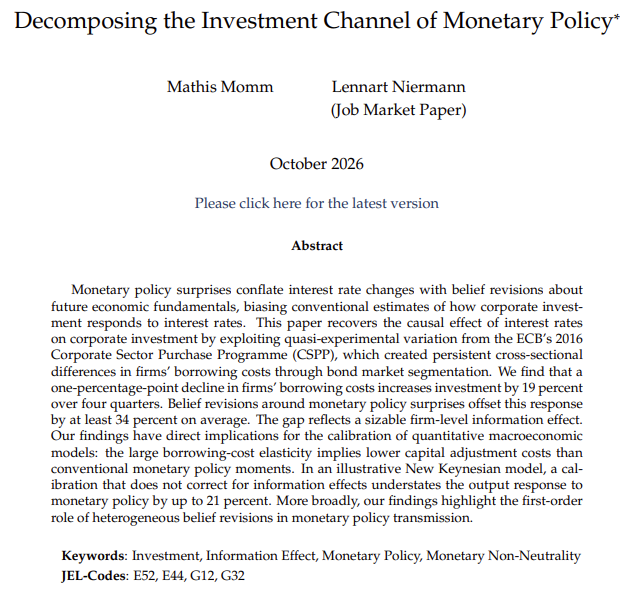
Excited to present my JMP: Decomposing the Investment Channel of Monetary Policy
❓How does corporate investment respond to lower borrowing costs? And how do contemporaneous belief revisions around monetary policy surprises affect this response?
💡We find that investment is more responsive to small changes in borrowing costs than previously thought. Further, belief revisions that coincide with monetary policy surprises appear to play a sizable dampening role.
🔗https://t.co/ZJlhpFAxNN
👇Summary
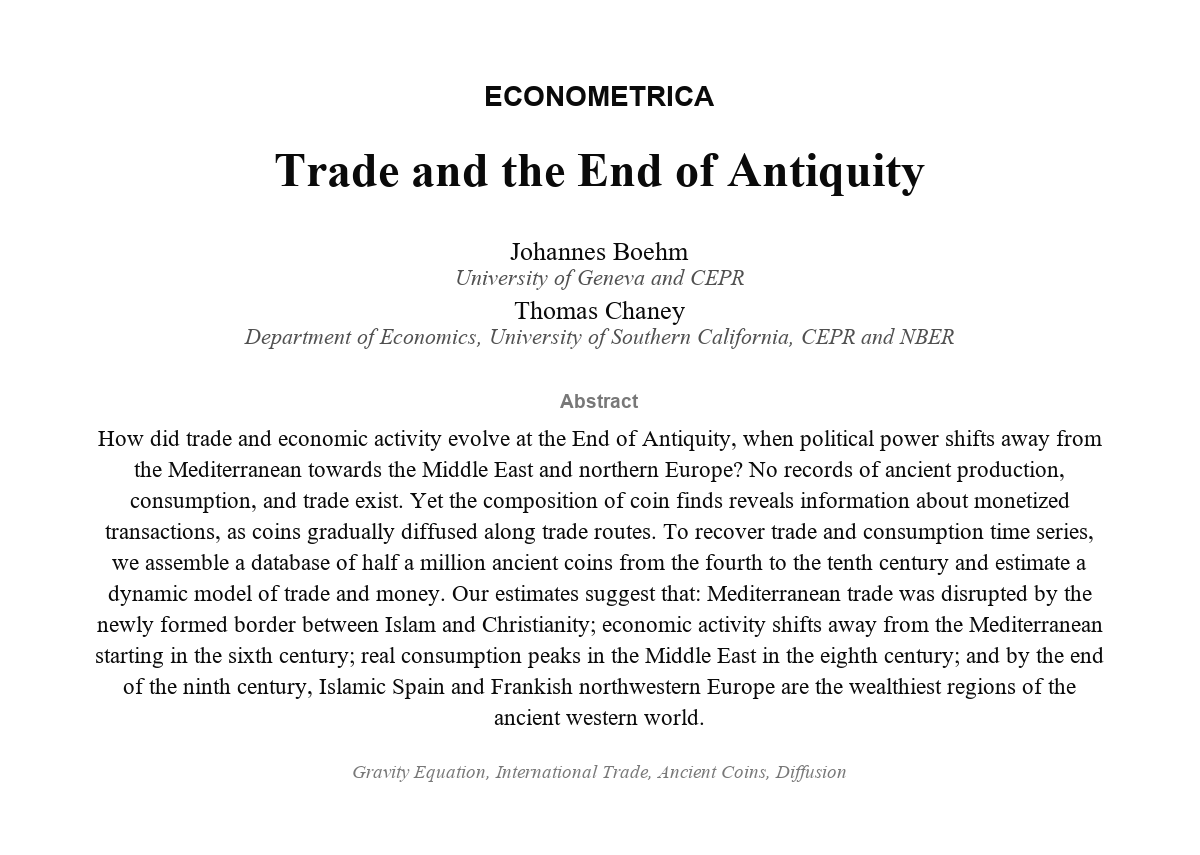
@johannesmboehm and Chaney combine data on half a million ancient coins with a model of trade and money to reconstruct trade and consumption from AD 325 to 950. The estimates show economic activity shifting away from the Mediterranean from the 6th century.
https://t.co/LjwuEevS2e
William Nordhaus was a giant in economics: he transformed how we think about climate change, and brought the environment into econ policy analysis. 🍃🌍📈
But his legacy goes beyond integrated assessment models: many themes/topics viewed as “extensions” of the standard DICE model, ranging from endogenous growth, finite energy resources, inequality in the face of global warming, or free-riding strategic interactions btw countries [that I studied in my research] were already the subject of his careful analyses long before we ever thought about them ☺️
RIP William Nordhaus
https://t.co/alqJLM0ELk
Incredibly happy to see my job market paper "The unequal economic consequences of carbon pricing" out in this month's issue of the 𝗔𝗺𝗲𝗿𝗶𝗰𝗮𝗻 𝗘𝗰𝗼𝗻𝗼𝗺𝗶𝗰 𝗥𝗲𝘃𝗶𝗲𝘄.
I find that carbon pricing reduces emissions and spurs green innovation, but disproportionately burdens poorer households - not only through higher energy bills, but also through larger income losses.
Here is an earlier thread of the paper: https://t.co/oRVwbvWJoV
New blogpost: Fable-5.1 can hide secret messages in benign images.
We gave the image to another Fable in a fresh session and simply asked: "Is there a hidden message in this image?"
It recovered the exact message without being told how it was hidden.
Sometimes, when I want to lift my spirits, as this week after brooding about the state of much of academia, I want to read a great paper I have already read dozens of times. Those are the papers that inspired me as a younger scholar and that, even today, make me slightly jealous.
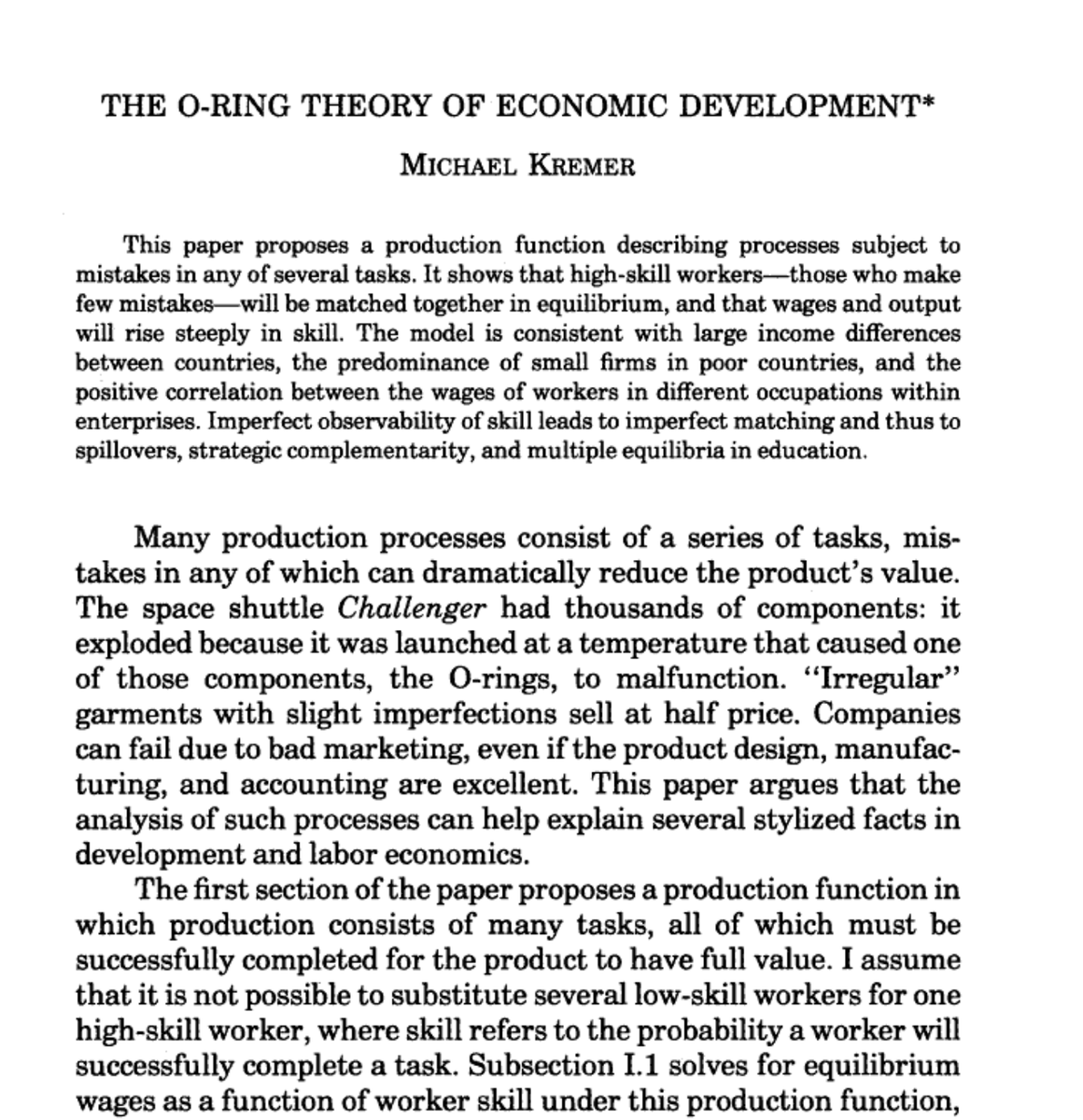
One of my favorite go-tos is “The O-Ring Theory of Economic Development,” by the inimitable Michael Kremer, at UChicago Econ.
The idea is that producing output requires many tasks, and failure in just one of them drastically lowers the value of the final output. My favorite examples are the British cars of the 1950s and early 1960s. Think of the Jaguars or the Austin-Healeys. Was anything ever more gorgeous than an XK120 in British Racing Green? And yet, that Moss gearbox with no synchro on first! Go for a Porsche 356 if you have the money, because the Jaguar will eventually break your heart.
But the paper is gorgeous because Kremer takes this simple observation and builds a whole theory of differences in output across countries around it. He lets the quality of each task multiply rather than add up, as in standard models. A good worker is worth more next to other good workers, so the best end up working with the best and wages fan out. And a small difference in the chance of a mistake, compounded over dozens of tasks, becomes a huge difference in output per worker across countries, plus a large set of predictions about the distribution of firms, wage correlations, matching, and more.
Here, back in 2014:
https://t.co/XexEUaKVNq
I used that model to think about some of Spain’s economic problems (an automatic translator will give you a very good English version).
It is such a wonderful and deft piece of economic craftsmanship. Read it. I just did.
1/ What can the flight patterns of birds teach us about innovation and economic growth?
Vasco Carvalho & I take a stab at this question in a new paper: Firms as Foragers
We develop an empirically grounded theory of growth in which firms forage in idea space.
🧵 (link below)
How does income inequality affect the economy?
This paper shows rich and poor households save in different assets, affecting which firms get financing. More inequality means bank-dependent firms create fewer jobs.
New paper by Doerr, @td_econ, and Lee:
https://t.co/ggtSWz4y4r
En español también hay bermejo y en gallego vermello. Vienen de vermiculus, que es el quermes vermilio, un pulgón colorado que se usa para hacer el rojo escarlata. Podría parecer lógico que se usase para hacer el rojo bermellón, pero no, el bermellón se hace de cinabrio.
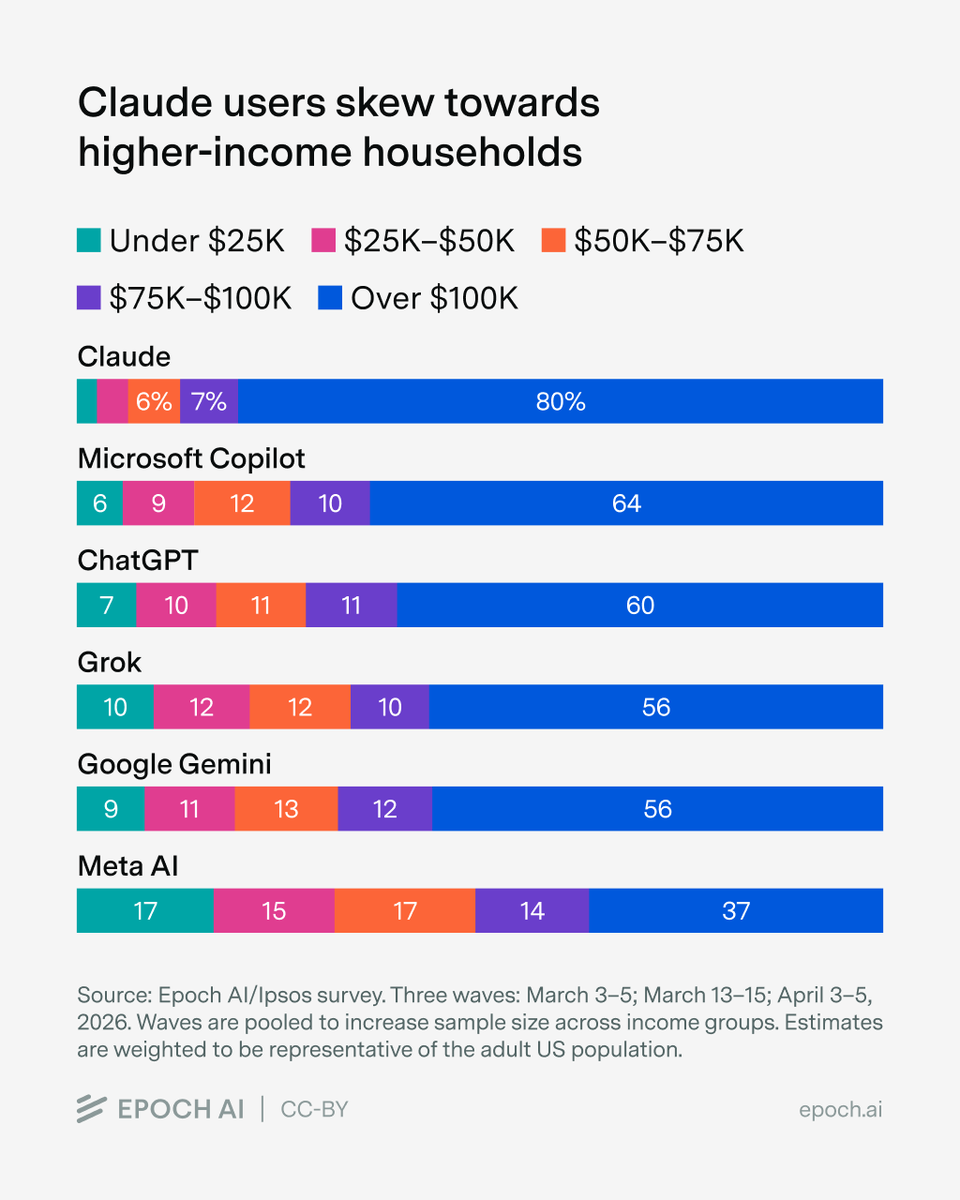
80% of US adults who report using Claude in the previous week live in households earning $100,000 or more a year, compared to 37% of Meta AI users.
Other major providers cluster in a relatively narrow band, with 56–64% of users in $100,000+ households.
There is another side to Brazil’s sun-soaked metropolis. All of Rio’s elected governors in the 21st century have been jailed or impeached on charges related to corruption https://t.co/E6JiHnEjPJ
Photo: Kristin Bethge
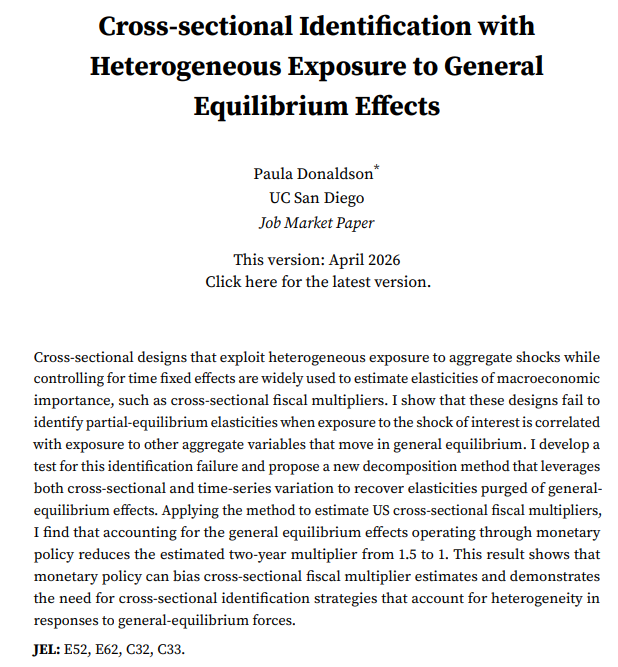
In her JMP, she studies when cross-sectional designs that exploit heterogeneous exposure to aggregate shocks can identify macroeconomic elasticities. She shows that these designs can be biased by general-equilibrium forces such as monetary policy, develops a test and decomposition method to correct this problem, and finds that the two-year U.S. cross-sectional fiscal multiplier falls from 1.5 to 1 once these effects are accounted for.
https://t.co/EBOkspB8Fw
14/16