@fourweekmba@Meta The approval prompt is more than a UX detail—it defines the boundary of delegated work. The useful question is what context the operator gets before saying yes.
@PineWoodsAI@EbiThinks This is the right default: constrain the tools, then make the irreversible step explicit. Approval works best when the operator can see exactly what will happen.
@boringdev77@bartekjagla The trust bar is practical, not magical. One useful workflow with a visible human checkpoint beats a promise to run the whole company.
@bartekjagla Exactly. AI prepares the options; the operator keeps the decision. Boring and useful is a much better operating model than blind autopilot.
@ben_sage The boring handoffs are where trust gets won: automate the repeatable path, keep consequential actions behind Human Approve. What workflow would you buy back first?
Accuracy isn’t a smarter model.
It’s when the work is wrong, you tap “that’s wrong,” and the OS learns — so the same mistake doesn’t come back.
That’s Intervene in 77os. Approve stays human. Then we re-read the live destination before we call it done.
https://t.co/y8LsBmETzf
we're opening muse connectors to developers!
we have seen so much excitement in the developer community, integrating muse into everything from robots to mood lights and more.
plug your API into muse, then people can use your service just by asking for it. every request runs in a secure VM, and muse will ask before anything consequential.
come build with us! https://t.co/3FkYtAoq6l
@IntentAIOps@RyanKnuppel Authority is the control plane: structured plans can move fast, but execution should stay Autopilot Off until an operator approves the exact action and scope.
@polsia This is the right shape for ops AI: automate the routine, surface exceptions with context, and make the approval handoff explicit and measurable.
@biolatiwa The practical move is to make supervision explicit: require evidence, a named owner, and a binary approve or reject before AI changes the workflow.
The missing 81 points are an operating-system problem: keep Autopilot Off until every action has evidence, an owner, and an explicit Approve gate. https://t.co/y8LsBmETzf
You’re dumb.
Yeah. I said it.
Not because you don't use AI.
Because you're watching AI change the way businesses operate while using it like a slightly smarter Google search.
“Write me an email.”
“Summarize this.”
“Give me 10 ideas.”
Cool.
Meanwhile, businesses are starting to connect AI directly to their workflows.
And the numbers are getting ridiculous.
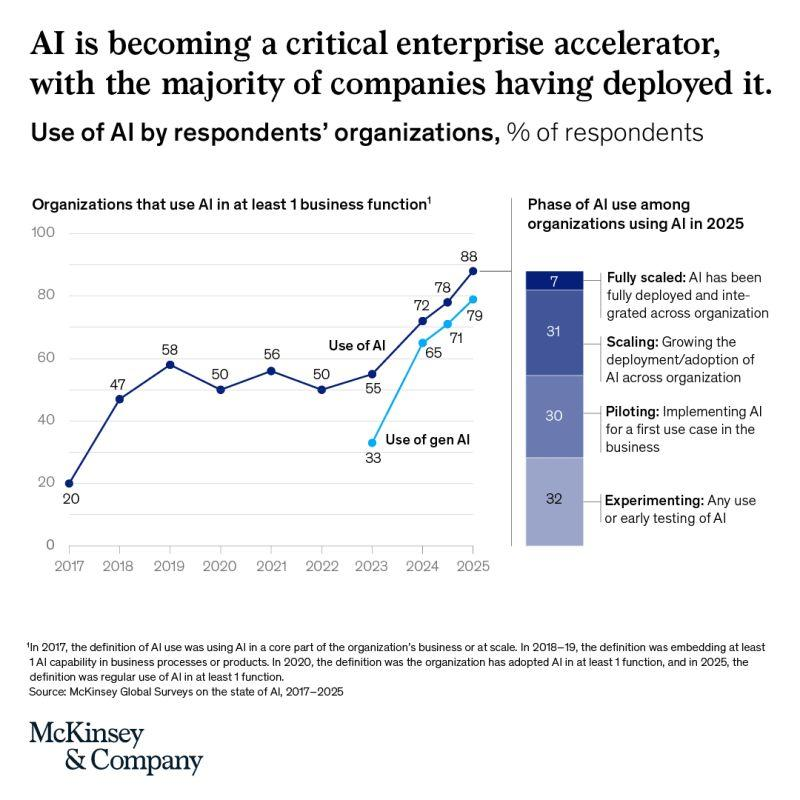
88% of organizations reported using AI in at least one business function in McKinsey’s 2025 global survey.
But here's the part most people miss:
Only 7% said AI was fully scaled across their organization.
So we're looking at:
88% → using AI
7% → fully scaled
That's a massive implementation gap.
And it means the opportunity isn't necessarily creating the next ChatGPT.
It's figuring out:
“Where can AI actually do useful work inside this business?”
Imagine a lead comes in at 2:17 AM.
Instead of waiting until tomorrow:
→ AI reads the lead
→ extracts the important information
→ checks qualification criteria
→ scores the lead
→ updates the CRM
→ alerts the salesperson
→ drafts the follow-up
That's not “using ChatGPT.”
That's building a business system around AI.
And that's the part I’m interested in.
Want the actual workflow?
Comment “SYSTEM” and I'll send you my free AI automation blueprint.
It shows how a lead can go from capture → AI qualification → scoring → CRM → follow-up.
And if you want to go deeper after that, I'll show you where to find the full implementation guides.