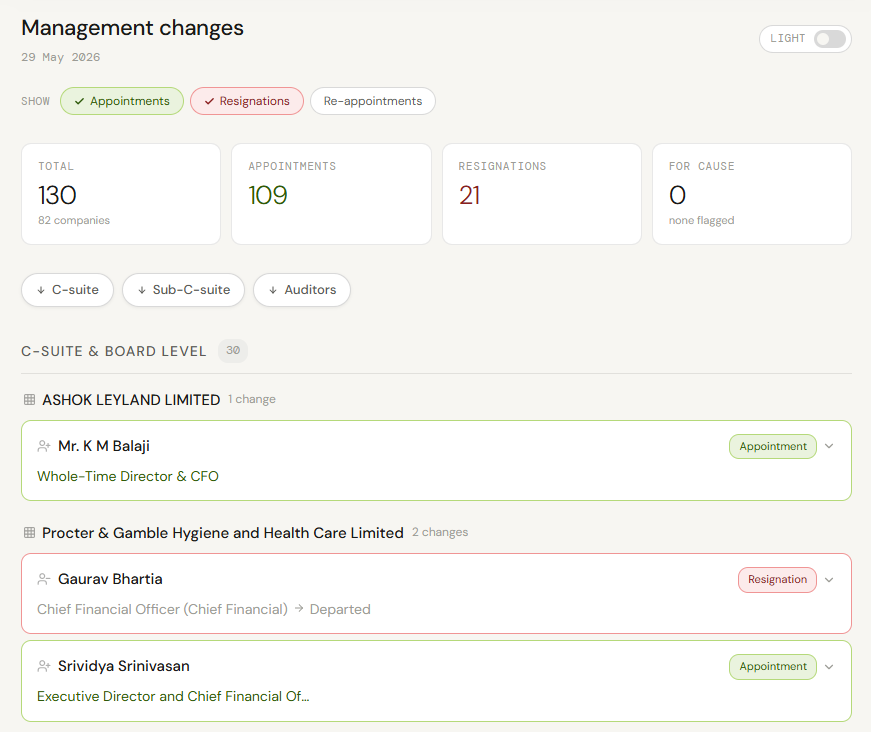
Our management changes tracker just got a major facelift.
Interactive dashboard. Changes split into C-suite/non-C-suite/auditors. Ability to filter for appointments, resignations, and re-appointments. And highlights in case of "for cause" resignations.
Check out today's report using the link the comments.
And sign up to @PerivisOnX - get a free account - and subscribe to the playbook to get your daily updates.
Studies show that management changes - especially CEO/CFO changes - can trigger dramatic changes in the trajectory of a company. They can be great opportunities to re-assess companies and their strategies when looking for long-term bets.
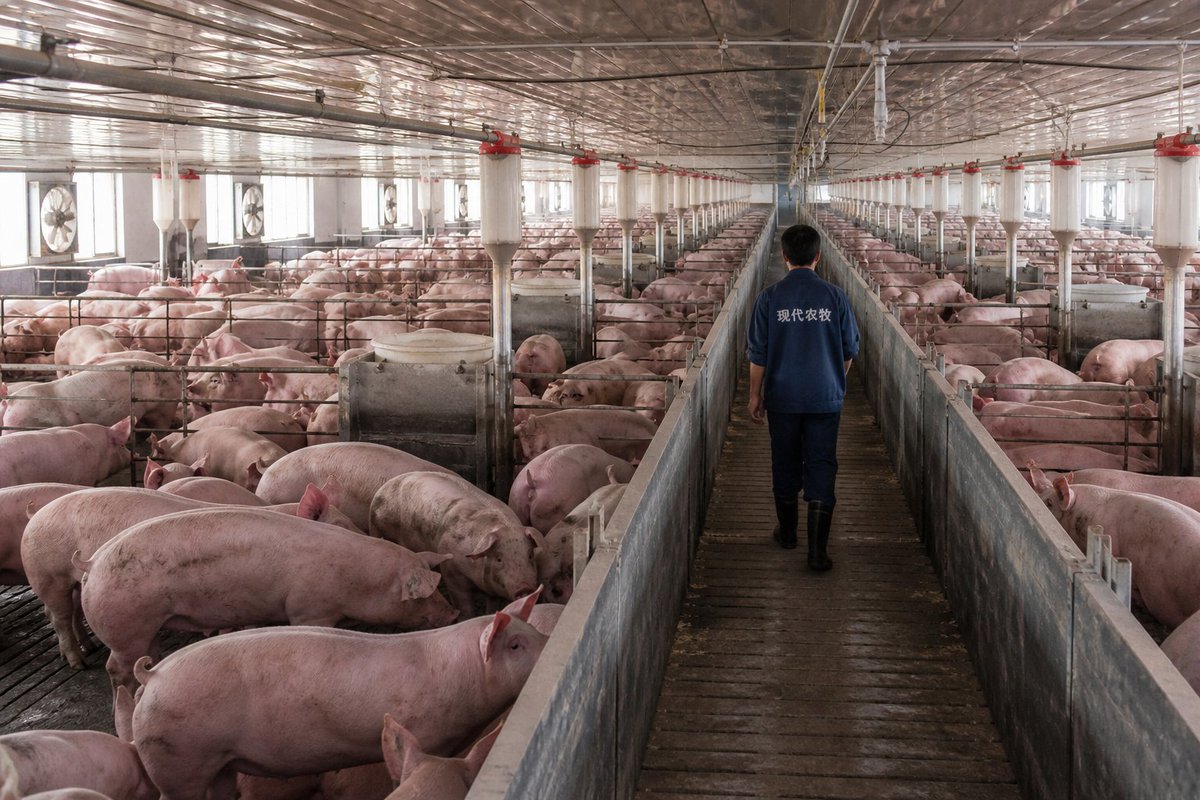
How does pig feed become a bargaining chip in the world's biggest trade war?
---
Here's a story about how the world actually works.
In 1978, China launched economic reforms. Over the next four decades, roughly 800 million people were lifted out of poverty. As incomes rose, diets changed. People ate more meat. Especially pork. China today consumes more pork than the next several countries combined.
But pigs don't eat rice. They eat soy. And that's where the story gets fascinating.
The soybean is native to East Asia. China invented tofu. It has been growing soy for thousands of years. And yet today, China produces only 20 million tonnes domestically — and imports 100 million tonnes more. Every year. That's 25% of all the soy grown on Earth, crossing oceans in bulk carriers, just to feed Chinese livestock.
The largest supplier? Brazil. A country that, until the late 20th century, had not meaningfully farmed soybeans at scale. Today, farmers in Mato Grosso grow soy on land that was grassland a generation ago. It moves by truck and barge to ports like Santos and Paranaguá, then by ship across the Pacific.
The second largest supplier? The United States.
For most of the 20th century, the narrative ran one direction: rich nations selling technology and capital to the developing world, which sent back raw commodities. Then China got rich. And now China depends on American and Brazilian farms to feed its animals.
It gets more fascinating. In 2018, during the US-China trade war, China stopped buying American soy almost entirely. Purchases shifted to Brazil. Midwest farmers - who had voted in large numbers for the very administration that started the trade war - took the hit. Brazil expanded capacity and locked in long-term relationships. Today it supplies 70-80% of China's soy imports. The US fills seasonal gaps.
A geopolitical dispute, fought partly with soybeans.
In 2025, as part of trade negotiations, China agreed to buy more American soy again. Pig feed, as a bargaining chip between superpowers.
---
This is what I find endlessly fascinating about the world: the connections are real, but invisible until you look. A farmer in Brazil doesn't think about Shanghai. A processor in Dalian doesn't think about the Mississippi. But pull on any thread and you find the whole cloth.
Chinese affluence → global protein demand → South American deforestation → US trade politics → port logistics in the Pacific Northwest.
One thread. Many consequences.
---
This is also the problem Perivis is trying to solve.
The world is wired this way. Events in one place ripple into industries, companies, and decisions in places that seem completely unrelated - and it's incredibly hard to anticipate how far those ripples travel.
That's what we're building: continuous monitoring that tracks the events, policy changes, and market signals that actually matter to your world - and surfaces them before they become surprises.
@signulll Yeah, meanwhile everyone and their uncle is throwing up a ridiculously configured Cloudflare wall in front of their website - even Government websites who are supposed to be open and distributing content to anyone who wants.
Palantir posted this to their X account a couple of days ago:
<quote>
14. American power has made possible an extraordinarily long peace. Too many have forgotten or perhaps take for granted that nearly a century of some version of peace has prevailed in the world without a great power military conflict. At least three generations — billions of people and their children and now grandchildren — have never known a world war.
</quote>
The assumption that WWII was the last great power conflict is laughable. And even that is 80 years ago, not a century. Also, Vietnam... Afghanistan...
Perhaps the more important observation is that the US has been involved in almost every serious conflict in the last century. Perhaps that should be considered as well...
Detailed analysis of Q4 investor call of ICICI Lombard. Red/Green flags, standout statements, analysis of delivery on promises in past calls, etc.
https://t.co/4rS3EnmUN7
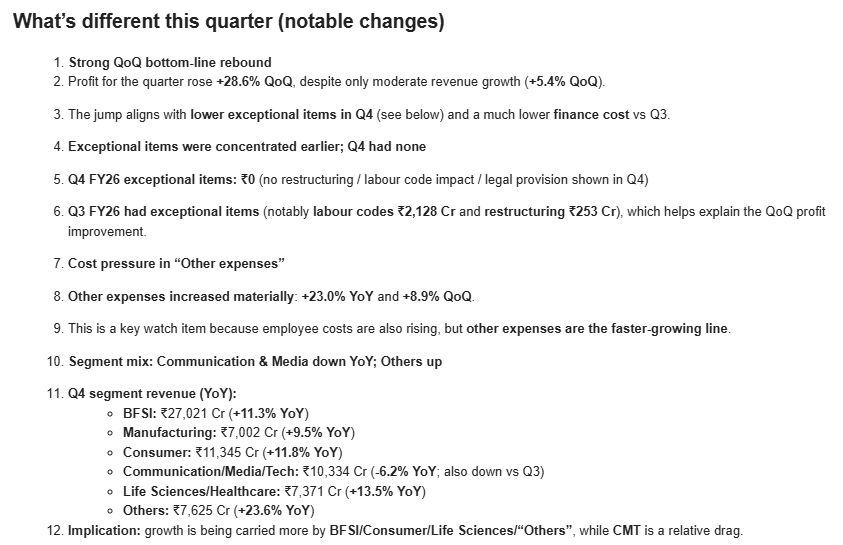
Perivis Playbooks just pushed out the first earnings result for the season. #TCS.
Here's just one section from the generated analysis. This was generated less than 10 minutes after the results went up on the exchange.
And now, you can *customize* how you want the analysis to be done. Go check out Perivis Playbooks.
https://t.co/0piy2v7PWk
Earnings season is back.
We built Perivis to watch markets, companies, and policy so you don't have to.
But today we're handing over the controls.
Playbooks — define exactly how Perivis analyzes and reports what it watches for you. Your lens. Set up in under 5 minutes.
Early access open at Perivis
Actually, I think the point is, that advantage has already been had. For an investor who was fully invested so far (and lost more), if he moves his money into a fund like say PPFAS which was so far not fully invested, it won't make any difference if PPFAS also fully deploys on Monday.
So, @Iamsamirarora is right.