Arthur Hayes made a point about HYPE that's more interesting than bullish or bearish.
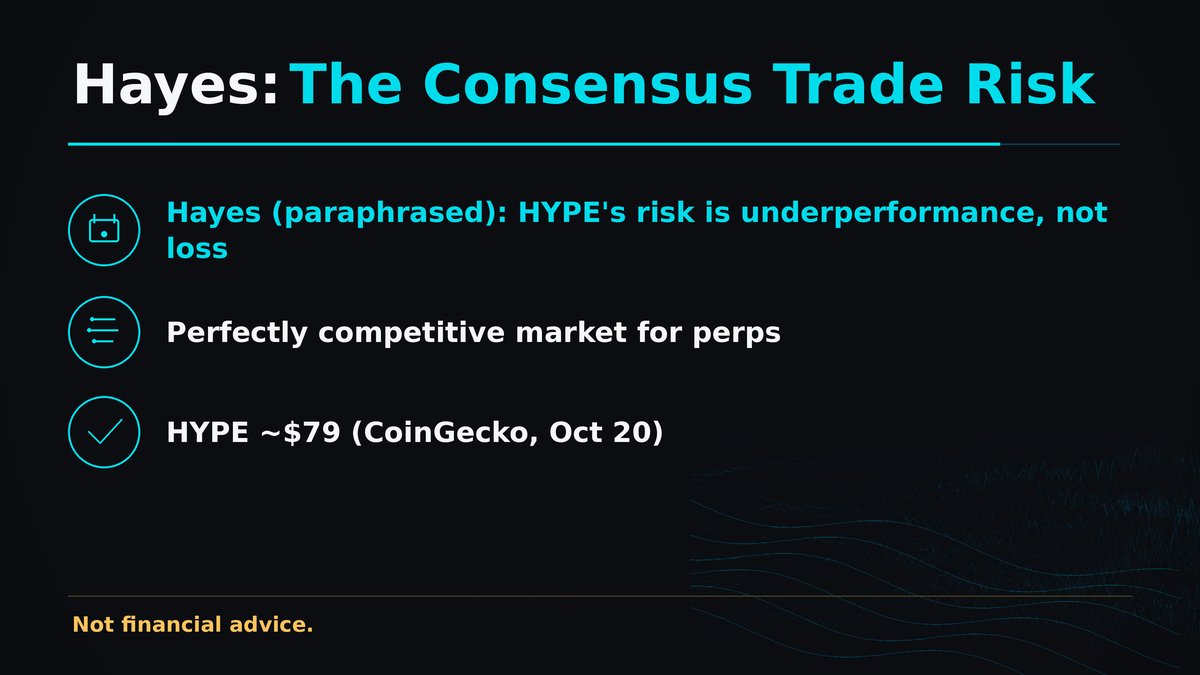
In a recent interview clip, @CryptoHayes argued that the danger with HYPE isn't that you lose money. It's that you badly underperform, because you're buying the thing everyone already knows is a winner. He gave @HyperliquidX full credit for proving the market and winning the volume, but said it now competes with centralized exchanges, TradFi venues and other DEXs, all offering the same product at the same price. A great business for users, he said, but not one he wants to own as an investor. He'd rather put new money into ETH, Zcash or another narrative.
That's a real argument. When an asset becomes the consensus pick, the upside is the part that's already priced in.
The counterpoint: Hyperliquid reportedly brings in a few million dollars a day in revenue and has burned around 5% of HYPE supply. Perfect competition usually doesn't look like that. HYPE was around $79 on Oct 20 per CoinGecko, below its high near $98.
Consensus isn't wrong. It's just expensive.
Not financial advice.
On Oct 19, @elonmusk posted: "Next year, I will give one of my SpaceX shares to every kid in America." Jeff Park had floated the idea about six hours before, then quoted Musk with one word: "Boom."
Earlier, @dgt10011 wrote: "If @elonmusk seeded every Trump Account with SpaceX shares as a 'public good,' whatever party he launched or backed would own American politics for a generation." That evening he added "Bet on the rise of 'socialism with American characteristics'" and "Bet on bitcoin." Then on Oct 20, just: "Duration is destiny."
His logic, as I read it: if child accounts become America's quiet UBI, a whole generation gets seeded with long-duration assets. The thing you want in that world is the asset that can't be printed.
You don't have to buy the politics. Programs like this decide who holds what for decades.
On Oct 18 he also posted "Might be an ugly Monday." Monday came in kinder: on Oct 19 the S&P 500 closed up 0.41% and the Nasdaq Composite up 1.11%, with BTC holding in the low $80Ks. Nobody's weekend call is a crystal ball.
The long thesis is the interesting part.
Vitalik just made an architecture argument that goes way beyond which signature scheme wins.
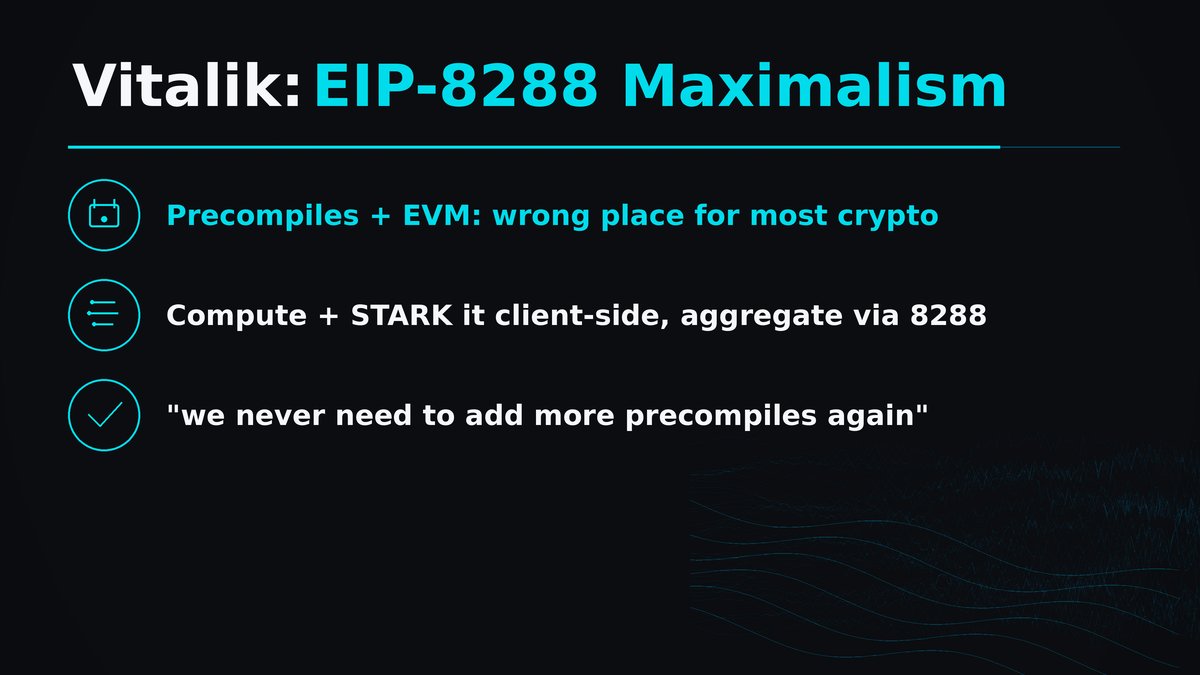
@VitalikButerin: "Ultimately, precompiles and EVM are both the wrong place to put most cryptography support into Ethereum." His reason: both work on data that has to land onchain, realistically as calldata, and even with PeerDAS there's a practical cap of about 8 MB/s.
His answer is "EIP-8288 maximalism." If a computation is heavy and self-contained, compute it and STARK it client-side, then push the proof through the EIP-8288 recursive aggregation mechanism. The chain sees that the computation happened and what the result was, never the data itself.
The payoff he describes: everyone uses whatever cryptography they want, the chain stays lean, and "we never need to add more precompiles again."
His line "it's not a blockchain. It's a cryptographic world computer" says it cleanly: keep the main thread for what only it can do.
My question for Vitalik: what does proving latency look like for a normal wallet on a mid-range phone? If signing takes seconds, users will feel it.
Stablecoins can cross the world in seconds. Then they have to land somewhere people can actually spend them.
That's how @coinbase framed its new partnership with Thunes on Oct 19. Coinbase powers Thunes' stablecoin infrastructure, and Thunes connects it to local bank accounts and mobile wallets. Thunes reportedly reaches 140+ countries and 90+ currencies, for remittances, gig worker payouts and supplier payments. No launch date yet.
That last mile is the hard part. Sending USDC is easy. Getting it into a mobile wallet in Manila in local currency is where most payment projects stall.
Same day, a very different product. Coinbase for Agents now lets you trade index and crypto perps from Claude, ChatGPT, Grok and other AI assistants. Their example prompt: "Hey Jarvis, long the US500."
@CoinbaseDev is clearly betting that agents will be a real user type. I'd just be careful. An agent that can open a leveraged position on one sentence can also open the wrong one on one sentence.
Risk: perps are leveraged and can wipe out your margin fast. Not financial advice.
Hyperliquid now holds more USDC than Solana. $6.93B vs $6.90B, the first time it's ever flipped.
I didn't get that from a press release. I got it from my feed, and three of the people below have been posting about Hyperliquid all week.
Seven English accounts that earned a spot this week:
@TheDeFinvestor posted the flip on Friday, plus the part most people skipped: Hyperliquid is the only major L1 earning on its own USDC reserves, and that revenue buys $500K+ of HYPE a day. His Sunday watchlist is worth the bookmark. This week it's Aerodrome's new DEX and Lighter's Q3 call, both Oct 21.
@Cbb0fe is the loudest Hyperliquid bull I follow, and he's honest about why. "Still $33b worth of HYPE to distribute." He also dumped another project in one line for changing the rules after users had already burned millions. Blunt, but he's been early more than once.
@Austin_Federa runs DoubleZero and posts receipts. Latest one: Hyperliquid on DoubleZero Edge came in 97 ms ahead of the public API, first 98.6% of the time. His thread on how exchanges are force multipliers, not value creators, is worth reading in full.
@0xbeans spent a month on URC-5, the Uniswap standard that lets a token declare its official v4 pool so aggregators stop routing around the hook. Hayden once said "simply don't route to bad hooks." Beans turned that into a spec.
@defidami wrote the clean explainer for it. If "vampire pool" means nothing to you yet, start there.
@dgt10011 (Jeff Park) is my macro pick. "Bet on the rise of socialism with American characteristics. Bet on bitcoin." Also: "every credit crisis starts with forced selling, and forced selling starts with a fallen angel." Read him for the second line, not the first.
@ZeMariaMacedo co-founded Delphi and posts rarely. Sunday night: "If everyone's posting about black Monday all weekend, it's probably not gonna be a black Monday." Monday came and went. No crash.
Save this one. Follow the one you'd argue with first.
Not financial advice. I follow back people who post receipts and argue in good faith. New list tomorrow.
Stablecoins settle in seconds. That's the selling point, and the compliance problem.
@Mastercard announced Stablecoin Security on Oct 19. It's one API that scores a stablecoin payment for risk before the funds move onchain, screening for fraud, scams and sanctions exposure. It launches in North America first, with a global rollout planned for 2027. @borderlessxyz is an initial launch partner, building it alongside Mastercard and Keyrails.
Here's the logic. A card payment can be disputed or reversed. A stablecoin transfer can't. So the check has to happen before you hit send, not after. Banks and payment companies that want to use stablecoins need that check, or their compliance teams will say no.
Stablecoin payment volume reportedly hit about $482B from January to September 2026, up 45% year over year. Growth like that brings more scams and more sanctions risk with it.
Visa and Mesh are working on how you spend stablecoins. Mastercard is working on whether the payment should go through at all.
Both are needed before banks move real volume.
Bitcoin treasury weekly, and the theme is balance sheets, not just buying.
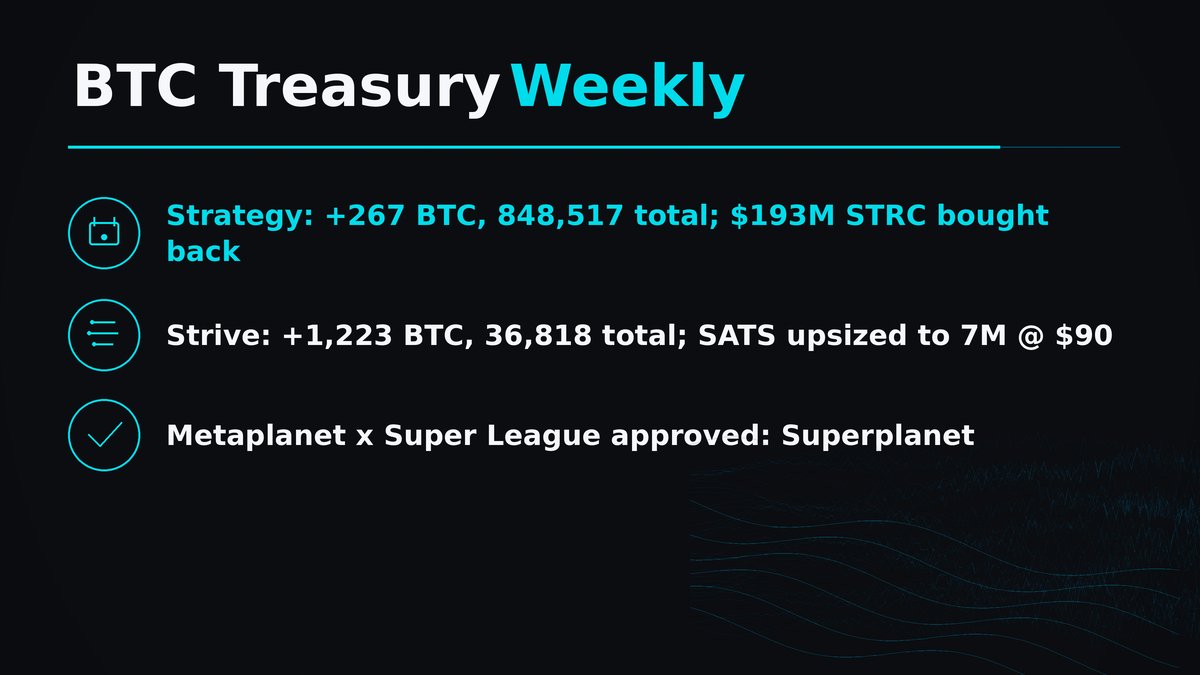
@Strategy added 267 BTC and repurchased $193M of its STRC preferred. As of Oct 18 it holds 848,517 BTC and $5.3B in USD assets, and it raised its Digital Credit Securities repurchase program from $2.0B to $3.0B. A buyback program that big says @saylor is also defending the price of his credit products, not only stacking coins.
Strive bought 1,223 BTC between Oct 14 and Oct 16 at an average of $81,734, taking it to 36,818 BTC. It also upsized its SATS perpetual preferred to 7M shares at $90, about $630M gross, with a 15% annual dividend. Per @ColeMacro, SATS proceeds settle on Oct 20, and Strive plans to keep an 18-month dividend reserve. A 15% coupon is expensive money. It works if BTC does the heavy lifting.
Metaplanet's deal with Super League won shareholder approval, and the combined company will become Superplanet, its US-listed platform. Saylor's note to @gerovich: "Superplanet expands the universe of Digital Credit. Congratulations, Simon."
Three companies, three ways to fund the same bet.
Four years ago, the Sparkassen group's own committees advised against offering crypto at all. On Oct 19 they put it in the app.
DekaBank, the securities house of Germany's savings banks, launched "Krypto powered by Deka." Sparkasse customers can buy and sell BTC, ETH, SOL, XRP and @0xPolygon's POL inside the Sparkasse banking app, at €0.99 per order plus a spread. No securities account needed.
The rollout is gradual. Each Sparkasse picks its own start date, reportedly 30-40 new banks a month, with 230+ interested and a total reach of reportedly 40-50 million customers. Reports differ on custody, with DekaBank or Börse Stuttgart named, so I won't pin that down.
One important limit: coins reportedly can't be withdrawn to your own wallet. This is exposure, not self-custody.
Is that a problem? For crypto natives, yes. For a 55-year-old in Bavaria who has trusted the local Sparkasse for 30 years, it's probably the only way they'd ever buy BTC.
Germany's most conservative retail bank network just decided crypto belongs next to the savings account. That's a cultural shift.
Uniswap v4 hooks have a quiet problem. Anyone can open a second pool for your token without your hook, and traders will go wherever is cheaper.
That's a "vampire pool." The hook that was supposed to charge a fee for holders or buybacks never gets used, because the volume goes around it.
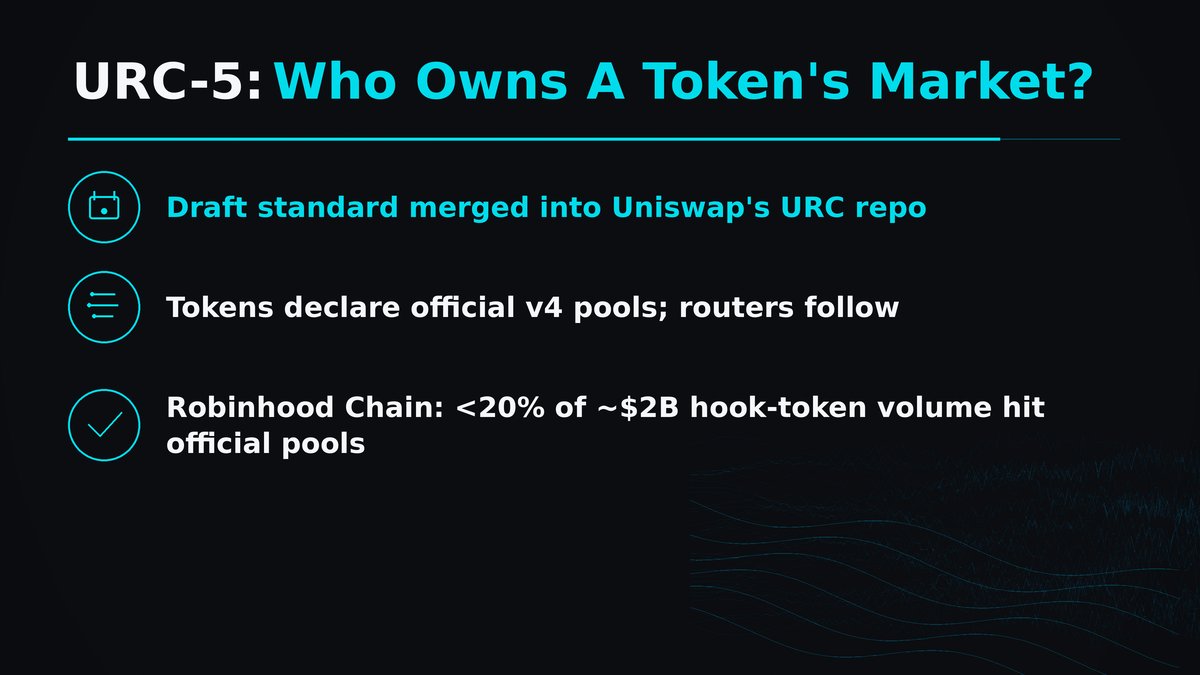
How big is it? On Robinhood Chain, five v4 hook tokens traded around $2B, and less than 20% of it went through their official pools. Their hooks collected around $3.4M when closer to $20M was possible.
URC-5, Token Venue Policy, is a proposed fix from @standard_rsv, written by @0xbeans, and now merged into @Uniswap's URC repository. A token publishes which pools are its official ones so routers and aggregators know where to send trades, and new tokens can choose to block trading anywhere else. It's still a draft.
0xBeans put it simply: Hayden Adams once said "simply dont route to bad hooks." URC-5 makes that a standard.
The real test is adoption. A standard only helps if routers actually respect it.
Following back devs who read the spec before the chart.
The crypto card might be about to disappear. Not because nobody wants to spend crypto, but because you won't need a card to do it.
@meshpay and @Visa announced on Oct 19 that crypto and stablecoin balances will be spendable anywhere Visa is accepted, at 175M+ merchant locations, straight from the wallet apps people already use. In Mesh's words: "No separate card. No cash-out. Nothing for merchants to change."
Then they showed it. On the Money20/20 main stage, Mesh CEO @bamazizimesh tapped to pay at a real POS terminal over the Visa network, straight from his balance in the @worldmoney app.
What's still missing: a launch date and the list of supported wallets. So this is announced and demoed, not live.
Why it matters. Right now, spending crypto usually means a separate card program, a top-up and a conversion you have to think about. If the wallet itself pays and the merchant still gets fiat, your wallet becomes your checking account.
Bigger shift than another card launch.
Following back builders working on the spend side of crypto.