The market may be dramatically under estimating how quickly AWS bedrock revenue is scaling, and its potential profit impact.
Here I show 3 scenarios:
- Flat NNARR vs 2Q26E, and 40% EBIT margins: implies model improvement slows and inference margins get competed down.
- Flat NNARR vs 4Q26E, and 55% EBIT margins: optimistic base case.
- Some NNARR growth in 2027-2029 as smarter models continue to increase the intelligence TAM.
Even in the low case, Bedrock alone could basically generate as much profit as all of AWS did in 2025, by 2030.
This is excluding incremental AI revenue from enterprise and lab compute, core cloud services attached to bedrock/compute, and other AI products.
$INTC the guys discussing it being overvalued are completely ignorant. They raised capex, lip bu tan said he wouldn't do that unless he had a customer lined up. That means 14A is about to announce someone soon. Also helps when the leader of the free world is your biggest fan.
Sergey Brin was one of the two Google founders. He created countless jobs for others and changed our lives.
Google and its employees paid about half a trillion in taxes.
Why don’t you start a business as well, instead of fighting job creation, innovation, and progress, Bernie?
This post isn't going viral, but I am going to write it anyway.
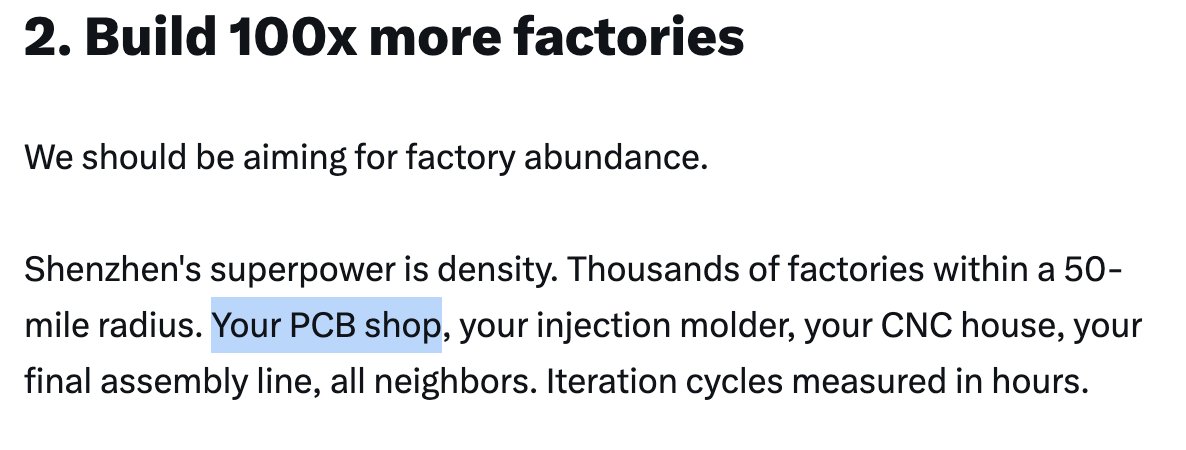
I have done the factory abundance thing. Is harder than it sounds. The problems are structural, and if we are not intellectually honest, none of this will happen.
We see the call for re-industrialization on Twitter every 6 months or so. These posts get a lot of play. This one is on its way to a million views.
Its popular because it feels so good. You can hit retweet, and go back to your non-industrialized life.
I invested a non-trivial amount of my net worth and joined the board of a Houston electronics manufacturing company. Fast online quotes. No need to talk to sales people. Software connected to pick-and-place machines in a US factory via programming interfaces we had to reverse engineers. All employees had health insurance and equity. It was beyond cool.
Then we built a marketplace to aggregate massive manufacturing capacity across 100+ factories in US and Mexico. I joined as CEO to help scale it for 6 years.
Here's what I learned:
1. True. It is about proximity. Its also about cheap labor. We credibly reshored factory capacity from China to Mexico and US (about 50/50 split). But even in Mexico, we were still more expensive than mid-continent China by 7-12%.
This seems counterintuitive. Labor costs in Mexico are lower, yet Chinese factories are willing to work at lower margins.
Its not just low margins. Chinese workers simply work longer hours than either US or Mexico. The work culture in factories in China isn't quite 996, but its common to see factory workers put in 10 hour days 6 days a week.
In US? Our most exciting political idea today is a 4 day work week.
North American manufacturing will always cost less than China, and there is only one answer - customers must be willing to pay higher prices. Someone has to fund that behavior (and by that I mean a government subsidy and protectionist controls). It makes me feel dirty saying this, but thats what it takes. Price parity is the single most important factor in reshoring.
Notice I said North America. US manufacturing will never be cost competitive with China. Thats a mathematical impossibility. No amount of Shenzhen of Texas maps can reverse this.
If you want proximity on this continent, you will need to get used to the idea that Latin America is part of our manufacturing region. Our government has to fund this build-out in foreign countries with more enthusiasm than deporting immigrants.
Yes, this means investing in factories in foreign countries. Economic development packages for Latin American countries - an idea deeply unpopular with both the right and the left.
2. PCBs? You will have to drop environmental protections to fabricate PCBs in North America. Not just in US, but also in Mexico.
At the height of Covid we made an effort to diversify from our Taiwanese and Chinese PCB suppliers. I knew Chinese competition hollowed out American PCB fabs over the years - from 2,000 factories to about 100 today. We're down from 35% to only 4% of worldwide market share.
But I was shocked to learn there are basically no PCB fabs in Mexico. We finally found a small supplier in Brazil. Why wouldn't fabs simply move south of the border to Mexico as they close? US was once a powerhouse of PCB fabrication. The expertise was concentrated on this continent.
There are a lot of reasons, but the main cause - you can do unspeakable things to the environment in China. Mexico has neither the government permissive of such environmental footprint, nor the water necessary to run the factories. No one is willing to admit just how much environmental destruction we offshored to China.
There is no easy answer on this one. If you want PCB fabs here - get used to the pollution. You can't avoid this conversation.
3. Software driven factories are cool. I built one. No one cares.
Here's the reality of the situation - its incredibly cool technology. It makes a real impact on operational efficiency. Not enough impact.
You know what does make a massive impact? Cash.
Working capital is the silent killer for American factories. I have quoted thousands of buyers sourcing electronics manufacturing in the US. The very same buyers who will pre-pay a 30% deposit to Chinese factories, also expect net-30, net-60 or net-90 day terms from US factories.
When we talked Honeywell about being a supplier they demanded net-100 and sent us to their preferred factoring "partner" when we refused. The "partner" shaves off 3% of the deal value to float your working capital. Baker Hughes was even worse. The engineering team loved us. The procurement team killed the deal. standard contract they send to all US factories. Thats just the way it is.
If you read the McKinsey post-mortems on which US factories survived the Chinese onslaught it really came down to one thing - if the manufacturer was able to run their cash cycle at less than 60 days, they survived. Everyone else died.
China? China floods their economy with cheap debt. Its everywhere. Your working capital is funded by debt costs in low single digits. When a Chinese factory needs to beat US or Mexico on a quote and can't make the math work, the provincial government magically kicks them the difference. They all get their money from the same place - Chinese central bank.
Our central bank is busy too, but not funding manufacturing wins. We prop up the financial sector by inflating money supply.
So I simply don't believe we can re-industrialize if we are collectively not willing to give our government a massive balance sheet for manufacturing expansion and forfeit environmental protections.
If we're not going to do that, we should talk in realistic terms about whats possible and what has to be done.
98% of you are bullshitting when you say a model is good or bad. It’s mostly indistinguishable and unless you’re a product expert it doesn’t make a different most of the time
When people talk about gold in the 1970s, they remember the beginning and the end. But what about the middle? What if we’re living through the part everybody forgets? https://t.co/C3YZGaG4wt
This is one of the more interesting AI charts I've seen recently.
Claude Code, OpenAI Codex, Cursor, and other AI coding tools have dramatically increased the number of new apps being built.
The question is if demand is higher just because supply has exploded.
History suggests quality always wins. AI will make it easier to build software, but consumers will only reward the products or services that best solve real problems.
(credit: The Economist)