1) Lot of companies are having similar commentary on domestic steel price hikes being higher than global , and there seems to be a large gap , leading to volumes being mismatched , hearing this from many companies
2) Another interesting thing we heard from API companies is the steep hike in solvent and reagent prices
3) Hiring across R&D in pharma remains very hot , there is a premium paid for strong scientists now as many CDMO companies ( listed+ unlisted) try to expand capabilties into complex chemisteries and move higher
4)Forgings , Castings , Bearings OEM's are willing to give huge visibilty to partners and suppliers provided that they give them visibility and volumes with less volatilty , Indian companies with hungry promoters can leap in these sectors if they are prepared and want to
5) Chemical spreads are holding up but RM costs and more importantly rationality in crude linked chemicals remains less as many companies are chosing to sit out of it by lowering volumes
6) Steel tubes , pipes are seeing good volume growth across the segments , there are dumping concerns from china in some grades leading to lower realisations, players are presenting the case to the goverment , and seamless staniless pipes capex is going to get go t, sambhv expects this market to grow exponentially , this Q volumes were higher than usual as dealers /distributors picked up and stocked the inventory on the back of further steel price hikes
7) IT is further dividing and winners are emerging , some with domain specific and AI led growth are leading , Coforge , Indegene which I really like , while others are still reacting
8) Biosimilars , Injectables , and Peptides are expected to see good growth incrementally , listen to commentary from Biocon , One source and CDMO duo from India ( L&D)
9) In private banks , the facts have not changed but the flows have , leading to allocation gains that may sustain , as the sheer underweight is normalising , plus the counters remain very liquid hence an allocators paradise
10) Gains will be in the value chain , there are many companies in the value chain that are showing disproportionate growth on the back of OEM growth , map the players and you will be surprised with the numbers
This is something I wrote for the first time , this is my my qualitative checks , things I remember on the back of my mind after listening to 50+ calls live , these are some broad but similar commentaries that stuck with me, if you like reading this or found this interesting to let me know !
Was going through some of my old stock picks that I had also covered on Twitter over the years.
Many of them went up 10x, 50x, or even 100x, only to eventually fall 30%, 50%, or even 80% from their peaks.
Some examples include Xelpmoc, Danlaw, Insolation, XPRO, and Inflame appliances.
One thing I've learned over the years is that microcap investing is rarely about Buy, Hold & Forget. Its about Buy, Evaluate & Churn.
Churning is often viewed negatively in investing, but in microcaps, I believe its an essential part of the journey.
You keep buying, evaluating, and churning until you find those rare businesses that truly deserve to be held forever.
Very, very, very few understand this.
Elon Musk's recent thread calling Ambani as PM looks written by a "South Asian", and definitely not like his usual posting style.
Excessive politeness, explanatory style with "so", starting a para with "Also". They are all a give away. Just read them for yourself.
So it seems like a coordinated operation run by the same DS which attacks India's companies and capitalists, but now it's using Elon to make it political.
I am at a loss to understand why Elon is getting influenced this way and letting himself be used to generate animosity with 1.4 billion people.
Especially at a time when his companies are gaining acceptance and good traction in India. If he thinks half the Indians may support him due to politics, he's mistaken.
For the small number of Indians getting carried away politically, and taking side with these foreigners interfering in India's sovereignty:
Do understand Starlink is not being unjustifiably stopped. They are in the same regulatory approval status as India's Jio and Airtel.
They have already got required licenses, setup required infra on the ground, and the distributorship to start operations once the final approval is given. Which is also expected soon along with Jio and Airtel.
But Elon seems to be very frustrated that Starlink wasn't approved two years ago when he clearly could have monopolized Satellite internet in India. Now, with Jio and Airtel competing in parallel for satellite net, it is super tough for Starlink.
So, as an Indian, it is important to understand while getting access to newer tech shouldn't be banned by GoI like pre-1990s India, it is also important to have a choice, competition, and clarity on security implications.
The politicians who have suddenly done a 180 degree in taking sides with Elon are the same who were, two years ago, questioning India even considering allowing Starlink claiming "Modi sold out to Elon."
We need to understand these sudden attacks on PM and India's companies are being done in tandem with other, on the ground, operations in India to destabilize and delegitimize the govt - which too has been completely organized via American social media.
The same Elon talking about how India will benefit with Starlink, when it is actually being considered for approval, doesn't say a word about how China - which bans most American companies in strategic sectors and never even considered Starlink - will benefit from it.
From this alone you can understand the agenda. India has enough services, network, the NDRF, and the Army, who can setup communication anywhere, to save our men women and children during a disaster.
Beware of such white savior syndrome. Need to remind ourselves, East India Company came in saying "Indians will benefit from western trade."
Gold - tired or getting ready for second run?
The recent volatility in gold has unnerved many investors. Read on to understand:
1) Reasons for the recent correction & volatility
2) Reasons why bull market can re-start towards end of 2026
3) Aawakening of the wester investor
4) How gold helps your family stay rich over the decades
https://t.co/Wj9a3dEZPF
@DigantHaria Gold INR pricing is derived from Gold in $ and ₹/$ conversion.. US devaluation mean stronger ₹ = risk for Gold prices in ₹ terms? Sir, what are your thoughts on this?
I resigned from Anthropic today. I spent the last three years doing pretraining research at both OpenAI and Anthropic. Neither company is acting responsibly. They are racing straight to self-improving superintelligence and gambling with our lives. More thoughts below.
Most companies are reporting great results and are very bullish
Qualitatively this cycle is different . It is occurring inspite of higher oil prices and geopolitical issues
The main reason seems to be the confidence of a lot of companies to grow both in India and especially exports based on unique capabilities, built over a decade
It is not about a temporary upcycle or labor arbitrage but specialized skills honed over a long period of time. We are now seeing the outward expansion of India inc.
Wanted to take a moment to thank someone who gave @SkyrootA its first real lift-off—Mukesh Bansal.
8 Years ago, we sent him a cold LinkedIn message.
He replied.
We met that very weekend.
Soon after, he became Skyroot’s first investor with a ₹10 crore cheque.
At the time, there was no space policy. No proof that we could build an orbital rocket. Immense technology risk. And every reason to say no.
Yet he looked beyond the uncertainty. He believed in our passion and saw possibility long before there was evidence.
But what stayed with me even more than the investment was the trust.
He gave us complete freedom to build, trusted us to make the right decisions, and was always there to mentor us whenever we needed him. More than capital, he helped shape our thinking with one piece of advice:
“Always do the right thing. This journey will be much longer and much harder than you imagine. Build two things with equal importance: the product and the organisation.”
This has guided us through every phase of the journey and continue to shape how we build Skyroot today.
The first cheque is never just capital. It is belief.
Every great startup needs someone willing to take that first leap of faith—when all they can really invest in is the founders’ conviction.
India needs many more such risk-takers backing ambitious deep-tech entrepreneurs long before success becomes obvious.
Thank you, Mukesh. 🙏
@mukeshbansal06
P.S. This picture was taken during one of Mukesh’s visits to our factory in Skyroot’s early days. We were showing him just how light Vikram-S’s carbon composite structures were—a small moment from a journey that has since come a long way. 🚀
Nothing special has happened in July in last 2 weeks. Some stocks up some down , some days up some days down .
Most important , many stocks closely tracking , good quarterly results not giving upmove - Sakar, Greenply, IGIL etc. Small small misses n dhulai.
Many break outs technically not sustaining and all this is not at all surprising if look at Technofunda framework (it does not mean doomsday , there is life beyond euphoria n doomsday where nothing much happens)
Why I am highlighting this - as usual many after 20% move at index declaring another bull market , I am not a bear but skeptic or sustainable easy bull market rally this time from here (that's does mean we may not get better than FD returns and also selective bets can work n hence m decent invested, m just putting a check on euphoria of easy money run up which happens in typical bull market ) which may last for 1-1.5 years with 40-50% returns.
Hence, buying with caution n booking some gains wherewcer possible
What's working :
1.Good Q4 results at smallcaps n all followed by so far decent Q1 show (not enough data ), big positive for markets
2. Already into almost 2 years of correction, history suggests markets will be kind
But market structure , quick run up in last 3-4 months make starting valuations look bad from here (plese note I highlighted multiple times on attractive valuations in the smallcap pocket during Jan-March 2026, markets swings r quicker n faster now a days.
This is what m doing this month n going forward - Trade/Invest with some caution from here with the new money having a very selective approach, testing in batches if the tranche put is yielding returns. If it's working in favor, gradually increase new money else pause.
Be agile and active react, do not predict. Ensure risk management is in place.
Read it 2-3 times before you decide to comment . Understand why I have used words like new money etc
Some of folks have declared start of bull market 3 times in last 2 years. One day they will be right n then say maine bola tha and I hope sooner and I will be most happy if this time they r right
A patient came to me needing bypass surgery. Since he worked as a driver and the procedure at our hospital costs around 4.25 lakh rs , I advised him to go to a civic (BMC) hospital where the surgery could be performed free of cost through a government scheme.
That evening, his son called me and said, "Doctor, we would prefer to get the surgery done here at Thunga Hospital only .
Please help us reduce the cost as much as possible." I assured him I would do whatever I could to help.
The next day, the patient's boss transferred the required funds directly via RTGS.
After a successful surgery, I called his boss to update him: "Thank you for your support—Mr. Shukla’s surgery was successful."
He replied, "Thank you, Doctor, for taking such good care of my colleague."
Surprised, I asked, "Colleague? But he mentioned he works as your driver."
He answered, "Doctor, we work together."
"I understand, but isn't he your driver?" I asked again.
He explained gently, "He has been with me for 15 years, and I don't see him as just my driver. I work, and he works. We simply hold different roles in our daily life, but we work together. His job is different from mine, but we are colleagues."
I was completely speechless.
The lesson learned: Never look down on your domestic help or staff as mere "servants." They are the ones who keep our lives running smoothly, and they deserve equal respect and dignity.
Most people analyse hospitals by counting beds. That's the wrong unit. A hospital is a six-stage manufacturing pipeline, and each stage has its own unit economics, time horizon and bottleneck. Read the chain in order and you can see exactly which lever moves which P&L line.
Stage 01 — Patient Acquisition. OPD walk-ins, physician referrals, insurance network steering. The key ratio nobody talks about: roughly 2.5-4 OPD visits convert to 1 IPD admission. OPD isn't a profit centre — it's the top of the funnel that feeds the profitable in-patient business.
Stage 02 — Triage & Diagnosis. Consultation plus diagnostics. This is the fork in the road: it decides whether a patient goes the IPD or OPD path, and sets the ARPOB potential of that case before a single procedure happens.
Stage 03 — Admission & Bed Allocation. Room category alone drives ~30% of the bill. CONGO cases (Cardiac, Oncology, Neuro, Gastro, Ortho) get routed to specialty wards. ALOS planning starts here — and ALOS is the hidden throughput lever.
Stage 04 — Treatment / Surgery. OT time, consumables, implants, surgeon and anaesthetist time. The single largest revenue chunk per patient day.
Stage 05 — Pharmacy + Recovery. In-patient drugs, post-op care, physiotherapy — ~18-22% of the bill, and heavily influences how long the patient occupies the bed.
Stage 06 — Discharge + Billing. Pre-auth → claim → realisation. A 30-90 day working-capital cycle sits right here. Bad debt is under 1% for the organised chains — which is precisely why scale matters.
Now follow the money.
1. Where revenue is made: Surgical/CONGO 42% · Medical/General 18% · Pharmacy 18% · Diagnostics 10% · OPD 8% · Other 4%.
2. Where cost is incurred: Doctor fees 23% · Drugs & consumables 20% · Nursing & staff 14% · Rent/Power 10% · Other opex 10% — leaving roughly a 23% EBITDA margin. (That composite is bang in line with FY26 reality: Fortis 22.2%, Apollo 22-24%, KIMS 28-30%.)
3. Who pays: Insurance/TPA 40% · Cash/Self-pay 40% · CGHS/ECHS 9% · Corporate/PSU 5% · PMJAY 3% · International 3%.
The read: case mix moves EBITDA, not footfall.
Surgical work is 42% of revenue while doctor fees plus drugs are 43% of cost. So the profit lever isn't "more patients" — it's which patients. A hospital that shifts mix toward CONGO specialties raises ARPOB without adding a single bed. That's why ARPOB (Max ₹2.84 cr/bed, Fortis ₹2.51 cr, Apollo ₹2.21 cr) tells you more than bed count ever will.
And the second-order insight: with insurance and cash each at ~40% of the payer mix, realisation — not billing — is the constraint. Payer mix quietly sets your working capital. A chain drifting toward government schemes trades margin and cash conversion at the same time.
Three numbers to track any hospital on: ARPOB (pricing power), occupancy (asset sweat, 70-75% for top chains), ALOS (throughput). Everything else is commentary.
Educational only. Not investment advice.
Explore more about us at https://t.co/E7oSZoMYv3
@AdityaKhemka5 This profile belongs to my husband Aditya Khemka and has been hacked
The hacker has changed the phone number, email id and password of the account and hence it is now completely inaccessible. @X kindly help him retrieve the account as he has emailed on the support
The French hate air conditioning.
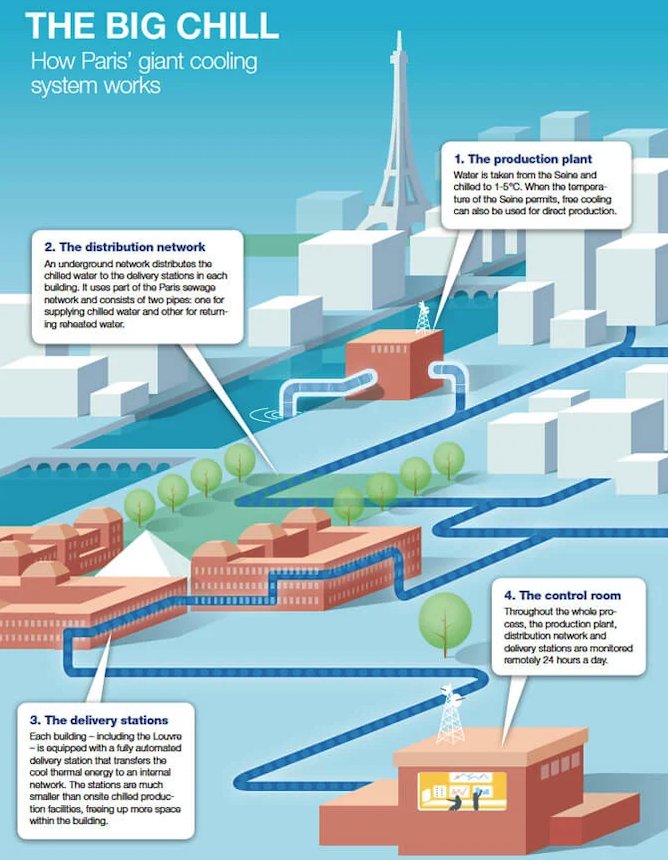
So Paris built a 120-kilometre machine under its streets for producing cold.
It’s called Fraîcheur de Paris, and it does for summer heat what district heating did for winter: centralise the problem.
Instead of every museum, office, hotel, hospital and shop bolting its own cooling plant onto the building, Paris moves cold through pipes.
The network sends water chilled to 2 to 4°C through buried supply lines. The water enters a connected building, absorbs heat through an exchange station, then returns at 12 to 14°C to be cooled again.
It essentially functions with two pipes. One carries the cold out, the other carries heat back.
The production plants cool the circuit from 12°C to 4°C. Some sites use the Seine as a heat sink. In colder periods, the system can use the river’s own temperature for free cooling, which means the machines work less and the electricity demand drops. The Seine water doesn’t become the building water. It stays separate, passing temperature across heat exchangers.
The scale is pretty strange when you see it written down though.
It's got 15 production sites, 4 storage sites, 120 km of underground network with 924 subscribers. This has resulted in 7 million square metres cooled, and 493 GWh of cooling sold.
A cold utility running beneath one of the densest cities in Europe.
The Forum des Halles has been cooled this way since 1979. The Louvre since 1986. Galeries Lafayette, Opéra Garnier, Hôtel de Ville, Station F, La Samaritaine and the National Assembly all sit on the same idea. Tourists stand in the Louvre looking at paintings while a municipal cold loop does part of the dull work below ground.
The boring part is the breakthrough.
Cold can be stored at night in chilled water or ice, then used during daytime peaks. The network is monitored from a control room with more than 125,000 control points. A delivery station inside a building takes 5 to 7 times less space than a standalone cooling installation and avoids the roof and façade clutter that turns cities into compressor farms.
That matters because conventional air conditioning solves heat by moving it somewhere nearby. In a dense city, thousands of private machines mean thousands of outdoor units rejecting heat into streets, courtyards and roofs, plus refrigerants, noise, vibration and maintenance spread across every building.
Paris’s public cooling network has a stated coefficient of performance of 4, against 3 for a wet standalone system and 2 for a dry standalone system. Against an equivalent set of autonomous installations, Fraîcheur de Paris says the network gives 100% higher energy efficiency, 35% less electricity use, 90% fewer refrigerant-fluid emissions and 50% lower CO2 emissions.
The climate backdrop is the real reason this exists.
Paris ran a full crisis exercise called “Paris at 50°C” in 2023. Météo-France’s 2050 reference trajectory for France points to heatwave days becoming five times more frequent, hot nights rising sharply in urban centres, and some local extremes around 48°C becoming possible.
The city signed a 20-year concession in 2022 with Fraîcheur de Paris, owned 85% by ENGIE and 15% by RATP. The contract is worth a projected €2.4 billion. The plan is to extend the network by 158 km by 2042, add 20 production plants and 10 storage sites, and reach more than 3,000 subscribers, including hospitals, nurseries, schools and care homes.
This is basically the infrastructure version of admitting that summer is becoming a public systems problem...