Today I'm publishing a new essay, Policy on the AI Exponential. AI is progressing extremely fast—much faster than the policy process was built to handle. The essay lays out where I think the technology is now, and the action needed to close the gap: https://t.co/Lh6PWae178
Claude Fable 5 is by far the most ridiculous model that makes me genuinely afraid for the future of software engineering.
I compiled the top 10 most unbelievable things I've seen Claude Fable 5 do today:
— Migrate a 50M line codebase from Stripe in a day (humans take 2mos)
— Draw amazing 3D graphics a) Boeing 747 b) space simulations with >5000 objects c) Minecraft roller coasters d) full photorealistic forest scenes e) NYC skyline f) stormy clouds)
— One-shot Pokemon FireRed the game
— Optimize a real world proprietary interaction net evaluator 10x more than the next best model, gpt5.5
AND it's about the same price as GPT 5.5 ($10/M input, $45/M output) vs Fable 5 ($10/M input, $50/M output) and 6x cheaper than GPT 5.5 Pro.
This is amazing. Do this:
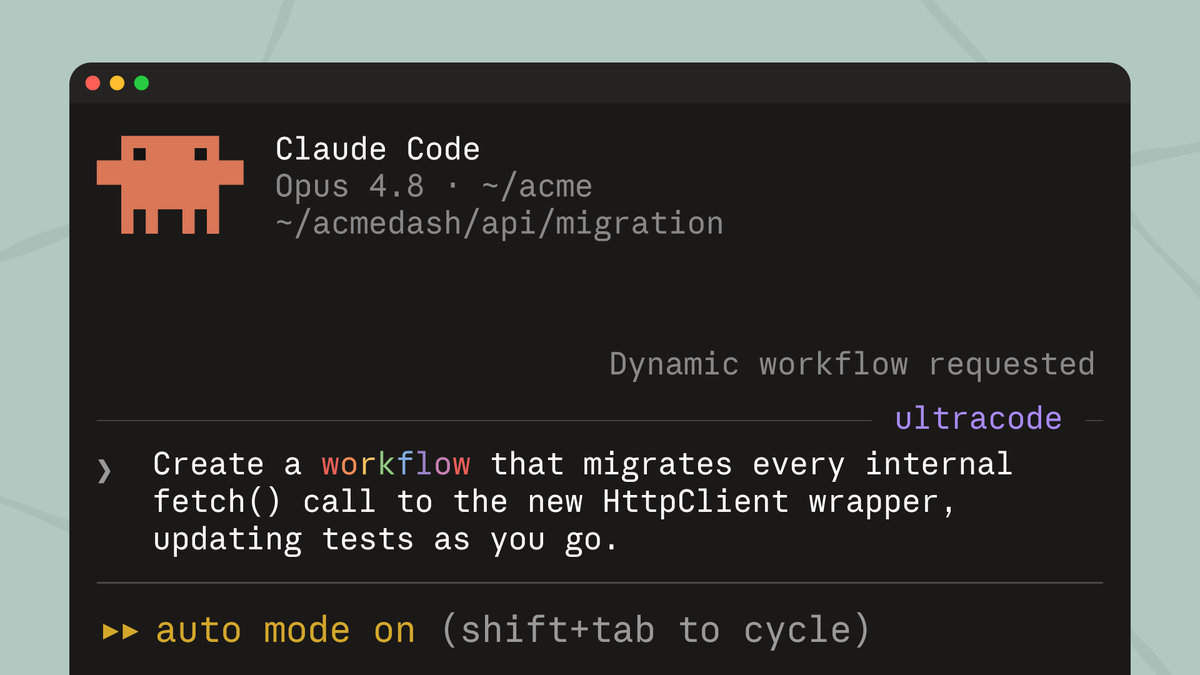
1. Set model to Opus 4.8
2. Reasoning effort to /ultracode
Enables Claude Code's new Dynamic Workflows.
Claude will autonomously detect complex tasks, write an orchestration script, and spawn an agent swarm.
New in Claude Code (research preview): dynamic workflows.
Claude writes an orchestration script on the fly, then spins up a large fleet of coordinated subagents in parallel to take on your most complex tasks.
Use the word "workflow" in a prompt to get started.
Anthropic co-founder Chris Olah was invited to speak at today's presentation of Pope Leo XIV's encyclical "Magnifica humanitas."
Read the full text of his remarks: https://t.co/CoBfkVOVcy
Introducing SubQ - a major breakthrough in LLM intelligence.
It is the first model built on a fully sub-quadratic sparse-attention architecture (SSA),
And the first frontier model with a 12 million token context window which is:
- 52x faster than FlashAttention at 1MM tokens
- Less than 5% the cost of Opus
Transformer-based LLMs waste compute by processing every possible relationship between words (standard attention).
Only a small fraction actually matter.
@subquadratic finds and focuses only on the ones that do.
That's nearly 1,000x less compute and a new way for LLMs to scale.
my god. Openai just dethroned claude 💀
GPT 5.5 crushes opus 4.7 across almost every benchmark. this thing is an absolute beast:
-> the new #1 coding model! claude is no longer the top.
-> when given a 20-hour software engineering task, GPT 5.5 solves it 73% of the time!
-> discovered ground-breaking research in mathematics and genetics.
the craziest part: the model helped build itself.
"Losing access to GPT-5.5 feels like I've had a limb amputated." - NVIDIA engineer
Earlier this year Yann LeCun left Meta because Mark Zuckerberg wouldn't bet the company on JEPA. Last week his group dropped the first JEPA that actually trains end-to-end from raw pixels. 15 million parameters. Single GPU. A few hours.
The timing is not a coincidence.
For four years Meta has been the house that JEPA built. LeCun published the original paper from FAIR in 2022. I-JEPA and V-JEPA came out of his lab. The architecture was supposed to be the escape hatch from LLMs, the path to robots that actually learn physics instead of hallucinating about it. Every version shipped fragile. Stop-gradients. Exponential moving averages. Frozen pretrained encoders. Six or seven loss terms that had to be hand-tuned or the model collapsed into garbage representations.
Meta kept funding LLMs. Llama shipped. Llama scaled. Llama got beat by Qwen and DeepSeek. Zuck spent $14 billion to buy ScaleAI and install Alexandr Wang. The FAIR robotics group was dissolved. LeCun's research kept winning papers and losing the product roadmap.
He left, started AMI Labs, and said publicly that LLMs were a dead end.
Now the paper. LeWorldModel. One regularizer replaces the entire pile of heuristics. Project the latent embeddings onto random directions, run a normality test, penalize deviation from Gaussian. The model cannot collapse because collapsed embeddings fail the test by construction. Hyperparameter search went from O(n^6) polynomial to O(log n) logarithmic. Six tunable knobs became one.
The downstream numbers are what should scare the robotics capex class. 200 times fewer tokens per observation than DINO-WM. Planning time drops from 47 seconds to 0.98 seconds per cycle. 48x faster at matching or beating foundation-model performance on Push-T and 3D cube control. The latent space probes cleanly for agent position, block velocity, end-effector pose. It correctly flags physically impossible events as surprising. It learned physics without being told physics existed.
Figure AI is valued at $39 billion. Tesla Optimus is mass-producing. World Labs raised $230 million to sell generative world models. Everyone in humanoid robotics is burning capital on foundation-model pipelines that plan in 47 seconds per cycle.
LeCun's group just showed you can do it with 15 million parameters on a single GPU in a few hours.
This is the Xerox PARC pattern running again. Meta had the next architecture. Meta had the scientist. Meta dissolved the robotics team, passed on the productization, and watched the exit. Three months later the lab that was supposed to be Meta's publishes the result that resets the robotics cost structure.
The paper is worth more than Alexandr Wang.
Right. Except that Mark Z, @boztank and others in the leadership were always supportive of the JEPA / World Models project as a long-term bet.
But the AI strategy of company became more LLM-pilled and short-term focused.
And many of the applications of JEPA/WM are in industrial domains that Meta is not particularly interested in.
Cet atelier de 30 minutes, animé par le créateur de Claude Code, vous en apprendra plus sur le
vibe-coding que 100 tutoriels vidéo sur YouTube.
Ajoutez-le à vos favoris et consacrez-y 30 minutes dès aujourd'hui.
Cette vidéo transformera votre utilisation de Claude à jamais.
Introducing Claude Opus 4.7, our most capable Opus model yet.
It handles long-running tasks with more rigor, follows instructions more precisely, and verifies its own outputs before reporting back.
You can hand off your hardest work with less supervision.
Finally. After 18 months of patience, FSD is officially approved and live in the Netherlands.
I’ve been driving with it for 2 days now.
And the experience is on another level.
It feels like the future unfolding in real time.
The precision.
The intelligence.
The confidence of the system.
This is not incremental progress.
This is a clear step forward in how mobility works.
Huge thanks to Elon Musk and the entire AI team at Tesla.
From a professional perspective, this shows what is possible when software, data, and real-world deployment come together at scale.
The question is no longer if this will take over.
The question is how fast it will expand.
This is a turning point.
@elonmusk
the French government’s MCP is better designed than 99% of MCP servers coming from tech companies
citizens can use agents to understand how their money is spent
It’s happened.
Mac Studio is here. Gemma 4 31b @GoogleDeepMind installed, chatting with my main @openclaw for $0 in token expenses now...
I've burned $5-6k on tokens on my crazy ideas over past few months, so this mac studio should pencil out for me within 3 months or so 🤓
Day 1 of 3 days of MLX:
Introducing MLX-Audio-Swift SDK 🚀
A modular Swift SDK for voice agents and tasks on Apple Silicon built by @lllucas and yours truly.
iOS, macOS, and visionOS developers can now build native apps with real-time, on-device audio intelligence:
🗣️ Text-to-Speech (TTS)
👂 Speech-to-Text (STT)
🔄 Speech-to-Speech (STS)
🎙️ Voice Activity Detection (VAD) and more.
Only import the capabilities you need, nothing extra.
Get started today and leave us a star ⭐️
https://t.co/AXJvHw0DY6
In this 2015 interview, the host — a Tsinghua University professor — expressed genuine curiosity about how Elon Musk was able to found SpaceX without prior experience and knowledge in aerospace, especially given that rocket science is one of the most demanding hard sciences — and that Musk was serving as both CEO and CTO.
Musk explained that deep expertise can be built outside formal academic programs — by reading extensively, conducting experiments, and speaking directly with experts in the field.
The next version of OpenClaw is also an MCP, you can use it instead of Anthropic's message channel MCP to connect to a much wider range of message providers.
(I know, this is awkward)
IBM built a cloud of suits to make sure the CEO never talked to anyone actually doing the work. @elonmusk does the opposite.
"Elon's method is extreme focus on substance. Extreme focus on getting to the truth.
In any organization with multiple layers, there's compounding lies. Each layer wants to look good. Each layer puts a little spin on things.
If one layer lies to the next layer above it, maybe that's okay. When that happens two or three times, the lies compound. If that happens six times, the lies really compound. If that happens 12 times, the CEO has no idea what's happening.
That was IBM.
By the time I got there as an intern, I calculated there were 12 layers of management between me and the CEO.
They even had a term for it: the great cloud. A cloud of men in gray business suits who followed the CEO around and prevented him from ever talking to anybody who was actually doing the work.
When he would come to visit, it was like a visit from the king. A completely impervious bubble.
That's the polar opposite of the Elon approach."
— @pmarca