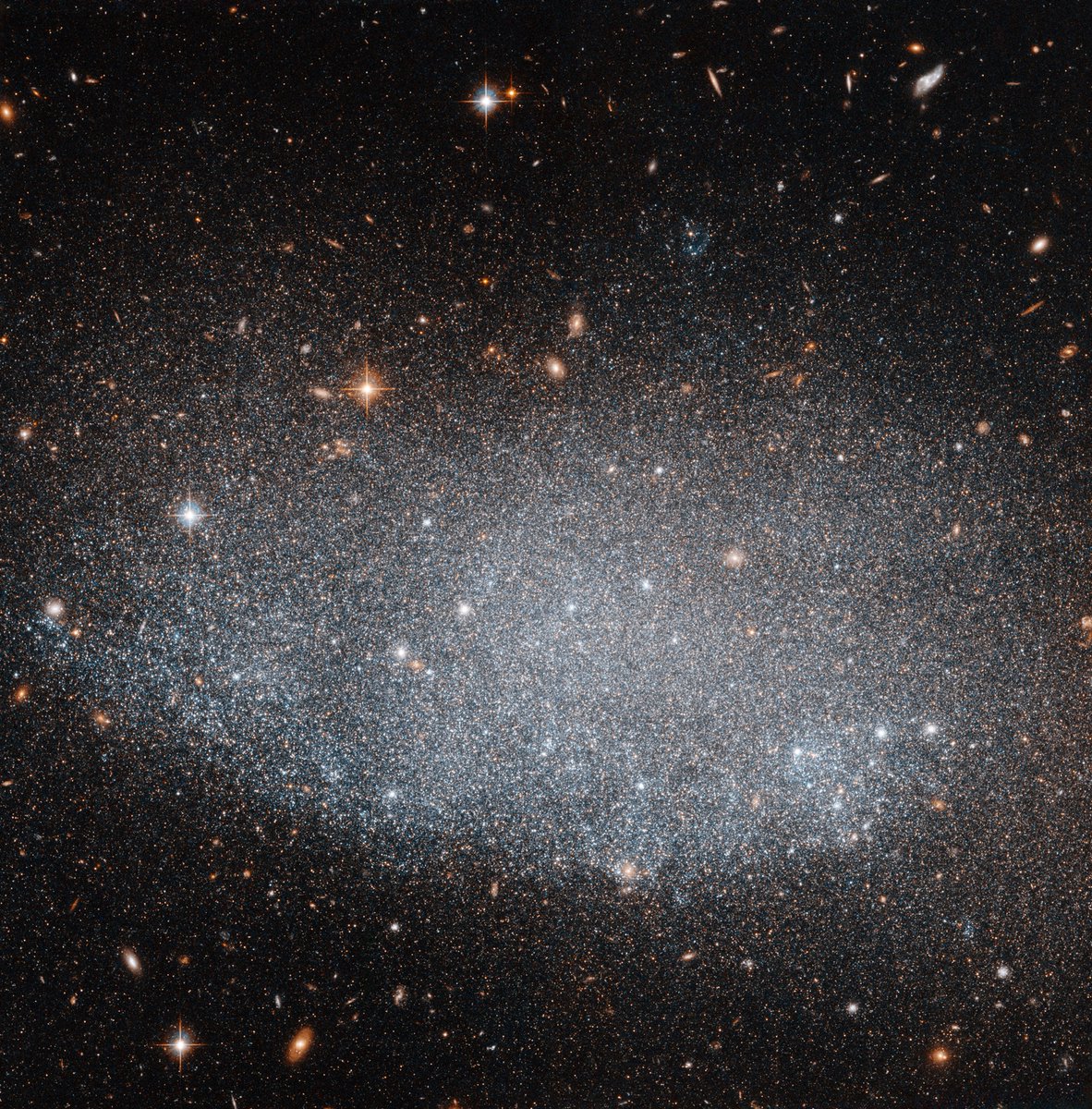
Astounding: UGC 8201, a dwarf irregular galaxy 15 million light-years away, has concluded a star-forming era spanning hundreds of millions of years, illuminating how compact galaxies maintain activity even with limited reserves.
(Credit: ESA/Hubble & NASA)
Fun fact: A day on Venus lasts 5,832 hours, longer than most people spend at work in an entire year. The planet rotates so slowly that one full turn takes the equivalent of 243 Earth days, making a single Venusian day longer than its year.
In this portrait of the Virgo Cluster, celestial objects form a striking chain. Towering in the upper half is NGC 4261, while NGC 4281 resides in the lower left.
(Credit: RubinObs/NOIRLab/SLAC/NSF/DOE/AURA)
Dark matter just lost one of its favorite alibis.
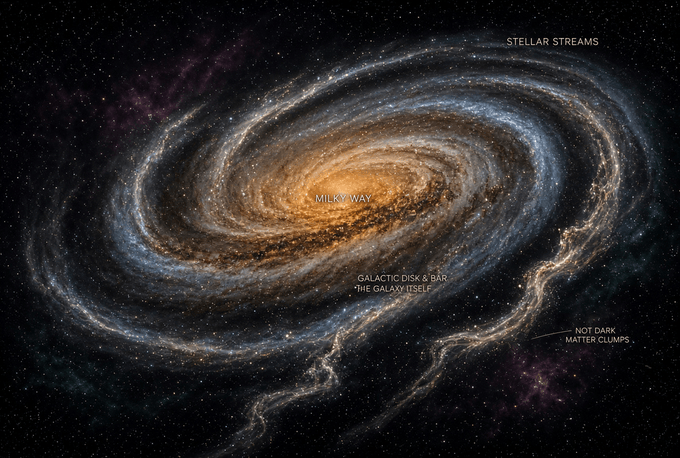
For years, astronomers treated the kinks, gaps, spurs, and strange thickenings in the Milky Way’s stellar streams as crime-scene evidence. A dwarf galaxy or globular cluster gets torn apart by the Galaxy’s gravity, its stars stretch into a long, thin river, and then something invisible punches holes in that river. The usual suspect: lumps of dark matter lurking in the halo.
A new set of simulations says the Galaxy itself is a far messier culprit than anyone expected.
Researchers built four Milky Way-sized galaxies, kept their dark-matter halos smooth and featureless, and then dumped about 15,000 stellar streams into them. They let the systems evolve for five billion years. Almost every stream came out looking wounded. Only about 70 of the 15,000 stayed clean. The rest developed bends, breaks, branches, clumps, and even complete disintegration — the same catalog of scars that observers had been blaming on dark-matter subhalos.
The damage is worst near the galactic center, where the disk, bar, and spiral arms create a lumpy gravitational landscape. But even streams on the outskirts pick up noticeable distortions. Perfectly straight, featureless streams turn out to be the rare exception, not the rule.
That does not mean dark matter is off the hook. It means the large-scale kinks we already see in streams like GD-1 or ATLAS–Aliqa Uma can no longer be treated as clean fingerprints of invisible clumps. The Galaxy’s own visible matter is noisy enough to produce the same look.
The real hunt now shifts outward. When the Vera C. Rubin Observatory starts mapping the faintest, most distant streams at the Galaxy’s edge, astronomers will finally have a quieter laboratory. If those far-out rivers still show violent, statistically unmistakable damage that ordinary matter cannot explain, then dark matter will have to answer for it.
Until then, the streams are telling a more ordinary story: the Milky Way is simply a sloppy, gravitationally chaotic place — and it doesn’t need invisible monsters to mess up its own leftovers.
Uranus is not just a planet. It is a cosmic rebel that decided to live by its own rules.
Its axis of rotation is tilted almost 98° — it literally rolls along its orbit on its side. Because of this, the poles take turns sinking into pitch-black darkness or bathing in endless sunlight for 42 years straight. Not a season. Not a winter. An entire lifetime spent in one polar day or one polar night.
This icy giant of hydrogen, helium, and methane holds the absolute cold record in the Solar System: temperatures in its atmosphere can drop to −224 °C. Colder than Neptune. Colder than it should be by every calculation. Why? Uranus stays silent. And we still don’t know what hides beneath its pale-blue mask.
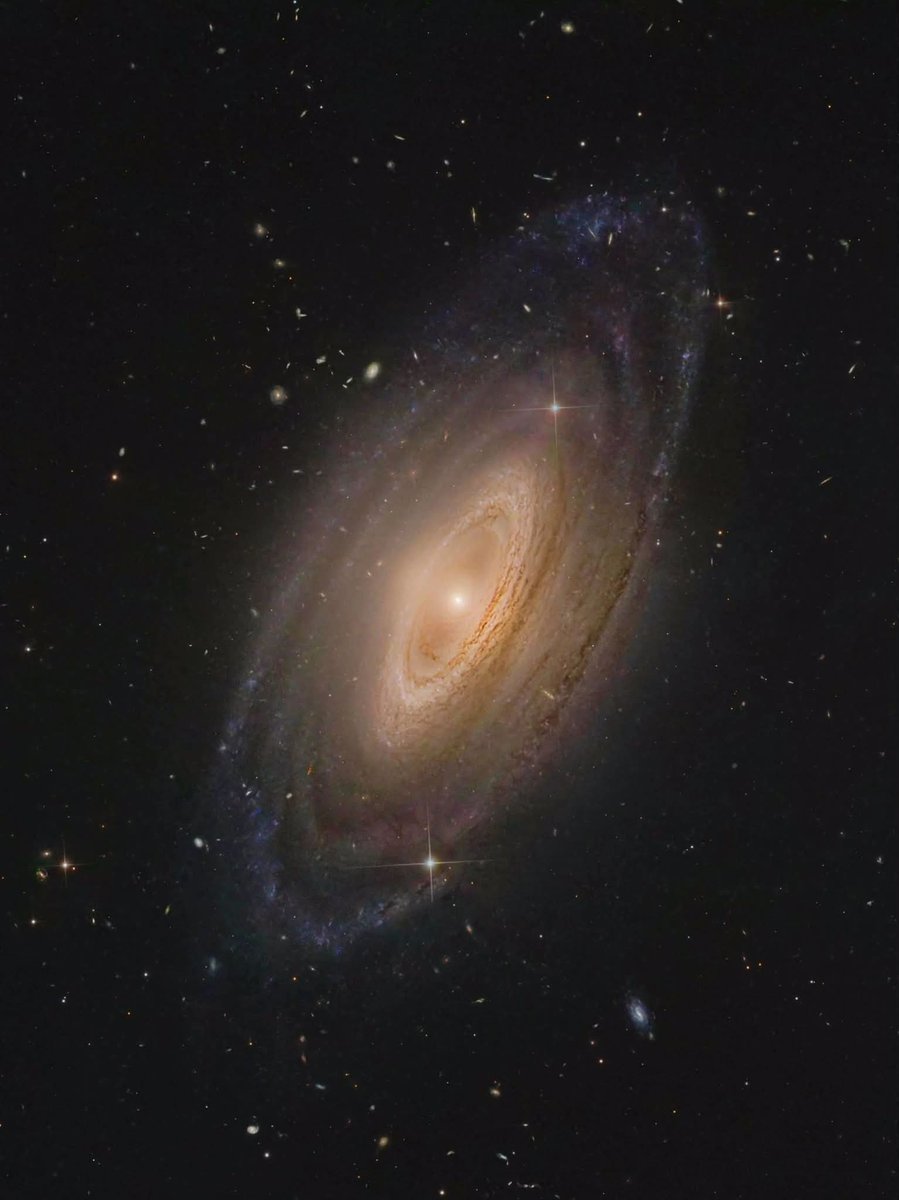
NGC 4698 looks like it has its life together.
Out in Virgo, 73 million light-years away, it sits as a clean lenticular disk — smooth, composed, no messy spiral arms tearing at the edges. Eighty-five thousand light-years across, only a little smaller than the Milky Way. From a distance it could pass for a finished thought.
Then you check the spin.
The outer disk turns one way. The heart of the galaxy turns the other. Like a top whose core decided to revolt against its own rim. Stars in the center stream against the current of everything surrounding them.
Galaxies don’t do that by accident. The only story that fits is a collision — two systems meeting, one sinking into the other, angular momentum left twisted and unfinished. The calm face is a lie. Underneath, the merger is still written in the rotation.
A quiet-looking galaxy with a civil war in its core. That’s NGC 4698.
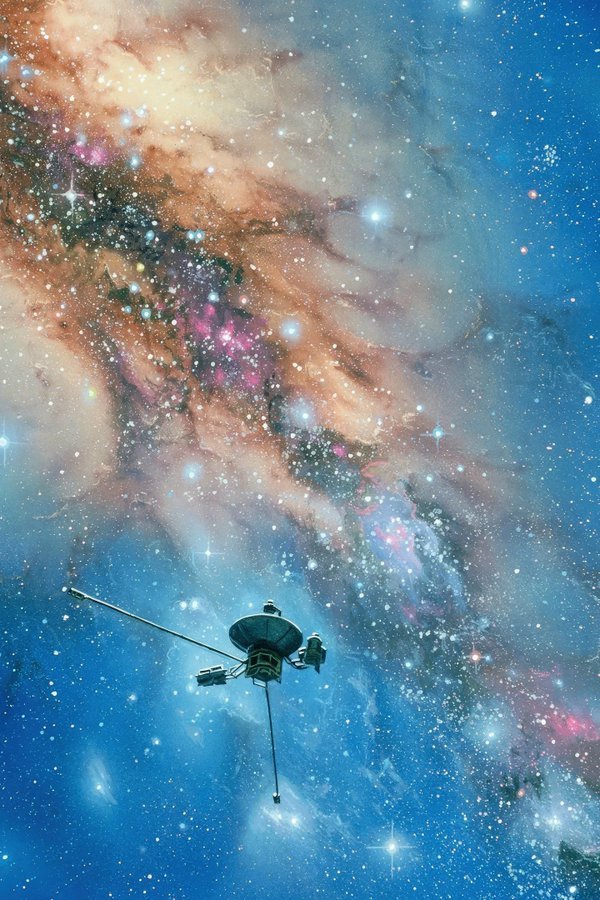
Today marks 49 years since the launch of Voyager 1—the spacecraft farthest from Earth. If you step outside on a clear night and shine a flashlight toward the constellation Ophiuchus, a couple of the photons you emit would, in theory, reach Earth's emissary. It would take them 23 hours and 47 minutes to get there.