Crypto is at a pivotal moment.
As Congress debates landmark market structure legislation, Marc Andreessen and Chris Dixon discuss the decisions that could shape where the next generation of financial infrastructure is built, and whether the United States remains the global leader in crypto innovation:
00:00 Intro
05:31 From crypto subculture to financial infrastructure
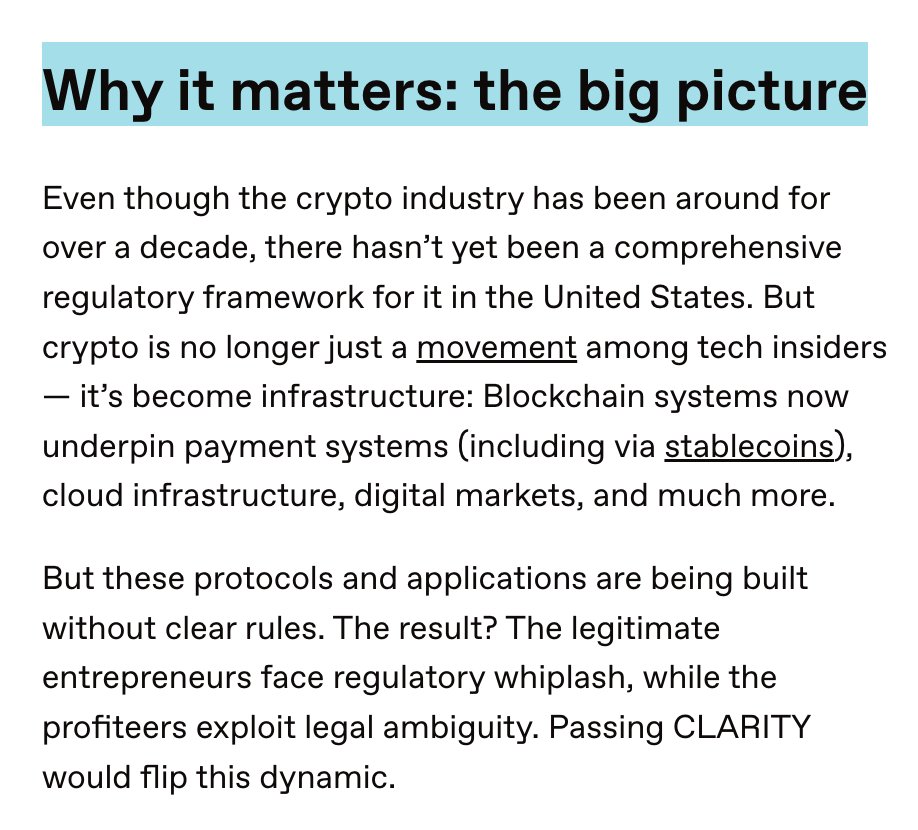
08:37 Why crypto needs rules now
12:20 The regulatory war on crypto
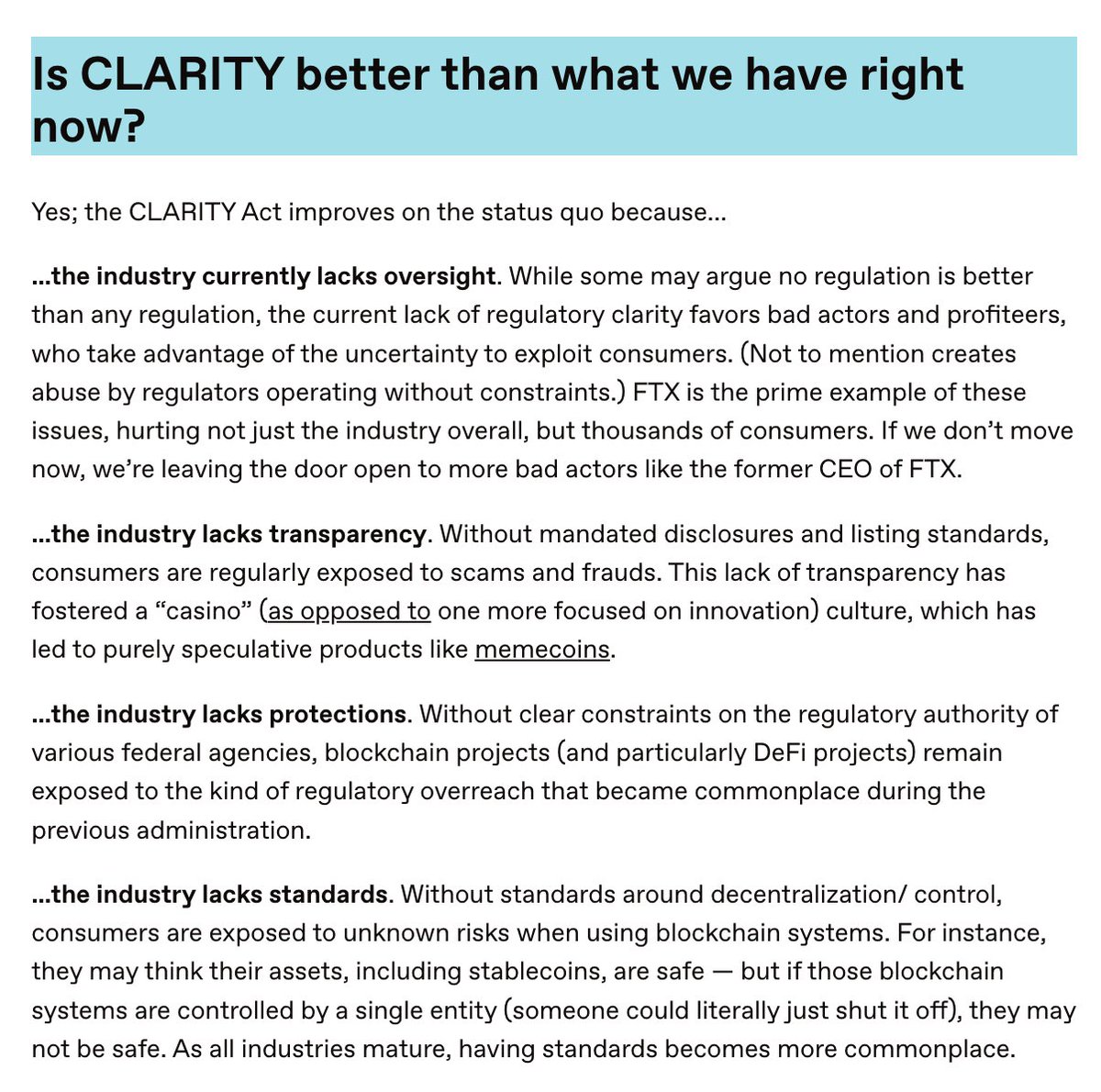
15:41 How CLARITY could prevent another FTX
22:42 Why criminals using crypto may be easier to catch
26:20 Privacy, blockchains, and the invention of HTTPS
30:41 Government ethics and crypto
34:52 The banking lobby’s stablecoin fight
37:05 Why every major bank is building on blockchains
41:04 Developer liability as a killshot
45:23 How CLARITY provides oversight
49:30 What happens if CLARITY fails?
50:50 Regulation vs. innovation
54:12 Why America should lead
55:36 What CLARITY could unlock
@pmarca@cdixon@rhackett
The bewildering thing about TradFi's extreme efforts to kill CLARITY is that they are likely accelerating their own obsolescence.
GENIUS is already law and it opened the floodgates for dollars to move onchain. Other real-world assets will follow regardless of whether CLARITY passes.
CLARITY offers TradFi a lifeline by letting institutions participate in the onchain economy, even enabling them to use permissionless DeFi. Without CLARITY, many institutions will be sidelined.
And without CLARITY, crypto intermediaries will keep paying yield on stablecoin deposits under GENIUS, the very outcome banks have been lobbying so hard against.
I have to believe a lot of this is driven by incentives rather than irrationality. At most TradFi orgs, no one will get punished for defending the status quo. But if things change and anything goes wrong, heads will roll.
Ultimately, it's easier to hold a pessimistic view of the world as you slowly dig your own grave than to take a chance on optimism.
.@pmarca has an answer for government inquiries into crypto use cases:
"I've had these conversations with some lawmakers in DC where they say, 'I'm gonna support crypto now because if it didn't die during this whole period when we tried to kill it, then it must be good.'"
"Which is the most reverse logic way I can think of to end up positive on something, but I guess I'll take it."
"'Where are all the use cases?' Well, there was a five-year regulatory and prosecutorial assault that tried to kill it. Most areas of the tech industry never go through that."
@pmarca@cdixon@rhackett
What the CLARITY Act actually does 👇
① Gives crypto builders a clear path to launch
② Puts exchanges and other intermediaries under real oversight
③ Gives consumers stronger protections
.@cdixon: “When you have gray areas in regulation, you have essentially a race to the bottom.”
Compliant U.S. companies follow the rules. Offshore competitors copy the product without the compliance.
“The ambiguity ends up favoring the bad actors.”
Crypto is at a pivotal moment.
As Congress debates landmark market structure legislation, Marc Andreessen and Chris Dixon discuss the decisions that could shape where the next generation of financial infrastructure is built, and whether the United States remains the global leader in crypto innovation:
00:00 Intro
05:31 From crypto subculture to financial infrastructure
08:37 Why crypto needs rules now
12:20 The regulatory war on crypto
15:41 How CLARITY could prevent another FTX
22:42 Why criminals using crypto may be easier to catch
26:20 Privacy, blockchains, and the invention of HTTPS
30:41 Government ethics and crypto
34:52 The banking lobby’s stablecoin fight
37:05 Why every major bank is building on blockchains
41:04 Developer liability as a killshot
45:23 How CLARITY provides oversight
49:30 What happens if CLARITY fails?
50:50 Regulation vs. innovation
54:12 Why America should lead
55:36 What CLARITY could unlock
@pmarca@cdixon@rhackett
.@pmarca on the proposal that would end open-source software:
"It's a kill shot to the industry. How can any software developer anticipate the use of the software down the road?"
"If I run a hotel and a criminal stays at the hotel and they plan their operation, does that make me part of their conspiracy? If I'm an engineer on a car and the car is used in a bank robbery, does that make me an accessory to bank robbery?"
@pmarca@cdixon@rhackett
.@cdixon on the ethics provisions in the CLARITY Act:
"I think there should be ethics rules for government officials. I don’t think those should be exclusive to crypto."
"This bill, as proposed right now, would be the first bill in US history that regulates an industry and also adds specific ethics provisions for government officials in it."
"Normally, government ethics rules are done separately, and an industry is regulated separately. This industry is being held to a completely different standard than other industries."
@cdixon@pmarca@rhackett
Crypto is at a pivotal moment.
As Congress debates landmark market structure legislation, Marc Andreessen and Chris Dixon discuss the decisions that could shape where the next generation of financial infrastructure is built, and whether the United States remains the global leader in crypto innovation:
00:00 Intro
05:31 From crypto subculture to financial infrastructure
08:37 Why crypto needs rules now
12:20 The regulatory war on crypto
15:41 How CLARITY could prevent another FTX
22:42 Why criminals using crypto may be easier to catch
26:20 Privacy, blockchains, and the invention of HTTPS
30:41 Government ethics and crypto
34:52 The banking lobby’s stablecoin fight
37:05 Why every major bank is building on blockchains
41:04 Developer liability as a killshot
45:23 How CLARITY provides oversight
49:30 What happens if CLARITY fails?
50:50 Regulation vs. innovation
54:12 Why America should lead
55:36 What CLARITY could unlock
@pmarca@cdixon@rhackett
This week is one of the most consequential for the CLARITY Act and the future of crypto in America.
@pmarca, @rhackett, and I discuss what the bill does, why it matters, and some common misconceptions.
.@pmarca says national security professionals actually want criminals using crypto, not less:
"They're hoping that more criminals and terrorists use crypto and use blockchains because there's a trail."
"The alternative is the hawala system... Two cousins in two countries, money never actually moves, one just tells the other the family has it. No digital trail whatsoever, because nothing has happened digitally. No paper trail, no nothing."
"There was a term a while ago that national security people were kicking around. They called crypto prosecution futures."
@pmarca@cdixon@rhackett
.@pmarca on why crypto's regulatory environment failed innovators:
"There's a specific degenerate form of government called anarcho-tyranny... The anarcho part is you let the rule breakers go absolutely nuts. The tyranny part is you regulate or prosecute the good actors to death."
"Startups outside the US went wild and did whatever they wanted, which led to FTX. Startups inside the US got brutally punished, with no route to safety, no route to a way to actually safely conduct business."
"If you were designing from scratch and saying, what's the worst possible policy? It would be anarcho-tyranny."
@pmarca@cdixon@rhackett
Marc Andreessen: “We need a stable, permanent regulatory structure for crypto in the US.”
“We need it so that it doesn’t result in more FTXs. And we need it so that people’s money doesn’t get stolen.”
“We’re not looking for a free lunch. We’re not looking for subsidies. We’re not looking for protectionism. We’re just looking for a basically permanent framework that lets people do business in a responsible way.”
@pmarca on why the US needs the kind of permanent crypto framework the CLARITY Act would create.
Crypto is at a pivotal moment.
As Congress debates landmark market structure legislation, Marc Andreessen and Chris Dixon discuss the decisions that could shape where the next generation of financial infrastructure is built, and whether the United States remains the global leader in crypto innovation:
00:00 Intro
05:31 From crypto subculture to financial infrastructure
08:37 Why crypto needs rules now
12:20 The regulatory war on crypto
15:41 How CLARITY could prevent another FTX
22:42 Why criminals using crypto may be easier to catch
26:20 Privacy, blockchains, and the invention of HTTPS
30:41 Government ethics and crypto
34:52 The banking lobby’s stablecoin fight
37:05 Why every major bank is building on blockchains
41:04 Developer liability as a killshot
45:23 How CLARITY provides oversight
49:30 What happens if CLARITY fails?
50:50 Regulation vs. innovation
54:12 Why America should lead
55:36 What CLARITY could unlock
@pmarca@cdixon@rhackett
For years, private equity bought companies and hired Harvard MBAs to run them.
@guywuolletjr thinks the new version may be to install people with the highest return on tokens to out-compete the companies — and under the hood, much of that transformation may run on stablecoins.
What happens when intelligence becomes a line item?
For the first time, companies can treat AI token spending almost like headcount: allocate more money, deploy more intelligence, and potentially get more work done.
That changes the economics of building a company. It could reshape how companies form, how teams are managed, how businesses are financed, and who is best positioned to build them.
a16z crypto General Partner @guywuolletjr and Head of Engineering @NoahCitron join @rhackett to explore why engineering leaders may soon manage token budgets like P&Ls, the emergence of software-engineering “pod shops”; and whether the future belongs to smaller, leaner businesses run by people who are unusually good at directing agents.
They also ask why AI agents may naturally transact using stablecoins, and confront a larger question: If AI has created so much new intelligence, why hasn’t it produced an obvious jump in economic growth? And in a world where everyone can access powerful models, will intelligence matter less than grit, judgment, and agency?
0:00 Intro
4:01 Why token spending is starting to resemble headcount
4:51 Deciding how much spend is too much spend
9:04 The agentic A/B test: How to quantify "return on tokens"
12:05 The software-engineering "pod shop"
25:13 Paying deference to the Machine God
26:06 The rise (or not) of lean, AI-native microbusinesses
28:05 Everyone's a manager? The new style of thinking for engineers
30:48 Why AI agents may naturally use stablecoins
34:33 When AI productivity will appear in GDP
47:49 Why grit and agency may matter more than IQ
51:38 How AI could create new paths for startups
54:53 Innovation, commoditization, and creative destruction