Supporting a 21st century unifying vision for Israel by rallying around BGU’s remarkable work and role as an apolitical beacon of light in the Negev desert.
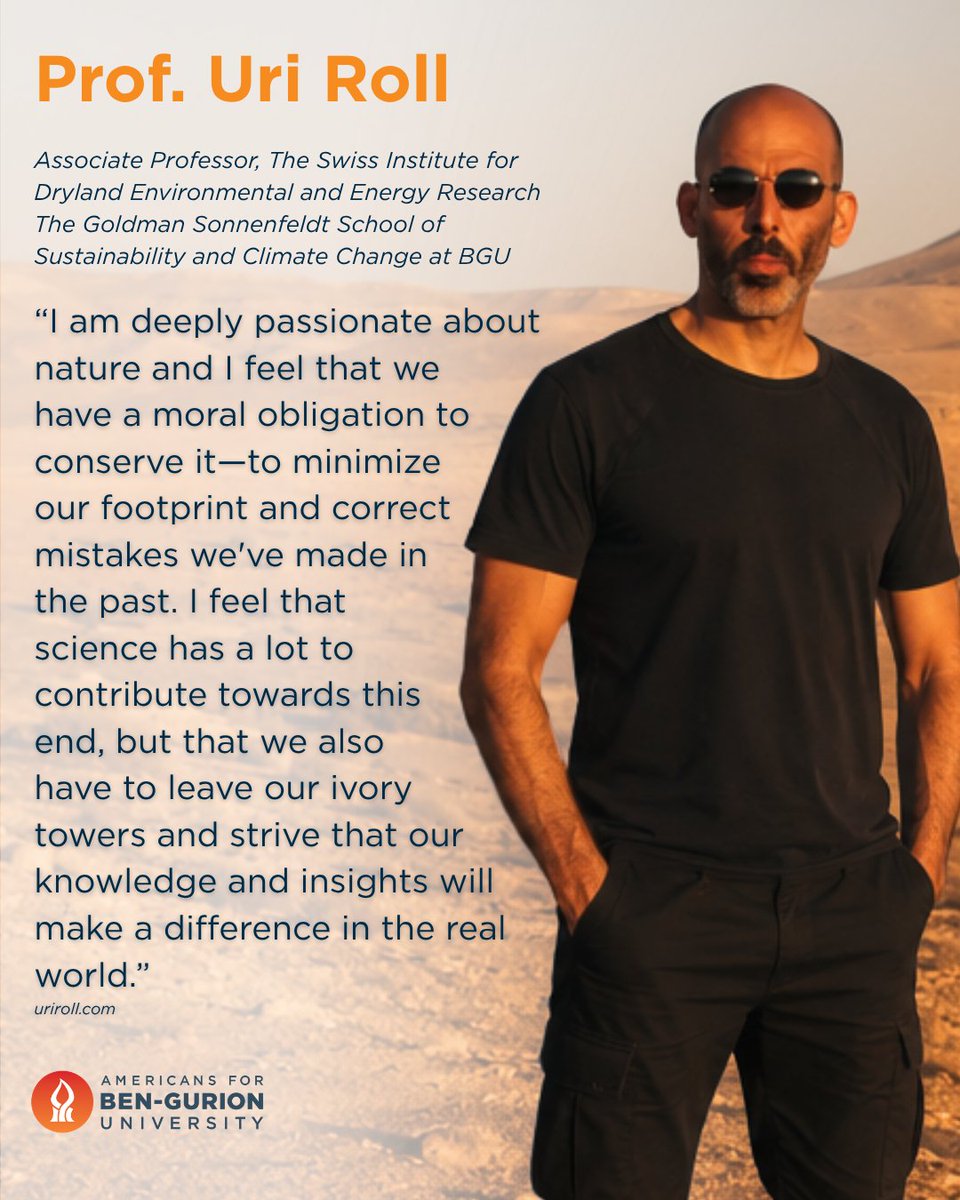
This World Environment Day, we're celebrating researchers at @bengurionu whose work is helping us better understand and protect our planet.
Prof. Uri Roll, Ph.D Student Noa Yaffa Kan-Lingwood, and Prof. Yaron Ziv are advancing environmental science in the Negev and beyond. From protecting species and habitats to studying the resilience of desert ecosystems, their research is helping build a more sustainable future.
𝘾𝙖𝙣 𝙩𝙖𝙠𝙞𝙣𝙜 𝙞𝙗𝙪𝙥𝙧𝙤𝙛𝙚𝙣 𝙙𝙪𝙧𝙞𝙣𝙜 𝙚𝙖𝙧𝙡𝙮 𝙥𝙧𝙚𝙜𝙣𝙖𝙣𝙘𝙮 𝙞𝙣𝙘𝙧𝙚𝙖𝙨𝙚 𝙩𝙝𝙚 𝙧𝙞𝙨𝙠 𝙤𝙛 𝙗𝙞𝙧𝙩𝙝 𝙙𝙚𝙛𝙚𝙘𝙩𝙨? Researchers at @bengurionu tackled this agonizing question by analyzing more than 264,000 pregnancies over a 20-year period.
https://t.co/xyUi2byZLg
"The study results showed that NSAID medications are safe for use in the first trimester of pregnancy and are not associated with the development of birth defects overall. The findings are supported by a large-scale, population-based database, which allows for a more accurate assessment of the safety of using these medications in the early stages of pregnancy," said Dr. Sharon Daniel, Biostatistician and Epidemiologist in BGU's Department of Public Health.
The findings provide important data to help physicians and expectant mothers make informed decisions when managing pain and fever during early pregnancy.
Read more: https://t.co/xyUi2byZLg
What if microbes know who their neighbors are and change their behavior because of it?
https://t.co/QZhsEwJKX5
Researchers at @bengurionu, led by Prof. Itzhak Mizrahi and Dr. Sarah Morais, are studying how microbial communities interact to reduce methane emissions and improve agricultural sustainability.
The research challenges long-held assumptions that organisms compete solely for survival, revealing that microbes adapt and shift their behavior in response to their environment and the organisms around them.
As Prof. Itzhak Mizrahi explains, “Just by using pairs or three, four, or even five microbes, we can see what type of decision a microbe will make as a function of the environment.”
The finding could change how we think about microbiomes, from human health and probiotics to agriculture, biotechnology, and environmental sustainability. Instead of focusing only on individual “good” microbes, the research highlights the importance of building the right microbial communities.
Because in the microbial world, it turns out that who your neighbors are may matter just as much as where you live.
Read more on @TimesofIsrael: https://t.co/QZhsEwJKX5
📢New Dates Announced!
The 56th Ben-Gurion University Global Community & Board of Governors Gathering will take place in Israel from October 18–22, 2026!
https://t.co/pn6rRUhmYZ
Experience inspiring conversations, immersive Negev experiences, and a special pre-Global Gathering Shabbat in Jerusalem alongside the global @bengurionu community.
Register now and be part of this unforgettable week: https://t.co/pn6rRUhmYZ
Built on more than 20 years of research at @bengurionu, MotionAnalytics is developing AI technology that identifies people by the way they move, not just by facial recognition.
The company’s MotionID platform is already reporting over 90% identification accuracy in operational video pilots.
Co-founders Prof. Raziel Riemer and Adi Nathan say the technology introduces “a new biometric dimension” that works in conditions where traditional systems fail, including poor lighting or hidden faces.
“Human movement contains a unique, measurable biomechanical signature,” said Prof. Raziel Riemer of BGU’s Department of Industrial Engineering and Management.
Read more below ⬇️
Israeli startup MotionAnalytics looks to build a new category of identification using biometrics.
Built on decades of university research, the pre-Seed startup identifies individuals not by their faces, clothing, or devices, but by the way they move.
https://t.co/BHEoua6HkL
New research from @bengurionu is shedding light on how GLP-1 medications may help protect the heart from atrial fibrillation (AF), one of the most common heart rhythm disorders linked to stroke and hospitalization.
https://t.co/MSHN6LZeMF
Led by Prof. Yoram Etzion and the Cardiac Arrhythmia Research Laboratory, the study found that semaglutide reduced heart tissue scarring and preserved healthy electrical signaling in the heart. Researchers also found that both semaglutide and colchicine reduced inflammatory pathways associated with AF progression.
“Our findings suggest that these medications could be used strategically to stop the progression of heart rhythm disorders before they become permanent,” the researchers noted.
The findings could open the door to more personalized prevention strategies for patients at risk of atrial fibrillation.
Read more on @EurekAlert: https://t.co/ENxidjEhHi
From a personal mission to a groundbreaking health-tech startup, Dr. Karny Ilan and co-founders Shani Klein Antman and Gal Yanuka are helping reimagine breast cancer detection through AI-powered innovation and accessible screening technology.
https://t.co/FvVPzFmgi7
Born out of BGU’s Yazamut 360° entrepreneurship center with an early investment of $100,000 from BGU-backed Cactus Capital, Feminai’s story didn’t begin in a lab or boardroom, but in a medical school classroom. Growing up with a family history of breast cancer—the most common cancer among women—Ilan felt the stakes personally. While training at BGU as an aspiring breast cancer surgeon, learning to perform clinical breast exams made one thing clear: screening could, and should, be better.
“Our goal is to make breast cancer screening more accurate, accessible, and affordable — ultimately improving outcomes for women’s health,” Dr. Karny Ilan Co-founder & CEO of Feminai
Read Dr. Ilan's full interview with A4BGU here: https://t.co/bJRn3tvJV3 and check out more about BGU's innovators in our latest Negev Connection here: https://t.co/LufVkiejCC
Americans for Ben-Gurion University honors and remembers the brave American service members who sacrificed their lives for the freedoms we share today.
Shavuot is a time to embrace learning and curiosity. It's a celebration of receiving knowledge and a reminder that education has the power to transform lives, communities, and our future.
https://t.co/oA8i8wxeWs
That transformative power comes to life at @bengurionu (BGU) through groundbreaking research and education that addresses real-world challenges.
At a time when meaningful connection can feel increasingly rare, BGU stands out as one of the only universities in Israel where community, collaboration, and the sharing of knowledge thrive. The BGU spirit is palpable across its bustling campuses, fueling innovation and inspiring the next generation of leaders and changemakers.
Invest in education, invest in possibility: https://t.co/oA8i8wxeWs
Researchers from @bengurionu are studying the growing threats to the vulnerable Nubian Ibex, including climate change, habitat loss, drought, and increased human interaction.
https://t.co/ZgAoPqhSu0
In Israel, core ibex populations live in the Judean Desert, the Negev Highlands, and the Eilat Mountains, with the Judean Desert home to the largest Nubian ibex population in the world.
The research also explores how these remarkable desert animals adapt to changing environments, including navigating steep rocky terrain and even crawling through narrow drainage tunnels beneath roads.
As desert water sources continue to shrink due to rising temperatures and prolonged drought conditions, researchers warn that access to water has become one of the species’ greatest challenges. “Without water, there are no ibexes,” said Dr. Jonathan Tichon, a faculty researcher at BGU, highlighting the importance of protecting desert water sources and wildlife habitats.
With “fewer than 5,000 mature individuals in the wild worldwide,” researchers say conservation efforts and public awareness are more important than ever.
Read more on @ynetnews: https://t.co/ZgAoPqhSu0
From the October 7 battlefield to building his future at @bengurionu, Levy’s journey is one of resilience and purpose.
https://t.co/r6U8X2Y5k3
Before becoming a student, he served in the IDF’s 7th Armored Brigade and was stationed near the Gaza border on October 7. He woke up expecting a routine day of service—within minutes, his base became one of the first targets of the Hamas attack, leading to a fight for survival alongside his fellow soldiers and the loss of close friends.
After taking time to heal, Levy chose to move forward with purpose, sharing his story across Israel and around the world while honoring those who didn’t make it.
“The biggest thing I take from that day is the understanding of how much life means…what a huge privilege all this is. I feel like one of my biggest obligations as someone who was there is to keep the memory alive.”
Read Koby Levy's story: https://t.co/r6U8X2Y5k3
We’re excited to share our latest edition of Negev Connection with you. This edition spotlights the people, partnerships, and breakthroughs shaping @bengurionu—its impact in securing a better future for Israel and the world. https://t.co/LjqGPDKXVW
At Ben-Gurion University of the Negev, innovation is powered by students on the frontlines of Israel’s healthcare system.
https://t.co/2jRCkgRbqi
Over the last two years, the fearlessness of Israel’s nurses has been on full display, from emergency response to community care. Their example underscores a clear reality, preparing the next generation of healthcare leaders is essential to Israel’s long-term strength.
Through BGU’s Faculty of Health Sciences, students integrate academic study, hands-on clinical training, and meaningful research that directly responds to real-world healthcare challenges, including:
▪️Chronic disease care
▪️Forensic nursing
▪️AI in clinical simulations
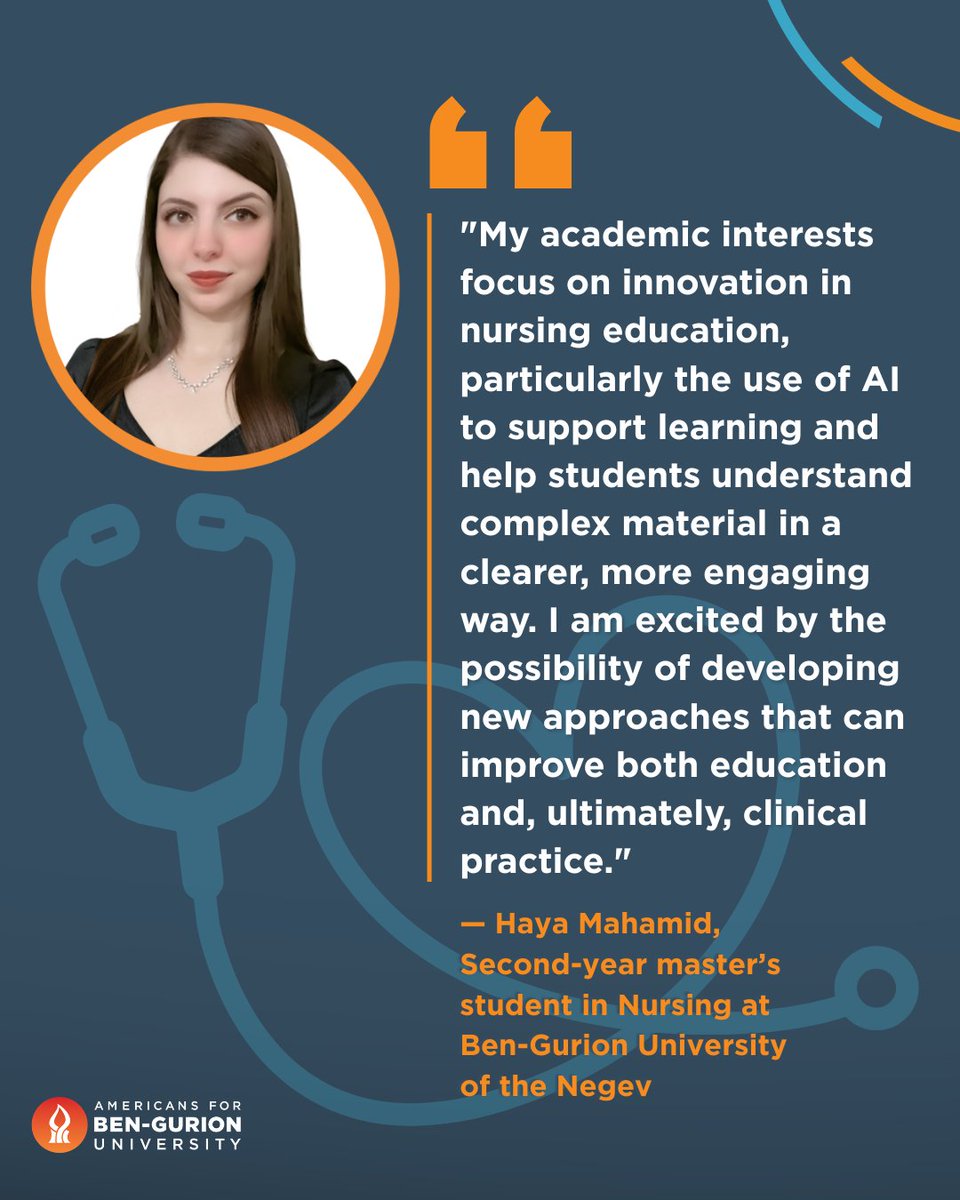
Haya Mahamid, second-year master’s student in Nursing at @bengurionu, shares: “My academic interests focus on innovation in nursing education, particularly the use of AI to support learning and help students understand complex material in a clearer, more engaging way.”
BGU nursing students are addressing urgent healthcare challenges while advancing innovative, forward-thinking solutions for the future.
Make a gift today to help strengthen nursing leadership in Israel for the future: https://t.co/2jRCkgRbqi
In the 1970s, when Beer-Sheva was still a developing city in Israel’s Negev desert, a young university was just beginning to take shape. It was during these formative years that Rob Spitzer’s parents first became acquainted with @bengurionu.
https://t.co/MNibsX4ZKh
Among the clearest voids in the University’s offerings at the time was a strong social work program. The Negev is home to various immigrants and underserved populations, and the demand for trained professionals to support these communities is urgent.
Yet as Spitzer explains, “Social work is not a field that necessarily attracts big money. It’s not a glamorous academic field.” Faced with limited funding, the University considered closing its social work department altogether.
For the Spitzer family—including Rob’s mother Charlotte B. Spitzer, who worked in the social work profession—that possibility was unthinkable. “My mom said, ‘We can’t let that happen, Jack,’” Spitzer recalls, referring to his father.
Rob Spitzer has witnessed firsthand how dramatically these needs have grown in the Negev and nationwide since October 7th.
Read more about the Spitzer Family's legacy: https://t.co/MNibsX4ZKh
Join the A4BGU family! We're looking for a major gifts pro in South Florida who is passionate about Israel and higher education. If you want to play a leading role in shaping the future of the Negev, we want to hear from you.
Apply today: https://t.co/bWhM6uEqvI
'The AI tsunami is here'—and it’s reshaping everything.
https://t.co/vljRL4XR5Z
Prof. Lior Rokach of @bengurionu recently published an op-ed in the Jerusalem Report on both the global impact of artificial intelligence and its implications for Israel’s future.
Despite limited computing resources compared to those of global superpowers, he emphasizes that Israel’s strength lies in its people and the need to invest in education and innovation to remain competitive.
"We must proactively educate ourselves, adapt to the new AI language, and prepare for a world where human intelligence is no longer the rarest commodity. Through international cooperation and steadfast investment in our human capital, Israel can help guide this technology toward a future that elevates, rather than diminishes, the human experience."
Read Prof. Rokach's full op-ed and support his work: https://t.co/vljRL4XR5Z