IT FINALLY HAPPENED!!
My IRL job ✨merged✨ with the field of crypto art!! (sort of).
As an architectural heritage engineer and NFT-collector I’d been waiting for over 2 years to join this space. A thread 🧵
It's only been 1 day of CES 2025, and the announcements have already been incredible.
The 10 most impressive reveals of CES 2025 so far:
1. Samsung's transparent micro led display 🤯
One of our biggest preservation projects to date: partnering with Aruba 🇦🇼 Collecion Aruba provides access to historical materials and cultural treasures—available on https://t.co/rvOhn0byKe
Projects like this are possible with your support: https://t.co/LaR5Akai80
“Stop thinking about art works as objects, and start thinking about them as triggers for experiences… That solves a lot of problems … Art is something that happens, a process, not a quality, and all sorts of things can make it happen … [W]hat makes a work of art ‘good’ for you is not something that is already ‘inside’ it, but something that happens inside you …”
— Brian Eno
There is a palpable difference in the work of artists who began collaborating with AI prior to COVID, prior to ChatGPT, prior to DALL-E, prior to the trends. Here's a snap from my first solo show, in Feb 2020, where I exhibited my AI-powered poem, "COMPLETION: Are you ready for the future?" (written with GPT-2 in 2019) for the first time, as well as paintings from my Ancient Binary and Cursive Binary series.
Mold, 2024
Rotated overdrawn
(cell phone photo)
Sakura fineliner on Terschelling paper
40 × 50cm / 15.7 × 19.7″
See whole series in progress: https://t.co/xIqpsbmDAN
Internet Archive's founder & digital librarian, @brewster_kahle, reflects on last week's move by the island nation of Aruba to endorse digital rights for memory institutions. Why is it so important for libraries to own, not lease, their collections? 👉 https://t.co/mkp8Fqrego
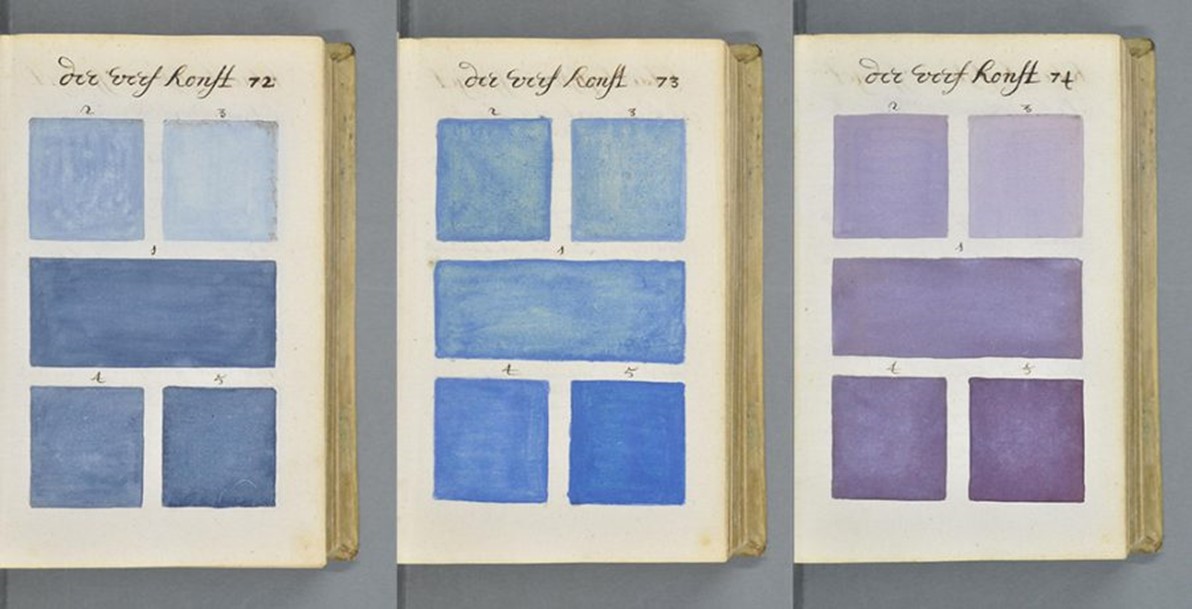
Back in 1692, obscure Dutch artist A Boogert produced a one-off, hand-painted, 900 page catalogue of every conceivable colour, complete with handwritten, detailed advice to artists on how to create them. Now available online, see
https://t.co/DIYUAPIv7R
🔥 It‘s done. The Foundation Herbert W. Franke is proud to present Herbert W. Franke’s database of digitized manuscripts starting in 1946. It is now publicly accessible online at ZKM Karlsruhe.
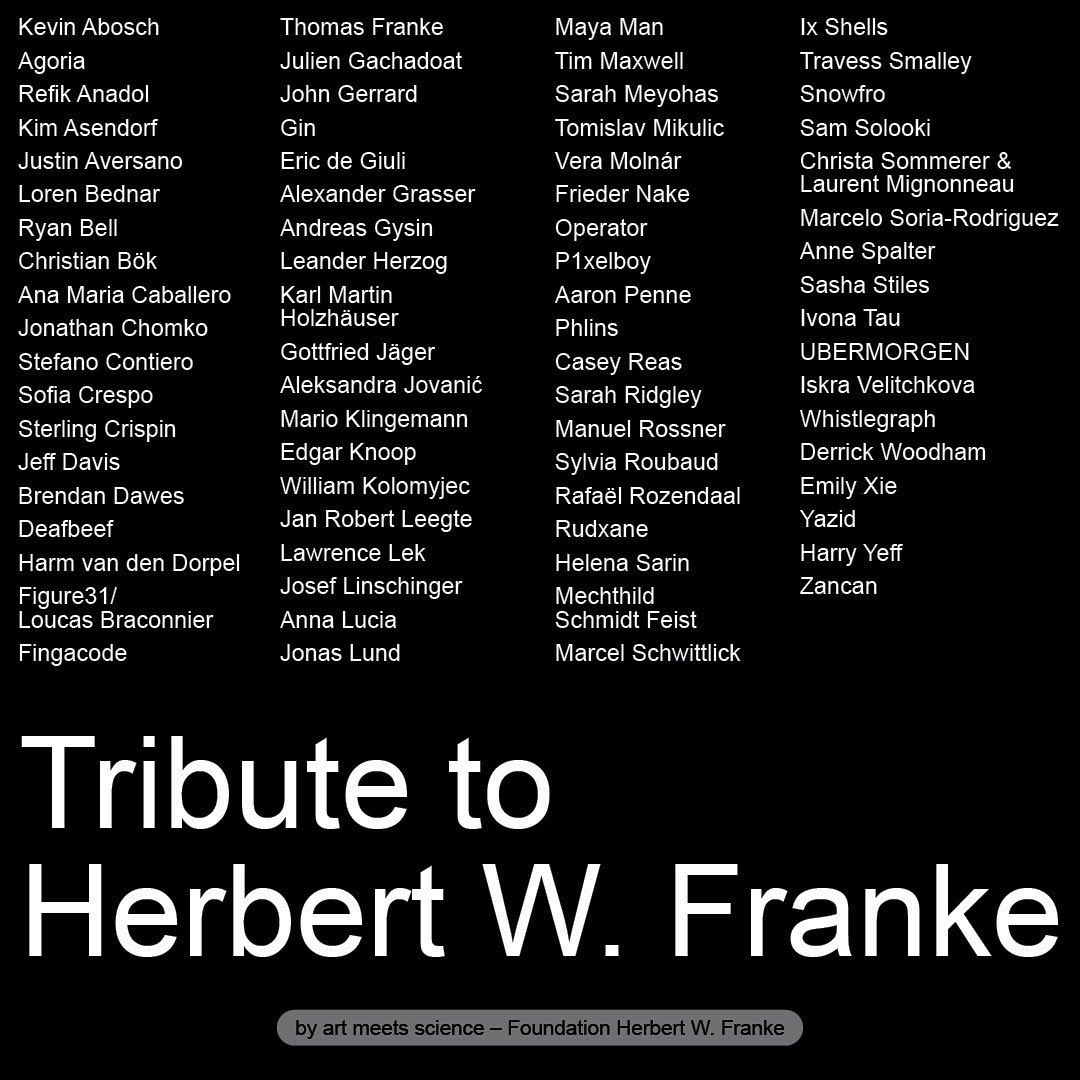
Made possible with the generous donations from the artists who were part of the Tribute to @HerbertWFranke.
✨ THANK YOU! ✨
The database of digitized manuscripts by Herbert includes non-fiction texts about media art and art theoretical considerations, as well as articles for art and computer magazines about algorithmic art. Articles on the role of future research and science fiction in society can be found, as well as popular non-fiction texts on topics in science and technology.
The database will be further optimized, expanded, and also integrated into the ZKM search engine.
Susanne Päch, Herbert’s wife and managing director of the Foundation, is already working on another major project in his spirit: in May 2024, around Herbert’s 97th birthday, a conference will take place on the history of generative art in Berlin.
Proceeds from the ZENTRUM release (in collaboration with @ExpandedArt and @proof_xyz) will be used to organize and host the conference. The Foundation HWF will bring together artists, curators, collectors, and researchers to discuss the history of generative art. And to support publishing the science fiction writing of Herbert in English, which is also planned for 2024.
@culturaltutor “Urban Lighting Design” is perhaps a more proper term to describe this,
as it considers artificial lighting of the entire built environment and its environmental-, economic-, psychological- and physiological- consequences.
4/28 In 1946, she began creating her first non-representational images, which consisted of abstract geometrical and systematically determined paintings.
OVAL WITH POINT, 1947 (below)
Here, you can see the petals behaving according to the rules of the Game of Life, a cellular automaton originally devised by John Horton Conway in 1970, in which deceptively simple rules lead to emergent patterns and complex self-organization.







![sashastiles's tweet photo. [runs to her library and then her studio] https://t.co/Du0lSiuH5w](https://pbs.twimg.com/media/F_O8xovXUAACPHv.jpg)





