Welcome, quick introduction to myself and Arborator Capital.
We are a Czech-based investment fund and research team focused on global small and mid-cap equities, compounders, and asymmetric opportunities.
My investing journey started during COVID. Between 2022 and 2024, I managed a small friends-and-family portfolio and spent thousands of hours researching businesses across global markets. The results were decent, but nothing extraordinary. I performed roughly in line with broader markets.
During those years, I began building positions in several companies that would later become some of our biggest winners. At the time, many of these ideas were highly contrarian and deeply unpopular. I was researching companies such as Bloom Energy $BE , MP Materials $MP , and others long before they became widely discussed by investors. In many cases, the charts looked terrible and most investors wanted nothing to do with them.
In 2024, I tried to break into the professional investment industry. I pitched some of these ideas, including Bloom Energy, to several investment firms during interviews in Prague. Nobody was particularly interested. I didn’t receive a single offer, and looking back, that wasn’t surprising. I was young, had no institutional experience, and many of my investment theses looked completely different from market consensus.
There was even a period during 2024 when I seriously considered whether pursuing investing as a career made sense at all.
Then things started to change. The very companies that had been dismissed by most investors began proving the original thesis right. Bloom Energy became one of the most successful investments of my life, appreciating roughly 3,000% from the time I first started pitching the idea. The AI infrastructure story played out, power demand accelerated, and many of the catalysts I had expected started materializing. At the same time, investments such as MP Materials benefited from the geopolitical shifts and supply-chain risks that had originally attracted us to the opportunity.
As those ideas played out, I continued finding new opportunities across defense technology, drones, critical minerals, software, healthcare, energy, infrastructure and others.
One example was Elsight $ELS.AX , an Israeli drone connectivity company that I discovered while researching Australian market by A-Z method. I shared the idea with several friends months before it became more widely known, and it eventually became one of our most successful investments, generating returns measured in several hundred percent.
I also invested early in Lindbergh $LDB.MI and even travelled to Italy with my friend to meet management in person and better understand the business. It was one of our first in-person meetings with a management team. We hope to continue meeting management teams directly and occasionally share some of the insights and observations we gather from those meetings here on X.
We identified Nebius $NBIS with my friend as a unique AI infrastructure opportunity and invested before the story became broadly recognized by the market. We also benefited from the long-term growth of retail investing through investments such as XTB $XTB.WA , one of the leading brokerage platforms in Europe.
Last big winner was EQ Resources $EQR.AX . After recognizing the strategic implications of China’s restrictions on tungsten exports, I identified EQ Resources as one of the few meaningful western producers positioned to benefit from higher tungsten prices. That investment also generated returns of several hundred percent.
And those are only a few examples. Today, we measure our successful investments in dozens rather than a handful. In 2025, our portfolio generated returns well above 100%, and year-to-date performance in 2026 is approaching 70 % (BE excluded). While we are proud of these results, we remain fully aware that investing is a long-term game and that difficult periods inevitably come with success. 1/2
🔎 Insiders Are Buying. The Valuation Looks Attractive. Is This Our Next Opportunity?
We’ve identified another interesting investment opportunity amid the recent market sell-off and have initiated a small position.
💰 Attractive valuation: We believe the market may be underestimating the company’s potential.
👀 Insider buying: Management and insiders are putting their own money to work, which we see as an encouraging signal.
📈 Potential upside: If the business executes successfully, we believe the current valuation could offer attractive returns.
⚠️ But the risks remain significant. This is far from a risk-free investment, which is why we’ve started with a relatively small position.
We’re still evaluating the opportunity and aren’t rushing to increase our exposure. In a market like this, even more attractive opportunities could emerge.
We’re finding plenty of interesting ideas, but we’re becoming increasingly selective about where we allocate capital.
We’ve shared our investment thesis and the key risks on Substack.
📖 Full research available on our Substack, link in bio.
Challenge accepted, Andy! 😅 Apparently, high-beta growth investors showing their YTD returns have become an endangered species. Well, here’s one still alive: +57.9% YTD.
Although I have to admit, the past month has felt like an absolute apocalypse for our portfolio.
We’re invested almost exclusively in small-cap growth stocks and commodities. Not exactly the ideal combination in this market.
We’ve made some good decisions, but also plenty of mistakes. And in this environment, every mistake gets punished brutally.
Looking back, we were probably too diversified. Several smaller positions significantly underperformed our core holdings, and our capital allocation could certainly have been better.
Still, I think we’ve managed to navigate this storm reasonably well, even if I’m far from satisfied.
We’ve also been prioritizing our investment vehicle, launched in late May, which is currently around breakeven or slightly negative since inception. Not the result we wanted, but given what our portfolio has been through, it could have been much worse.
So what are we doing now?
We’re becoming more concentrated and doubling down on our highest-conviction ideas.
🛢️ Arrow Exploration ($AXL.V) looks cheaper than ever on metrics such as EV per barrel of production, trading at a substantial discount even to South American peers. We’ve been adding.
🇰🇷 TNE Korea ($0053F0) is one of our newest investments, acquired during the sell-off. We believe its exposure to Bloom Energy and exceptional operating leverage remain significantly undervalued.
🇯🇵 FitEasy ($212A.T) remains one of our highest-conviction holdings. Earnings are approaching, and we’re planning another update explaining why we remain so bullish.
🚀 Drones and defense technology: We believe the sector has become heavily oversold. We’ve added to selected positions and are actively researching several more opportunities.
The interesting thing about this market is how disconnected share prices have become from fundamentals.
Take JSH ($150A.T) in Japan. The stock was sold off alongside other growth companies, despite the business continuing to perform well. Then management delivered another guidance upgrade, and the shares rallied roughly 50% around the earnings announcement.
That’s exactly what we believe could happen with several of our other holdings once their fundamentals become impossible to ignore.
Of course, not every decline is unjustified. We’ve made mistakes, acknowledged them publicly, and reduced positions where our investment theses have deteriorated.
But our conviction in our core holdings hasn’t changed. In some cases, we’ve increased exposure; in others, we’re already at our position limits.
We have several exciting management calls coming up and plenty of new research in the pipeline.
Unfortunately, many of the stocks we’ve shared recently haven’t performed well. We genuinely regret that, but we believe much of the weakness reflects the current market environment rather than deteriorating fundamentals.
I’m not planning to disappear just because growth stocks are getting crushed.
We’ll keep sharing our research, our mistakes, and our performance — good or bad.
Let’s see where we stand when the market finally starts rewarding fundamentals again.
The challenge is accepted. Let’s see how this plays out.
Jan
Arborator founder
📊 Two of Our Larger Holdings Just Reported Earnings — And Both Reinforced Our Investment Theses!
With Japanese and Korean small caps under enormous pressure, it’s encouraging to see some of our companies continuing to deliver fundamentally.
🇯🇵 1️⃣ JSH ($150A.T) — Another Guidance Upgrade!
JSH reported excellent results last week, even during its seasonally weakest quarter.
🚀 H1 revenue +36.9% YoY, with operating profit swinging from a ¥121M loss to a ¥218M profit.
✅ Its core disability employment farm business grew 36%, delivering an impressive 31.8% segment margin.
📈 Management raised FY2027 operating profit guidance to ¥520M, its second upgrade in just four months, and increased its FY2028 operating profit target to ¥1.43B.
💰 The dividend was doubled, and the company completed a buyback equivalent to roughly 12% of its shares.
Not everything is perfect — the home-care business remains unprofitable, and the guidance upgrade is largely driven by cost savings. But the core business is performing extremely well.
It’s a smaller position for us, but at least something in our portfolio is delivering during this brutal small-cap sell-off!
🇰🇷 2️⃣ TNE Korea ($0053F0) — Today’s Results Strengthen Our Conviction
Our recently published Bloom Energy ($BE) supplier thesis is playing out largely as expected.
The most important takeaway? Profitability is already significantly stronger than management’s original IPO projections implied.
📊 38.8% gross margin in the first nine months, compared with just 30.4% assumed in the 2026 IPO forecast.
📈 Operating leverage is becoming increasingly visible. September’s operating margin reached approximately 16.2%, and we expect further improvement as volumes scale.
💰 Management’s original 2026 operating profit estimate was just KRW 6.1B. Our updated model suggests KRW 8–11B, with a base case of KRW 9.3B — roughly 50% above the original forecast!
Why?
Higher gross margins, relatively slower growth in operating expenses, and a historically strong Q4. The company generated only KRW 4.5B in operating profit during the first nine months, but our model suggests Q4 alone could contribute another KRW 4.8B.
Importantly, we now have greater confidence that the 2027 profitability assumptions may also prove conservative, although the ramp-up of next-generation recirculation blowers remains a key execution milestone.
Even if the company merely delivers its original 2027 guidance, we still consider the valuation extremely attractive.
So why aren’t we buying more immediately?
Bloom Energy shares remain under pressure, sentiment toward Korean AI stocks is extremely negative, and several IPO lock-up expirations are approaching.
We expect significant volatility and wouldn’t be surprised to see another substantial pullback.
If that happens, we’ll very likely increase our position. The fundamentals are developing broadly in line with our expectations, and today’s results have only strengthened our conviction.
We’ve published our detailed TNE investment thesis on Substack — link in bio.
And to everyone navigating this difficult market: hang in there. These are challenging days, but we believe they’re also creating some exceptional opportunities for patient investors.
Wishing everyone the best with their portfolios!
Of course, you can never be completely sure with a company like this, especially given its hedging arrangements and the exceptionally high freight rates we’ve seen recently. There’s always a risk that the actual results won’t be quite as strong as we’re expecting.
Nevertheless, we believe these could be the best result in the company’s history.
What’s particularly interesting is the valuation. Even though the share price has appreciated by more than 100% since the beginning of the war, we estimate that, following these results, the company’s enterprise value could be roughly where it was at the start of the conflict.
The reason is that the company previously had substantial debt, whereas we now expect it to be in a net cash position. So despite the significant share price appreciation, the business could actually be even cheaper on an EV basis than it was back then.
That’s why we still consider the valuation extremely attractive and continue to hold our position. We’re even considering increasing it further ahead of the earnings release.
By the way, do you happen to know the exact earnings release date? We looked into it with Claude and expect the results sometime toward the end of November, based on last year’s reporting schedule, but couldn’t find a confirmed date.
We see the upcoming earnings as a potentially significant catalyst. If the company delivers even roughly what we’re expecting, I think the stock could rebound by at least 20–30% from current levels. Obviously, that’s just our expectation, but we believe the risk/reward is very attractive here.
🚨Stock at 0.9× P/E? The Cheapest Company We’ve Ever Bought🛢️
We just bought what might be the most absurdly cheap stock we’ve ever found.
A tiny, almost completely uncovered Asian refinery that was priced for bankruptcy just a year ago is now potentially generating more net profit in a single year than its entire market capitalization.
Yes, you read that correctly.
The stock has already rallied several hundred percent from its lows. We wish we’d discovered it earlier.
But we believe the market still hasn’t fully understood what’s happening.
And here’s the interesting part: this might be one of the most attractive geopolitical hedges we’ve found in the current environment.
The very conditions putting pressure on broader equity markets are creating extraordinary profits for this company.
Why are we so bullish?
→ Less than 1× P/E: We estimate FY2026 net profit of ~RM2.8bn against a market capitalization of roughly RM2.4bn.
→ An extraordinary Q3: Our model projects ~RM965m of net profit in a single quarter, approximately 40% of the company’s market cap.
→ The perfect product mix: Nearly half of refinery output consists of diesel and jet fuel, precisely the products experiencing some of the most extreme global shortages.
→ A hidden competitive advantage: Unlike many Asian refiners, the company sources a substantial portion of its crude locally, avoiding much of the extraordinary tanker freight and insurance costs.
→ A complete balance-sheet transformation: We estimate that the current windfall could eliminate net debt and leave the company generating cash even after refining margins normalize.
→ Potential dividends and re-rating: If our estimates materialize and cash conversion improves, the company could have substantial capacity to return capital to shareholders.
The market appears to be pricing in a rapid return to almost zero profitability next year.
We think that scenario is excessively pessimistic.
The global economy isn’t necessarily running out of crude oil. It’s running short of the ability to refine crude into the fuels the world actually needs.
Russian refineries remain under attack, Middle Eastern refined-product exports are disrupted, Chinese exports are restricted, and global diesel inventories are exceptionally tight.
Meanwhile, the U.S. midterm elections are approaching, and we see considerable uncertainty around what happens next in the Middle East.
And while expensive growth stocks may struggle with renewed inflation, elevated rates and geopolitical uncertainty, this refinery could continue generating extraordinary cash flows.
That’s precisely the kind of differentiated exposure we want in our portfolio.
The valuation is what makes it so interesting
At approximately RM4.05/share, that represents around +40% upside in our base case and +127% in our bull case.
Of course, this is a cyclical, single-asset business, and our bear case is not a guaranteed downside floor.
But we believe the potential cash generation provides an unusually attractive margin of safety relative to the current valuation.
We spent a LOT of time researching this one.
We went through historical financial statements, reconstructed the refinery’s product mix, analyzed diesel and jet-fuel crack spreads, modeled crude sourcing and tanker costs, and rebuilt the company’s quarterly earnings almost barrel by barrel.
We also studied its hedging exposure, working-capital requirements, historical crises, customer contracts and potential dividend capacity.
This isn’t a simple screen showing a low P/E.
The company has almost no meaningful analyst coverage, and we believe very few international investors are paying attention.
We genuinely think this is one of the most unusual and asymmetric opportunities we’ve uncovered this year.
📖 Our full deep dive, valuation model, scenario analysis and investment thesis are now available on Substack:
https://t.co/hZFfE2rH1G
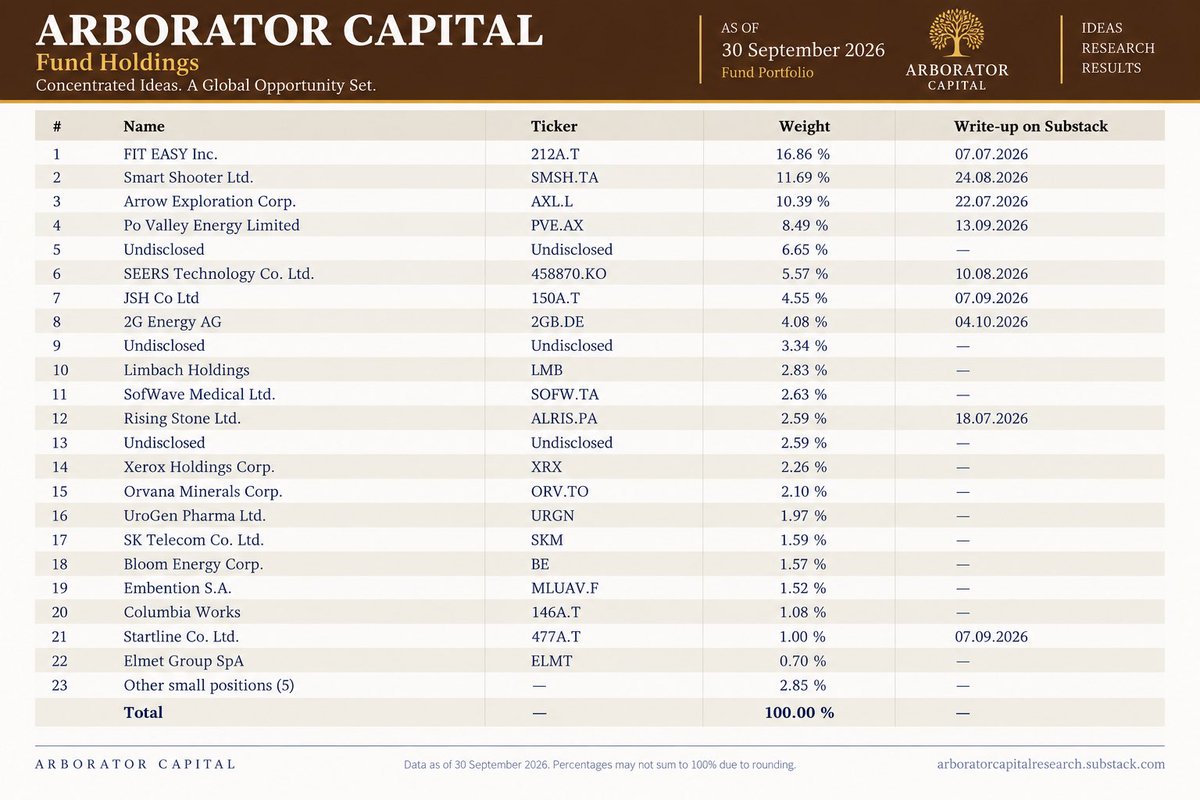
Arborator Capital | Q3 Portfolio Update & Full Portfolio Disclosure🔥📈 1/2
For the first time, we’re sharing almost our entire portfolio, position sizes and the results from our first full quarter managing a meaningful amount of external capital.
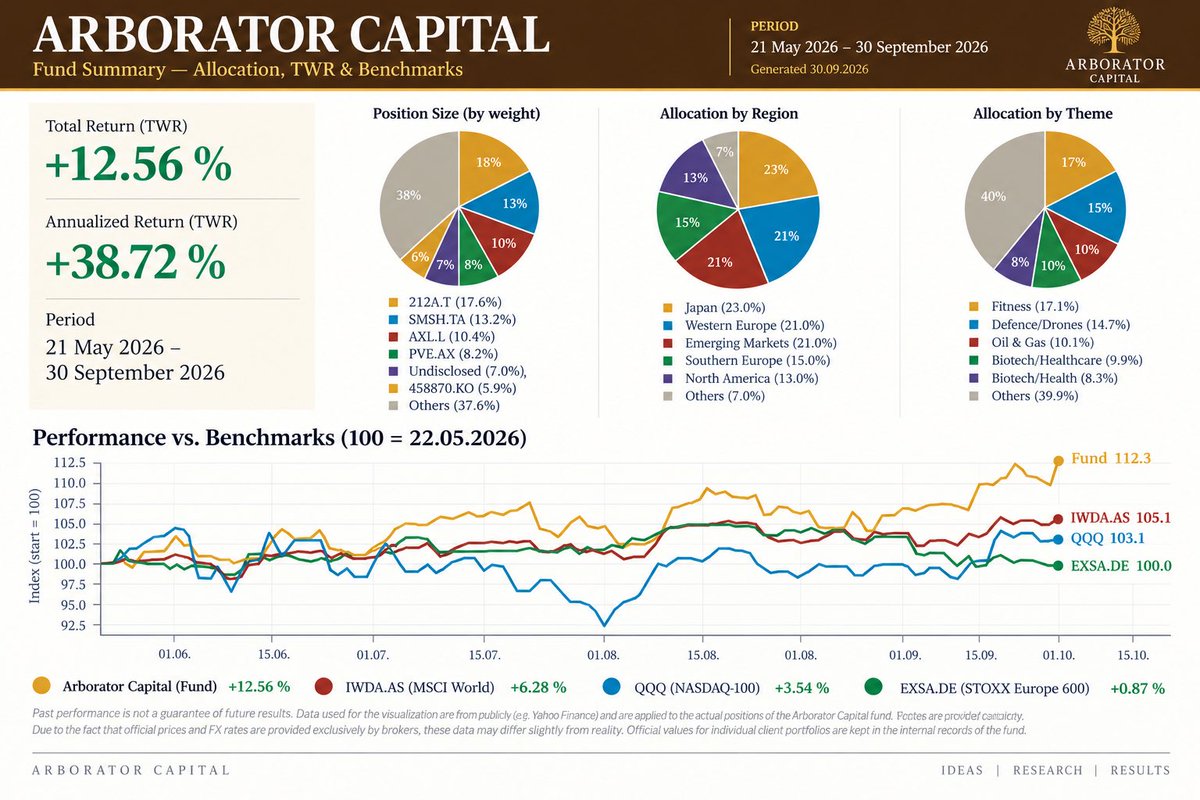
Since launching the strategy for external investors on May 21, Arborator Capital returned +12.56% TWR through September 30, equivalent to a +38.7% annualized return over this admittedly very short period.
For comparison over the same period:
Arborator Capital: +12.56%
MSCI World: +6.28%
Nasdaq-100: +3.54%
STOXX Europe 600: +0.87% Arborator_Capital_Kvartalni_report_K004_30.09.2026.pdf
September itself was particularly strong, with the portfolio gaining roughly 5–6%, despite a considerably weaker environment across European equities and many of the small/micro-cap markets where we invest.
It’s obviously far too early to draw conclusions from a few months of performance, and there were plenty of decisions we could have executed better.
But one thing we are particularly happy with so far is the relatively low correlation of our returns with major equity indices.
That is exactly what we’re trying to build: not another portfolio whose performance ultimately depends on whether U.S. mega-cap tech goes up, but a collection of differentiated, concentrated ideas whose return drivers come from completely different sources.
What actually drove the quarter?
Our energy/geopolitical book was probably the biggest success.
Instead of simply buying commodity futures or large producers, we tried to identify small companies where higher commodity prices create enormous operating leverage while company-specific catalysts provide another way to win even if the macro thesis eventually normalizes.
Arrow Exploration ($AXL.L / $AXL.V) and Po Valley Energy ($PVE.AX) became the clearest examples.
Both returned roughly +40% for the fund through September 30, despite being accumulated at different points throughout the period.
Po Valley was particularly interesting. At one point in September, we were almost +80% on a position we had owned for roughly a month. Arrow benefited from higher oil prices while simultaneously increasing production, and we still see the potential Tapir licence extension as an important independent catalyst.
Our largest positions
FitEasy ($212A.T) remains our largest position at roughly 15%.
The latest results were mixed, but our thesis hasn’t materially changed. Monthly operating data suggest the company has already exceeded some of its original full-year objectives, and we think the December full-year results and FY27 guidance could be the next major catalyst.
Smart Shooter ($SMSH.TA) remains our second-largest position at roughly 14%.
This was also probably our biggest execution mistake of the quarter. We might have built the initial position too aggressively and too early, and at one point were down more than 30%.
But we distinguished poor timing from a broken thesis and continued buying within our risk limits. On the final day of September, the company announced the three-year U.S. military framework with a ceiling of up to $150m, and the stock jumped roughly 30% in one session.
The framework is not the same thing as $150m of guaranteed backlog, but relative to Smart Shooter’s historical revenue base, even partial utilization could be highly significant.
Arrow Exploration and Po Valley Energy now follow as two of our other largest positions, alongside names such as SEERS Technology, JSH and 2G Energy.
And that illustrates quite well what we’re trying to do.
Completely agree, and thanks for clarifying! We certainly didn’t mean that production would increase 5× in Q1 2027. In fact, if you’ve read our Substack deep dive, our model assumes full production from the expansion no earlier than 2029.
Our point was about the near-term share price catalyst, not the timing of actual production. We believe that if the expansion receives approval in Q1, potentially coinciding with peak European gas prices, the market could push the stock up significantly.
That’s why we see Q1 as a particularly attractive catalyst window, even though the additional production is still years away.
🔥 Our Best Bet on the European Gas Crisis Is Back on Sale. And Our Largest Oil Position Just Delivered a Fantastic Update! 🛢️
Sometimes the market gives you a second chance.
🇮🇹 Po Valley Energy ($PVE.AX) trades just ~10% above its March price, despite European gas prices nearly doubling since then.
Meanwhile:
🇪🇺 European gas storage is at historically low levels, and the Strait of Hormuz crisis remains unresolved.
🇮🇹 Italy has lifted restrictions on new gas developments. A project we previously valued at zero could now potentially be worth tens of millions of euros.
💰 Po Valley has net cash and, by our estimates, is generating over €1M in monthly cash flow at current spot-linked gas prices.
📈 A reserve update is approaching, followed by potential regulatory approval in Q1 2027 for up to 5× production growth.
And Q1 could coincide with the peak of Europe’s gas shortage, potentially pushing prices significantly higher.
We hold roughly 1% of the company alongside our partners and are considering increasing our exposure.
The stock has essentially given back its recent gains, even as we believe its fundamental outlook has improved dramatically.
🛢️ Our Largest Oil Position, Arrow Exploration ($AXL.V), Just Delivered a Fantastic Update — Yet the Stock Is Still on Sale.
In fact, we believe this could be one of the best buying opportunities we’ve ever seen in Arrow, despite the stock’s appreciation over the past year.
The latest operational update confirmed exactly what we’d been expecting:
🚀 Record production exceeding 7,000 boe/d.
💰 Approximately $35M in cash at the beginning of November.
💵 Around $7M in monthly free cash flow AFTER capex, an extraordinary figure relative to its current enterprise value.
At the EV before today’s trading, that FCF run rate would effectively cover the entire enterprise value in approximately one year. Even assuming lower oil prices, our estimated payback period is only around 18 months.
And perhaps most importantly, a major catalyst is just around the corner: the potential extension of its Colombian production license.
Record production, record cash generation, a near-term regulatory catalyst, and a valuation that we believe remains absurdly low.
Both Po Valley and Arrow are among our five largest positions.
With the Iran conflict showing no clear signs of resolution and energy supply risks remaining elevated, we believe the market is significantly underestimating the cash-generation potential of both businesses.
The sell-off has been painful, but fundamentally, we believe these companies are in a stronger position than ever.
Two of our highest-conviction energy investments. Two extraordinary valuations. And potentially two of the best opportunities created by this sell-off.
📖 We’ve published detailed deep dives on both companies on our Substack, covering our investment theses, financial models, valuations, and key catalysts.
Find the link to our Substack in our bio.
❗️We just bought almost 1% of a tiny European gas producer.
And we think it may be one of the most asymmetric bets we’ve found this year.
European gas is back above €80/MWh, storage levels are low, and we don’t think Europe’s energy problems are over.
We’re Europeans ourselves, so our thinking is simple: if we’re going to freeze at home this winter, we’d rather get rich while doing it than just freeze.
Over the past few weeks, we’ve therefore bought as many shares as liquidity allowed. Together with our partners, we now own close to 1% of the entire company.
And liquidity matters here. A large part of the shares is held by management, insiders and other long-term holders, so building a meaningful position isn’t particularly easy. We don’t plan on selling ours anytime soon either.
Why do we like this setup so much?
• Potential ~5x production growth. The company is approaching several important catalysts that could allow production to increase dramatically over the coming months and years.
• Multiple near-term catalysts. Permits, reserve development and new production could all materially change the economics of the company. Several of these catalysts could arrive within the next few months.
• Extremely attractive gas economics. The company produces exceptionally clean, low-cost natural gas and sells its production essentially at spot prices, even achieving a premium to the relevant benchmark.
• The downside case still looks attractive. We don’t need another European energy crisis for the investment to work. If only a few things go right and gas prices eventually normalize, we still see a realistic path to 100%+ upside over the next 3–4 years.
• The bull case is much more interesting. The company owns additional projects to which we believe the market currently assigns essentially zero value. If those assets are developed and European gas prices remain elevated, our bull case points toward roughly a 5x return over the next four years.
• And management is unusually aligned. The CEO has significant skin in the game, takes relatively modest compensation, and doesn’t want to endlessly recycle cash into new oil & gas projects. The objective is to derisk and monetize the existing assets and ultimately return the cash to shareholders.
That last point is particularly important to us. We’ve looked at plenty of tiny commodity producers where management seems more interested in building an empire than creating per-share value. We think the incentives here are very different.
The asymmetry is what ultimately made us build such a large position.
If European gas prices normalize significantly, we believe the company can still create substantial shareholder value simply by executing on the assets it already owns.
But if Europe’s energy crisis persists, production ramps as planned, and some of the assets currently valued at essentially zero begin to be monetized, the economics become completely different.
It’s also exactly the kind of diversification we’re looking for right now. While seemingly everyone is chasing the same AI trades at increasingly demanding valuations, this is a tiny, overlooked European gas producer with completely different return drivers and potentially enormous operating leverage to one of Europe’s biggest macro risks.
My colleague put together what I think is one of the best write-ups we’ve published on our Substack so far — very concise, straight to the point, and easy to follow. Definitely worth a read if the idea sounds interesting.
Our full investment thesis, valuation scenarios and the company itself are all in the Substack write-up below.
🚀 UP MORE THAN 40% IN JUST TWO DAYS SINCE OUR WRITE-UP!
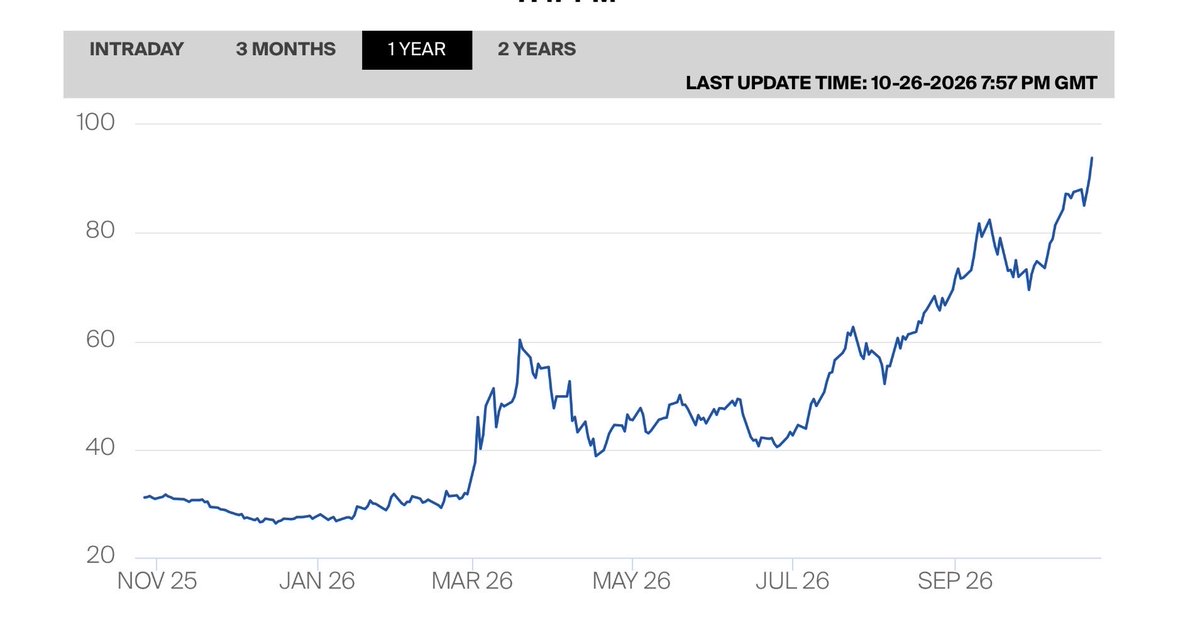
On Monday, we published our research on TNE Korea ($0053F0), which we believe is one of the most attractive reasonably valued ways to bet on the AI infrastructure boom.
It’s a critical supplier to Bloom Energy ($BE), with potentially faster earnings growth, greater operating leverage, and a valuation that’s still a fraction of Bloom’s.
After a 40%+ rally, the risk/reward is obviously less attractive than when we published. We expect substantial volatility and wouldn’t be surprised by another pullback.
Still, it’s been a long time since I’ve been this excited about an investment idea. Our original post didn’t get much attention, but our conviction remains extremely high.
TNE has also been one of the few bright spots helping rescue our portfolio’s performance during this brutal sell-off.
With additional shares set to be released from the IPO lock-up, we expect significant volatility ahead. While we’d love to increase our position further, we’re not planning to chase the recent rally. We believe there’s a good chance the stock will revisit lower levels, potentially giving us a much better opportunity to add.
Unfortunately, several other major holdings have been hit hard, particularly Po Valley Energy ($PVE.AX) and Arrow Exploration $AXL.V , following the US midterms.
We remain bullish on both. European gas prices could stay elevated, Po Valley has major production expansion catalysts, and Arrow is approaching 7,000 boe/d of production while trading at an EV around $80M, based on our estimates. Its Colombian license extension is another potential catalyst.
We also remain confident in FitEasy and Smart Shooter despite their recent weakness.
That said, our overall portfolio performance has been disappointing. We also got Seers wrong and reduced our position following results that seriously undermined our confidence in management.
We’re not happy with the drawdown, but we believe the sell-off has created some good opportunities. We’re actively reallocating capital toward our highest-conviction ideas.
We’re genuinely sorry to everyone who invested in ideas we’ve shared and suffered losses. This has been one of our toughest periods since the 2025 tariff crash. While everyone invests at their own risk and nothing we share is investment advice, we still care deeply about your results. We’ll keep working hard to bring you better opportunities and hopefully much stronger returns ahead.
We’ve published a more detailed portfolio update, along with our full 100+ hour TNE investment thesis, on Substack link in bio.
🩸100 Hours Searching for the Best AI Stock in the Sell-Off. Here’s What We Bought.💣
We found a ~$100M Korean microcap with such compelling upside that we’re considering acquiring up to 0.5% of the entire company, with potentially more buying from our partners.
As the AI sell-off hit Japan and Korea particularly hard, we searched for overlooked small caps offering the same AI exposure as US giants at a fraction of their valuations.
What we discovered was even better: a critical Bloom Energy ($BE) supplier that could grow faster than Bloom itself, trading at less than ¼ of its valuation.
It’s been a long time since I’ve been this excited about an investment idea or spent so much time researching every aspect of a company and its surrounding ecosystem.
We first invested in Bloom Energy in 2023–24 at roughly 1/15 of today’s price. We’re still extremely bullish on fuel cells and behind-the-meter power, and believe we’ve now found an even more attractive way to capture that growth.
Democrats are pushing for data centers to generate their own power, minimize water consumption, and reduce emissions. That’s almost a perfect description of Bloom Energy’s technology. Ironically, $BE shares have plunged by tens of percent despite offering exactly the kind of solution these policies could favor.
Why we’re buying so aggressively:
1️⃣ Bloom Energy exposure at a fraction of the valuation. Our base case implies ~5× 2028E earnings and 3.2× upside by the end of 2028 (~72% annualized IRR), even using a conservative exit multiple. We believe the upside could be substantially higher.
2️⃣ Potentially faster growth than Bloom itself. The company is gaining market share from Bloom’s incumbent supplier. Combined with Bloom’s capacity expansion, we expect accelerating revenue growth, margin expansion, and significant operating leverage.
3️⃣ A powerful competitive position. Superior technology, years of joint development, and deep integration with Bloom. Our research suggests it could capture a much larger share of future orders and potentially become the main supplier for certain next-generation products.
4️⃣ We reconstructed the entire business from the bottom up. Product-level pricing, expected volumes, manufacturing costs, margins, Bloom’s production capacity, and its expansion pipeline. We also analyzed competing suppliers, their exposure to Bloom, and their trading multiples.
The result? Comparable critical suppliers can trade at similar or even higher multiples than Bloom, while this company trades at less than a quarter of its valuation.
5️⃣ An extraordinary market dislocation and zero analyst coverage. Despite massive demand for its IPO, the stock has crashed more than 60% from its post-listing peak and now trades below its offering price. We believe the sell-off has little to do with its underlying business prospects.
Why does this opportunity exist?
The AI sell-off has been driven by concerns over unsustainable capex, debt-financed infrastructure investment, and potential project delays or cancellations.
But the damage has been particularly severe in Japan and Korea, where even fundamentally strong businesses have been caught in indiscriminate selling. Korean small caps and recent IPOs have been especially vulnerable.
Meanwhile, Korean retail investors largely focus on short-term price action, while US investors following Bloom Energy rarely pay attention to a tiny Korean supplier.
We believe this creates a rare information and valuation arbitrage.
There’s also a compelling relative-value angle. Even if Bloom Energy fails to meet the market’s aggressive expectations, we believe the valuation discount here is simply too large. A long supplier / short Bloom Energy pair trade could therefore be particularly interesting.
Full thesis on our Substack link in bio.
🔥 EUROPEAN NATURAL GAS IS APPROACHING €100/MWh AGAIN. AND WE THINK IT COULD GO EVEN HIGHER THIS WINTER. #NaturalGas
One of our favorite ways to play this energy crisis remains Po Valley Energy ($PVE.AX) 🇮🇹
European gas prices are approaching €100/MWh, and we believe there’s a significant chance they could break above that level during the coming winter.
And here’s why we still love this investment:
🟢 100% spot exposure: Po Valley sells its entire gas production at spot-linked prices, meaning elevated European gas prices translate directly into extraordinary cash generation.
🟢 The expansion could effectively pay for itself: At current gas prices, we estimate the company could generate enough cash to fund the CAPEX required for its planned ~5× production expansion over the next few years.
🟢 Major catalysts approaching: We expect a potentially significant reserve update before year-end, followed by important permitting decisions for additional production, potentially in early 2027.
🟢 Italy’s regulatory environment is becoming more favorable: Restrictions on domestic gas development have been eased. During our conversation with the CEO, he even indicated that Italian authorities are encouraging the company to accelerate development rather than slow it down.
🟢 Hidden asset value: Po Valley also owns additional resources that the market appears to assign very little value to. Some of these assets were historically restricted from development, but regulatory changes could eventually allow the company to monetize them.
And the most interesting part?
This isn’t simply a bet on gas prices staying at €100/MWh forever.
We believe the company has significant upside even under much more normalized gas-price assumptions, thanks to its production growth, low operating costs and additional assets.
If the European energy crisis continues, however, the upside could be substantially greater.
📈 The stock has already appreciated significantly since we started accumulating it, but we haven’t sold a single share.
It remains one of our highest-conviction positions and, in our view, one of the most asymmetric ways to gain exposure to Europe’s ongoing energy challenges.
We spent considerable time researching the company, speaking directly with management and building our own production and valuation scenarios.
If you haven’t read our original deep dive yet, we strongly recommend taking a look.
📖 Full investment thesis, management insights and valuation model:
https://t.co/hZFfE2rH1G
Sometimes the best hedge against an energy crisis is owning the company that benefits directly from it. 🛢️
❗️We just bought almost 1% of a tiny European gas producer.
And we think it may be one of the most asymmetric bets we’ve found this year.
European gas is back above €80/MWh, storage levels are low, and we don’t think Europe’s energy problems are over.
We’re Europeans ourselves, so our thinking is simple: if we’re going to freeze at home this winter, we’d rather get rich while doing it than just freeze.
Over the past few weeks, we’ve therefore bought as many shares as liquidity allowed. Together with our partners, we now own close to 1% of the entire company.
And liquidity matters here. A large part of the shares is held by management, insiders and other long-term holders, so building a meaningful position isn’t particularly easy. We don’t plan on selling ours anytime soon either.
Why do we like this setup so much?
• Potential ~5x production growth. The company is approaching several important catalysts that could allow production to increase dramatically over the coming months and years.
• Multiple near-term catalysts. Permits, reserve development and new production could all materially change the economics of the company. Several of these catalysts could arrive within the next few months.
• Extremely attractive gas economics. The company produces exceptionally clean, low-cost natural gas and sells its production essentially at spot prices, even achieving a premium to the relevant benchmark.
• The downside case still looks attractive. We don’t need another European energy crisis for the investment to work. If only a few things go right and gas prices eventually normalize, we still see a realistic path to 100%+ upside over the next 3–4 years.
• The bull case is much more interesting. The company owns additional projects to which we believe the market currently assigns essentially zero value. If those assets are developed and European gas prices remain elevated, our bull case points toward roughly a 5x return over the next four years.
• And management is unusually aligned. The CEO has significant skin in the game, takes relatively modest compensation, and doesn’t want to endlessly recycle cash into new oil & gas projects. The objective is to derisk and monetize the existing assets and ultimately return the cash to shareholders.
That last point is particularly important to us. We’ve looked at plenty of tiny commodity producers where management seems more interested in building an empire than creating per-share value. We think the incentives here are very different.
The asymmetry is what ultimately made us build such a large position.
If European gas prices normalize significantly, we believe the company can still create substantial shareholder value simply by executing on the assets it already owns.
But if Europe’s energy crisis persists, production ramps as planned, and some of the assets currently valued at essentially zero begin to be monetized, the economics become completely different.
It’s also exactly the kind of diversification we’re looking for right now. While seemingly everyone is chasing the same AI trades at increasingly demanding valuations, this is a tiny, overlooked European gas producer with completely different return drivers and potentially enormous operating leverage to one of Europe’s biggest macro risks.
My colleague put together what I think is one of the best write-ups we’ve published on our Substack so far — very concise, straight to the point, and easy to follow. Definitely worth a read if the idea sounds interesting.
Our full investment thesis, valuation scenarios and the company itself are all in the Substack write-up below.
🩸100 Hours Searching for the Best AI Stock in the Sell-Off. Here’s What We Bought.💣
We found a ~$100M Korean microcap with such compelling upside that we’re considering acquiring up to 0.5% of the entire company, with potentially more buying from our partners.
As the AI sell-off hit Japan and Korea particularly hard, we searched for overlooked small caps offering the same AI exposure as US giants at a fraction of their valuations.
What we discovered was even better: a critical Bloom Energy ($BE) supplier that could grow faster than Bloom itself, trading at less than ¼ of its valuation.
It’s been a long time since I’ve been this excited about an investment idea or spent so much time researching every aspect of a company and its surrounding ecosystem.
We first invested in Bloom Energy in 2023–24 at roughly 1/15 of today’s price. We’re still extremely bullish on fuel cells and behind-the-meter power, and believe we’ve now found an even more attractive way to capture that growth.
Democrats are pushing for data centers to generate their own power, minimize water consumption, and reduce emissions. That’s almost a perfect description of Bloom Energy’s technology. Ironically, $BE shares have plunged by tens of percent despite offering exactly the kind of solution these policies could favor.
Why we’re buying so aggressively:
1️⃣ Bloom Energy exposure at a fraction of the valuation. Our base case implies ~5× 2028E earnings and 3.2× upside by the end of 2028 (~72% annualized IRR), even using a conservative exit multiple. We believe the upside could be substantially higher.
2️⃣ Potentially faster growth than Bloom itself. The company is gaining market share from Bloom’s incumbent supplier. Combined with Bloom’s capacity expansion, we expect accelerating revenue growth, margin expansion, and significant operating leverage.
3️⃣ A powerful competitive position. Superior technology, years of joint development, and deep integration with Bloom. Our research suggests it could capture a much larger share of future orders and potentially become the main supplier for certain next-generation products.
4️⃣ We reconstructed the entire business from the bottom up. Product-level pricing, expected volumes, manufacturing costs, margins, Bloom’s production capacity, and its expansion pipeline. We also analyzed competing suppliers, their exposure to Bloom, and their trading multiples.
The result? Comparable critical suppliers can trade at similar or even higher multiples than Bloom, while this company trades at less than a quarter of its valuation.
5️⃣ An extraordinary market dislocation and zero analyst coverage. Despite massive demand for its IPO, the stock has crashed more than 60% from its post-listing peak and now trades below its offering price. We believe the sell-off has little to do with its underlying business prospects.
Why does this opportunity exist?
The AI sell-off has been driven by concerns over unsustainable capex, debt-financed infrastructure investment, and potential project delays or cancellations.
But the damage has been particularly severe in Japan and Korea, where even fundamentally strong businesses have been caught in indiscriminate selling. Korean small caps and recent IPOs have been especially vulnerable.
Meanwhile, Korean retail investors largely focus on short-term price action, while US investors following Bloom Energy rarely pay attention to a tiny Korean supplier.
We believe this creates a rare information and valuation arbitrage.
There’s also a compelling relative-value angle. Even if Bloom Energy fails to meet the market’s aggressive expectations, we believe the valuation discount here is simply too large. A long supplier / short Bloom Energy pair trade could therefore be particularly interesting.
Full thesis on our Substack link in bio.
🚀 3 Stocks to Buy Before Year-End
Each With 20%+ Upside Potential!
Three of our highest-conviction opportunities right now. Completely different businesses, but all with major catalysts approaching before year-end.
We believe each could deliver 20%+ returns over the next two months.
🇯🇵 1. FitEasy ($212A.T) — Our Largest Position
A Japanese fitness disruptor and market leader, with earnings growing at over 50% annually since its IPO.
Today was the ex-dividend and shareholder-benefit cutoff date, pushing the stock close to its lowest level since the latest earnings release and upward FY2026 guidance revision.
The major catalyst: December earnings and FY2027 guidance.
Management’s FY2027 plan hasn’t been meaningfully updated for ~18 months, despite several major improvements in the underlying business.
The company already exceeded its full-year membership target ahead of schedule, and our updated model suggests FY2027 operating profit could beat existing guidance by ~20%.
We’ve also identified another company-specific factor that makes us particularly confident about a significant earnings beat.
If management delivers and raises guidance, we believe the stock could react very strongly, potentially +10–30%.
🔥 2. Po Valley Energy ($PVE.AX) — The Ultimate European Gas Play?
European natural gas has reportedly broken €100/MWh for the first time since 2022.
And Po Valley is almost perfectly positioned to benefit.
100% of its production is sold at spot-linked European gas prices, reportedly at a slight premium. At current prices, the company is generating extraordinary cash flow relative to its market cap.
Po Valley is approaching major permitting decisions that could unlock a ~5× production expansion over the coming years.
If gas prices remain elevated through winter and the necessary permits arrive, we believe another substantial re-rating is possible.
We’ve also spoken directly with management, and the CEO’s interests are exceptionally well aligned with shareholders, something we rarely see to this extent among micro-cap producers.
🛢️ 3. Hengyuan Refining ($4324.KL) — Below 1× P/E?!
Possibly the cheapest stock we’ve ever bought.
Just a year ago, this Malaysian refinery was priced almost for bankruptcy. Today, the global diesel shortage and disruption around Hormuz have completely transformed its economics.
We estimate FY2026 net income could exceed the company’s entire market capitalization.
The next major catalyst is Q3 earnings in late November.
Our model projects approximately RM965m of quarterly net profit, equivalent to around 40% of the company’s market cap in just three months!
That is an extraordinary level of profitability.
We believe the resulting cash generation could eliminate net debt and potentially create room for substantial dividends.
The market still treats these profits as a temporary windfall. We agree refining margins will eventually normalize, but even a relatively short period of exceptional profitability could fundamentally transform the balance sheet.
Our year-end outlook
Three completely different businesses. Three major near-term catalysts. And three opportunities where we believe 20%+ upside before year-end is possible.
FitEasy benefits from structural growth and potential earnings upgrades.
Po Valley benefits from Europe’s energy crisis and production expansion.
Hengyuan benefits from extraordinary refining margins and a potential balance-sheet transformation.
We particularly like that these investments have very different return drivers, helping us build a portfolio less dependent on the direction of major equity indices.
Of course, none of these outcomes is guaranteed, but we’re particularly optimistic about these three setups heading into year-end.
📖 All three detailed deep dives, management insights and financial models are available for free on our Substack:
https://t.co/hZFfE2r9c8
Which one would you buy before year-end?
🚨 INFLATION IS STARTING TO BITE. AND THE ENERGY CRISIS IS FAR FROM OVER. 🛢️🔥
Brent is approaching $110, WTI is nearing $100, and European natural gas is trading around €90/MWh.
Equity markets are already starting to react negatively. And unfortunately, we don’t see an obvious resolution to the energy crisis anytime soon.
The geopolitical situation is becoming increasingly concerning:
🇺🇦 Ukraine continues targeting Russian refineries and oil infrastructure, despite pressure from Washington to stop. This is putting further strain on an already extremely tight global refined-products market.
🇮🇷 Iran appears unwilling to back down. Attacks on vessels around the Strait of Hormuz have intensified, and transit remains substantially below pre-war levels. Even the oil that manages to get through faces extraordinary shipping and insurance costs.
🇸🇦 Saudi Arabia is increasingly exposed to the escalation. Reports of attacks targeting Saudi Aramco infrastructure and threats against the company underline how vulnerable the region’s energy supply remains.
Meanwhile, tanker rates and insurance premiums have become so expensive that some shipping routes are economically viable only at elevated oil prices.
The longer this continues, the greater the risk of another inflation shock — and the more pressure it could put on equity valuations.
How we’re positioning our portfolio
Fortunately, our exposure to expensive U.S. growth stocks is relatively limited.
Instead, two of our four largest positions are direct bets on elevated oil and European natural gas prices.
🛢️ Arrow Exploration ($AXL.L / $AXL.V) — Our unhedged Colombian oil producer, benefiting enormously from high Brent prices while continuing to increase production. We recently published an exclusive management interview and updated valuation model on Substack.
🔥 Po Valley Energy ($PVE.AX) — Our Italian natural gas producer, with direct exposure to European gas prices and substantial production expansion potential. We published a full deep dive explaining why we believe the risk/reward remains exceptionally attractive.
Both companies also have significant independent catalysts, meaning our investment theses do not rely exclusively on energy prices staying this high forever.
We believe our portfolio is positioned to potentially benefit from further geopolitical escalation, even if broader equity markets correct.
And we’re preparing what could be our most interesting energy idea yet.
⛽ The ultimate diesel shortage play?
Global diesel supplies are under enormous pressure, and refining crack spreads have reached extraordinary levels.
We’ve identified a refinery that we believe could be one of the most asymmetric opportunities we’ve encountered this year.
Despite the stock already appreciating by several tens of percent, our model suggests it still trades below 1x P/E under current exceptionally favorable refining conditions.
Even more interestingly, our conservative scenario suggests relatively limited downside compared with the potential upside if today’s diesel market persists.
We’re currently building the position and aim to publish the full investment thesis, financial model and valuation sensitivity analysis on our Substack within the next 14 days.
This could be one of our most interesting write-ups yet.
📖 Don’t follow our Substack yet? Make sure to subscribe so you don’t miss this one!
https://t.co/hZFfE2r9c8
👀 Want an early look?
We’re curious what other investors are buying in this environment.
Send us a DM with your single best investment idea for the current energy and geopolitical cris, whether it’s oil, natural gas, refining or another overlooked opportunity.
In return, we’ll share our preliminary research and investment thesis with you privately, potentially almost immediately and well before the public release.
We don’t know how long this energy crisis will last. But we’re trying to make sure our portfolio is positioned to benefit from it.
By the way, regarding refineries, I think we’ve found a really interesting opportunity in Asia. It’s a refinery trading at a forward P/E of around 1 based on our estimates, and we’re currently buying shares.
We’re planning to publish a detailed write-up on Substack, hopefully this weekend or sometime in the next few days.
We think we’ve uncovered a very attractive and overlooked investment opportunity, so stay tuned!
❗️We just bought almost 1% of a tiny European gas producer.
And we think it may be one of the most asymmetric bets we’ve found this year.
European gas is back above €80/MWh, storage levels are low, and we don’t think Europe’s energy problems are over.
We’re Europeans ourselves, so our thinking is simple: if we’re going to freeze at home this winter, we’d rather get rich while doing it than just freeze.
Over the past few weeks, we’ve therefore bought as many shares as liquidity allowed. Together with our partners, we now own close to 1% of the entire company.
And liquidity matters here. A large part of the shares is held by management, insiders and other long-term holders, so building a meaningful position isn’t particularly easy. We don’t plan on selling ours anytime soon either.
Why do we like this setup so much?
• Potential ~5x production growth. The company is approaching several important catalysts that could allow production to increase dramatically over the coming months and years.
• Multiple near-term catalysts. Permits, reserve development and new production could all materially change the economics of the company. Several of these catalysts could arrive within the next few months.
• Extremely attractive gas economics. The company produces exceptionally clean, low-cost natural gas and sells its production essentially at spot prices, even achieving a premium to the relevant benchmark.
• The downside case still looks attractive. We don’t need another European energy crisis for the investment to work. If only a few things go right and gas prices eventually normalize, we still see a realistic path to 100%+ upside over the next 3–4 years.
• The bull case is much more interesting. The company owns additional projects to which we believe the market currently assigns essentially zero value. If those assets are developed and European gas prices remain elevated, our bull case points toward roughly a 5x return over the next four years.
• And management is unusually aligned. The CEO has significant skin in the game, takes relatively modest compensation, and doesn’t want to endlessly recycle cash into new oil & gas projects. The objective is to derisk and monetize the existing assets and ultimately return the cash to shareholders.
That last point is particularly important to us. We’ve looked at plenty of tiny commodity producers where management seems more interested in building an empire than creating per-share value. We think the incentives here are very different.
The asymmetry is what ultimately made us build such a large position.
If European gas prices normalize significantly, we believe the company can still create substantial shareholder value simply by executing on the assets it already owns.
But if Europe’s energy crisis persists, production ramps as planned, and some of the assets currently valued at essentially zero begin to be monetized, the economics become completely different.
It’s also exactly the kind of diversification we’re looking for right now. While seemingly everyone is chasing the same AI trades at increasingly demanding valuations, this is a tiny, overlooked European gas producer with completely different return drivers and potentially enormous operating leverage to one of Europe’s biggest macro risks.
My colleague put together what I think is one of the best write-ups we’ve published on our Substack so far — very concise, straight to the point, and easy to follow. Definitely worth a read if the idea sounds interesting.
Our full investment thesis, valuation scenarios and the company itself are all in the Substack write-up below.