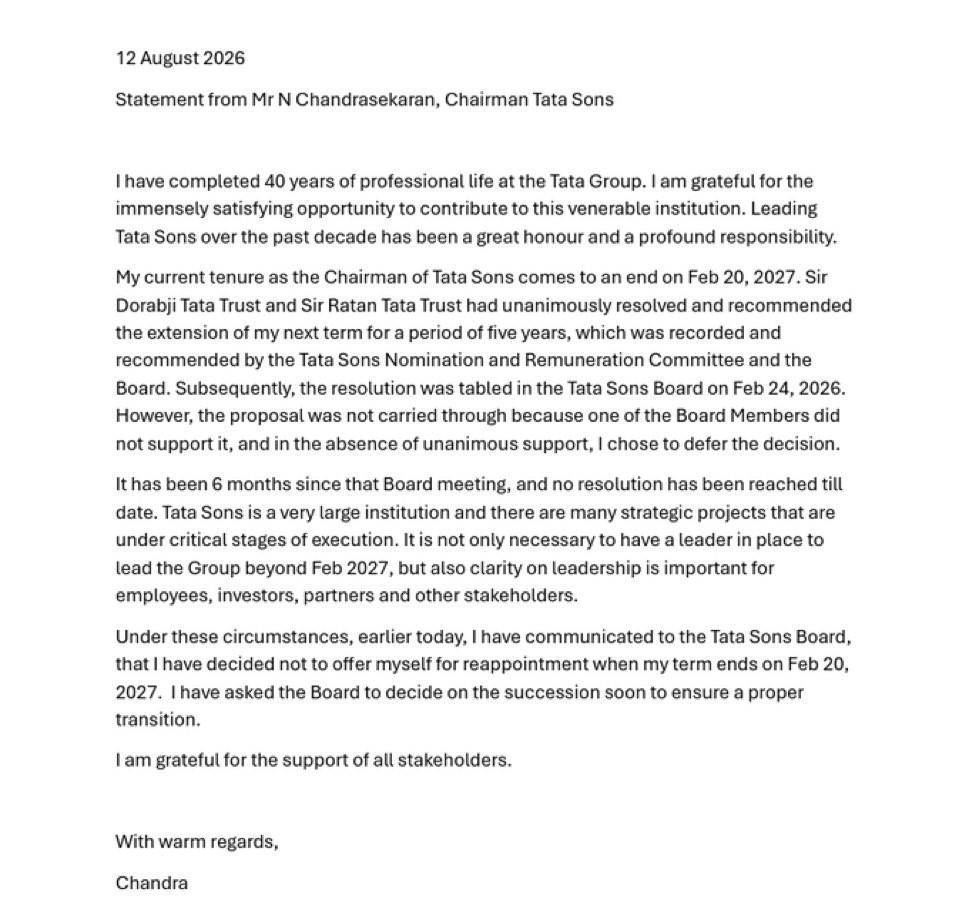
#RememberingRatanTata
Ratan Tata was a visionary , a philanthropist and an uncommon leader who touched the lives of many.
But, what I absolutely love is that everyone he met also remembers him for his gentleness, kindness, humility & sense of humour.
Thankyou for being you
A merchant survey included in How Urban India Pays 2026, a report by Pahlé India Foundation in partnership with Amazon Pay, found that 25% of respondents expect to pay more than ₹5,000 a month. Another 58% of the merchants expect to pay ₹1,000 or less, including 13% who expect no charge.
https://t.co/eUb43uCuy0
Only about 5% of India's coastal and marine areas are protected, against a 30% target. Lakshadweep's reefs have already lost about half their cover. Rohini in @htTweets on the polycrisis facing our oceans, and why there's still hope 👇
https://t.co/WMW80pDplK
No Charges for #UPI Users
➡️ The Government of India wishes to categorically state:
✅️ No charges for users: Consumers making payments will not face any transaction charges.
✅️ P2P transactions free: All Person-to-Person transactions will continue to be free of charge.
✅️ Nominal MDR for merchants: As and when MDR charges are introduced, they will apply only to a limited set of merchant transactions, above a certain threshold, at a nominal rate, far lower than debit or credit card MDRs.
✅️ Vast majority of the transactions will remain free of charge for merchants on UPI. MDR, if introduced, will only be threshold based and not blanketly levied to all.
✅️ Once the Parliament passes the Taxation and Other Laws (Amendment) Bill, 2026, which proposes to amend Section 10A of the Payment and Settlement Systems Act, 2007, the “UPI and Services Steering Committee” headed by NPCI will decide on the MDR, if any.
Read here: https://t.co/qWOiTYqncG
@FinMinIndia@MIB_India
@ECISVEEP website shares numbers and names of BLO’s to contact for SIR related help. But the same BLO’s don’t answer calls or respond to messages and when they do they just pass on names to connect to. Who again don’t respond. It’s like they don’t want people to get the job done
VIDEO | Delhi: As Union Education Minister Dharmendra Pradhan posts a letter, saying he has sent his resignation to PM Modi, CJP founder Abhijeet Dipke says, “We have done it. Dharmendra Pradhan has resigned.”
(Full video available on PTI Videos - https://t.co/n147TvrpG7)
India's loss, Singapore's gain
India's reluctance to allow family offices to set up family investment funds in GIFT city means that Indian HNI families have largely gone to Singapore. But exactly what is allowed in GIFT and what is allowed outside India? Read this superb article by @rohitagarwal_30 in thefynprint today - Comment Global for the link
Regulation does not clearly say how much of a single GIFT outbound fund's corpus one Indian corporate group is allowed to hold. Some practitioners work to a 33% ceiling, others to 50%, because the rule itself never specifies a number and each side defends its own reading.
And then there is the problem of exclusivity. Because one Indian corporate group can only hold roughly a third to half of a single GIFT outbound fund's corpus, the rest of that money, by definition, has to come from other families - sitting in the same fund bank account, run through the same single strategy, since a GIFT fund can only carry one NAV.
On top of all this sits a hard licensing rule: the IFSCA will not grant a fund management licence unless the applicant discloses, at minimum, a Principal Officer and a Compliance Officer who are actually based in GIFT City. For a global manager already reluctant to build out real infrastructure in a still-developing city that does not yet match Singapore or Dubai for the everyday business of relocating senior staff, that one rule is often where the conversation ends.
None of this means wealthy Indian families have stopped wanting global exposure. It means a number of them are getting it somewhere else. Several large Indian business families have set up their own family office in Singapore instead in recent years, funded through India's overseas direct investment route rather than the portfolio-investment route GIFT relies on. The mechanics rely on a specific reading of the rules: an Indian acquiring genuine equity control of a Singapore holding company satisfies what overseas direct investment is meant to capture, even if that Singapore company then hands the money to a local advisor who runs it like any other global portfolio. A law firm's opinion makes the structure, an authorised dealer bank clears the remittance on the strength of that opinion, and a Singapore-based advisor manages the money day to day.
🇮🇳 @amazon CEO Andy Jassy meets PM Modi in New Delhi
💰 $13 billion more in AI & cloud — total India bet now at $48 billion by 2030
☁️ AWS to expand in Mumbai & Hyderabad; 3.8 million jobs pledged
#Amazon #AndyJassy #PMModi#AWSIndia #AIInvestment #CNBCTV18Digital
Watch Here: https://t.co/p5A4hW2ZCr
A great meeting with Mr. Andy Jassy. I welcome Amazon's record $48 billion investment in India. This will create new opportunities for our youth. At the same time, it shows the growing interest across the world to invest in India!
@amazon
Really enjoyed my meeting with Prime Minister @narendramodi about what’s ahead for Amazon in India.
We’ve been serving customers, sellers, developers, startups, and enterprises in India for more than a decade and just getting started.
Shared that we’re investing $48 billion over the coming five years, including $21+ billion in AI and cloud infrastructure.
By 2030, we plan to support 3.8 million jobs, enable $80 billion in ecomm exports, and bring benefits of AI to 15 million small businesses and 4 million government school students.
Excited about what’s ahead. Still early days for what we can build. https://t.co/sxkRka2Qng
Great to be in India and visit an Amazon Now micro-fulfillment center in one of the busiest areas of Mumbai.
The things you need quickly—groceries, shampoo, baby products, and more—get picked and delivered just minutes after ordered. Customers are loving it… Prime members triple their shopping frequency once they start using it, and we've seen orders double every quarter since launch.
It's our fastest-growing ecommerce business unit in India and we're expanding to 300+ cities as part of our plan to build the country’s largest delivery-in-minutes network. And what we've learned building it here is now helping us scale it across the U.S. and around the world.
Team's also investing in how we support delivery associates, expanding our air-conditioned rest centers to 250 across the country (open to anyone in the industry), plus education scholarships for their kids, and upgraded insurance.
Proud of what the team's built and the associates and partners who make it happen for customers every day. Still at the beginning of what's possible. https://t.co/gpqQiRCzAn
Blood is on the streets. Sadly, even literally.
Portfolios will bleed too, and this time it's a man made disaster. We've seen these before, and we've emerged eventually out of them better, but man made disasters tend to take a little longer.
I am the CEO of a mutual fund, so I will be biased towards telling you to invest.
I honestly believe that market drops provide opportunities, but there's no way to say what the bottom is, so any lumpsum investing should be spread over a period of time - could be three months to a year. But it's a period when the red in your portfolios will turn out to be an opportunity, not a permanent colour.
It's too early to say it's over, since we are just about 10% below all time highs on the Nifty 500 and we have seen more. But the 10% drop is usually a good point to start looking at measured allocations going forward. A lot of cash has been on the sidelines, and if you have a 3+ year view, it does make sense to consider allocating cash.
Diversification will help if only to reduce the magnitude of a fall, it however should help you remain less fearful. You might say we managers talk our book, but I can't see anything good coming out of a "sell now, you can buy back later" - mostly because in my experience, when it sounds like that is the best option, it's usually the worst option in hindsight later.
My view: Things are going to look bad, brace for it, and where opportunities rise because of panic selling, you might be better off on the buying side.
The deal is out, in some way. Not as bad as Trump first posted, but worse than I thought we would do.
All US industrial goods to be zero tariff in India? Or "reduced"? They have some cars but most are just too expensive. We do get some intermediate goods.
Agri stuff is fine.. none of the core things we want to protect are in the deal apparently
Wine and liquor. My understanding is that state taxes are a big factor here, and states will likely raise taxes to equalize if import taxes on foreign made whisky or bourbon is brought down to zero or closer.
They talk about making digital trade better, which likely means they won't screw with remittances and we won't specifically tax digital transactions.
India will buy $500bn over five years, but some of this will be natural as we get delivery of aircraft, our gpu purchases eetc. Coking coal is in there but we need to diversify from Australia and were anyhow planning this (it's an intermediate product to make crude steel) While 500 bn imports is worrying I think we will end up doing 700bn of exports in goods to the US in that time.
No mention of services. Or visas (I would personally love to see them remove that nasty h1-b visa which chains indians to jobs, makes them ask questions like oh "my father just had a heart attack but my h1-b isn't valid if I leave the country so should info", so I'm sure people will hate me but it would be nice to not have that visa at all. (Btw this applies to even worse work visas in Dubai and saudi) No mention of Russian oil from india, though it probably comes anyhow and there is a bigger game here that will likely render this moot.
We have a part of a deal. It's something that could last till Monday because you know, Trump. More Specific details will still be needed as the final deal is still not done (this is an interim deal) the 25% additional tariffs go from today, so rates are still 25% not 50%.
The 18% should come later I think. It is murky, and while not as sweet as I might have thought it will be, it's still workable. The goal of making in india for india remains, and yes we can compete with whatever industrial thingies they make too.
I'm biased because I like bourbon and steak but I don't think they will allow us cheaper imports of those from the US. I want a resident Indian owned global biryani and dosa brand too. But still, a deal is kinda sorta done.