I’ve started a Substack: The Dependent Variable.
X is great for short-form discussion, but it’s not ideal for building a coherent archive.
This will be the home for longer-form writing on cardiovascular physiology, haemodynamics, fluids, shock, ultrasound and critical care reasoning. All in one place, easier to follow and return to.
First post: https://t.co/om8CMEgs6W
1/14
Why can't you use direct oral anticoagulants (DOACs) in patients with mechanical valves (MVs)?
DOACs have been one of the most important advances in my career. And yet, the presence of a MV is one of the few contraindications.
The reason highlights the unique nature of thrombus formation in those with a MV and provides insights into the evolution of human hemostasis.
William Harvey in De Motu Cordis (1628):
“I tremble lest I have mankind for my enemies, so much does custom become as another nature. Doctrine once sown strikes deep its root, and respect for antiquity influences all men.”
In other words: once an idea is taught for long enough, people start treating it as natural and true – even when it is wrong.
That still applies to physiology and haemodynamics. Familiar doctrine can outlive sound mechanism. #MedX #FOAMcc
Image from Alice In Intensiveland
AHFTC training covers an enormous clinical landscape — MCS, transplant, shock, palliative care, etc. — often in a single fellowship year.
I created the Heart Failure Fellow Lecture Series to help close the education gap.
Free. No paywall. No sign-up. 🎓
https://t.co/0oOG9Ekrlx
@saikatmitra05@khaycock2@IM_Crit_@BharatJagiasi@ross_prager@Drnasap Swan placement in the RV, reposition to accurately see PA pressurses.
I'd probably try to check with a transthoracic echo if there is a good window..
An RVEDP of 6 and a CVP of 9 doesn't fit, might have a localized hematoma compressing the RA..
@JonW1993@icmteaching@ross_prager From what Dr Miller explained before, it's a myth to be intravascularly dry and puffy at steady state
>70% of patients I see are puffy
And everytime I turn the IVF off, I get raised eyebrows from many other specialties.. it's like most are still stuck with the 30mls/kg
Efficiency 🧵
The physics of circulation part 7
Coupling tells us whether contractility (Ees) appropriately matches arterial load (Ea).
But matching is not just about tolerating the load.
It determines how efficiently the ventricle converts chemical energy into useful work.
Which Oil is good for health and associated with less risk of heart disease? Why?
✅The oil most consistently associated with a lower risk of cardiovascular disease (CVD) is olive oil, especially extra-virgin olive oil (EVOO).
✅ Best choice: Extra-Virgin Olive Oil (EVOO)
Why it’s heart-protective:
1. Rich in monounsaturated fats (MUFA)
Mainly oleic acid
Lowers LDL (“bad”) cholesterol
Maintains or increases HDL (“good”) cholesterol
2. Powerful antioxidants
Contains polyphenols (e.g., hydroxytyrosol)
Reduce oxidative stress and inflammation
Protect blood vessels and prevent plaque formation
3. Proven clinical evidence
The PREDIMED trial showed:
~30% reduction in major cardiovascular events.
When EVOO was part of a Mediterranean diet
4. Improves endothelial function
Enhances nitric oxide
Improves blood vessel flexibility and blood pressure
🫀 Other heart-healthy oils (good alternatives)
✅Oil and its Benefit
✔Canola oil: High MUFA + omega-3
✔Avocado oil: Similar fat profile to olive oil
✔Flaxseed oil: Very high omega-3 (use cold only)
✔Walnut oil: Omega-3 rich
⚠️ Oils to limit (higher CVD risk)
✔Palm oil
✔Coconut oil (high saturated fat)
✔Butter, ghee
✔Partially hydrogenated oils (trans fats)
🔥 Cooking tip
✔Use EVOO for salads & low–medium heat
✔For higher heat: avocado oil or refined olive oil
✔Not all oils belong in your kitchen. Some fuel inflammation, others protect your heart.
✔Here’s the truth—
❌ Never use: Highly processed oils that harm your body
⚠️ Use rarely: Refined options with mixed effects
✅ Use more: Natural oils rich in healthy fats
https://t.co/3VEeHVqYwA
@ross_prager I would specify #1 more into:
Restrict fluids to those who have tissue hypoperfusion due to a low cardiac output and are fluid responsive.
Might give the wrong idea that fluid responsiveness means you have to give fluids. Being fluid responsive is a normal state.
🫡
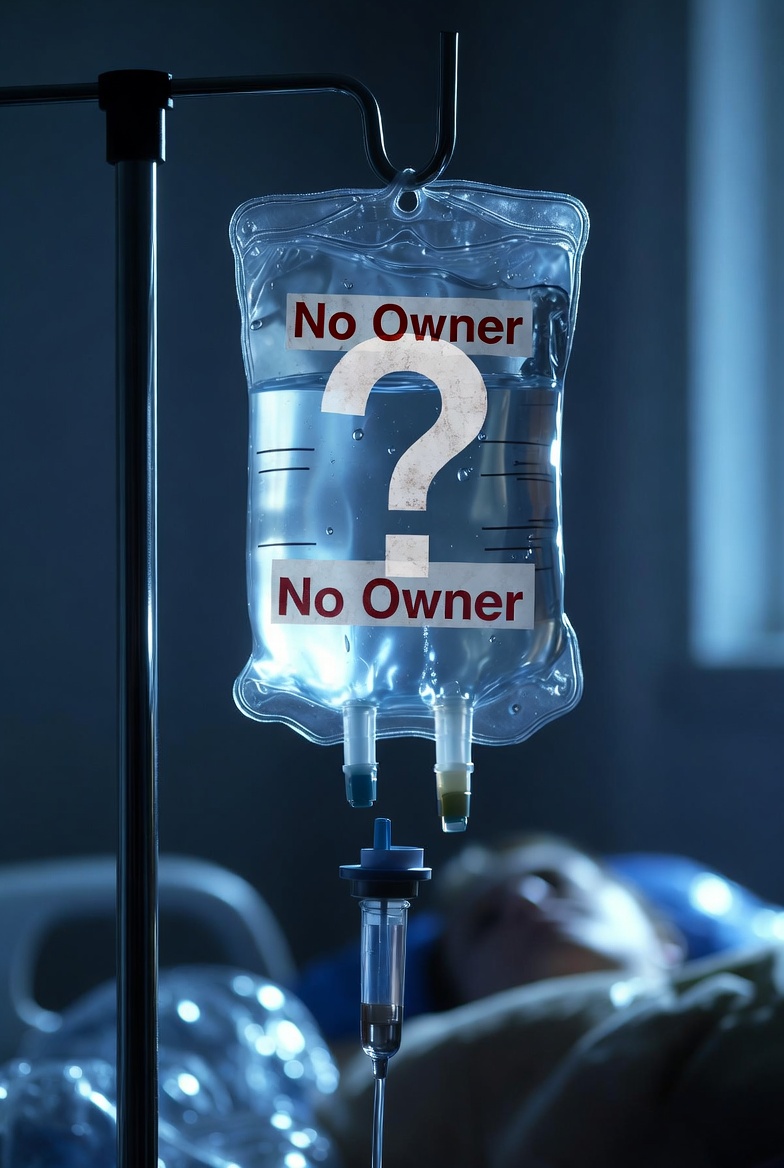
IV fluid is the only drug with no owner
IV fluid is the only drug in hospital practice that is commonly prescribed without clear ownership.
Antibiotics have an indication, a dose, a prescriber, a review date, and a stop rule.
Insulin is owned.
Oxygen is owned.
Vasopressors are owned.
IV fluids often aren’t. Especially after the first day.
When a drug has no owner, continuation becomes the default. Escalation happens without intent. Harm accrues without attribution. This is not because clinicians are careless, but because systems allow responsibility to dissolve across handovers, nights, and routines.
Fluid overload is rarely the result of a single bad decision. It is the predictable outcome of many small, unowned ones. Each bag feels modest. Each decision feels reversible. But physiology does not reset between shifts.
The paradox is that the safer a drug feels, the less tightly it is governed. IV fluids feel benign, so they escape scrutiny. That is precisely why they deserve more.
This is not an argument against fluids. It is an argument for ownership.
If IV fluids had a named owner, an explicit indication, and a daily decision to continue or stop, practice would change more than through education alone. Ownership is a safety intervention.
No drug this powerful should be allowed to act without accountability.
Time to @Turningthe_Tide
#fluidstewardship
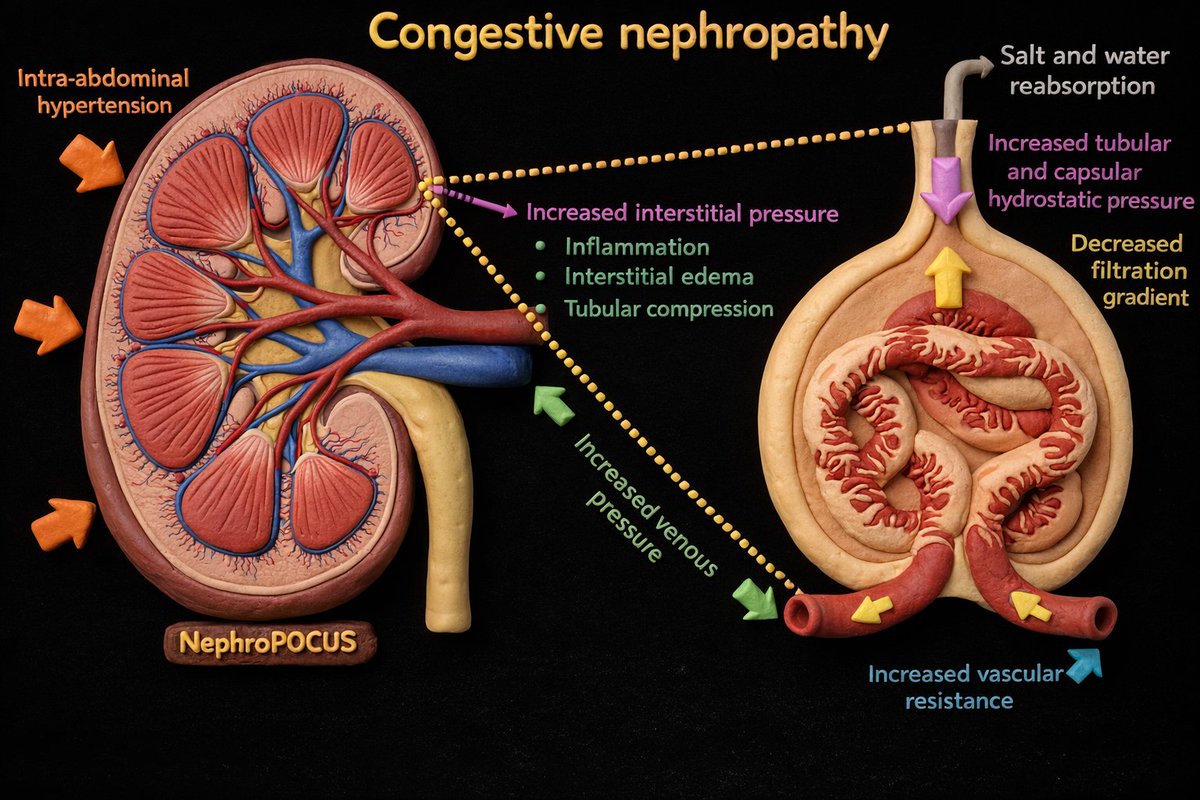
AKI ≠ reflex indication for intravenous fluids 💧
Use #POCUS and 🧠 to thoughtfully work through the diagnostic pathway and tailor management accordingly.
#FOAMed#Nephpearls
Congestive nephropathy results from sustained elevation in renal venous pressure, often due to systemic or intra-abdominal congestion, leading to increased interstitial and tubular hydrostatic pressures within the kidney. This impairs the transglomerular filtration gradient, compresses renal tubules and microvasculature, and promotes interstitial edema and inflammation. The consequent reduction in effective filtration and increase in tubular sodium and water reabsorption further exacerbate volume overload, creating a self-perpetuating cycle of renal dysfunction driven by venous congestion rather than arterial hypoperfusion.
@icmteaching Need more information.. diastolic blood pressure?
Passive leg raise?
Although a VTI of 18 is considered normal, a VTI of 16 may already be enough for this patient..
More info needed to properly manage, most acceptable likely to start noradrenaline,
MAP-CVP 49, quite low..
🧵 Albumin in Critical Care: 70 Years, 700 Papers… Zero Benefit
1/
Albumin is the most studied fluid in critical care.
Decades of trials. Endless meta-analyses.
And yet – not a single clinically meaningful benefit.
Here’s why the entire theory collapses once you understand Extended Starling. 👇
The very 1st line of a recent @BJAJournals states:
'In early critical illness, intravascular volume depletion secondary to capillary leak is common & requires aggressive fluid resuscitation to improve cardiac output & tissue perfusion'
Why are we still propagating these myths? 🧵
🧵 What drives blood flow – the heart or the vessels?
Eminent physiologists have argued this for decades.
The disagreement survives because of imprecise causality.
Here’s the resolution 👇