Our last talk of this virtual conference! Snowbirds of the Sea: Environmental Associations of Migratory Cownose Ray (Rhinoptera bonasus) Presence in their Summer and Winter Habitats along the U.S. Atlantic Coast #AFSvirtualspring#fishsci@SERCFisheries @SpinyDag
Genetically distinct population distribution suggests both Cape Cod and Cape Hatteras act as migration barriers to Hard Clams #AFSvirtualspring#fishsci@VIMS_News
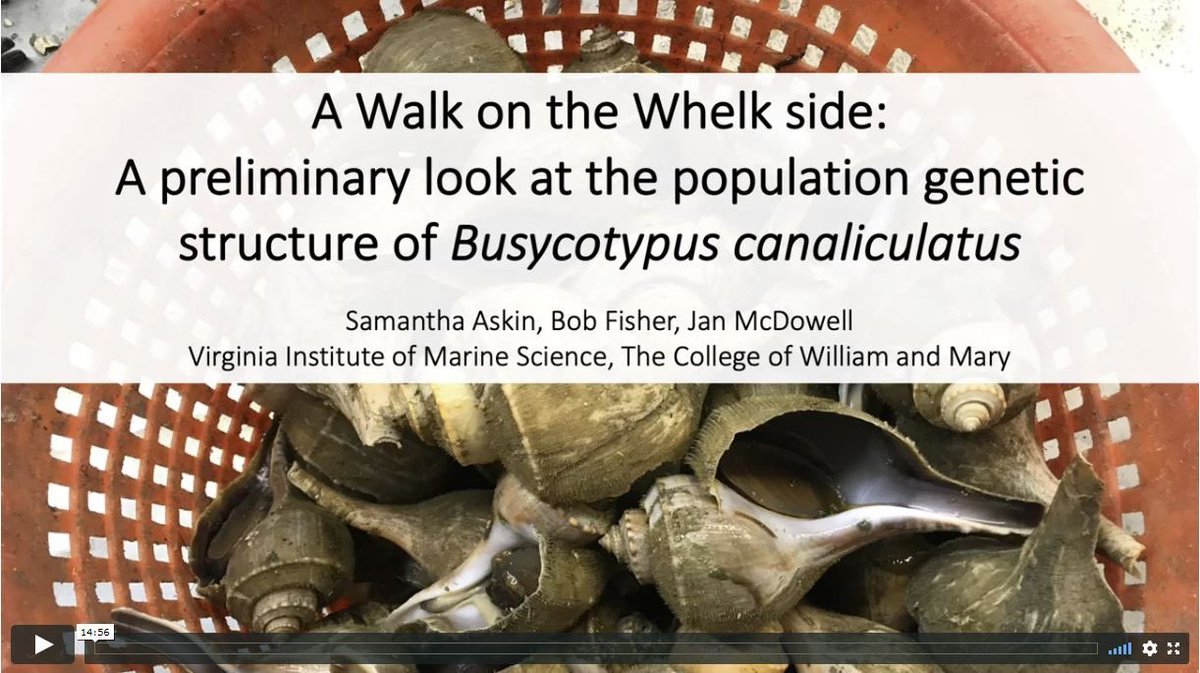
Populations in North Carolina and South Carolina as well as Massachusetts and Rhode Island showed the most genetic divergence in channeled whelk populations likely due to barriers to migration #AFSvirtualspring#fishsci@VIMS_News
Our ninth talk of the day Population genetic structure of Channeled Whelk: Implications for management in the mid-Atlantic #AFSvirtualspring#fishsci@VIMS_News
Creation of inlets by storms resulted in different biotic inputs depending on the storm. One brought in oysters to the bays while another brought in parasites competitors and predators of oysters, disappointing for agencies restoring the species #AFSvirtualspring#fishsci
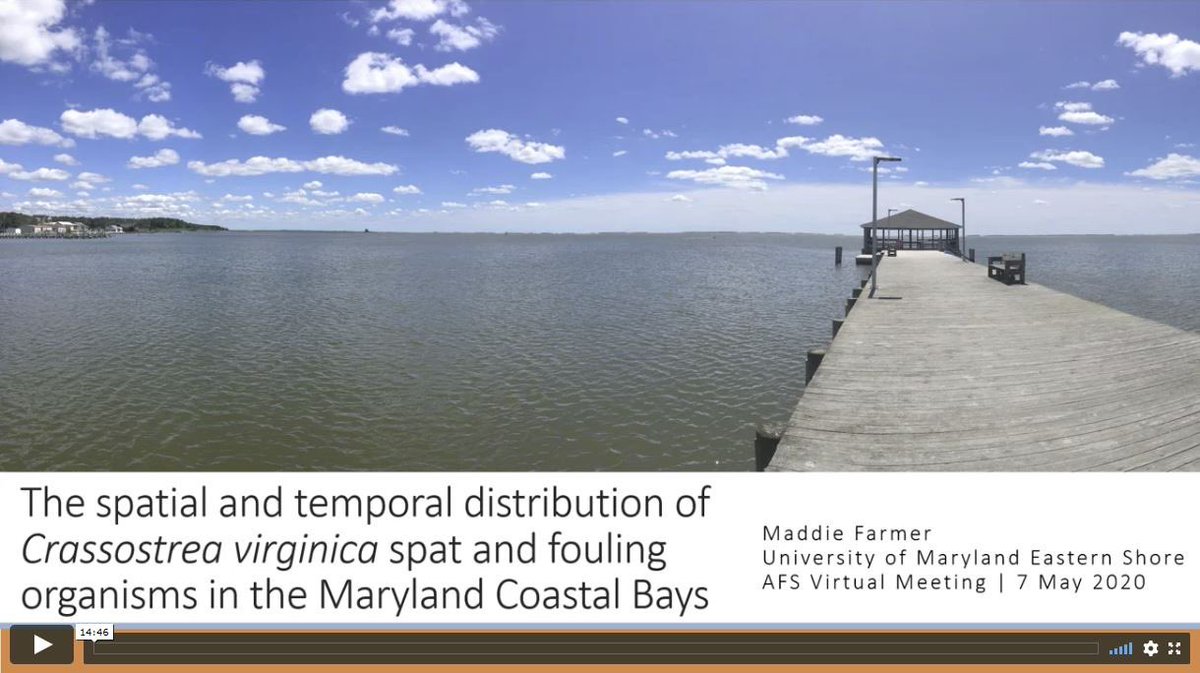
Next up is Assessment of the Spatial and Temporal Distribution of Crassostrea virginica Spat and Fouling Organisms in the Maryland Coastal Bays #AFSvirtualspring#fishsci@UMESNews
In these invaded estuaries, parasites using fish as definitive hosts were more prevalent than those using either birds or turtles as definitive hosts #AFSvirtualspring#fishsci@eastcarolina @TSL_Ecology
Our next talk is Biogeographic Diversity of Fish-Infecting Digenean Trematodes in Estuaries Dominated by Non-native Macroalga #AFSvirtualspring#fishsci @TSL_Ecology @eastcarolina
The family Sciaenidae has its highest marine diversity along the Western coast of the Americas unlike many other families. #AFSvirtualspring#fishsci@ODU
Although the Spotted Seatrout has a range from Virginia all the way to Texas, there is a distinct genetic break in populations on either side of the New River, roughly at the border between North and South Carolina #AFSvirtualspring#fishsci@VIMS_News
Coming up next Signatures of Selection and Phenotypic Plasticity of An Estuarine-Dependent Teleost, Spotted Seatrout (Cynoscion nebulosus) #AFSvirtualspring#fishsci@VIMS_News
Juvenile flounder have shown large size variation within the same year class, some individuals larger up to threefold than others! Diet does make a difference. Larger individuals switched to piscivorous diet sooner than smaller ones #AFSvirtualspring#fishsci@UNCWilmington
Back to the Hickory Shad talk, populations across latitudinal gradients show different structures such as spurs on their otoliths! Excited to learn more and hear some potential purposes for this additional structure! #AFSvirtualspring#fishsci@eastcarolina