THE LADS ARE BACK 🫡
@gametheorizing, @JustinCBram, @TaikiMaeda2, @dim_ss (and maybe a special guest or two) are going LIVE to break down whether the bottom is in — and what they're buying.
�� TOMORROW, Friday 8/28 @ 12:15pm ET on @YouTube 👇
LINK: https://t.co/U5KAD7S6lt
The Lads are back for their first episode of 2026! Is it time to celebrate 🎉 or is this a major top signal? 🫡
🚨 OUT NOW on @YouTube & @Spotify!
In Ep #101 we cover:
📈 The State of Market
🏦 @saylor & $STRC
🥷 The Big Defi Hacks
📉 @zachxbt vs RaveDAO
🍝 Pasta of the Week & More!
Full links below!
We just bought more $STRC ❗️
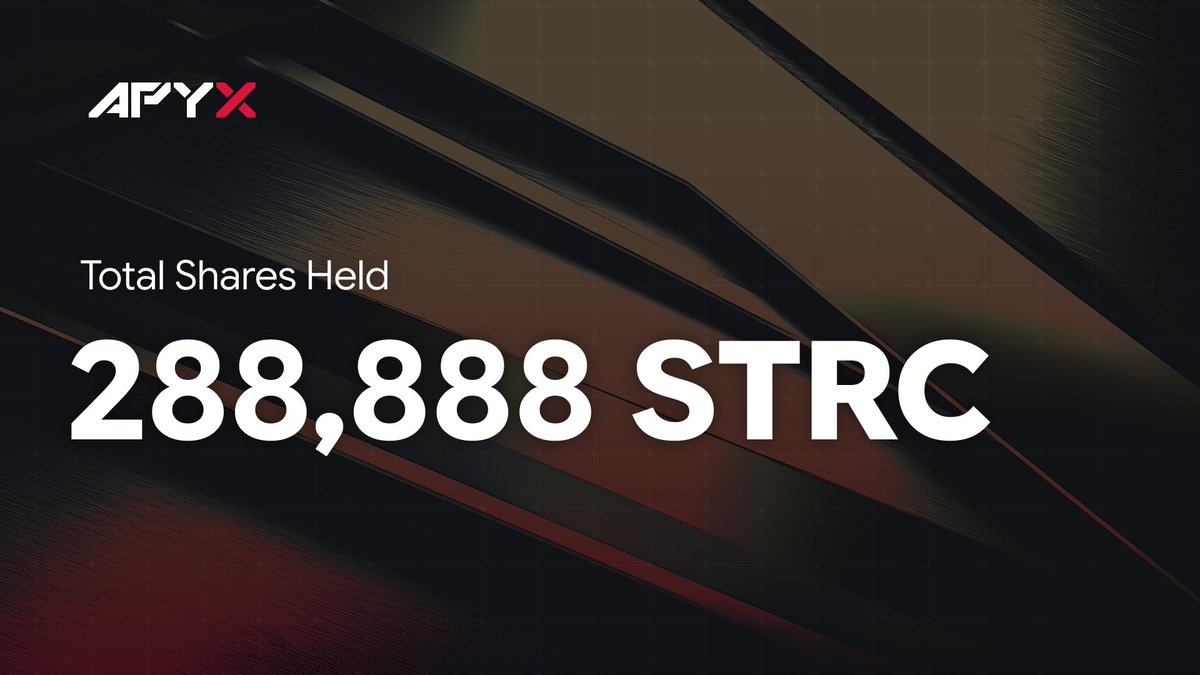
After purchasing an additional 33,888 shares, Apyx now holds 288,888 $STRC.
Enhanced digital credit yield is now onchain.
And it's coming for stablecoins & yield farming.
A Simple Theory of Digital Credit:
1. Acquire a large pool of appreciating capital ($BTC).
2. Issue credit ($STRC) against that capital, overcollateralized by the equity base.
3. Monetize a portion of the appreciation—directly or via derivatives ($MSTR)—to fund the dividend.
This is how it works:
If $STRC is trading above $100, then Saylor has to issue new STRC shares, and as soon as he collects the USD, he turns around to buy BTC
At the same time, he wants his leverage ratio to remain stable, so he also sells something like 2x the STRC ATM in MSTR ATM, then turns around and buys BTC with the proceeds again
$100M of STRC volume means that he could be raising $40M (40% of the volume) in STRC to buy BTC + twice that amount ($80M) coming from the MSTR ATM
So $100M of STRC volume can result in $120M worth of $BTC bought
The dividend date is March 15 so STRC holders are incentivized to hold until then, meaning the price is quite likely to remain at par during this whole week
Given today's volume, an optimistic estimate for this week could be $250M daily volume *5 = $1250M weekly volume on STRC, meaning 1250*1.2 = $1.5bn worth of $BTC could be purchased by MSTR
THE REAL REASON BEHIND THE OCTOBER 10TH CRYPTO CRASH IS FINALLY OUT.
And it’s much bigger than what people thought.
For weeks, traders kept asking the same question:
"Why did the market collapse so violently on Oct 10 when there was no macro event, no ETF news, no exchange failure, nothing?"
Now we have the missing piece and it explains a lot.
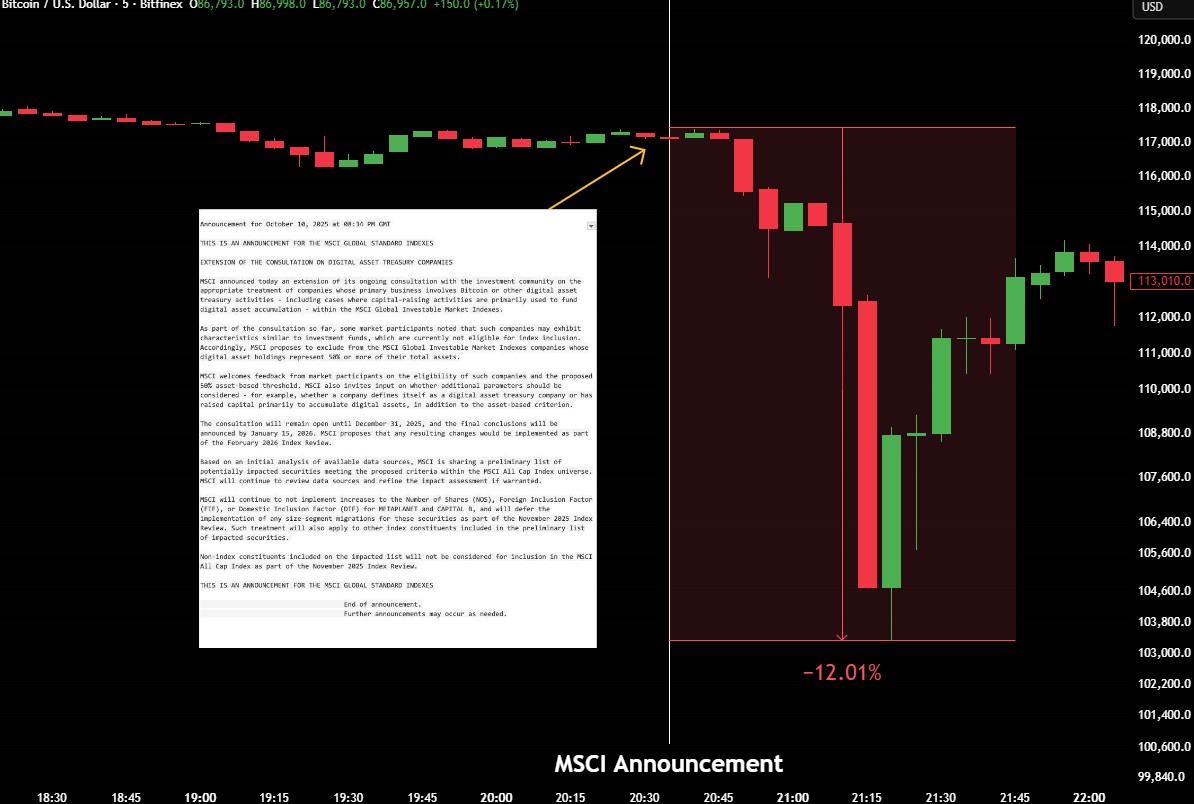
1) MSCI quietly dropped a major update on Oct 10
On the same evening the crash began, MSCI released a consultation note that almost nobody in crypto paid attention to.
MSCI said they are reviewing how to classify companies whose main business involves accumulating Bitcoin or digital assets.
Key proposal:
- If digital assets = 50% or more of a company’s total assets
- And the company’s operating activity resembles a digital asset treasury
→ That company can be excluded from MSCI global indexes.
This directly puts several Bitcoin-heavy companies at risk, especially MicroStrategy.
2) Why this matters
If MSCI excludes these companies:
• Index funds are forced to sell
Funds tracking MSCI indices must remove these stocks.
They do not get to choose. This is literal forced institutional selling.
• MicroStrategy becomes a primary target
If MSTR is labeled fund-like, MSCI indexed funds could be forced to reduce or exit positions.
• When MSTR dumps → BTC reacts immediately
Like it or not, $MSTR is treated as a leveraged Bitcoin proxy.
If the stock shows weakness: confidence drops → Bitcoin correlation increases → retail panic accelerates → liquidations start hitting → BTC falls harder.
3) How this connects to the Oct 10 crash ?
The market was already fragile:
- Trump new tariffs
- Weak Nasdaq
- High leverage in BTC markets
- Fear of 4-year cycle top
When MSCI’s note dropped, it added a new type of structural risk that traders did not expect.
The fear was simple:
"If MSTR or similar companies get removed from MSCI, large funds will be forced to sell, what happens to Bitcoin then?"
This fear hit right into an already stressed market.
The result: one of the biggest liquidation waves in crypto history.
4) But there’s another layer: JPMorgan’s timing
3 days ago, JPMorgan published a bearish report highlighting the same MSCI risks, right when:
- MSTR was weak
- BTC was weak
- Liquidity was thin
- Sentiment was fragile
This amplified panic, causing a 14% dump in a few days.
And if you know JPMorgan’s history, you know this pattern:
They speak bearish when prices are weak.
They accumulate assets when retail is scared.
They publish bullish notes near tops.
Their timing is never random.
This is not a secret. This is standard Wall Street behavior.
5) Is JP Morgan manipulating the market?
Not illegally. But strategically, yes.
This is how big institutions operate:
- Push fear when liquidity is low
- Trigger panic
- Let weak hands sell
- Accumulate at a discount
- Turn bullish later
They’ve done it with metals. They’ve done it with bonds. They are doing it with Bitcoin.
This is not a cartel. This is Wall Street strategy.
6) Now the plot twist: Michael Saylor responds publicly
Right when MSCI fears started dominating headlines, Saylor dropped a detailed clarification:
"MicroStrategy is not a fund, not a trust, not a holding company. It is a publicly traded operating company with a $500M software business and a Bitcoin based treasury strategy."
He also highlighted:
- 5 new digital credit instruments ($STRK, $STRF, $STRD, $STRC, $STRE)
- $7.7B notional value issued this year
- Stretch ($STRC), the first Bitcoin backed variable yield credit instrument
- Ongoing software operations and financial product innovation
His message was simple:
"We are not passive holders. We are builders. We are innovating. Index labels do not define us."
7) So what does all this mean for the market?
✔ Oct 10 crash was NOT random
It aligns exactly with MSCI’s consultation release.
✔ Forced-selling fear created liquidity stress
Traders panicked because they assumed index funds might eventually dump large positions.
✔ JPMorgan amplified the fear
Their bearish note came at the perfect moment to shake markets further.
✔ Saylor finally cleared the air
His statement explained why MicroStrategy is fundamentally different from what MSCI is describing.
✔ But uncertainty remains
Final MSCI decision comes on 15 January 2026.
Policy goes into effect February 2026.
Between now and then? The market may price in more volatility.
Final Take:
The market did not crash because of a single event.
It crashed because one unexpected structural risk hit an already fragile system.
And large institutions used that moment to shape sentiment.
But the long term picture is simple:
Bitcoin adoption unchanged.
Corporate interest unchanged.
Saylor remains on track.
Institutions still building.
ETF flows will stabilize.
Liquidity cycles will return.
MSCI classification will not stop Bitcoin.
Fear creates opportunity. Narratives create volatility. But fundamentals do not change.
This is why the Oct 10 crash was violent and why it will be remembered as a technical panic, not a fundamental breakdown.
The Lads are venturing back into the Wild West of crypto once again with special guest @dim_ss🫡
🚨 OUT NOW on @YouTube & @Spotify!
In Ep #97 we cover:
🤠 Is @HyperliquidX The Wild West?
🐋 DMs From The Whale!
🏖️ @fundstrat Is On Vacation
🍝 Pasta of the Week & More!
Full links below!
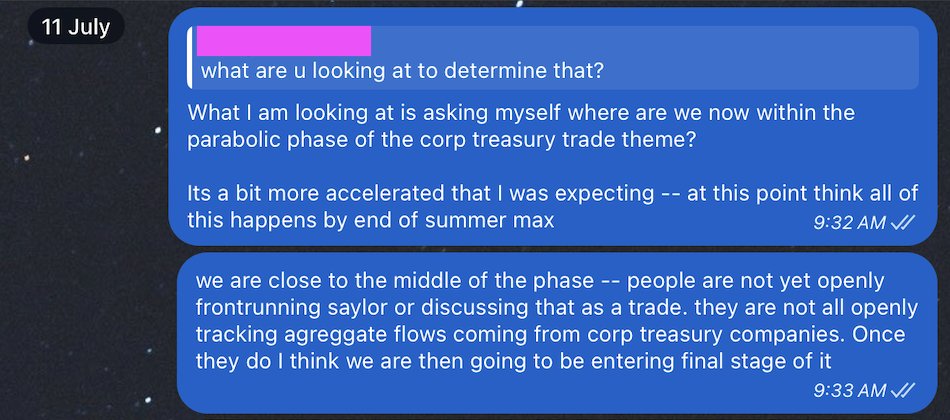
About a month ago I said a real late-stage signal would be when everyone starts tracking corporate treasury flows the way they did for ETF flows
Update: In 4 separate group chats in the past 24hrs everyone is discussing how to best track treasury flows for $BTC, $ETH, and $SOL
Over the past year, I have spent a LOT of time exploring the liquid crypto x AI token space. Let's just say there aren't many that stand out. $NEAR (@NEARProtocol) does; Some thoughts below.
Comment 'DM' below if you’d like the full thesis, and I’ll forward it to you.
Some tokens might go to $0.
Others might break all-time highs in the next cycle.
How can you know which one is which?
Here's a framework for evaluating possible bear market winners & losers:
i am seeing too many random explanations and interpretations of funding rates and thats not good for my mental health
explaining funding rate, a thread
Merry Christmas, here's some genuine free alpha that you can use
Funding Rate vs Realized Drift
automation not required
most of y'all think of the funding rate like RSI; negative = oversold, positive = overbought
but you're wrong, it's way more specific