My new research piece: what the politics of jobless prosperity might look like in an AGI world, why the real political backlash to AI hasn’t started yet, and how the labs should prepare.
1. The backlash to AI isn’t here yet. There is anxiety among American voters, but there is no populist backlash yet, because the job losses haven’t started yet—and we don’t even know if they ever will. AI is not in the top 20 issues Americans say they care most about, and the AI policy issue with the most energy right now, data center opposition, reflects not just AI but also NIMBYism, as @mattyglesias has pointed out.
2. Real backlash will happen if and when unemployment climbs by two percentage points, because that’s where data shows we tend to see meaningful electoral effects of unemployment. At that point, if we do not have a good inventory of smart policy ideas ready, we could be overwhelmed with bad ones.
3. The labs should focus more on measurement, and less on dreaming up New Deals. There is tremendous uncertainty about what kind of job displacement there’s going to be. Instead of attempting to write a new social contract from the top down before Americans are even asking for one, the labs should be helping us all get more intel on whether, when, and how job displacement is occurring—building from the helpful data sharing they’ve already started piloting. This will put society in a better position to design policies that make sense for everyone.
In doing the research for this piece, I came to two broader realizations.
First, there is way more uncertainty than I appreciated about how the economics of AGI might play out, and there is stronger evidence than I appreciated that job losses from AI have not meaningfully started yet.
And second, if AGI plays out the way the labs are predicting, the politics will be very hard to forecast, because it will be the politics of “jobless prosperity,” with jobs falling while the economy grows. We have very little experience with this happening at this kind of scale, and it will break our typical models of politics.
For both of these reasons, we should all be really humble in making pronouncements about the politics of AGI. I hope my piece will be read in this light, as an attempt to reason about something that is super important but also super hard to forecast accurately.
You can check out a lot more in the piece here:
https://t.co/JlwaF1fF8V
This from @AnnieHLiang should go to the top of your reading list!
(PS: it might pair well with our paper on using LLM simulations to develop and test theories: https://t.co/sQ7GJXf5r2)
We have reached an agreement with OpenAI to conduct an independent review, with Redwood Research, of the model behavior observed during the Hugging Face incident. We will publish a blog post that describes the terms of our engagement, the scope covered, and tentative conclusions.
@altryne@davidshor@jasminewsun@ArchieHall Yes absolutely! We are tracking it weekly and are super curious to see how it may evolve from now until November and beyond
My new research: I analyzed 280,000 fundraising emails to track the recent, sharp rise in anti-billionaire populist rhetoric among Democratic politicians, and to show how it's slowly merging with a new kind of anti-AI populism.
We know from @davidshor, @jasminewsun, @ArchieHall and others' writing and research that American voters are skeptical of AI, but we know less about how politicians at large are thinking about it. Fundraising emails are a super useful way to measure, in roughly real-time, what politicians are saying to their most devoted followers about key issues.
Here are some of my main findings:
(1) Anti-billionaire rhetoric took off sharply in 2025 among Democrats, driven by anti-Elon fundraising appeals and now including a variety of tech themes.
(2) Anti-AI content is only a small fraction of Dem emails even today---but it's rising quickly.
(3) Anti-AI Dem emails don't tend to focus on job loss or x-risk; they're focused on how AI is the next thing that billionaires are "doing to us"---the latest symptom of an oligarchy rigging the economy against us.
(4) The spike in anti-billionaire populism looks similar to a previous spike in anti-social-media rhetoric among Republicans around 2021. That spike never really turned into meaningful policy.
(5) On the other hand, the adoption of the AI topic among Dems is on a similar trajectory to their previous embrace of anti-billionaire rhetoric---so it could be a major focus in the near future.
Lots more details in the full write-up here:
https://t.co/9o0w2XMgIb
I think perhaps now would be a good time for us to consider a global pause on the development of open letters about AI policy.
The past several weeks have seen a remarkable spike in the frequency of "open letters"---from the economists' letter on the urgency of studying AI, to NVIDIA's open letter on open-weights models, to today's from lab researchers on building infrastructure for slowing down AI development.
It's great that so many people are engaging publicly on such important questions. In the long run, though, I think we'll probably conclude that open letters are not the best way to foster enlightened discourse around difficult policy questions, as we experienced repeatedly during past policy flashpoints---look back on the many open letters during the COVID pandemic, for example, and you'll find few that have stood the test of time well.
I have three main concerns with a culture that leans too heavily towards open letters.
First, open letters can encourage conformity and preference falsification. Especially in an environment where loyalists monitor closely to see who *hasn't* signed and calls them out. We've seen these dynamics around several open letters recently, and I think they're bad.
Second, open letters risk substituting prestige and popularity for logic and evidence. Like arguments of the form "90% of scientists believe X," to the media and to the many people who don't read closely, the main effect of the letter is to showcase who signed it, a signaling exercise tied up with perceptions of authority more than an argument based on reason.
Third, in order to stitch together as big a coalition as possible, open letters tend to lean towards ambiguous platitudes, because more precision would fracture the coalition, and also because it's simply difficult to coordinate a letter signed by many people over time.
I don't think this is an all or nothing issue---I'm not saying every open letter is bad. But I am dubious it would be productive for the AI community to continue issuing open letters as frequently as what is going on currently.
Some questions:
1. If we cannot get to RSI, i.e., we can only keep/maintain a 6-12 month lead over China for the foreseeable future, is there any benefit to Pause? What are the costs?
2. What's the maximum spend at equilibrium that US can maintain that China et al can't match us with?
3. How long will chip mfrg and supply chain restrictions hold China back by? How long a lead is "worth it" to lose control plus antagonise them?
4. What is the durable competitive advantage buildup we can get with a 2 year lead? How much of that advantage do you need to get, beyond hitting a steady state (since no RSI), in order to hold others back?
5. How resilient is *any* feasible agreement to inevitable defections, whether US or China or others, including "North Korea gets a nuke" level state actions?
Yes I like that point -- I wonder if there's an underlying model for that -- like, open letters are particularly helpful when they reveal surprising information, i.e., that more people believe X than was commonly realized before. I think that was part of the justification for the economists' open letter, that it didn't call for much in terms of specifics, but it would act as a signal to academics that more people than you think are taking AGI seriously.
And maybe they're particularly unhelpful when they reinforce existing beliefs.
I'm thrilled to release a follow-on to my research on fundraising emails that revealed Democrats' increasing focus on AI and data centers:
https://t.co/zKpmBGSSf1
This live dashboard auto-updates weekly as Derek Willis's email data updates. It tracks mentions of billionaires, AI, and data centers, shows the distribution of keywords, and lets you click through to see actual email examples.
In addition to helping us all monitor politician rhetoric around AI and populism, it's a cool example of how AI is changing social science research and letting us build live, continuously updated artifacts instead of static papers.
It's been awesome to see people building on this, too, including @milansingh03 and @johnjhorton and The Economist. The code is available here:
https://t.co/b2OGWgWNS7
My new research: I analyzed 280,000 fundraising emails to track the recent, sharp rise in anti-billionaire populist rhetoric among Democratic politicians, and to show how it's slowly merging with a new kind of anti-AI populism.
We know from @davidshor, @jasminewsun, @ArchieHall and others' writing and research that American voters are skeptical of AI, but we know less about how politicians at large are thinking about it. Fundraising emails are a super useful way to measure, in roughly real-time, what politicians are saying to their most devoted followers about key issues.
Here are some of my main findings:
(1) Anti-billionaire rhetoric took off sharply in 2025 among Democrats, driven by anti-Elon fundraising appeals and now including a variety of tech themes.
(2) Anti-AI content is only a small fraction of Dem emails even today---but it's rising quickly.
(3) Anti-AI Dem emails don't tend to focus on job loss or x-risk; they're focused on how AI is the next thing that billionaires are "doing to us"---the latest symptom of an oligarchy rigging the economy against us.
(4) The spike in anti-billionaire populism looks similar to a previous spike in anti-social-media rhetoric among Republicans around 2021. That spike never really turned into meaningful policy.
(5) On the other hand, the adoption of the AI topic among Dems is on a similar trajectory to their previous embrace of anti-billionaire rhetoric---so it could be a major focus in the near future.
Lots more details in the full write-up here:
https://t.co/9o0w2XMgIb
it seems pretty domain specific?
also, it gets very complex very quickly:
for example, cyber would initially seem to favor defenders (over the long run) because it's possible to make formally verified systems (basically, eventually you can find and fix the real problems)
but then, many attacks have social components to them, and these do *not* necessarily favor defenders (it's about the weakest link in your org)
there's also the whole ecosystem to consider (ex: there is more vibe coded software in the future--how does that net out against the availability of better security tools?)
and bio seems even more complex!
This is a super thoughtful piece -- I think I disagree with it, though. As @alexolegimas has laid out, I think in a post-AGI world we will still value human creativity and expression. I also think AI is unlocking new ways of expressing ourselves, thinking about the world, etc.
"Every word of Rubio’s castigation of communism could apply even more fully to the views of an industry to which his administration is extremely close."
Greg Conti on Big Tech's plan to obsolesce humanity:
https://t.co/j2S2QMOxfP
Seb's signal to noise ratio is crazy high, and he has been consistently very decent and good-natured; I'm heartened to see the community actively defending him.
I think this is a good cite: https://t.co/2XgiYwQJV8
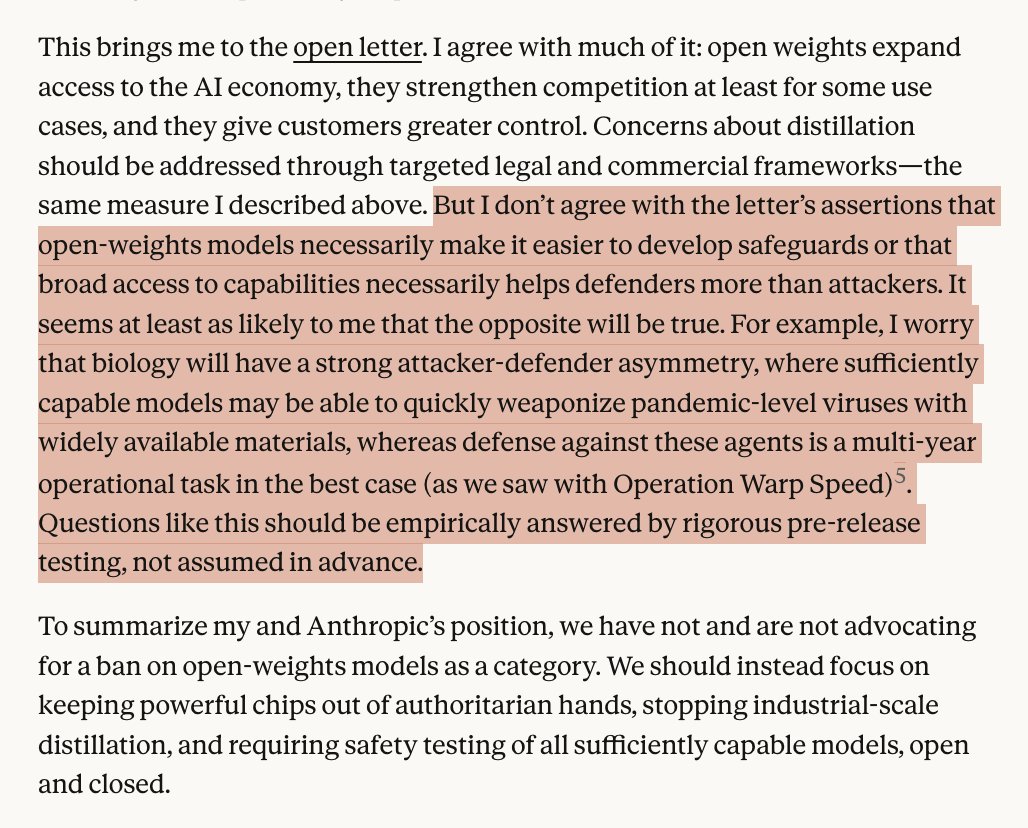
"The identification of four out of five asymmetries favoring attackers suggests that biology currently confers a distinct advantage to attackers."
The key unanswered question in the debate around open-weight models and safety is, are they better for offense or defense?
I'm not aware of any good research on this question. Is there any?
@0xkydo I'm sure there will be many issues that arise, but given the many challenges we face with existing empirical social science research, I think change is good
This is the worst coding agents will ever be at empirical social science research.
No matter what happens -- market crash, backlash to AI, whatever -- we're never going back to the way research was done before.
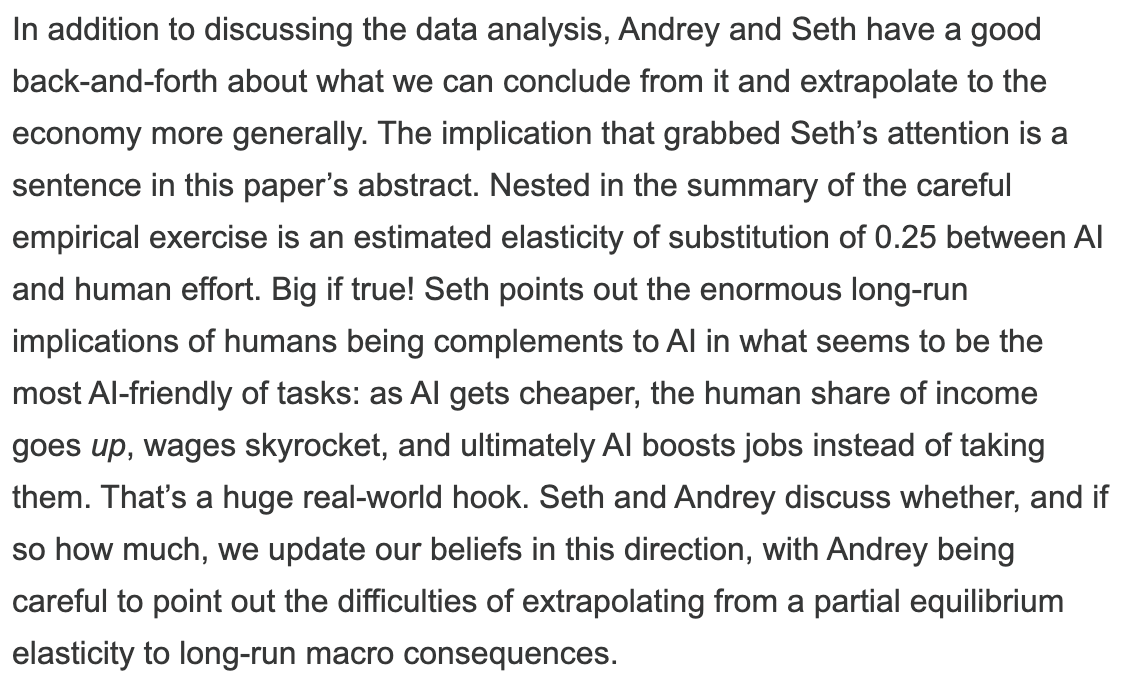
Great Justified Posterior conversation with @AndreyFradkin and @SBenzell about the "Writing Code vs. Shipping Code" paper. This part of the conversation was particularly important: the paper's estimates imply that (at least for now) humans are a complement to the most AI-friendly tasks.
This goes a long way in potentially rationalizing the employment effects we've seen, namely the lack of displacement, and if anything, increased hiring in exposed tasks.
https://t.co/mSrTQiiFrA