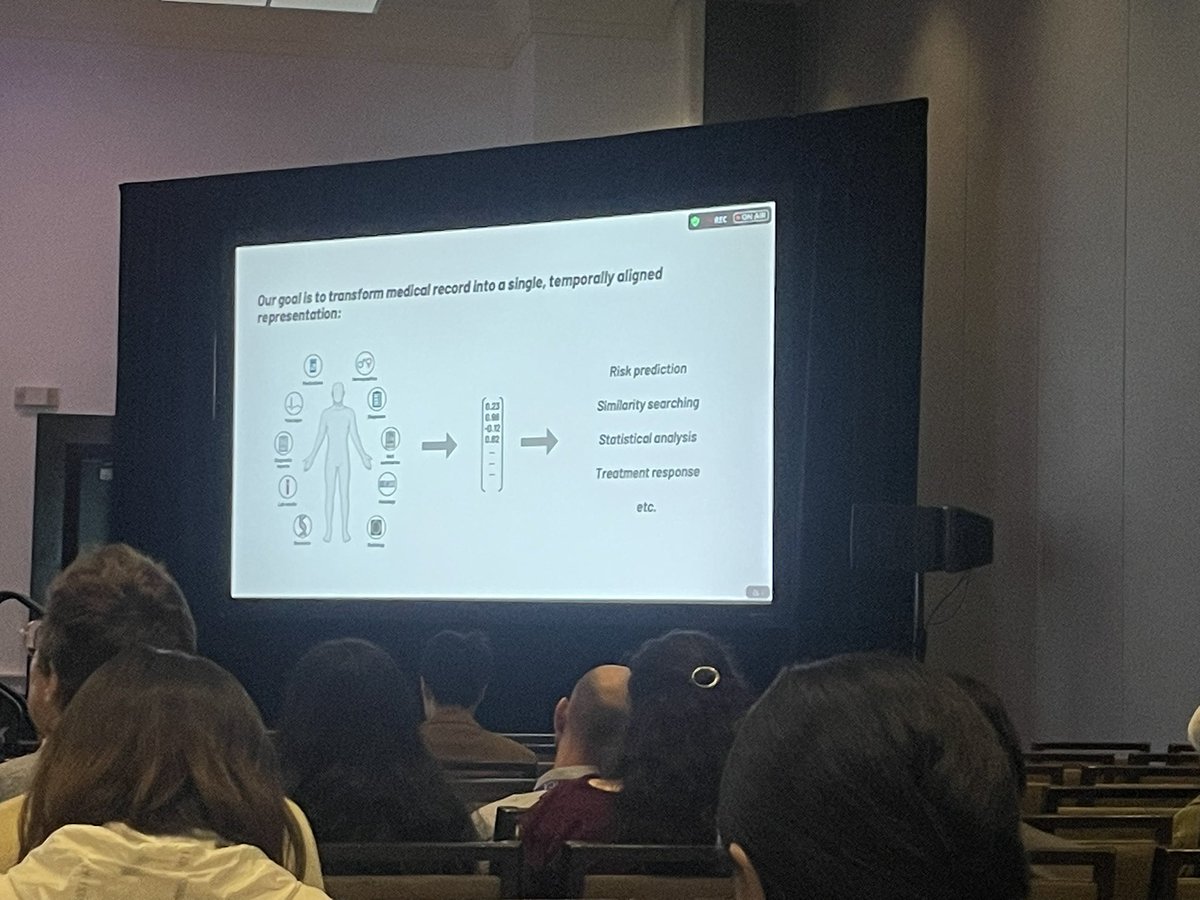
Today we are thrilled to announce Clinical System One (CS1), a fast and efficient general-purpose decision model for medicine.
Read our preprint 📄: https://t.co/hceIIqwbhH
Watch the video 🎬👇
Blog: https://t.co/2TapCNTe16
Healthcare has a scale problem. Every health system holds decades of notes, reports, and timelines. They contain answers to questions we rarely get to ask of more than a few patients at a time. Which patients could join this trial? Who missed a follow-up? What happened to everyone who took this drug? Reading all of it, for every question, has always been too slow and too expensive. That was true even with LLMs.
Thats why our team built Clinical System One (CS1). Its a small, fast decision model tailored for clinical records. Trained on 12.4 million questions and 3.6 million patients, CS1-4B beats open decision models on reading real-world patient records across diverse healthcare systems, and it runs on a single desktop GPU. We show the power of composing CS1 with traditional System 2 LLMs into agentic systems that read dense patient timelines and assess trial eligibility from a pool of a thousand candidates. Imagine trials that find every eligible patient automatically, registries that fill themselves, and care gaps surfaced across a whole population. Thats the future were building toward.
Thank you @WSJ and @BrianPGormley for sharing the story behind Aevius and our $22M financing. We’re building toward a goal we care deeply about: making medicine computable.
@RowlandPettit@AI4Pathology@MYLu97
https://t.co/5JetlsyGXM
So excited to announce Aevius Labs @aeviuslabs, the third startup to spin out of our research lab! The company builds on our research to make medicine computable. Especially proud to see two of our superstar former trainees, @RowlandPettit (CEO) and @MYLu97 (CTO), leading the company.
https://t.co/wgxe0RnVgc
Can an EHR model trained at one hospital read another hospital's records?
Excited to introduce our new paper, "Discrete Neural Interlingua for Ontology-Agnostic EHR Modeling," accepted at NeurIPS 2026. See you in Sydney 🦘🏖️!
Paper: https://t.co/0M5uzSe3kN
Code: https://t.co/iOjO4Xh8MM
Model: https://t.co/DcaNYRxBGR
Video: See👇
The same clinical concept can be an ICD code, a SNOMED term, a local identifier, or free text, and standard EHR tokenizers treat each one as an unrelated symbol. A model trained on MIMIC-III with a closed vocabulary can use only 13% of eICU events. It isn't only a cross-hospital problem. For example, inside one hospital, "acute kidney injury" can be a billing code, a flowsheet identifier, and free text in a note, and the vocabulary shifts again with every coding transition and EHR migration. The redundancy is there before a model ever leaves the building.
MEDIATOR is a discrete, ontology-agnostic tokenizer. Any clinical concept written as text maps to one of 100,000 shared tokens, so "acute kidney failure" (ICD-9), "AKI" (a local code), and "acute kidney injury" (free text) become the same token. It is trained on cross-ontology synonyms from UMLS and guided by LLM-enriched descriptions, code co-occurrence, and a medical relation graph. It is a drop-in token interface for standard EHR Transformers: no manual code mapping, and new code systems can be tokenized without retraining.
Main results:
• In-domain: +4.0 AUPRC points (8% relative) over SOTA, across 20 MIMIC-III tasks. Merging within-dataset redundancy pays off before you transfer anything.
• Zero-shot transfer: on eICU with no vocabulary alignment, MEDIATOR uses all 3.58 million events and improves AUPRC over MedTok by 8.6 points (29% relative) across 14 tasks, up to +21.2 on subarachnoid hemorrhage. Restricted to the same inputs as the closed-vocabulary baselines, it is still the best tokenizer.
• Transferable attribution: one shared token space means attributions compare directly across hospitals. For cirrhosis mortality, token importance is rank-correlated between MIMIC-III and eICU at Spearman ρ = 0.92.
Tokenizing a dataset's entire vocabulary is a one-time step of about 70 seconds on one GPU. Code and weights are public, and the co-occurrence teacher can be rebuilt from public data with near-identical results.
Congradulations to Caiwei Tian Tong Ding and everyone else.
#NeurIPS2026 #ClinicalInformatics #EHR #MachineLearning
🎊 Excited to share our new study, Beyond Sparse Captions: Aligning Slide-Level Text and Patch-Level Vision in Pathology accepted at NeurIPS 2026 as a Spotlight article (top 1.3% articles) from our superstars @Daniel__Shao and Eugene (Dongmin) Bang.
Code: https://t.co/5SgUUVKhPI
Model: https://t.co/JrCLF747HJ
Paper: https://t.co/1A3WFWZafA
🧵 Biohub, @ENERGY, @NIH, and new funding partners today announced a major expansion of an international effort to generate and make accessible the data enabling predictive AI models of biology. Together, the organizations are investing $1.8 billion in funding, data, computation and new measurement technology - largest coordinated commitment to map the biology of the cell to power development of digital models of biology. https://t.co/PaCs7ZV2Fg
Tokenizing a patient's health arc. Our new @TheLancet essay just published
@AI4Pathology and I review the implications of 5 AI large recent health models, which includes prediction (and prevention) many years out
https://t.co/yXO2ciRq6A
Congratulations to Luca Weishaupt on a fantastic PhD defense and on becoming the fifth PhD student to graduate from our group. A wonderful milestone, very proud of Luca and excited to see what comes next!
Happy 4th of July! 🇺🇸 Celebrating our ideals of freedom, unity, & opportunity that bind us all. To our service members, veterans & first responders who safeguard our freedoms, thank you for your dedication. Wishing everyone a safe, joyful Independence Day! #FourthOfJuly
For medical information, general AI frontier models (Google, OpenAI, Anthropic) outperformed specialized @openevidence and @UpToDate as assessed by 12 US clinicians, randomized and blinded to which model and extensive testing/benchmarks. This was not anticipated. @NatureMedicine
https://t.co/KCH1ADfQWz
Please join us on June 3rd in Room 607 for the #CVPR2026 Foundation Models for Medical Vision (FMV) workshop!
Four world-leading keynote speakers, @jnkath, @AI4Pathology, @hoifungpoon, and @pranavrajpurkar will share cutting-edge AI models across oncology, pathology, virtual patients, and agentic systems.
Plus: winners of our medical image foundation model challenges will give highlights on their solutions.
🔗 https://t.co/3O9fXChJac
@yuyinzhou_cs@vishalm_patel@BoWang87@CVPR
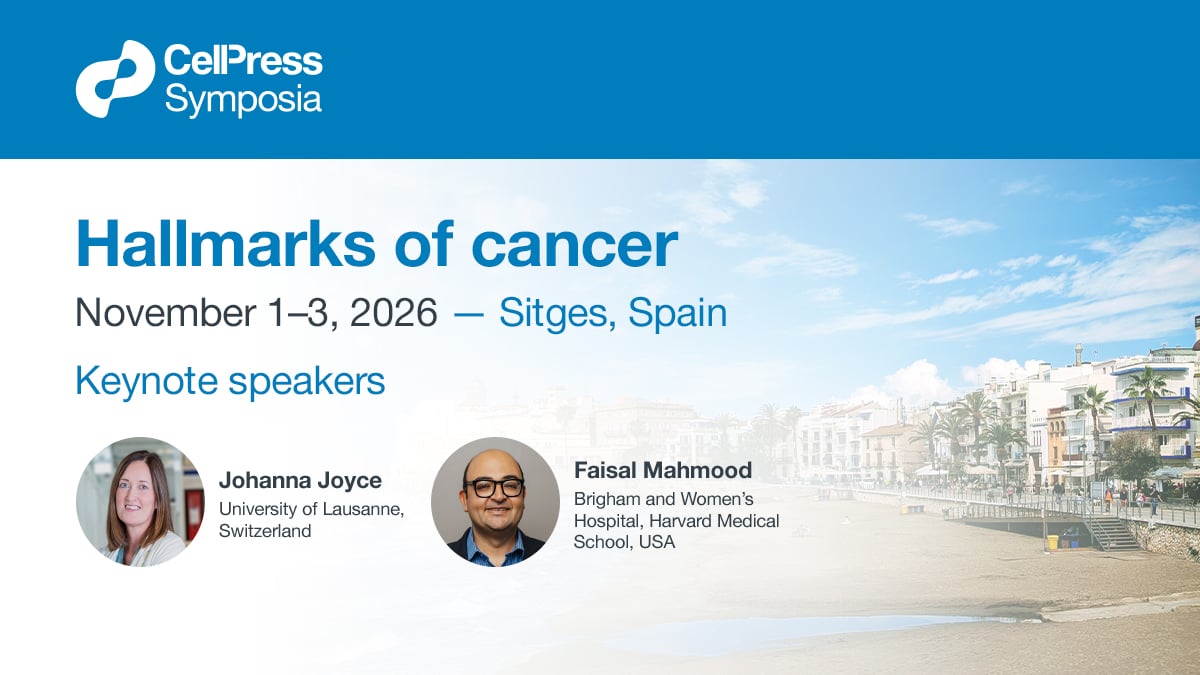
Be part of the Hallmarks of cancer legacy.
Join our distinguished keynote speakers Johanna Joyce @Joycelab & Faisal Mahmood @AI4Pathology in Sitges, Spain, November 1–3, 2026.
Abstract deadline: June 26, 2026
🔗https://t.co/Y9J2FDwXe9
@CellPressEvents#CSHallmarks2026
Be part of the Hallmarks of cancer legacy.
Join our distinguished keynote speakers Johanna Joyce @Joycelab & Faisal Mahmood @AI4Pathology in Sitges, Spain, November 1–3, 2026.
Abstract deadline: June 26, 2026
🔗https://t.co/FQwabYAsQA
@CellPressEvents#CSHallmarks2026
🎉 🎊 Congratulations to our superstar @anurag_vaidya7 on successfully defending his PhD at @mit_hst! 🎓
During his PhD Anurag led an extraordinary body of work spanning multimodal outcome prediction (SurvPath, CVPR 2024), a landmark audit of demographic bias in computational pathology (Nature Medicine, 2024), and multiple foundation models that have pushed the field forward: MADELEINE (ECCV 2025), THREADS (Nature Cancer, 2026, to appear), and KRONOS. A unifying idea behind much of this work: biology is a powerful learning signal.
It has been a privilege to advise @anurag_vaidya7 and to watch him grow into an independent scientist. Proud of all he has accomplished, and excited for what comes next.