A non-profit community of #teachers, #literacy researchers, & experts providing professional training on literacy & language-based learning differences.
🆕 Deep Dive article: Understanding Psychometric Properties
A closer look at the psychometric properties behind literacy screeners, diagnostics, and progress monitoring tools. Understand what validity, reliability, sensitivity, and specificity are, and why widely used assessments may not always accurately identify students at risk.
Dive in here: https://t.co/ays5TUYYNZ
Attending the @NMPED's 2026 Literacy & Humanities Summer Conference?
Stop by Booth #10 to connect with Dr. Carolyn Durante and learn about AIM Institute's partnership with the NM PED.
Completed New Mexico's state-funded Pathways to Proficient Reading: Secondary course? We'd love to celebrate you! Visit Booth #10 to pick up your completion pin and add it to your school lanyard.
See you in Albuquerque!
🆕 Ask AIM article: Phonological Working Memory
"What is the best strategy or activity to promote phonemic awareness with students who tend to forget the sounds in a word that has been segmented for them to put together?"
Read AIM's answer: https://t.co/A6oEDDhWWa
Even when schools invest in strong literacy programs and instructional materials, students can experience reading instruction very differently as they move between classrooms, interventions, and support throughout the day.
What happens when instructional routines, language, and expectations don't align?
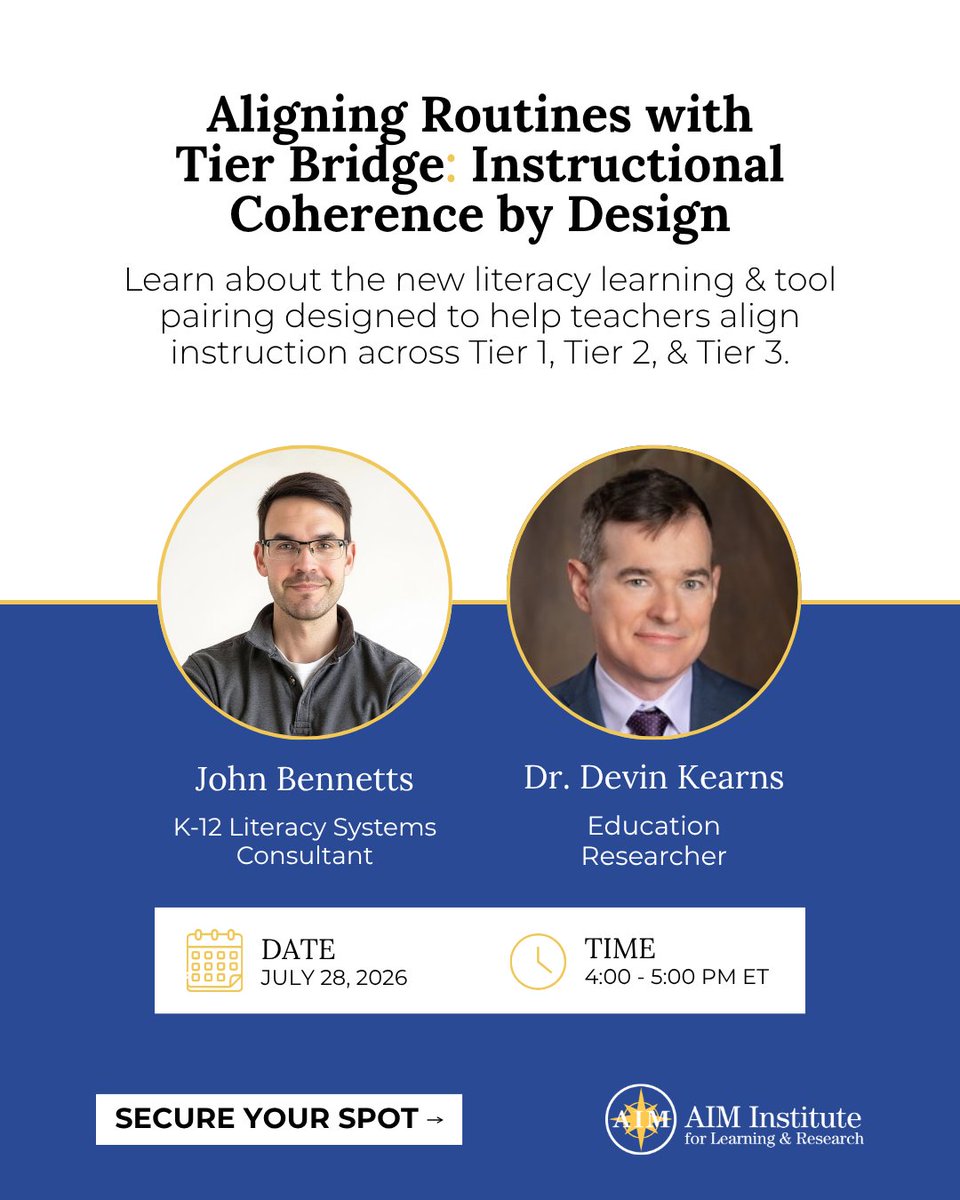
Join Goodnight Distinguished Professor in Early Literacy at North Carolina State University @devin_kearns, K-12 Literacy Systems Consultant John Bennetts, and AIM Institute for Learning & Research for Aligning Routines with Tier Bridge: Instructional Coherence by Design.
In this free webinar, you'll explore:
• Why instructional alignment matters
• How inconsistent routines can impact learning
• Ways Tier Bridge, a BRAND NEW innovative tool, could support you in creating instructional coherence
Registrants will also be invited to submit a classroom routine that could be featured in the demo of practical ways to design explicit instruction, compare routines, and refine classroom practices to improve learning outcomes.
If your school or district is working to strengthen literacy outcomes, this webinar is for you.
📅 July 28, 2026
🕓 4:00-5:00 PM ET
Register today to learn how instructional coherence can move from aspiration to action: https://t.co/ruDDXBF8WY
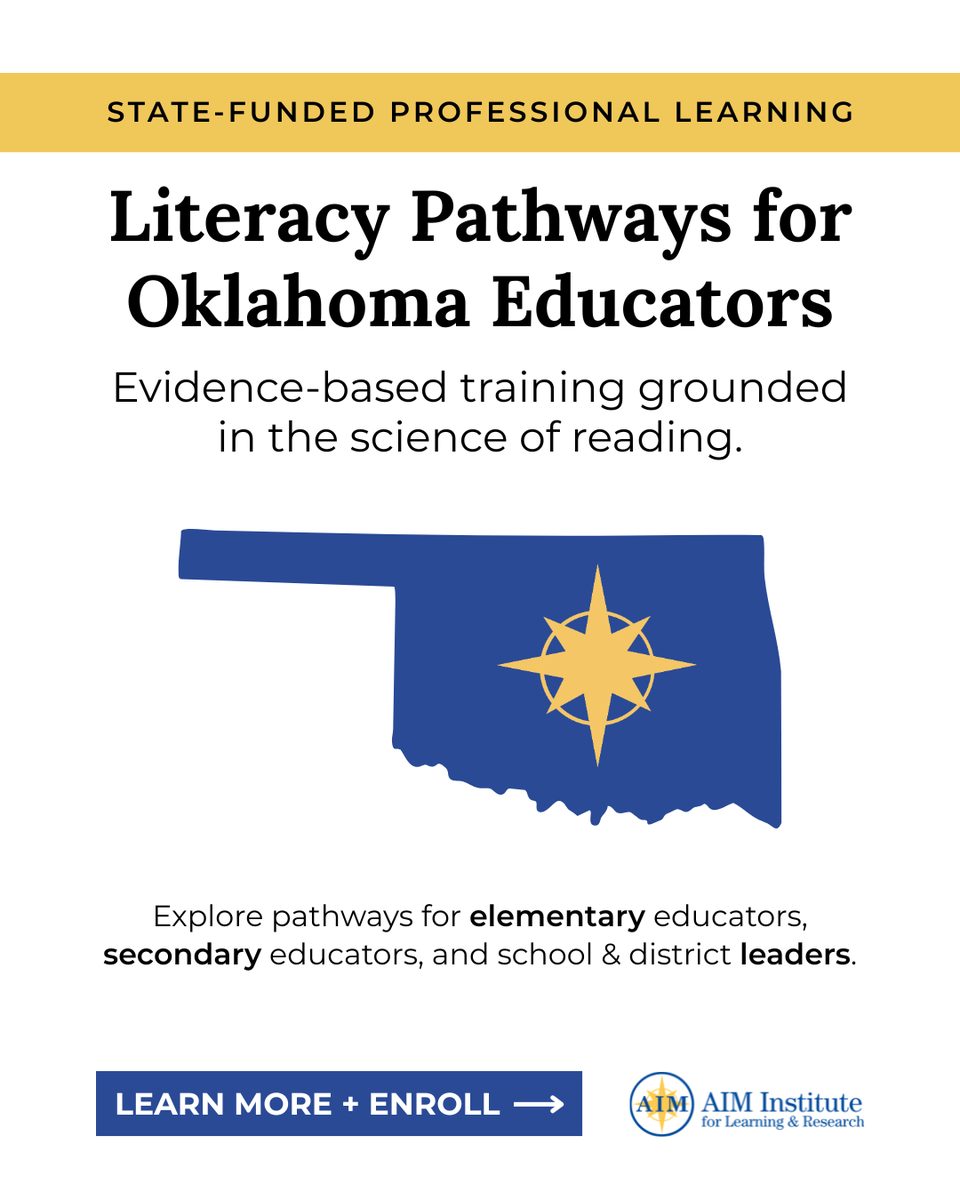
Oklahoma educators: State-funded literacy professional learning opportunities are now available through AIM Institute and the Oklahoma State Department of Education’s Office of Special Education Services.
This year’s Pathways opportunities include:
• Pathways to Proficient Reading: Elementary
• Pathways to Proficient Reading: Secondary
• Pathways to Literacy Leadership
Designed for educators, specialists, and school leaders, these evidence-based learning experiences connect the science of reading to practical classroom and leadership application.
Depending on the course, participants may also be eligible for:
• Dyslexia micro-credentials
• Graduate credit opportunities
Enrollment is now open, and some courses have limited capacity.
Learn more and explore the pathway designed for your role: https://t.co/lhkF0wBbdX
🆕 Ask AIM article: 6 Traits
"My district requires us to score our students' work using the Six Traits of Writing rubric. I feel like scoring for every trait is time-consuming, and then we have so much data that it's not actionable. I'm curious about what the research actually says. Is there evidence that scoring student writing across the traits leads to better writing outcomes? And are there any critiques of the framework I should be aware of? I want to make sure the instructional time I invest in this approach is well-supported by evidence."
Read AIM's answer: https://t.co/xF6wSAn0h5
🆕 Ask AIM article: Doubling Consonants Confusion
"My students want to know why the consonant doubling rule does not apply when adding -es to the end of a word. For example: foxes, buses, boxes."
Read AIM's answer: https://t.co/sGqIreG00J
Another Texas milestone! 🎉 AIM Institute for Learning & Research has been added to @ESCRegion11's approved provider list for professional development and educational services.
Serving 70+ districts and nearly 600,000 students across North Texas, ESC Region 11 helps connect schools with trusted partners and high-quality support for educators.
We’re proud to continue expanding access to evidence-based literacy and professional learning opportunities across Texas.
I am proud to say that I completed the @AIMtoLearn’s Pathway to Literacy Leadership! It was a great opportunity to affirm the knowledge I had and grow from the learning. Thankful for the opportunity provided by OCPS to complete the course! 🧡 @rmccloe@DrRahim_Jones@mandybOCPS
We’re excited to share that AIM Institute has been selected as a partner for Wyoming’s Comprehensive Literacy State Development (CLSD) initiative.
At AIM, we believe literacy changes lives. This opportunity allows us to work alongside educators and leaders across Wyoming to strengthen literacy systems, build educator expertise, and bring evidence-based practices into classrooms where they matter most.
We’re honored to be part of this important work and energized by the impact ahead for students across the state.
What happens when research and classroom practice come together? Students benefit sooner.
We’re proud to share a newly published article highlighting research done in @AIMSchool classrooms with AIM educators, students, and Research Advisory Board members.
This collaboration reflects AIM’s commitment to accelerating the connection between research and practice so evidence-based literacy instruction reaches classrooms faster.
🔗 Read the article: https://t.co/OThXrq47fL
🆕 Ask AIM article: Round Robin Reading
"What is best practice for successful whole class reading? I know round robin has been proven ineffective, but choral reading isn't working for my students with ADHD, and several aren't participating at all. Reading one at a time takes too long. Thanks for the advice!"
Read AIM's answer: https://t.co/BtevN5rlvb
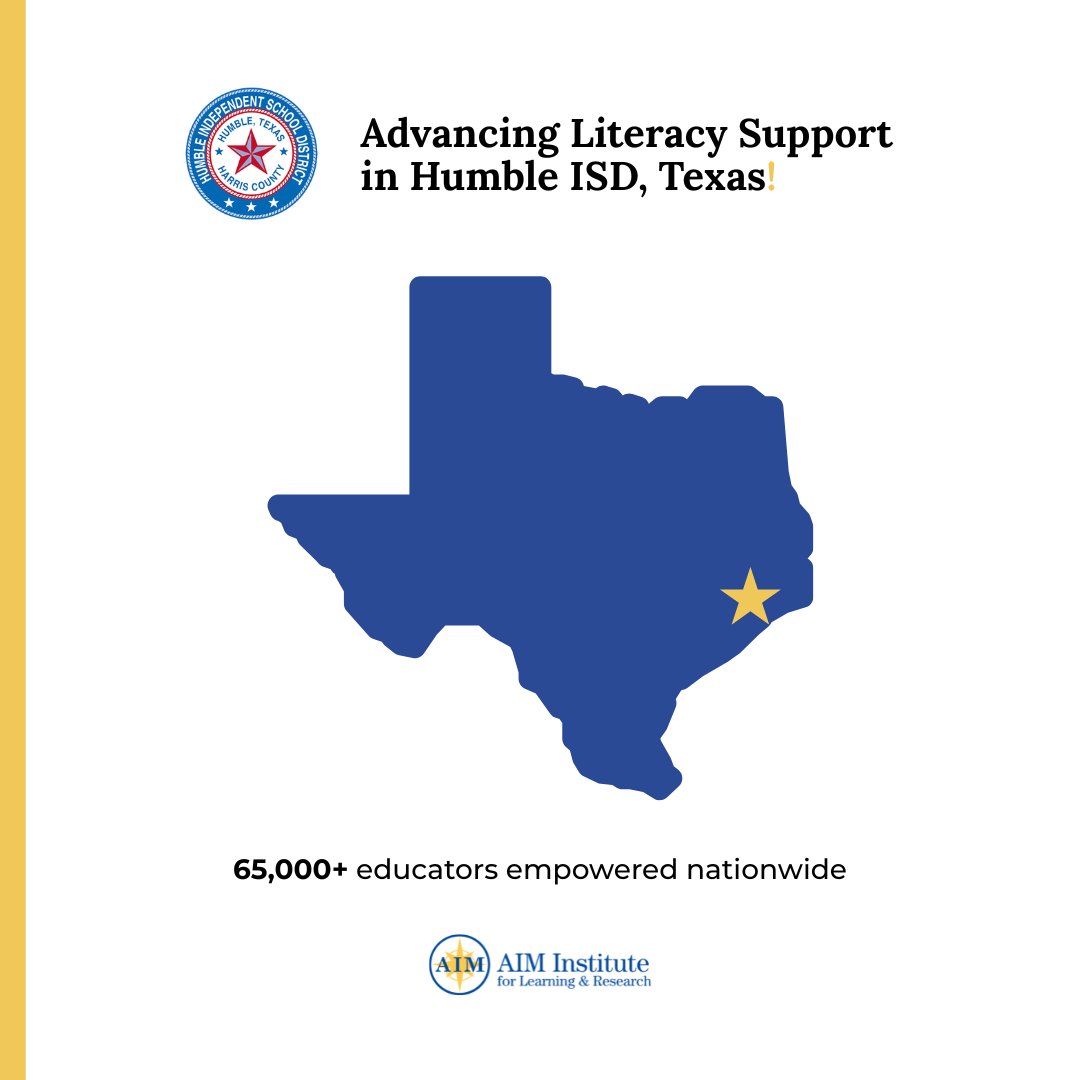
Another Texas update! 🎉 In addition to our existing partnership with @HumbleISD, AIM Institute for Learning & Research has now been added to the district’s approved vendor list supporting students with disabilities.
As we continue working alongside educators and school systems nationwide, partnerships like this help expand access to evidence-based literacy instruction, professional learning, and student-centered support designed to help all learners thrive.
Learn more about AIM’s work in Texas: https://t.co/y5YAGW45P8
🆕 Deep Dive article: From Elementary to Secondary: What Transfers?
Structured literacy professional development is often geared towards primary school teachers, leaving gaps in how educators approach adolescent literacy- and expectations that secondary teachers apply elementary practices in middle and high school. This article examines which literacy instructional strategies transfer to adolescent reading demands and their unique student needs, and which do not.
Dive in here: https://t.co/1K6aOGcHlQ
This Teacher Appreciation Week, we’re celebrating the educators who make literacy possible every single day. 💛
As a small thank you, we’re offering 50% off Essentials Bundles, three hours of flexible, self-paced learning designed for real classrooms, with CEUs and completion badges available.
Whether you’re building background knowledge, exploring a new topic, or looking for practical strategies you can use right away, Essentials are designed to meet you where you are.
➡️ Explore Essentials: https://t.co/YoRzgsI1pB
🔑 Use code: Appreciation26
📅 Valid through 5/15
Thank you for all you do to support and inspire your students every day.
This Teacher Appreciation Week, we celebrate all of the educators who are shaping the future of literacy, one student, one classroom, one breakthrough at a time. 💛
We are inspired every day by the educators we partner with across the country. Educators who are not only dedicated to their students, but committed to deepening their practice, applying research in real time, and creating meaningful change in their classrooms.
To every educator, thank you for your dedication, your curiosity, and your unwavering belief in your students.
Your impact reaches far beyond the classroom, opening doors for every learner to read, succeed, and thrive.
🆕 Ask AIM article: ORF (Oral Reading Fluency) Interpretation
"How am I supposed to differentiate between a decoding/fluency problem and a comprehension problem?
In the winter, one of my 6th graders read 130 words correct per minute (WCPM), which is lower than most of my other students, and he really struggles with multisyllabic words in particular. I suspect his comprehension difficulties are actually issues with decoding and fundamentals, but I’m not sure how to get to the root of the problem."
Read AIM's answer: https://t.co/2GAP3iZl3Z
We sat down with Dr. Reid Lyon, former Chief of Eunice Kennedy Shriver National Institute of Child Health and Human Development, lead of the National Reading Panel, and Hollis Scarborough Award recipient at AIM’s 2026 Symposium.
His message: it may be time for a renewed national focus on reading grounded in clarity, evidence, and implementation.
🎥 Watch the conversation: https://t.co/T8aaxoLjiX
What does it take to ensure access to reading for all students, especially in secondary classrooms?
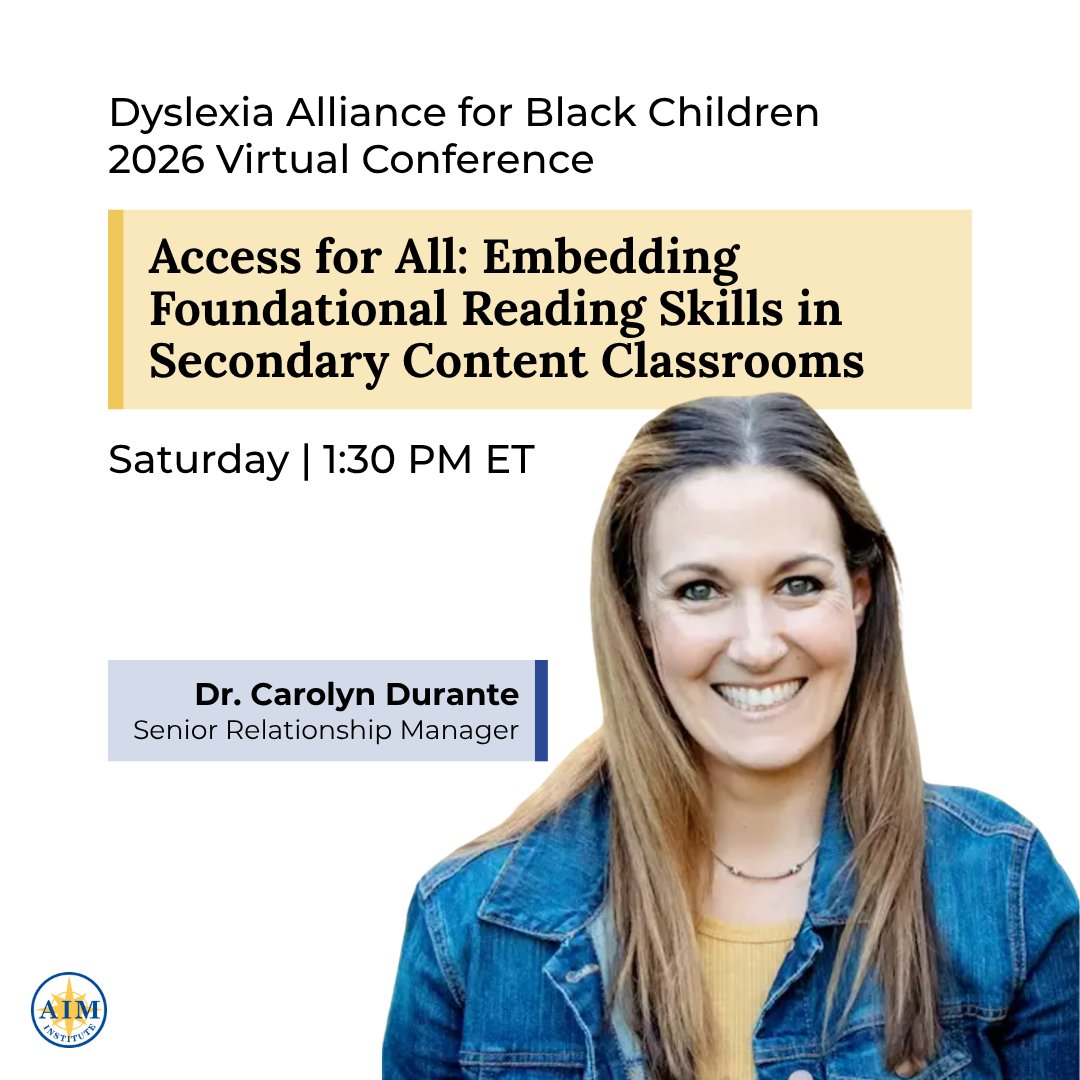
At the Dyslexia Alliance for Black Children 2026 Virtual Conference, Dr. Carolyn Durante will present “Access for All: Embedding Foundational Reading Skills in Secondary Content Classrooms.”
This session will explore how educators can integrate foundational literacy into content-area instruction to better support adolescent learners.
📅 Saturday
🕒 1:30 PM ET
💻 Virtual
Learn more + register: https://t.co/MXtmwASOYn