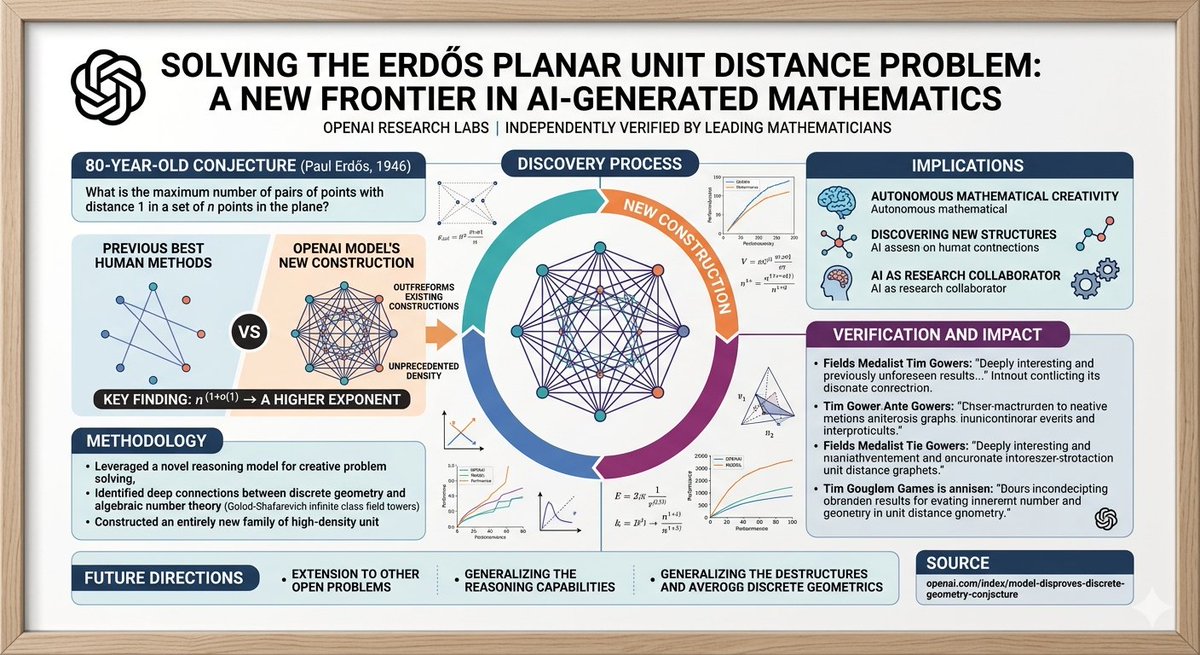
"If a human submitted this,
I would recommend immediate acceptance." — Fields Medalist Tim Gowers.
OpenAI just dropped a 125-page proof disproving Paul Erdős’s 1946 planar unit distance conjecture.
It's arguably that AI has generated deeply original, unprompted pure math👇
Most people are still using AI as a chatbot.
A few are turning it into a workforce.
Recently, I built a system that allowed AI to analyze markets, make decisions, and execute actions with minimal human involvement.
The results challenged everything I thought I knew about automation.
Soon, I'll be sharing the complete architecture, workflows, and lessons learned.
This isn't another AI demo.
It's a glimpse into where autonomous systems are heading.
Stay tuned.👇
Recently, I started paying attention to how often I open apps without a clear goal.
What surprised me wasn’t the habit itself.
It was how quickly recommendation systems filled that uncertainty with endless content.
Every feed today is powered by behavioral prediction:
• what keeps users scrolling
• what increases curiosity
• what delays exits from the platform
These systems are incredibly advanced at understanding attention patterns.
But the real question is:
What should that intelligence actually optimize for?
Because maximizing engagement and maximizing usefulness are two completely
different objectives.
And over the next few years, platforms that prioritize user outcomes instead of attention
extraction may become far more valuable.
Interesting direction here:
https://t.co/3w9d7lKjUJ
Most creators spend more time managing tools than creating content.
@DeeVid_AI is trying to simplify that with an all-in-one AI production workflow.
From brainstorming to cinematic video generation, everything stays connected.
https://t.co/12pu1bHghl
Most AI email tools generate generic templates.
Nitrosend creates pixel-perfect, on-brand emails you can edit in native markup and sends them through SES + Mailgun with 99.9% deliverability.
Built for teams that care about quality.
Try it free: https://t.co/ZLBTkaqmNs
🚨 Must Read: hey, did you know that when someone ignores your texts, the exact same part of your brain lights up as when you feel physical pain?
the woman behind this discovery is naomi eisenberger, a psychology professor at ucla. back in 2003, she ran a study that completely changed how we think about heartbreak, ghosting, and those “just feelings” moments.
she invited 13 people into a brain scanner and had them play a simple virtual ball-tossing game with two other players. at first, everything felt normal — everyone was passing the ball around. but then the other two suddenly started leaving the person out. they just kept throwing it back and forth to each other, ignoring the real player completely.
naomi wasn’t really watching the game. she was watching their brains.
she focused on the anterior cingulate cortex — that little alarm system in your brain that says “ouch!” when you stub your toe or burn your hand. and guess what? when the person got left out, that same alarm went off. the more hurt they felt, the stronger it fired.
her paper came out in the journal *Science* with a powerful question: “does rejection hurt?” the brain’s answer was a clear yes — it hurts just like real pain.
a few years later, she dug even deeper. in 2009, she looked at a gene called oprm1 that makes some people more sensitive to physical pain. the people who felt physical pain more strongly? they also felt social exclusion much more deeply. their brains lit up even brighter in that same pain area.
this showed something beautiful and important: physical pain and social pain aren’t separate. they share the same system.
why?
because for most of human history, being rejected by your group wasn’t just sad — it was dangerous. getting kicked out of the tribe could mean you wouldn’t survive. so your brain learned to treat social pain with the same seriousness as physical injury. it’s an ancient survival signal.
that’s why you feel that tight ache in your chest when a message goes unread.
that’s why checking your phone over and over feels so heavy.
that’s why being left out stings so much.
please hear this: you’re not too sensitive. you’re not weak. you’re not overreacting.
you’re just being guided by a wise, old brain system that has kept humans safe for hundreds of thousands of years. it
SOMEONE BUILT A FITNESS APP USING THE SAME PSYCHOLOGY AS A CASINO.
You bet money on whether you'll hit 10,000 steps today.
Miss the goal, you lose your bet. Hit it, you split the pot with everyone else who succeeded.
Disciplined people literally profit off inconsistent ones.
Here is why this is genius.
Most fitness apps motivate you with streaks, badges, and push notifications you learn to ignore after day three.
This one motivates you with financial loss aversion.
The psychology is completely different.
Imagine it is 11:52pm. You still need 1,700 steps. You have $30 on the line.
You are not thinking about your health goals. You are not thinking about your streak. You are putting your shoes on because losing money feels awful and your brain will do almost anything to avoid it.
Entire friend groups would be outside at midnight walking laps around the block just to not lose their money to each other.
That is not a fitness app anymore. That is a game with real stakes.
→ No badges
→ No motivational quotes
→ No streaks
→ Just cold financial consequences for sitting on your couch
It sounds extreme. But loss aversion is one of the most powerful forces in human psychology. We feel the pain of losing $30 far more deeply than the pleasure of gaining $30.
Every other fitness app is fighting that instinct. This one weaponizes it.
Would you put real money on your step count today?
After 3 years using Claude, I can say it’s the technology that has revolutionized my life.
Here are 18 prompts I use daily that have transformed my day to day; they could do the same for you:
(Save this 🔖)