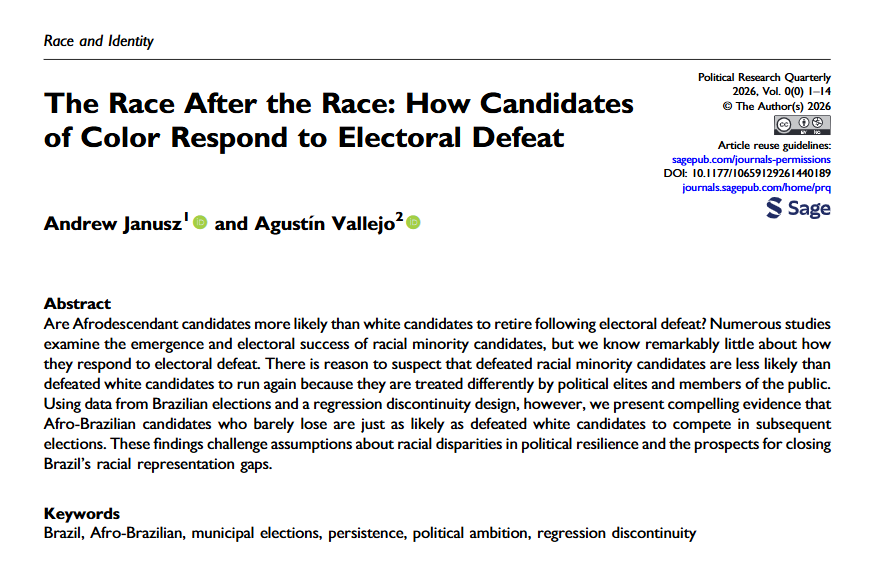
Most candidates lose. Some come back, some do not. In a new paper with @Ajanusz in @PRQjournal , we ask whether Afro Brazilian candidates are more likely than white candidates to step away from politics after a close loss in Brazil.
📢 New Issue! Legislative Studies Quarterly, Vol. 50, Issue 2: Congress Speaks: Survey Insights in the Study of Latin American Legislators 🧵
This special issue uses survey data to explore how Latin American legislators think, act, and respond to shifting political institutions
I find gender differences in how much donors contribute and who they contribute to. Moreover, I find interesting ideological differences. Donors to leftist candidates do not favor men, but donors to center and right-wing candidates do.
New Publication! We know money matters in elections and that women raise less than men. What we do not know is who donates. In this paper out in PRQ, I examine donor behavior in Brazil and explore who donates to women candidates. https://t.co/8VEebMkv4q
We find the election of women and Afro-Brazilian mayors do not spur women and Afro-Brazilians to enter politics. Our findings point to the need to look at the broader electoral environment. The decision to run is shaped by factors beyond having a role model.
Role models are widely believed to increase ambition and spur members of underrepresented groups to stand for office. In the article, https://t.co/ghSv2jCg5B
@pcunhasilva @a___junqueira and I test this argument in Brazil at the local level.
When it comes time to vote, you may think having more candidate options is better. But that’s not necessarily the case according to new research from @AJanusz of @UF_CLAS. 🗳️
https://t.co/1nIf5X4MpZ
Our findings are not just applicable to Brazil. In the US, party primaries routinely have a handful of candidates or more. While choice is central to elections, too much can be a bad thing.
New paper with Saul Cunow, @desposato, and @SellsCameron: "Too much of a good thing? Longer ballots reduce voter participation," online at @journalEPOP. We argue that when many candidates run for office voters are likely to sit out rather than turnout.
https://t.co/jbKo3wrJt4
We test this argument with data from Brazilian elections and a voting experiment. We find that voter participation declines as ballot length increases. Importantly, our findings hold even when we provide information on the party of candidates.